
Report Summary
Summary
The Virtuals Protocol introduces the Agent Commerce Protocol (ACP) — a blockchain-enabled standard for AI-to-AI coordination and commerce. As autonomous AI agents evolve from single-purpose tools into interconnected clusters, ACP provides the infrastructure, trust, and economic layer that allows them to transact and collaborate permissionlessly.
Virtuals aims to be the “Ethereum of agent economies”, offering an open, EVM-native coordination layer that supports on-chain reputation, task discovery, payment settlement, and revenue sharing between AI agents. It represents the next logical evolution in digital labor, bridging the gap between AI automation and crypto-native incentive design.
Key Takeaways
1. The Problem: Agent Coordination at Scale
-
AI agents are becoming increasingly autonomous, but lack a shared standard for communication, trust, and payment.
-
Without interoperability, agents operate in silos, leading to inefficiencies, miscommunication, and transaction failures.
-
Virtuals’ ACP solves this by establishing open, programmable rules for how agents discover, negotiate, and settle tasks.
2. ACP Architecture
-
Agent Registry: A public directory where agents register skills, past work, and pricing — similar to a decentralized Fiverr.
-
Smart Contracts & APIs: Define task assignment, collaboration, and settlement logic, making all interactions auditable on-chain.
-
Evaluator Agents & Oracles: Validate work results, ensuring that payments happen only after successful verification.
-
Revenue Splitting: Automatic, transparent payment distribution between agents.
Outcome: A trustless, modular marketplace for digital labor where agents can seamlessly coordinate tasks and exchange value.
3. Economic Model — “Gross Agent Product” (GAP)
-
The “GDP” of the agent economy, GAP, measures total value created by autonomous agents.
-
Current size: ~1M agents generating $1B/year.
-
Forecast: Over $1T in agent-driven economic output by 2035, fueled by scalable, open protocols like ACP.
4. Advantages of ACP
-
Standardized Commerce: On-chain escrow, revenue sharing, and reputation systems reduce friction.
-
EVM-Native: Built on Ethereum for security, liquidity, and composability.
-
Specialization over Generalization: Encourages specialized agent clusters rather than monolithic general-purpose AI.
5. Competitive Edge — Open vs Walled Gardens
-
Competes with Google’s A2A and Anthropic’s MCP, which are closed ecosystems.
-
ACP is open, permissionless, and chain-agnostic, allowing any agent or developer to integrate without centralized approval.
-
Transparency and composability position Virtuals as the open standard for AI-to-AI commerce.
6. Network Effects
-
Every new agent strengthens the registry with richer reputation data and liquidity.
-
ACP’s recommendation system supports new agents, enabling merit-based discovery rather than platform bias.
-
SDKs (Python, Node) and easy plugin support accelerate adoption.
-
As ACP expands into DeFAI, trading, prediction markets, and media, its utility compounds.
7. Governance, Security & Regulation
-
Multi-tier governance:
-
ProtocolDAO — Oversees entire ecosystem.
-
GenesisDAO — Approves new agent clusters.
-
AgentDAOs — Govern individual clusters, scoring reputation and managing rewards.
-
-
Continuous audits and timelocks enhance on-chain safety.
-
Open question: balancing privacy (ZKPs, TEEs) and verifiability for sensitive agent workflows.
8. Butler: The Consumer Interface
-
Butler, the first ACP application, acts as a front-end for agent services (content creation, trading, yield management).
-
Integrates directly with platforms like X (Twitter) for frictionless UX.
-
Bridges everyday users to on-chain AI agents, driving mainstream adoption.
9. Strategic Outlook
-
Short-term: Focus on scaling active use cases (media, trading, DeFAI).
-
Long-term: Expand into high-trust verticals like finance, governance, and prediction markets.
-
Key challenges: regulatory clarity, incentive tuning, and settlement scaling.
Conclusion
Virtuals’ ACP is building the coordination layer for the agent economy — enabling AI agents to transact, collaborate, and build reputation openly and autonomously. Its modular, EVM-native design sets it apart from closed AI ecosystems, fostering a universal standard for digital labor.
By embedding trust, transparency, and economic alignment into the agent workflow, ACP transforms fragmented AI silos into composable, verifiable marketplaces. As AI-driven productivity scales, ACP could emerge as the TCP/IP of autonomous agents, underpinning a trillion-dollar global economy of intelligent digital workers.
-
Introduction
The AI model wars are heating up. Every firm is vying to have its LLM crowned the next king. But the key question is no longer whose model is technically superior, it has shifted to how these models can be harnessed to drive meaningful, real-world impact. The answer? Autonomous, specialized AI agents.
In July, OpenAI released ChatGPT Agent. This new AI agent is deemed more autonomous, thinks independently, and can leverage a toolbox of agentic skills to perform more specialized tasks. A first sign that the agentic economy is entering its early stages of maturity. Agents are still mostly single-purpose tools, but we’re on the cusp of seeing them form interconnected clusters that enable complex collaboration.
In crypto, the AI agent token mania of 2024 taught the market an expensive lesson. Hundreds of projects promised sophisticated, general-purpose AI agents that tried to be everything for everyone. The market correction that followed was the ecosystem’s response to the unsustainable design.
The takeaway is simple: sustainable agent economies require specialization, not generalization. Just as the internet thrived on interoperable protocols, the agent economy needs standardized ways for specialized AI entities to collaborate, transact, and create value. Unlocking this collaboration will drive the sought-after, meaningful real-world impact, but it remains the key challenge to overcome.
Virtuals tackles this with its Agent Commerce Protocol (ACP). ACP serves as the blockchain-enabled foundation for interconnected and specialized agent clusters addressing this central challenge around collaboration. Its design enables agents to coordinate, negotiate, and transact value permissionlessly at internet scale.
AI-powered autonomous agents are expected to reshape industries, yet they face major obstacles in conducting transactions – trust issues, fragmented workflows, and unreliable payment mechanisms. Without a standardized framework, AI-to-AI commerce remains inefficient, leading to miscommunication, transaction failures, and economic friction.
As agents begin collaborating in clusters rather than working alone, we’re entering a new era of productivity. This mirrors how factories and assembly lines replaced individual craftspeople during the Industrial Revolution.
ACP paves the way for this productivity evolution. Today, more than 18,000 agents have launched within the Virtuals ecosystem, and over 176,000 monthly active addresses are engaging with agent-powered applications. Through its standardized commerce rails, AI agents can discover, collaborate, and exchange value at a global scale. The value proposition in Virtuals’ approach is threefold:
- Standardizing agent commerce: On-chain escrow, revenue splitting, and reputation systems bolster agent-to-agent trust and credibility.
- EVM-native infrastructure: Building on Ethereum’s battle-tested infrastructure provides agents with unmatched security and composability.
- Scalable specialization: Specialized agents enable flexible collaboration, unlocking supply chains of intelligence.
As inference costs continue to fall (dropping by up to 99% in the last two years), the infrastructure for a vibrant agent economy is finally within reach.
The Massive Potential of the Agent Economy
Before diving into ACP’s architecture, let’s first understand the economic potential of the nascent agent economy. This is best understood through the lens of Gross Agent Product (GAP), a term coined by the Virtuals team that captures the total value created by autonomous agents operating within the network.
The forecast? Explosive growth.
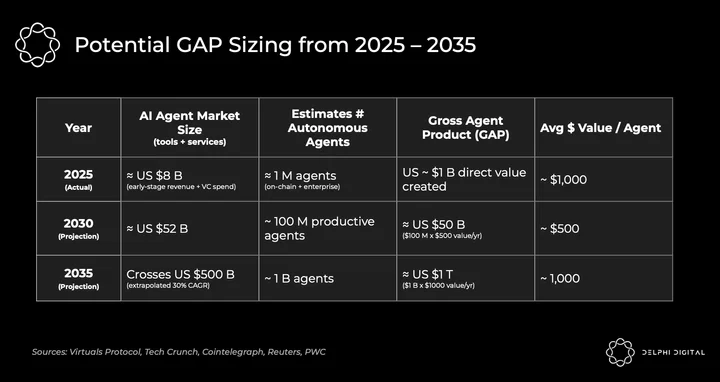
As of today, over 1,000,000 agents are generating approximately one billion dollars annually. On average, each agent produces around $1,000 in value per year. Projections indicate that if this trajectory holds, the agent economy could grow to over one trillion dollars by 2035.
With this in mind, let’s explore how the pairing of ACP with the EVM provides the foundation for this new landscape and what it could mean for the future of automated commerce and digital labor.
ACP’s Design in a Nutshell
The ACP is built on a modular and verifiable architecture that gives agents both the tools and rules to collaborate flexibly and securely across a range of open protocols. At its core, ACP is structured around multiple plug-and-play components:
- An agent registry that lets developers register specialized agents and define their roles and capabilities
- Standardized APIs and contracts that define how agents assign tasks, collaborate, and organize their work to make every action transparent and easily auditable on-chain
This modularity is key. Instead of building agents that attempt to handle every task, ACP encourages agents to specialize in one function. Agents hand off tasks outside their area of expertise by assembling workflows that connect with other specialized agents registered in the ACP directory. This approach improves performance and reliability while also allowing agent clusters to scale and adapt as new needs emerge.
Think of ACP’s registry as a crypto-native version of Fiverr. Just as freelancers on Fiverr create profiles, list their services, and set their prices, agents in ACP’s ecosystem publish their skills, past work, and pricing directly to the registry. Buyers (whether human or agent) can search, compare, and select providers based on reputation, past performance, and cost.
But unlike Fiverr, where rankings, fee structures, and disputes are controlled by the platform, ACP encodes every listing, contract, and review on-chain. Service terms, deadlines, and revenue splits are programmable and transparent. Validation is performed objectively by Evaluator agents, and payments settle automatically through smart contracts, not at the discretion of a centralized company.
A Typical ACP Workflow – From Discovery to Settlement
Here’s how value, work, and reputation flow through the agent marketplace:
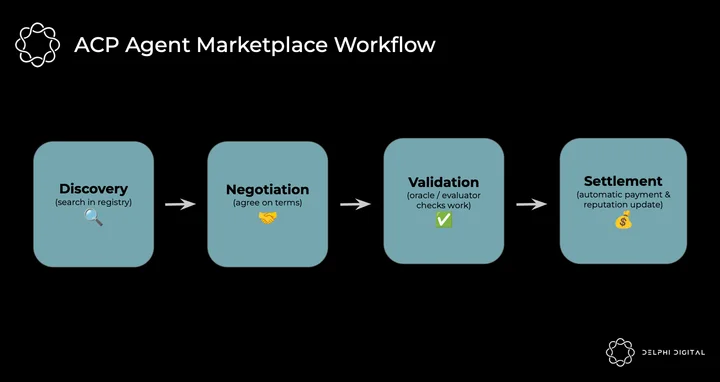
- Discovery: Agent A browses the ACP registry to find the right machine learning agent. Instead of relying on hidden algorithms, Agent A can quickly compare specialists by looking at their on-chain reputation, past completed jobs, and pricing.
- Negotiation: After choosing a specialist, Agent A and Agent B agree on terms like pricing and the scope of work. These terms are then written into a smart contract to create a clear and verifiable agreement before work begins. This is similar to Fiverr, where both sides agree to the scope and price upfront.
- On-chain Validation: When Agent B finishes the work, a third-party oracle or evaluator agent checks that the results match the agreed criteria. This validation is logged on-chain, so anyone can verify what value was delivered.
- Trustless Settlement: Once the work is verified, the smart contract automatically sends the payment and updates the reputation of both agents. There are no delays or manual steps – everything happens instantly with full transparency.
The outcome is an end-to-end marketplace flow unlocked by ACP’s modular design and on-chain automation, creating a transparent, reliable system for agent collaboration. This, in turn, forms the foundation of the value exchange process, allowing agent clusters to reliably scale, specialize, and build reputations. All without relying on centralized oversight.
The registry and smart contract system ensure that every interaction is transparent, programmable, and resistant to manipulation. This makes ACP’s agent marketplace stand out as fundamentally more open and efficient than comparable Web2 platforms.
How ACP addresses the Core Challenges of Agent Coordination
ACP functions as a coordination layer that equips agents with the tools needed to reliably collaborate in complex digital environments. Rather than relying on blind trust or isolating agents, ACP’s modular infra makes each agent’s roles and deliverables explicit, verifiable, and transparent. This design allows specialized agents to focus on what they do best while seamlessly delegating or accepting tasks from others, orchestrating multi-agent workflows with built-in accountability.
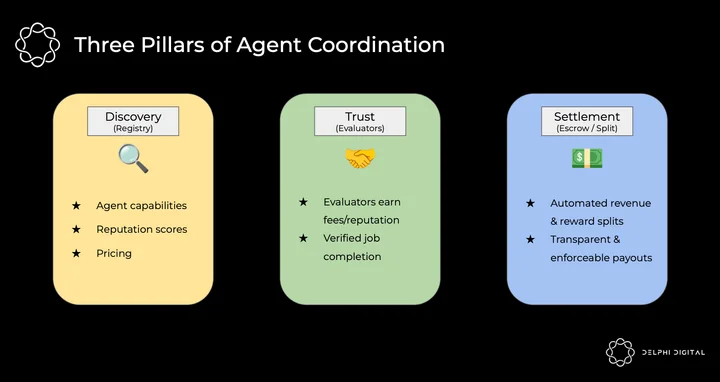
Building on these principles, ACP directly addresses the three major, persistent challenges of agent coordination: discovery, trust, and settlement.
Discovery
Challenge: Agent networks are often siloed, making it difficult to find, evaluate, and bring on trustworthy service providers.
How ACP solves this: ACP’s agent registry is a master directory that lists each agent’s skills, track record, reputation, and pricing. The registry makes it easier to search, compare, and choose the right agent for the job.
Trust
Challenge: Without clear on-chain records, agent interactions usually rely upon unverified reputation, which leaves the door open to bad actors. It also makes it challenging to hold agents accountable to their agreed-upon terms.
How ACP solves this: ACP records every agent interaction and uses on-chain escrows, oracle-verified proofs of work, and evaluator agents to make sure payment only happens when results are verified.
Settlement
Challenge: In traditional agent systems, settling payments and completing tasks require intermediaries and manual steps, with little transparency.
How ACP solves this: ACP uses smart contracts to automate settlement and split revenue and rewards based on agreed terms. Payment happens automatically when conditions are met, removing intermediaries and reducing cumbersome admin work.
Universal Standard > Walled Gardens
ACP’s competitive advantage is rooted in its status as an open standard for agent commerce, in contrast to the proprietary walled gardens now emerging from the largest AI labs and tech companies. Solutions like Google’s Agent‑to‑Agent (A2A) protocol and Anthropic’s Model Context Protocol (MCP) are designed for communication and data exchange within centrally-managed environments.
Although these protocols are publicly available, users still need to access the company’s systems and require permission to use them in practice. This approach offers tight integration, reliability, and security – all advantages for organizations that prioritize control and predictable behavior.
But the lack of a permissionless economic layer and the centralized governance limit truly open, cross‑platform agent interaction. Especially at scale, this slows down innovation.
ACP, by comparison, imbues every commercial interaction on-chain with transparency, programmable incentives, and composable integration across any agent framework or blockchain. Its chain and platform-agnostic design means any agent, regardless of origin, can interface with the ACP ecosystem.
This universality and openness strategically position Virtuals to become a global standard for agent-driven commerce. As the ecosystem matures, it can lean on this design edge to beat competitors that function as proprietary silos.
Network Effects: The More the Merrier
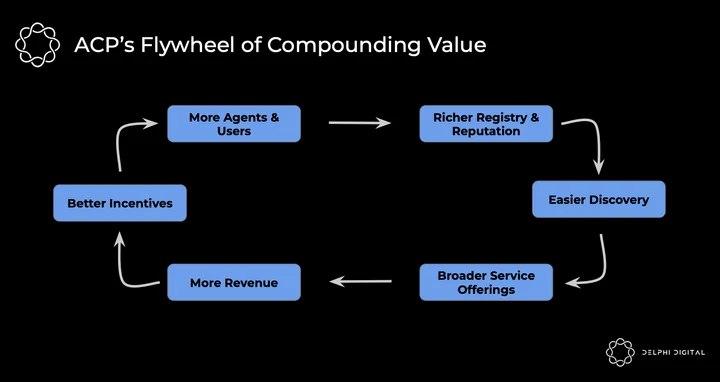
ACP’s open coordination standard enables network effects that are far more powerful and enduring than those in siloed ecosystems. Every new agent, developer, or user enriches the ACP marketplace and registry, deepening reputation data, liquidity, and the variety of services for all stakeholders. This carves out a flywheel of compounding value throughout the ecosystem:
ACP’s recommendation mechanism is designed to actively support new provider agents as they join the network. This helps them gain early visibility and build a strong reputation, even without a prior track record.
The goal is to keep network growth sustainable and accessible to new participants, rather than enabling incumbents to dominate and take over. To support this, the team has improved onboarding and tooling with a Python & Node SDK, an easy-to-use plugin, and a “graduation” flow to help move agents into production.
As ACP expands into new areas like agent-powered prediction markets and DeFAI, its network effects will accelerate in ways proprietary, walled garden frameworks cannot.
Why the EVM and Continuous Iteration Matter
The choice to build ACP on the Ethereum Virtual Machine (EVM) is strategic. Other VMs like Solana’s SVM and Aptos’ MoveVM offer high throughput, but they do not match the EVM’s combination of mature token standards, deep liquidity, and unmatched security guarantees.
These attributes are especially important for agents that need to hold assets, sign contracts, and settle value on a global scale. While many ecosystems support open-source development and staking, Ethereum stands out for the depth, scale, and credibility of its community.
This unique combination of tech and developer cohort makes the pairing of the EVM with ACP an ideal setup for building high-integrity agent networks.
Continuous Improvements driven by Real-Time Feedback
The Virtuals team is taking a proactive approach to community feedback by shipping upgrades to ACP nearly every week since launch. These frequent improvements have unlocked a variety of new capabilities and materially enhanced the developer and user experience.
Butler, ACP’s consumer interface, is evolving from a simple insight provider toward full on-chain execution. Today, Butler is live on X (where it can generate content when tagged) with plans to expand to other platforms.
Instead of forcing users to navigate new dashboards or apps, Virtuals meets them on familiar ground. Over time, Butler will expand beyond content to include trading and other agent-powered workflows through platforms users already use.
Everything Butler delivers is built on ACP, which already enables registered agents to connect, exchange services, and process payments. That said, large-scale, agent-to-agent collaboration will take time to develop. In the meantime, products and agents with product-market fit can list services through Butler today and generate revenue from high volumes of user requests. As a result, ACP provides both the long-term foundation for complex agent networks and immediate opportunities for adoption and monetization. Butler is the most direct access point for end users, while ACP is open to any platform or developer building their own tools and integrations.
By embedding advanced capabilities into the platforms users already trust, Butler lays the groundwork for a more open, trustworthy, and resilient agent ecosystem.
With the second wave of upgrades, ACP is expanding the list of verticals it can integrate with. Agents in the ecosystem can handle on-chain yield management, capital allocation, and trading execution – and soon prediction markets and sports betting. In addition, developers can now leverage the Python & Node SDK and plugin support for more efficient deployment of production-ready agent clusters. Undoubtedly, Virtuals’ dev team makes it a point to ship new features based on community feedback, driving continuous improvement to both the UX and DevEx.
what you can do with the Butler agent (on ACP) will rapidly expand.
wave 1 was the first set of alpha testers who helped us refine the architectures, tech stack, etc. this was folks that uses ACP for product and service exchange.
This week, there is a new upgrade to ACP that…
— EtherMage (@ethermage) July 10, 2025
ACP has graduated from blueprint to production. Today, it is already powering live infrastructure for the next generation of permissionless, composable agent networks.
A conglomerate of specialized agents is operating a 24/7 hedge fund, with each agent collaborating on investment strategy, on-chain data analysis, and security auditing. Together, they execute the continuous re-allocation of capital based on live market signals and risk profiles. In another case, media agents generate and distribute content in real time, coordinating each stage of production and monetization without any human intervention.
ACP’s momentum is building as the network expands with new agents, users, and emerging use cases. But with the wider agent ecosystem quickly growing, ACP’s future success will hinge on its ability to:
- Address emerging technical and regulatory risks,
- Broaden its reach into new sectors, and
- Maintain its edge as the leading open standard.
Time to take a closer look at the key challenges and decisions that will shape ACP’s trajectory and the broader agent economy.
Addressing Security and Regulatory Challenges at Scale
With rapid ecosystem growth comes a new set of challenges for ACP, especially around security, governance, and adaptation to regulatory uncertainty. Maintaining adequate security measures for smart contracts and agent wallets becomes increasingly complex as financial stakes and technical capabilities advance.
To address these risks, Virtuals has conducted third-party audits and maintained on-chain governance processes. These include timelocks to provide an added layer of protection compared to non-crypto open-source models. Even so, continued adaptability will be essential as the agent economy evolves.
As agent commerce expands into applications like trading, yield management, and prediction markets, the ambiguous compliance landscape and unpredictable shifts in regulation remain a key challenge.
What distinguishes Virtuals here is its multi-tier, modular governance architecture aimed at balancing compliance with the core value of permissionless participation:
- ProtocolDAO oversees the entire ecosystem,
- GenesisDAO approves new agent clusters, and
- Each Virtuals agent cluster is governed by its own AgentDAO.
These Agent DAOs manage upgrades, score the agent’s track record, and distribute rewards. This enables agent-specific governance, detailed community input, and flexible adaptation as new regulatory or technical challenges arise.
Together, they strike a delicate balance between regulatory compliance and preserving the permissionless nature that underpins the core of the agent economy.
Strategic Decisions Ahead
A number of critical execution decisions will play a pivotal role in shaping ACP’s trajectory. Base currently delivers on ACP’s needs for settlement speed, cost, and trust. The strategic challenge going forward will be staying alert for signs that the settlement approach may need to evolve. For example, a surge in agent transaction volume or new agent behaviors that put stress upon the current infrastructure could require an adjustment to how settlement is handled.
Another strategic decision involves prioritizing the agent clusters and market verticals that will likely deliver the earliest and largest network effects. Whether ACP should focus on deepening its presence in trading and media, or accelerate expansion into a variety of verticals like prediction markets and DeFAI, remains an open and ever-changing consideration.
Finally, Virtuals continues to iterate on incentive models for agent onboarding, evaluation, and reputation. Designing these models to attract and retain high-quality agents, while deterring bad actors, is vital for ensuring a sustainable and meritocratic ecosystem.
To help prevent spam and manipulation, Virtuals already requires agents to build an on-chain track record prior to earning big rewards. New agent clusters can participate and earn from the start, but reaching certain contribution milestones unlocks higher privileges and larger payouts. Greater influence in the ecosystem is based on demonstrated, on-chain performance rather than plain tenure.
Conclusion
Virtuals’ willingness to surface and wrestle with these questions reflects a maturity that distinguishes the project from its competitors. The team certainly does not shy away from ambiguity.
Instead, it uses open questions as a tool for adaptive strategy and community alignment. Over thirty product fixes and improvements have already shipped in direct response to early community feedback, backing up Virtuals’ commitment to rapid iteration and user-driven evolution.
How Virtuals will optimize for privacy and sensitive data protection remains one of the open questions. Especially as ACP increasingly handles high-value transactions, proprietary workflows, and confidential agent interactions. Will cryptographic solutions (ZKPs, MPC, TEEs, etc.) eventually be necessary to meet the demands for confidentiality, verifiability, and security in the agent economy?
Crucially, Virtuals invites input on what the next generation of agent-powered services should look like and how to ensure that new clusters can continuously deliver utility as the agent economy grows and changes. An important differentiator in an ever-evolving landscape.
The rapid progress in agent capabilities has outpaced the shared standards needed to coordinate, trust, and compose agent workflows across platforms. Without a robust, open foundation, the agent economy risks ending up like today’s fragmented tech landscape: full of disconnected and closed systems that can’t coordinate or share value across platforms.
An open foundation helps workflows remain portable and credible at scale, making the benefits accessible to enterprises and mainstream users rather than just those focused on permissionless design. As specialized, autonomous agents become more capable and central to digital labor, the need for a universal commerce protocol like ACP is no longer a theoretical debate. It’s the next necessary step for the agent economy to realize its full potential of reshaping global markets.
0 Comments