Voltz, IPOR, and the Next Wave of Interest Rate Derivatives
MAY 22, 2023 • 22 Min Read

Introduction
Interest rate derivatives are perhaps the most underdeveloped and underexplored area in all of crypto. Interest rate projects have struggled mightily to attract liquidity, and seemed forgotten about towards the end of 2022.
So far in 2023, there has quietly been a lot of progress in this area. Voltz and IPOR have emerged to bring interest rate swaps to DeFi and are replenishing the momentum for the interest rate derivatives space as a whole. In this report, we will explore what makes Voltz and IPOR unique to previous yield derivatives projects. We will reevaluate the state of the yield derivatives sector and look at how it may shape up moving forward.
Why Interest Rate Derivatives Haven’t Taken Off
A swap is an agreement between counterparties to exchange cash flows according to preset conditions. Interest rate swaps in particular are a huge deal in legacy finance. Interest rate swaps are the biggest market in TradFi, with roughly $414T of outstanding notional. Swaps are the foundation for swap and yield curves, and are packed into structured products like fixed rate mortgages.
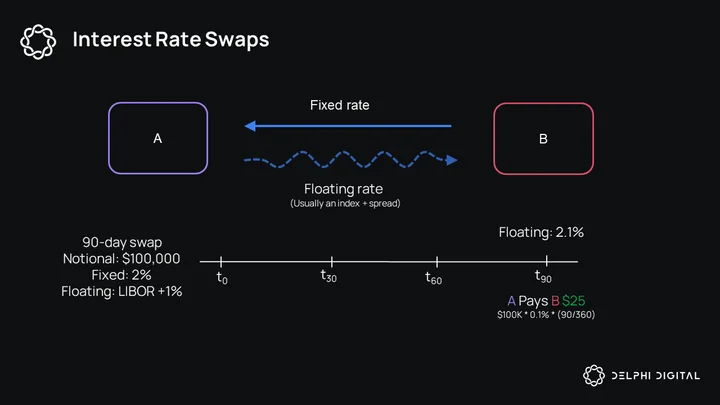
IRS are largely inaccessible, being traded on private OTC markets. They are also subject to counterparty and credit risk. On the other hand, swaps are very capital efficient, as only the difference in cash flows changes hands. It would seem IRS are one of the financial instruments DeFi was built for.
So far, the dominant method for creating fixed income/interest rate swaps in DeFi has been yield stripping. Yield stripping essentially creates a zero coupon bond with a time-locked deposit into money markets or similar yield venues. The position is split into a principal token and yield token and users are able to trade on these assets until maturity. The discount on the principal token creates an implied fixed rate of return. Trade activity on the yield token mimics an IRS, with the seller receiving an upfront value and the buyer receiving variable payments until maturity.
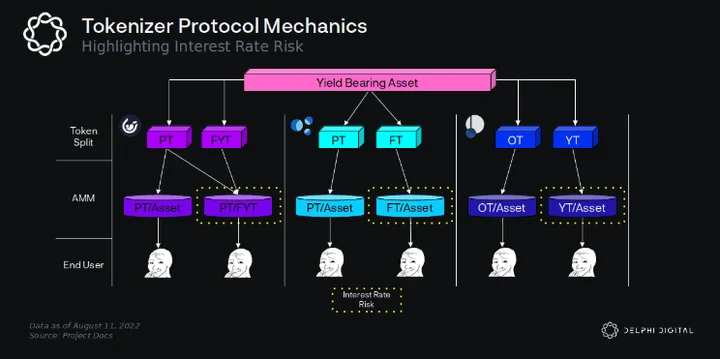
The graphic above is an excerpt from a recent deep dive on the mechanics of yield stripping and fixed income projects. For a more complete understanding of how these projects work, check out The Path Forward for DeFi Fixed Income and Yield Tokens.
There are 10+ projects with some iteration of this mechanism. Most involve trading on an AMM, and none of them have earned significant traction. There are several reasons that contribute to the lack of success:
-
Capital Efficiency – With the yield stripping method, the entire value of the principal is required up front. This is far less efficient than an actual IRS, where little to no collateral is required up front and only the discrepancy in cash flows changes hands at predetermined intervals.
-
Impermanent Loss – Yield stripping tokens are time dependent assets. A yield token is worthless at maturity. When providing liquidity to tokens on an AMM that are subject to time decay, impermanent loss is guaranteed.
-
Fragmented Liquidity – A variety of assets and maturities has made it difficult for any one project to build out a complete product offering. The capital inefficiency of the design and impermanent loss concerns make the problem worse.
-
Exotic Assets – It’s difficult to onboard exotic assets since the principal amount is required in full.
-
Lack of Demand – DeFi has a risk tolerant user base and is generally less intrigued by fixed income, fixed rate borrowing, or hedging use cases. Furthermore, DeFi loans generally serve leverage rather than more traditional financial purposes.
Until recently, we haven’t seen an attempt at creating a pure interest rate swap protocol that functions just like the real deal. This is where Voltz and IPOR come in.
Voltz
Voltz is a non-custodial interest rate swap protocol on Ethereum and Arbitrum. Voltz solves the issues described above by using synthetic architecture and leverage to make the use case more practical.
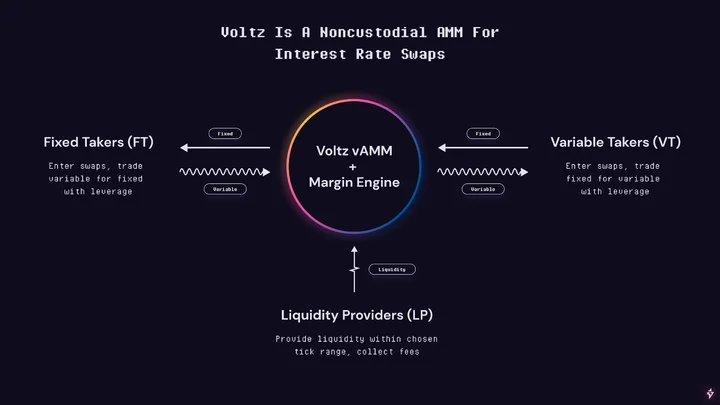
Voltz uses a concentra
Read the full report
This report is part of Delphi Pro.
- 800+ Pro reports across every major sector
- Talk directly with our analysts
- Private community of funds and builders
Already a Pro member? Log in
0 Comments