
L2s Got Room to Grow: Optimism’s Growth Stats
Optimism garnered quite a bit of attention recently due to the popularity of its token airdrop back in May of this year. Not only did they offer nearly 249K crypto users the newly-launched $OP token, but they also made promises that future airdrops were on the table as well. The goal of this airdrop was to invigorate the ecosystem and onboard new users into it — but was it effective? Or did people just dump and run?
These questions and some additional insight into the state of the Optimism ecosystem will all be discussed in this article.
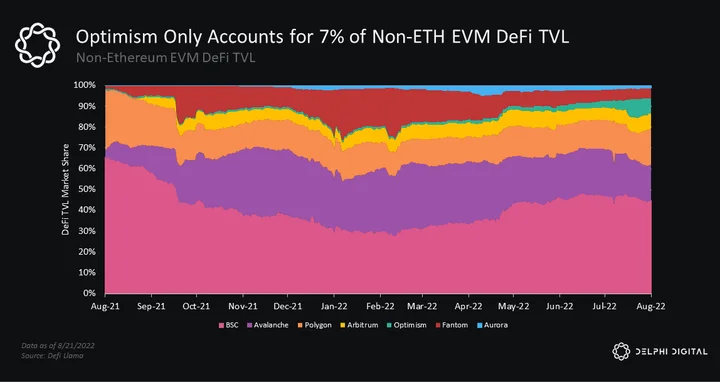
When looking at a relatively new ecosystem that is gaining momentum, it’s key to ensure there is room for it to grow in the future. As seen above, Optimism only accounts for around 7% of the non-Ethereum EVM DeFi TVL, while alt-L1s such as Polygon and BSC currently are dominant. These chains caught formidable traction over the past year, when Ethereum’s high fees rendered it unusable for most. But now that projects like Optimism and Arbitrum offer cheaper execution costs, we could see capital start to flow back into the Ethereum ecosystem — which includes rollups built on top of it. With this in mind, there’s little doubt that there’s space for Optimism to grow and attract more capital/users over time.
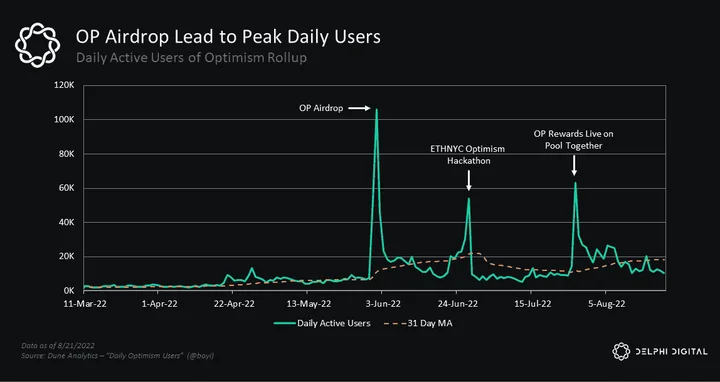
As mentioned, one of the airdrop’s goals was to onboard new users into the ecosystem. And it seemed to work, albeit for a short period of time. On the day of the OP airdrop, daily active users soared to a peak of just over 106K before quickly dropping back down. While daily active users have spiked twice more since then, these instances have been significantly less impactful compared to what we saw the day of the airdrop. This isn’t all too surprising; it’s well established that airdrops are great tools to attract users, but not necessarily keep them around.
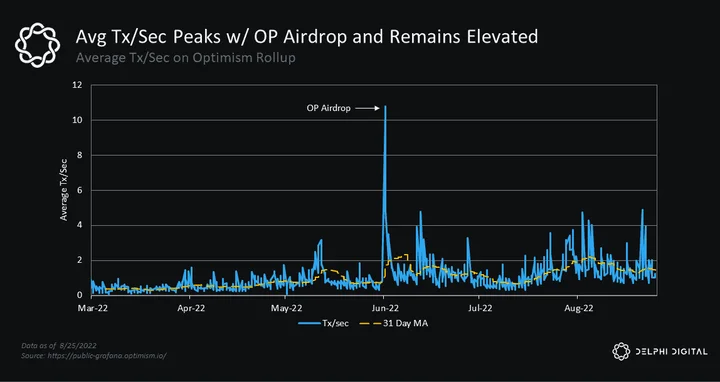
The good news is that post-airdrop, the floor for daily active users did trend upwards, meaning that some of the users enticed by the airdrop stuck around to play. Furthermore, it can be seen that average transactions per second were also higher post-airdrop, implying the airdrop was able to encourage some level of additional activity in the ecosystem.
Airdrop Activity: Onboarding New Users or Just Something to Dump?
Below, we break down some key data surrounding the OP airdrop.
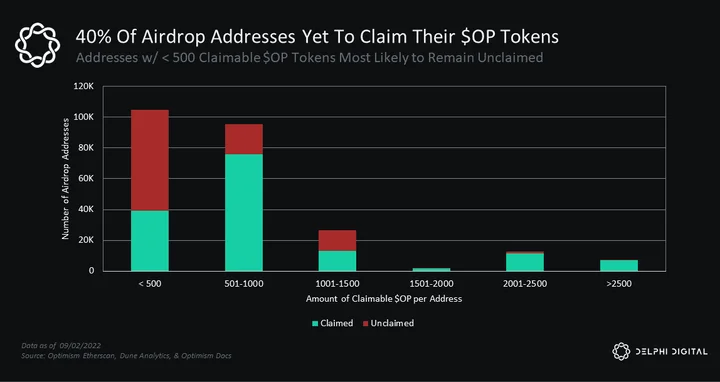
First thing’s first, users need to actually claim the tokens that they’ve had airdropped to them. In the case of the OP airdrop, close to 40% of total recipients haven’t claimed their OP yet. Unsurprisingly, most of the addresses that didn’t undertake this endeavor were those who would’ve received less than 500 OP. More than half of the addresses eligible for 500 OP or less haven
Read the full report
This report is part of Delphi Pro.
- 800+ Pro reports across every major sector
- Talk directly with our analysts
- Private community of funds and builders
Already a Pro member? Log in
0 Comments