Why Asia Will Lead Web3 Gaming: Learnings From Token2049 & KBW
OCT 09, 2023 • 42 Min Read

Foreword
The number of well-funded blockchain games that are opening their doors to the public with playable builds is swelling. It feels like 2024 might actually be the year that broader player sentiment shifts and attention flows back toward gaming. Nowhere else is this feeling stronger than in Asia. Fresh from two of Asia’s largest crypto-focused conventions, Korean Blockchain Week and Token 2049, we wanted to take the time to highlight some of the most promising blockchain gaming projects from the region that we have been tracking.
As we go on to outline in this report, it is clear that the number of builders and consumers actively exploring the intersection between blockchain and gaming in this region outpaces all others. Furthermore, due to a number of synergies, such as the digital-first culture, wide acceptance of deep monetization practices, and select key entities spearheading development, we will undoubtedly see games scale much faster here compared to the West.
We will start by providing some background on what’s behind all this excitement and then go on to list some of the most prominent and innovative ecosystem projects and content developers. Paying especially close attention to the South Korean, Japanese, and Chinese markets, we will also highlight future key challenges and opportunities for both the bear-hardened veterans and new entrants.
Why All The Excitement?
It is no secret that many of the world’s largest gaming companies have been exploring blockchain gaming in one way or another for years. The two main reasons Asia represents a comparatively more “crypto-friendly” gaming market that is positioned to see outsized growth over the next decade comes down to synergistic user behaviors and active participation from established incumbents.
There is a fundamental difference in the behaviors of Eastern and Western gamers. The latter has shown significantly more pushback against any shift in the status quo of how games are monetized – going all the way back to the introduction of in-game cosmetics to the more recent rise of P2E and NFTs. Asian gamers, on the other hand, are less offended by the idea of financialized game loops. For example, F2P gaming and massively multiplayer online role-playing games (MMORPGs), in particular, scaled faster and are now more heavily monetized in Eastern markets. Not only is there less protest against predatory monetization practices, but almost all top-grossing games are F2P, and roughly 50% of global gaming revenues are derived from Asian markets.Social trends have a large role to play in this behavioral shift across user demographics. Studies have shown that capitalism is losing popularity among young American adults, with only 49% of those aged between 18 and 34 having a positive view of capitalism (down 20 points from two years prior). Many Asian countries, on the other hand, have experienced a rapid change in wealth within a single generation, in large part thanks to capitalism and globalization.
This rapid growth has created highly competitive domestic markets where hustling is encouraged and material status is aspired to. Ironically, the blockchain industry has played an important role in concentrated wealth generation over the past five years. It is no coincidence that crypto adoption is rapidly increasing in South and Southeast Asian countries, to the point where five of the top 10 countries for crypto adoption are from this region. A similar trend occurs when looking at top-ranking countries by cryptocurrency value received in 2022, with Vietnam and the Philippines, in particular, standing out as ranking first and second, respectively (in large part thanks to P2E gaming).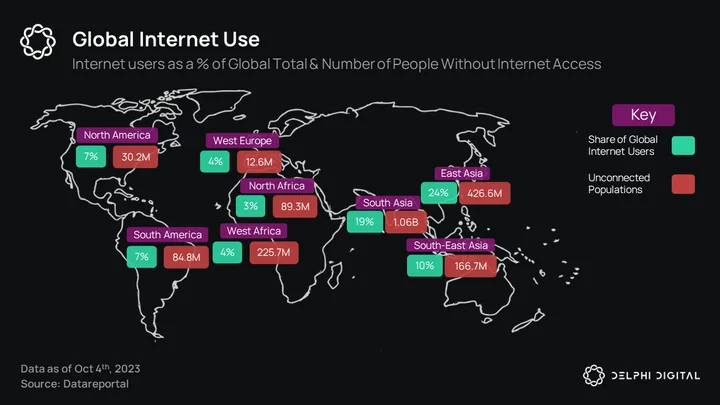
Another side effect of the sudden growth seen throughout much of Asia is the rise of an increasingly digital-first population. By leapfrogging a lot of the legacy financial infrastructure embedded in the West, Asia has gone straight to mobile “everything apps,” like WeChat and Line, and is spending an increasingly large amount of time online. Interestingly, although Asia has approximately 290% more internet users than the next highest region, it is still lagging in terms of penetration rate. Looking past the skew in population size, this would suggest that there is still a lot of room for future growth in the region. The sum of all of these factors is a massive market that is already one of the largest consumers of digital content. Asia is also inherently more accustomed to the financial aspects of the gaming industry and is significantly more attracted to many of blockchain gaming’s core competencies (digital ownership, player agency, and value distribution).
Simultaneously, both regulators and incumbent industry leaders are proactively tackling the emergence of this new technology. In Japan, Prime Minister Fumio Kishida has, on several occasions, publicly promoted the important role blockchain technology will have in the country’s future (even after the Terra Luna, 3AC, and FTX roadbumps). The country also recently introduced favorable laws for blockchain startups, including the ability to be exempt from the “unrealized capital gains” tax that essentially makes it easier for Web3 companies to receive token-based VC funding.
Similarly, Hong Kong has its own Web3 Taskforce and $6.4M in government funds to help develop its domestic Web3 ecosystem. Almost all Hong Kong banks have been encouraged to allow foreign blockchain businesses to set up shop in the country, and retail trading of certain cryptocurrencies is being allowed. Further, reading between the lines, it would appear as though mainland China is using Hong Kong as an intermediary testing ground that may one day lead to wider adoption in the middle kingdom (as evidenced by China’s largest national broadcaster, CCTV, promoting the ability to trade BTC in Hong Kong). In South Korea, 9 out of 13 of the largest gaming companies have either invested in or are actively developing blockchain gaming products, allowing a new wave of small and optimistic gaming startups to emerge.
All that said, due to the relatively adverse domestic regulatory environments in both South Korea and China, studios exploring blockchain integrations have positioned themselves to be predominantly gaming exporters that focus on international markets. That said, there will always be a percentage of domestic gamers that use a VPN to access these games. Additionally, although much more of a pro-crypto market, Japan has its own struggles when launching Web3 games targeted at the domestic market. Although some regulations for blockchain business have eased up in the country, certain workarounds are still highly in demand, and retail tax laws are lagging further behind.
To summarize, a culmination of various factors has positioned Asia to lead growth in blockchain gaming, and the three largest gaming markets in the region (Japan, South Korea, and China) have all expressed outsized interest in the sector when compared to their Western counterparts. However, this level of insight alone is not enough to get excited. To truly understand what’s brewing in Asia, it’s imperative to explore the major areas of interest and the standout projects operating within them.
Studios & Publishers
Despite the much more progressive regulatory environment surrounding blockchain projects, relatively few Japanese gaming giants are openly implementing blockchain into their products compared to South Korea. SEGA was one of Web3’s early supporters at a time when gamers were chastising Western developers like Ubisoft. However, the Japanese studio recently stated that it would be pulling away from pursuing these initiatives due to the potential for it to “devalue” its brand.
Nonetheless, it appears that the previous partnership with DoubleJump.Tokyo is
Read the full report
This report is part of Delphi Pro.
- 800+ Pro reports across every major sector
- Talk directly with our analysts
- Private community of funds and builders
Already a Pro member? Log in
0 Comments