World: A Trillion Dollar Opportunity, or Just Another Low Float, High FDV?
MAY 22, 2025 • 26 Min Read
House of Mirrors
The internet is becoming a house of mirrors.
Those concert tickets for your favorite artist that sold out in seconds? Snatched up by scalper bots. That attractive dating profile you just matched with? Probably a catfish. Even the integrity of social media debates have collapsed, with comment sections flooded by armies of AI accounts pushing identical talking points with just enough variation to seem like different people (sometimes it’s not that hard to tell).
Our internet was originally designed to connect humans, but this internet is being taken over.
The authenticity crisis will continue to infiltrate every corner of our online experience as AI capabilities accelerate and commoditize, hindering our ability to communicate and transact online.
World aims to tackle this problem by building what Sam Altman has called “one of the only trillion-dollar opportunities left” – a global proof-of-personhood (PoP) system creating a verified human-identity layer for the internet.
Their mission: build the largest global identity and financial network, owned by humanity rather than corporations or governments.
Get Up-to-Speed
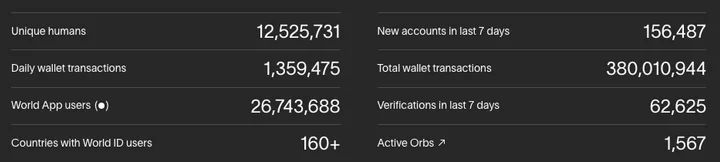
World has already verified over 12.5M humans with their iris-scanning Orb devices, with aggressive expansion plans announced during their recent event earlier this month (highlights from the event below).
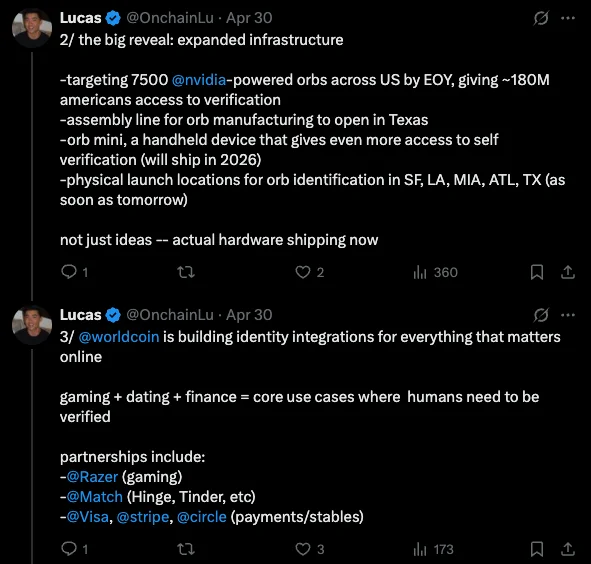
In the long-term, they have their sights set on expanding to over 1 billion users.
Despite this impressive growth and ambitious vision, CT remains hesitant because of:
- the seeming contradiction of cypherpunk values around anonymity and privacy
- early execution challenges and negative PR around biometric collection
- questions about the tokenomics and value accrual for WLD
- uncertainty about whether this is just a Sam Altman AI-narrative investment play
In this report, we’ll examine World’s tech stack, economic model, and roadmap to address these concerns as well as the important questions everyone is wondering about:
Do we need this identity layer?
Can we trust World?
Can WLD create sustainable value for its holders?
Why Proof-of-Personhood?
At its core, the internet lacks a way to verify that a user is (1) human and (2) unique without sacrificing privacy. This missing primitive opens the door for sybil attacks – where bad actors create multiple fake identities to gain disproportionate influence – turning “one person, one vote” systems into “whoever can create the most accounts wins.”
Automated bot traffic accounted for 51% of all web traffic in 2024, but the stakes here extend far beyond just preventing spam. As Vitalik Buterin notes, without reliable proof of personhood, “decentralized governance becomes much easier to capture by very wealthy actors, including hostile governments.” Many protocols aim to create democratic systems online but, without solving the unique-human verification problem, these inevitably become plutocracies.
Current attempts at this identity layer fail in critical ways:
- Government IDs: Exclude over half the global population without digital IDs, sacrifices privacy completely, and centralizes control with governments (e.g., Holynym)
- Social-graph verification: Struggle with bootstrapping (you need connections to join) and favors well-connected users who can generate more identities (e.g., BrightID, Idena)
- Web of trust systems: Susceptible to collusion & social engineering attacks (e.g., Proof of Humanity, PGP Web of Trust)
- ZK registries: Don’t check uniqueness, so prone to sybil attacks (e.g., Rarimo)
- Phone/email verification: Easily bypassed with SIM farms and account markets
- CAPTCHAs: Increasingly defeated by AI while creating friction for legitimate users
World’s Proof-of-Personhood seems to be the best shot we have at maintaining an internet built for humans without the tradeoffs of privacy and accessibility. A proper proof-of-personhood system that you’re a real, unique human, all without exposing who you actually are (I’ll walk through how it works later on). The applications are far-reaching:
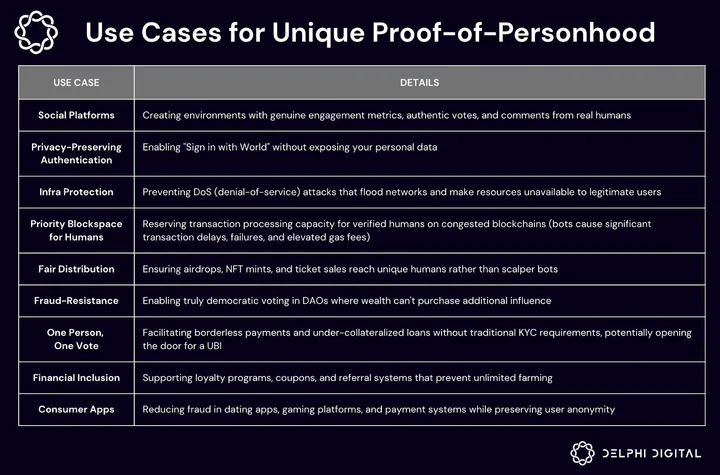
What is World Building?
Let’s get into the high-level components that make up World.
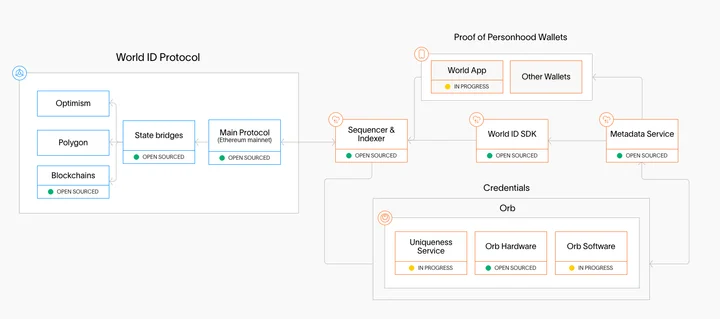
World ID
At the heart of the ecosystem lies World ID, a digital identity proving you’re human without revealing personal information.
This is implemented primarily through the Orb, a specialized biometric device that uses iris scanning and sophisticated neural networks to verify humanness and uniqueness (this is done through a deduplication mechanism, which we will get to later). World’s new iteration of this Orb are powered by NVIDIA Jetson processors, which are not cheap.
A more portable verification device called, the Orb Mini, is planned for 2026. The hardware and software is all currently produced by Tools for Humanity (think of them as World’s R&D contractor) and have been audited by Trail of Bits to ensure security standards are met. There are currently 1,567 Orbs spread across 22 countries.
World ID recently expanded to include the World ID Credentials feature, enabling NFC-enabled passport verification. With ZK-proofs, this allows you to store credentials locally on your device
Read the full report
This report is part of Delphi Pro.
- 800+ Pro reports across every major sector
- Talk directly with our analysts
- Private community of funds and builders
Already a Pro member? Log in
0 Comments