ZKsync & Elastic Network's Q1 Wrapped: Ecosystem & Development Highlights
MAY 07, 2025 • 19 Min Read

Report Summary
ZKsync Era and Elastic Network Highlights:
-
Institutional Adoption: Major institutions including Deutsche Bank, UBS, WonderFi, and Tradable are actively developing compliant solutions on ZKsync.
-
RWA Dominance: ZKsync Era is the second-largest blockchain for tokenized Real World Assets (RWAs), holding 27% market share, only behind Ethereum.
-
Leading ZK Rollup: ZKsync Era leads ZK rollups in total value secured (TVS, $780M+), total value locked (TVL, $190M+), ZK proof volume (58% share), and user activity (470,000 MAUs).
Elastic Network Overview:
-
Customizable Appchain Hub: Elastic Network has become a central ecosystem for specialized ZK-powered appchains, leveraging ZK Stack’s modularity for customized privacy, scalability, and regulatory compliance.
-
Expansion: Over 19 distinct ZK Chains launched, covering sectors such as institutional tokenization, consumer crypto, gaming, and AI applications.
-
Core Components:
-
Ethereum Smart Contracts for shared liquidity and chain registration.
-
ZK Gateway middleware for cross-chain interoperability.
-
Modular ZK Chains for tailored blockchain architectures.
-
Strategic Advantages of Elastic Network:
-
Interoperability: Enables seamless, inexpensive cross-chain transactions via ZK Router/Gateway.
-
Shared Liquidity: Assets move freely across chains, enhancing economic efficiency.
-
Customization and Privacy: Tailored blockchain configurations and Validium chains for privacy-intensive applications.
-
Horizontal Scalability: Multiple parallel-running chains aggregate proofs into Ethereum efficiently, ensuring performance.
-
Superior User Experience: Web2-like onboarding (single address, account abstraction, passkey integration) for ease of use.
-
Security: Multi-layered approach using ZK cryptography, SGX confidential computing, and formal verification.
Key Ecosystem Developments:
-
Abstract: Consumer-focused chain with over 1.4 million wallets since January 2025; heavy focus on creator economy and streaming.
-
Sophon: Consumer blockchain combining crypto, gaming, and AI; partnered with OPEN Ticketing (19M tickets/year), Mirai Labs (27M wallets), and Anomaly (AI gaming); launched a $5M AI development initiative.
-
GenLayer: AI-native blockchain, offering intelligent contracts powered by AI and a novel “Optimistic Democracy” consensus; aims to enable trustless real-time decision-making.
-
GRVT: First licensed derivatives exchange blending CeFi/DeFi, with $1.3B traded in 30 days post-launch; integrated institutional-grade trading via CoinRoutes.
-
WonderFi: Canada’s largest crypto platform, launching ZK-based L2 and wallet, bridging 1.7M retail users onto DeFi with institutional compliance.
Notable Additional Developments:
-
Union Chain: Institutional-grade L2 targeting Southeast Asia with access to over 20M KYC’d users.
-
UBS & Tokenized Gold: PoC deployment on ZK validium to scale gold offerings.
-
Buenos Aires Digital IDs: ZK-based digital identity solution launched for 3.6M citizens.
-
Lens v3 Migration: Lens migrated from Polygon to Elastic Network, enhancing social media capabilities with ZK tech.
Technical Developments and Security:
-
Developer Experience (DevEx):
-
Launched ZK Stack CLI, streamlining local chain deployment.
-
Smart Sign-On (SSO) introduced for simplified onboarding.
-
Integration with Fermah decentralizes ZK proof generation, increasing reliability and cost efficiency.
-
-
Consensus and Decentralization:
-
Transitioned to new ChonkyBFT consensus, enhancing decentralization of the sequencer.
-
-
Security Audits: Over $10M spent on audits; recent formal verification of ZK verifier by Nethermind significantly boosts security.
Looking Ahead (2025 Roadmap):
-
Shift to Elastic Network-first Approach: Prioritize the decentralization of sequencers and new value-accrual mechanisms.
-
UX & Developer Simplification: Enhance developer experience and user onboarding (web2-like UX).
-
Native Interoperability: Strengthen seamless connectivity across public and private chains.
These developments position ZKsync and the Elastic Network at the forefront of scalable blockchain innovation, particularly in institutional finance, consumer crypto, RWAs, and AI-driven applications.
-
- null
Q1 – Key Insights
- Institutional adoption accelerates with Deutsche Bank, UBS PoC, WonderFi, and Tradable building compliant solutions on ZKsync
- ZKsync is the second-largest blockchain for tokenized RWAs, capturing over 27% market share, trailing only Ethereum.
- ZKsync Era dominates ZK rollups, leading in TVS, proof volume, and user activity.
- The Elastic Network expands as a ZK appchain hub in Q1, with 19+ ZK Chains leveraging modular architecture for customization, privacy, and soon seamless interoperability.
- Major ecosystem growth in consumer crypto, RWAs, and AI, with chains like Abstract, Sophon, and GRVT gaining traction.
- ZK Gateway upgrade deployed on testnet, with the mainnet upgrade expected soon – improving cross-chain interoperability.
- Decentralization advances with the new ChonkyBFT consensus and progress towards decentralizing the sequencer.
Elastic Network in a Nutshell
Offering customization, interoperability, and unique privacy features, the Elastic Network has established itself as the hub for bespoke appchain solutions powered by ZK tech. Thanks to the modularity of the ZK Stack, companies and developers can tailor the blockchain architecture of ZK Chains to their specific specialization. To no surprise, the Elastic Network Endgame has become concurrent and very much aligned with the appchain thesis.
ZKsync Era ≠ Elastic Network, but they’re connected. ZKsync Era is the first ZK Chain in The Elastic Network. The Elastic Network is a growing ecosystem of interoperable ZK Chains. ZKsync Era is an L2 zkEVM leveraging ZK proofs to scale efficiently. And Era laid the foundation of the Elastic Network, since the ZKsync L1 bridge contract was reconfigured into a shared router contract. It’s a foundational chain in the Elastic Network that empowers the ecosystem with critical infrastructure and capabilities. Era is also the home of governance, RWAs and DeFi, and is a launchpad for app builders exploring privacy, zkTLS, or other ZK innovations.
High Level Architecture
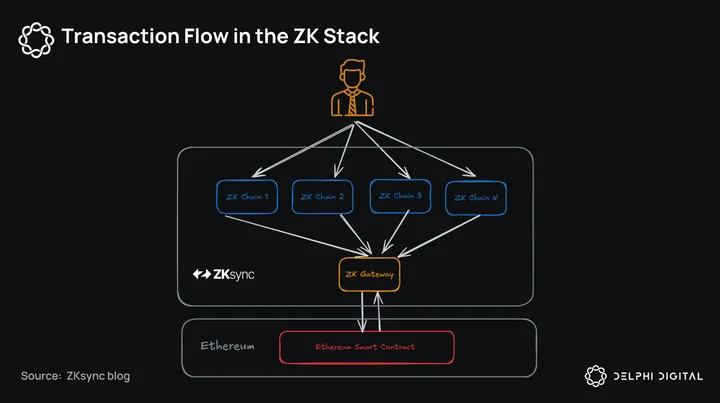
The Elastic Network’s architecture consists of three core pillars:
- Ethereum Smart Contracts, a set of smart contracts deployed on Ethereum. They manage network state, facilitate chain registrations, and ensure shared liquidity across ZK Chains.
- ZK Gateway, the middleware that will connect Ethereum and ZK Chains, enabling seamless interoperability and optimizing proof aggregation for cost efficiency.
- ZK Chains, independent, parallel-running instances of the zkEVM that achieve consensus and finality on Ethereum. Each ZK Chain is fully customizable, leveraging the ZK Stack to meet specific use case requirements.
Why build on the Elastic Network?
In practice, the Elastic Network offers unique benefits to ZK Chains in its ecosystem. Utilizing the ZK Stack, ZKsync’s open-source codebase, anyone can build a modular ZK Chain and easily integrate with the Elastic Network to be part of an ecosystem that benefits from:
- Seamless Interoperability
- ZK Chains will be interconnected through the ZK Router and ZK Gateway, enabling cheap cross-chain transactions and trustless interoperability
- Shared Liquidity across the network, allowing assets and data to move freely between chains
- Customization & Confidentiality
- ZK Chains are fully modular in regards to DA models, access controls, consensus, and more
- Validium chains provide confidentiality with verifiability, unlocking privacy use cases
- Full control over data privacy and accessibility allows enterprises to meet regulatory requirements, enabling compliant tokenization and banking applications
- Horizontal Scalability
- Achieved by running multiple ZK Chains in parallel and aggregating proofs into a single proof-of-proofs for Ethereum settlement
- New ZK Chains can be added without compromising performance or decentralization
- Better UX
- Users interact with the Elastic Network as if it were a single blockchain requiring only one address, account, and signature
- Native account abstraction and simplified onboarding via SSO, passkeys, secure enclave, and WebAuth, creating a web2-like UX
- Multi-layered Security
- ZK cryptography eliminates the need for honesty assumptions in the ecosystem
- Elastic Network leverages SGX for confidential computing, formal verification for code correctness of the zk verifier, and supports cross-chain forced transactions to level up censorship resistance
To date, this has attracted over 19+ unique chains focused on institutional tokenization, permissioned private blockchain solutions, gaming, and consumer applications, creating a vast ecosystem of interoperable L2s.
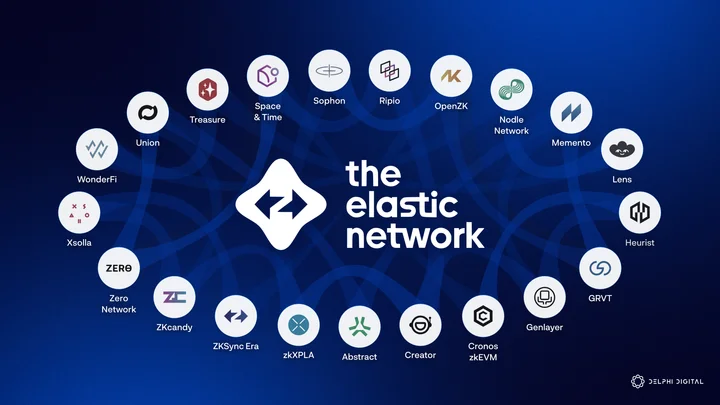
With RaaS providers such as Caldera, Alchemy, Quicknode, Ankr, and Zeeve, deployment of a ZK Chain is as simple as clicking a few buttons. In a nutshell, the Elastic Network aims to fulfill the appchain vision, leveraging ZK tech and a shared settlement layer to succeed.
At the beginning of this year, we published our deep dive, ZKsync & The Elastic Network Endgame, which thoroughly dissects its elastic architecture and dives into the tech behind the benefits – a recommended read for anyone interested in learning more about the design. Much has happened in the ecosystem since then, presenting a great opportunity to discuss the latest ecosystem and tech developments.
Checking in on ZKsync Era
Over the course of Q1 2025, ZKsync Era has solidified its position as the dominant ZK rollup.
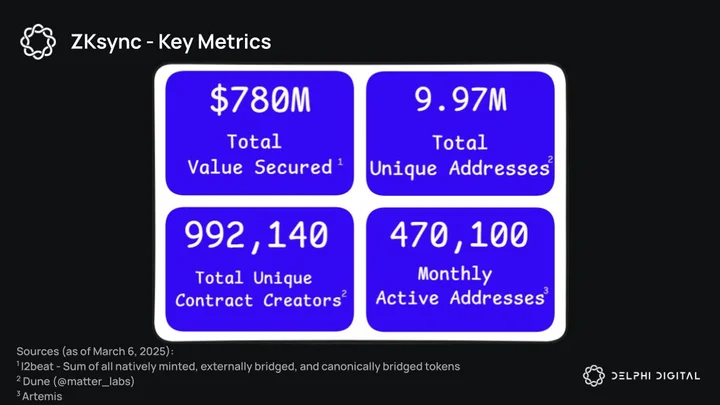
With over 9.97 million unique addresses, 470,000 monthly active users, and nearly 1 million unique contract creators, ZKsync leads all ZK rollups in key activity metrics. In terms of assets, ZKsync Era also ranks as the top ZK rollup by both TVS, total value secured, and TVL, securing over $780m and $190m, respectively.
Zooming in on the volume of ZK proofs verified on Ethereum, ZKsync Era’s dominance becomes even more apparent. In February 2025 alone, Era commanded over 58% of all ZK proof volume across ZK projects, spanning both networks and dApps. No other rollup or application comes close, highlighting the growing traction and increasing demand for ZKsync and the Elastic Network.Most notably, ZKsync Era has experienced remarkable growth in tokenized assets on the network. Fueled by initiatives like Fidelity International and Sygnum’s collaboration to bring NAV data onchain and Tradable’s efforts to build a full-scale private credit market onchain, total RWA value on Era now exceeds $2.032B. Representing over 27% of the total RWA market share, ZKsync Era is now positioned at the top among all rollups and second across all networks, trailing only Ethereum.
Ecosystem Spotlights
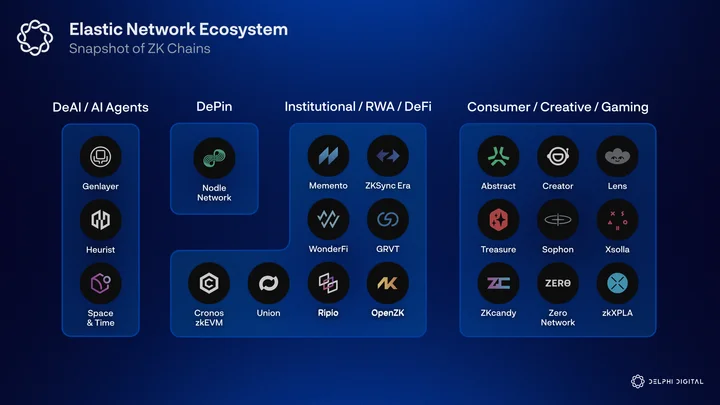
A comprehensive review of every ZK Chain within the Elastic Network is beyond the scope of this memo. Instead, the following excerpt highlights a few key developments.
Abstract
Abstract mainnet launching on January 28, 2025, was one of the major ZK Chain launches we saw this Q1, 2025. Built on top of the ZK Stack, Abstract is a ZK rollup designed to provide low transaction fees and high scalability for consumer-focused applications and products.
Specializing in consumer crypto, Abstract prioritizes UX, aiming to combine the best of web2 with the best of web3. Such as enabling users to set up an Abstract Global Wallet (AGW) using just an email address.
Since the Abstract mainnet launched 42 days ago, over 1.4m Abstract Global wallets have been deployed. Daily active AGWs exceed 548,000 as of March 10, 2025, meaning over one third of total deployed wallets are actively engaging with apps and projects in the ecosystem. And total transactions on the Abstract network surpassed 17m, overall denoting a very successful network launch.
The main driver behind this activity lies in the team’s effort to build out a vibrant creator economy spearheaded by Abstract’s Portal, the network’s flagship product offering token-based rewards for both creators and consumers. While the ecosystem spans over 100 apps and projects, streaming has emerged as the leading form of entertainment on Abstract. Users have tipped over $1,351,700 in total, including a top donation of $56,300.
Sophon
Sophon is another consumer network among the most prominent ZK Chain launches. As a consumer-first blockchain, Sophon aims to merge crypto with AI and gaming to create a unique end-user experience. Leveraging the ZK stack, Sophon is the first implementation of Validium architecture using Avail’s DA to provide a UX that is gas-free, has near instant finality, leverages automated account creation, and soon seamless interoperability with other blockchains in the Elastic Network. Key partnerships and integrations include:
- OPEN Ticketing – online ticketing system, bringing 19m annual tickets onchain.
- Aethir – distributed cloud computing solutions aggregating GPU chips into a single global network.
- Mirai Labs – mobile gaming studio, onboarded over 27M wallets to date.
- Anomaly – AI-focused gaming studio, using AI agent orchestration across Reddit, Telegram, and Discord.
Since the mainnet launch in December 2024, Sophon’s farming program has reached a TVL of $138m. Here, users can earn Sophon Points (SP), which will later be converted to SOPH at TGE, the network’s native token. Currently, SOPH cannot be transferred, sold, or redeemed, and its tokenomics have not been finalized yet.
Since then, the Sophon team has continued to ship. In January, Sophon built a custom USDC bridge utilizing Circle’s USDC standard, bringing the native USDC standard to the entire Elastic Network ecosystem. Although the market opportunity for consumer crypto spans multiple sectors (like gaming, online betting, ticketing, social/ entertainment platforms), AI projects have emerged as a leading sector on Sophon. Subsequently, Sophon launched the Sophon Intelligence Agency (SIA) in February, a $5m AI initiative funding the development of an agentic economy. In addition to direct funding, developers have access to go-to-market & technical support.
Program participants to keep an eye on:
- Anomaly’s Nova – first AI agent platform on Reddit, autonomous AI agents create game scenarios and evolve through real user interactions (live)
- SPHNX – gamified AI red-teaming platform to improve AI systems’ ability to maintain privacy (live)
- ScorePlay – enhancing sports prediction market odds using AI (coming soon to Sophon)
- Cod3x – launch platform for autonomous DeFi AI agents, no coding required (coming soon to Sophon)
GenLayer
Beyond Sophon’s network, AI projects are popping up left and right in the Elastic Network. To name a few, Treasure is pioneering decentralized AI agents in gaming with Mage, EternalAI enables users to deploy autonomous AI Agents to ZKsync Era in just a few clicks, ZyFAI simplifies DeFi via specialized & customizable DeFAI agents, and Halliday leverages agentic workflows to automate payments across the Elastic Network.
Undoubtedly, Solana and Base are currently the leading networks for AI x. Crypto projects and dApps. However, the Elastic Network will have one distinct advantage: seamless interoperability between ZK Chains. Whenever a new dApp integrates with a ZK chain, the entire Elastic Network benefits, as all contracts become universally accessible once the ZK Gateway is live. There is a case to be made that a strong AI sector emerging from the Elastic Network could challenge Solana’s and Base’s duopoly. And GenLayer is working to make this happen sooner rather than later.
At the end of January, GenLayer announced the launch of its GenLayer Chain, an AI-native blockchain leveraging intelligent contracts. In a nutshell, GenLayer enables smart contracts to be intelligent by leveraging AI to access the internet, process natural language, and handle non-deterministic operations. Using intelligent contracts, apps can autonomously analyze and adapt to data in real time – unlocking trustless decision-making.
The network’s dynamic consensus mechanism is dubbed “Optimistic Democracy”. Validators are linked to LLMs and randomly chosen to be the leader. Each validator executes the transaction while the leader proposes an output that is then cross-verified. A majority vote decides whether to approve the transaction, otherwise it’s rejected and the process restarts.
Currently in testnet, intelligence contracts will be accessible across the whole Elastic Network once the GenLayer mainnet is live. Potential use cases for trustless decision-making and real-time data processing include gaming, gambling, DAO & futarchy, prediction markets, dispute resolution, result-based contracting, and more.
GRVT
Shifting gears to trading infrastructure, GRVT is a self-described CeDeFi protocol and, in the team’s own words, “blending TradFi’s regulatory rigor with blockchain innovation for a safe, easy-to-use self-custodial experience”. Securing a Class M Digital Business License from the Bermuda Monetary Authority (BMA) in December 2024, GRVT stands as the world’s first licensed DEX.
We already touched on GRVT and its validium design in the deep dive when the protocol was pre-mainnet alpha, highlighting it as a competitor to Hyperliquid that’s worth watching. Quick TLDR: GRVT is a hybrid derivatives exchange blending CeFi and DeFi mechanics. Coupling an off-chain orderbook with onchain trade settlement, GRVT leveraged the strengths of each design to achieve deep liquidity while enabling high security, self-custody, and zero-gas trading.
In the first 30 days after the GRVT mainnet Alpha went live, total volume traded hit $1.3B. Today, the average 24h futures trading volume hovers around $30m, with daily active traders crossing 1,000. In total, GRVT has onboarded 33,266 KYC’d users since the Alpha mainnet launch.
On February 27, 2025, GRVT officially announced the integration of CoinRoutes, an order execution management system. Tailored to advanced trading strategies, GRVT optimized its product suite for institutional onchain trading with CoinRoutes. The goal: increasing the market share of institutional DEX trading volume. Institutional traders are now able to access GRVT directly through CoinRoutes’ interface, accessing advanced trading tools for smart order routing (optimized routing through multiple LPs), automated spread & multi-product trading, cross-exchange arbitrage, and more.
Additionally, GRVT announced the GRVT Genesis airdrop, which will amount to 200m GRVT tokens, 20% of GRVT’s total token supply of 1B tokens, from three different reward pools:
- 5% for ecosystem rewards
- 11.5% for trader rewards
- 3.5% for LP rewards
The distribution model was determined in collaboration with the community, resulting in 75% of the Genesis airdrop allocation being based on points earned and the remaining 25% being reserved for a community bonus directly rewarding platform contributors.
Epochs currently run weekly, and the points program will not conclude until the GRVT TGE occurs. The official GRVT TGE has yet to be announced, offering the opportunity to retroactively participate in the airdrop program and earn points, counting towards the Genesis distribution.
WonderFi
Similarly to the AI sector, many things have happened in Q1 in the RWA space on the Elastic Network. As highlighted earlier, ZKsync Era is now the second largest blockchain by total RWA value onchain with over 27% of total market share.
Tradable, a platform offering secure, efficient, and compliant migration of investments onchain, plays a major role in ZKsync’s dominance. Built on top of Era, the project enables asset managers to securely and compliantly tokenize assets, unlocking access to diverse private credit opportunities. In January 2025, Tradable tokenized $1.7B of assets across almost 30 institutional-grade private credit positions in collaboration with Victory Park Capital, Janus Henderson, and ParaFi Capital.
In the same vein, WonderFi, Canada’s largest regulated crypto platform, announced the launch of a native ZK Chain and wallet in February. Being the owner of Bitbuy, Coinsquare, SmartPay, and WonderFi Labs, WonderFi has impressive stats across the board:
- Over 1.7M registered user accounts
- Over $2.1B in client assets under custody
- $3.4B in 2024 crypto trading volume
- Over $100M in staked assets
Holding the strong belief that the future is onchain and borderless, WonderFi Labs is spearheading the strategic pivot to build the WonderFi L2 powered by the ZK stack and the WonderFi EVM wallet. Owning two centralized trading platforms, WonderFi’s L2 will serve as a gateway to DeFi, improving the current UX to bring over 1.7m users onchain. Key focus lies on gasless transactions, high throughput, and institutional-grade security. While the L2 will feature compliant infrastructure for payments, trading, and RWAs serving both retail and institutions, the EVM wallet featuring gasless transactions is primarily designed to upgrade the retail UX.
Other notable ecosystem developments in the Elastic Network include:
- Union Fintech launches Union Chain, an institutional grade RWA L2 powered by the ZK stack, targeting SEA
- Goal: bridge the gap between TradFi & Crypto in Southeast Asia
- Initiative unites leading regulated exchanges and RWA tokenization platforms (Coinhako, Indodax, Coins.ph, InvestaX, and IX Swap)
- Developers on Union Chain will gain access to a combined pool of over 20M KYC’d users and a TAM of 600M users.
- Switzerland’s largest bank, UBS, deployed a Proof-of-Concept of their “Tokenized Gold” initiative on a ZKsync validium.
- Currently built on the UBS Global Gold Network, UBS Gold allows clients to purchase a claim to physical gold.
- UBS deployed smart contracts on a ZK validium testnet to experiment with ways to scale its gold offering while maintaining data confidentiality.
- Buenos Aires launched ZK-backed digital IDs for all of its 3.6 million citizens via QuarkID.
- QuarkID, powered by ZKsync, is a decentralized, open-source identity protocol.
- Citizens use the Quark wallet to access and manage personal data (driver’s license, birth certificate, marriage record, and proof of income).
- ZK proofs enable document validation without exposing sensitive information, ensuring privacy and security.
- Lens v2 on Polygon migrated to Lens v3 on Lens Chain – set to deploy on the Elastic Network.
- In collaboration with ZKsync, Lens underwent the onchain migration of 125GB of social data to Lens Chain, a SocialFi ZK Chain.
- Lens Chain is set to be deployed on the Elastic Network, following the [ZIP-7] onchain vote in favor of inclusion.
- Launched Grove, onchain controlled storage with data ownership for users.
Development Highlights
Things have been moving fast over the past year, from new dev tools to deeper integrations. So, before we dive into recent development highlights, let’s quickly recap the achievements of the DevEx in 2024.
Beyond compiler updates, new third-party integrations, remix plugin, Foundry-zksync updates, and Viem support, ZKsync SSO was released on testnet, marking a major UX improvement. This SDK introduces modular smart accounts, passkeys, and sessions to enable passless sign-ons and avoid unnecessary transaction signing, along with spending limits. Giving developers better tools to build much more user-friendly apps.
The ZKSync Developer Account put out a cool clip on X summarizing the product:
Introducing ZKsync Smart Sign-On (SSO) a simplified way for developers to manage user authentication, session management, and transaction processing by leveraging the best features of ZKsync. https://t.co/YXkVFOpoHM pic.twitter.com/DlFMKpUk9j
— ZKsync Developers (∎, ∆) (@zkSyncDevs) December 2, 2024
Moreover, ZKsync published the ZK Stack CLI, a new developer tool. It allows developers to run a ZK Chain locally, offering greater flexibility and optimization to experiment and test new ideas before mainnet deployment. In 2024, the hardhat plugins were also streamlined into one ZKsync plugin, installing all ZK-sync features with one integration. By adding support for EVM-like scripts to this new plugin, migrating apps to the Elastic Network now no longer requires rewriting of deployment code.
Jumping to January 2025, Zksync made new updates to the use of TEEs. At a high level, the ZK stack uses both ZK proofs and TEEs to benefit from a multi-prover system, hedging the risk of potential bugs in ZK proofs by having a fallback option that can validate transaction batches. Since TEEs are faster than ZK proofs, they may be used in the future to improve interoperability between ZK Chains.
Staying on the topic of ZK proofs, Fermah integrated with the ZK Stack to decentralize proof generation. Fermah is a universal proof market that leverages a network of nodes, providing supply-side infrastructure for proof generation. It enables any ZK Chain to send a proof request, making proof generation cost-effective and reliable.
In late January, [ZIP-4] passed the onchain vote, reducing the execution delay from 21 hours to 3 hours. In the deep dive, we touched on how transaction finality technically took 24 hours in total, despite L2 soft confirmations being instantaneous to make tokens immediately transferable for users. The execution delay serves as a safety measure, scrutinizing the batch in a final verification step before settling it on Ethereum and making transactions irreversible (unless Ethereum’s network state is challenged).
Since the introduction of ZK’s government structure, the Security Council, one of three governing bodies, now oversees this process. This allowed for the reduction of the delay to enable faster finality without compromising security.
In early February, the ZK Gateway upgrade outlined in [ZIP-6] was integrated on the ZKsync testnet in preparation for mainnet deployment. By upgrading ZKsync’s contracts to improve compatibility with ZK Gateway’s requirements, the testnet launch aimed to streamline deployment for the upcoming mainnet rollout. Included in the upgrade are improvements to the support of custom DA solutions, optimizing flexibility and functionality for ZK Chains. Mainnet deployment is expected to take place in Q2 2025.
On February 13, ZKsync Era validator nodes transitioned to using ChonkyBFT, a new consensus algorithm. It is committee-based and features one round of voting, single slot finality, and tweaks fault tolerance. This switch marked an important step toward decentralizing the sequencer. The new consensus is accessible to all ZK Chains. For the future, a staking integration for permissionless node participation and a mechanism enabling multiple block proposers by rotating nodes are planned to conclude the process of decentralizing the sequencer.
After spending over $10 million on security audits and bug bounties over the last years, ZKsync continues to prioritize security and consults third parties for audits in 2025. Open Zeppelin conducted three audits for ZKsync covering the ZKsync paymaster, distributor diff, and ZK token & merkle distributor. Additionally, Audittens completed an audit of the shared USDC bridge and ZK Gateway in early February.
In the same vein, Nethermind formally verified ZKsync’s onchain zk-verifier after partnering with ZKsync in Q1, 2025. Formal verification entails taking a mathematical approach to proving the correctness of code. Since human-conducted audits can miss critical bugs, formal verification provides additional security assurance. Nethermind formally verifying the integrity of ZKsync’s zk-verifier marks the first time this method has been applied to a zk-verifier in production.
The Road Ahead
Q1 was quite an eventful quarter for both ZKsync and the Elastic Network. Many things have unfolded in the broader ecosystem, from development milestones and major ZK Chain launches to growing dominance in key sectors like RWA/ tokenization, private blockchains, and consumer crypto. Yet, things are just getting started, especially in the realm of Crypto x. AI projects in the ecosystem.
With the ZK stack serving as robust modular architecture and the ecosystem growing steadily, the Elastic Network is uniquely positioned to become the bespoke appchain solution. For this to fully unfold, the development efforts should pivot from a ZKsync Era-centric approach to advancing the Elastic Network as a whole. Low hanging fruits being the decentralization of the sequencer and updating ZK’s utility functions to feature a new sensible value accrual mechanism.
Looking ahead, executing on the technical roadmap and planned DevEx improvements throughout 2025 will be critical for success. Clearly, the ZKsync team has a good grasp of what technical integrations to prioritize and is aligned with taking an “Elastic Network-first” approach. Key objectives of the 2025 roadmap include simplifying the DevEx, enabling web2-like UX, and interconnecting the public and private ZK Chains (focus lies on native interop). If the internal dev teams continue to deliver on promises made, the Elastic Network has the potential to become the hub for bespoke appchains.
0 Comments