
Introduction: Decentralized Identity
There are 7.7 billion people. Each one of us is unique. We have different tastes, hobbies, and aspirations. Our identity is who we are, a set of traits that define us. We place an extraordinary amount of importance on this. Our digital identity — how we represent ourselves and behave online — often differs from our physical identity. And often, it is even more important.
Today, our digital identities are owned and access-controlled by large centralized entities — Google, Apple, Meta, Twitter, YouTube, etc. Through our online behavior, they know what we like to see and what we have done in the past. All of this is siloed; when I move from Twitter to Instagram, nothing carries over.
There are two fundamental premises in decentralized identity that make it different from our Web2 digital identities:
-
The user owns their identity instead of the organization
-
The identity is portable and interoperable, able to be used wherever and whenever the user wants
Hence, the idea of a decentralized identity is a compelling one. It is a core component of the Web3 technology stack. As it matures, it will unlock a whole new set of use cases in DeFi, NFTs, and future paradigms in crypto.
Our report aims to provide a state-of-the-market on the usage and adoption of reputation-layer protocols in 2022. It is not intended to be a technical review of the different approaches to decentralized identity.
Top Protocols Have Reached Millions of Users
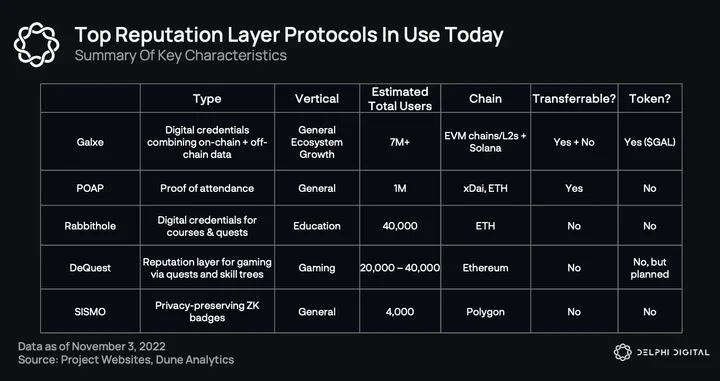
As a quick overview, a handful of “live” reputation-layer protocols have already reached a substantial number of users: Galxe, POAP, RabbitHole, and DeQuest. We’ll dive into each of these to understand their growth metrics and use cases later.
What Is Reputational Identity?
Identity in Web3 can be approached in various ways, all of which can be combined to form the true picture of an individual. I like to think of the analogy of a group of blind men and an elephant — everyone tries to imagine what the elephant is like when they touch it, but their version is different from the others. The elephant only emerges when all the information is put together. Some of these pieces of information include:
-
On-chain transaction history
-
Asset ownership
-
Biometric verification (bringing off-chain identity on-chain)
-
Web3 social graphs
We focus on reputational identity, which relies on track records and accomplishments to represent identity. Imagine a Web3 LinkedIn-type resume. This typically involves NFTs and soulbound tokens (SBTs, essentially non-transferrable NFTs). We believe these are worth looking at because several reputation-based protocols have taken off this year, some with over 1,000,000 users.
Verifiable Credentials Are Fundamental to Reputational Identity
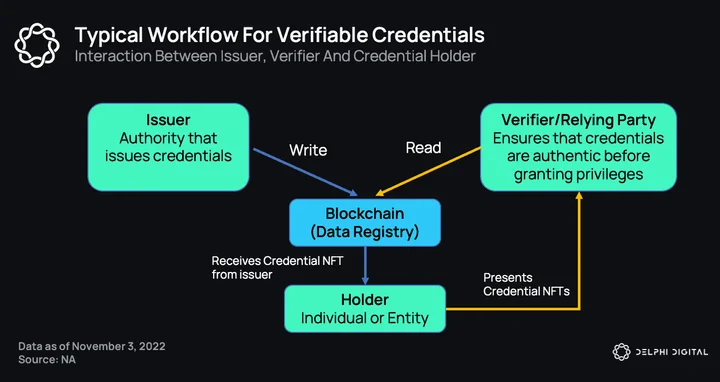
Reputational identity relies on verifiable credentials (VCs), a W3C standard that enables credentials to be digital and interoperable. In the physical world, using credentials for identification has existed for a long time — think driver’s licenses, vaccine certificates, and diplomas.
Verifiable credentials are tamper-proof credentials that can be verified cryptographically on the blockchain while representing all the same information as a physical credential. VCs are doing for physical credentials what crypto has done for cash. There are three parties involved in verifiable credentials:
-
Issuers. These create and transfer VCs to holders. VCs can be issued to represent milestones, accomplishments, and significant activities. Many of the projects we will get into function as issuers.
-
Holders. Holders possess VCs in their wallets and present them to others. They can be an individual like you and me or an entity.
-
Verifiers/relying parties. These receive the presented VCs from holders and rely on the credentials to grant access or process transactions.
In the process, all three parties interact with the blockchain, which functions as an immutable, verifiable data registry where all the information is stored.
Non-Transferability
It is our view that non-transferability is a critical component of reputation. Imagine if you could transfer your university degree to someone else —
Read the full report
This report is part of Delphi Pro.
- 800+ Pro reports across every major sector
- Talk directly with our analysts
- Private community of funds and builders
Already a Pro member? Log in
0 Comments