
This is an excerpt from “Markets Will Save the World”
We talked about the why; now it’s time to talk about the what. MetaDAO’s initial implementation of futarchy is elegant in its simplicity. Every major decision the DAO faces — like whether to build a new product or burn 99% of the treasury — is subject to a market. The market asks traders to consider one thing and one thing only: “Will this decision make the token price go up or down?” If traders think a decision will increase the price of MetaDAO’s governance token, they bid pass. And if they think it will make the token go down, they bid fail.

One of MetaDAO’s most recent proposals sparked record volume and is a good case study. It was titled “Should we release Futard.io?” and the idea behind it actually came from Anatoly, who suggested that memecoins should use futarchy.

The MetaDAO team heeded Toly’s advice and submitted a proposal to the market asking whether they should build Futard.io — a pump.fun fork that would let memecoins use futarchy to make decisions. Traders had two options — pass or fail — depending on whether they thought the new product would be bullish or bearish for the price of META, MetaDAO’s governance token.
Let’s walk thru how to trade this proposal. First, we need to navigate to the MetaDAO website. Once there, we will see three important prices. Note: these are examples.
- spot META: $1,000
- pass META: $1,100
- fail META: $900
The spot price is the actual spot price, meaning it’s the price of META you would see on Jupiter or Orca. The pass and fail prices refer to conditional tokens. This is MetaDAO’s primary innovation. Conditional tokens let you create two temporary markets during a vote: one contingent on a proposal passing and the other on it failing.
In our example, the pass market is winning.
- spot META: $1,000
- pass META: $1,100
- fail META: $900
The Futard.io proposal would pass as long as the prices hold. But let’s say we really want this proposal to pass because we think it would be yugely bullish for our META bags. In this case, we have two options to express an “I want this proposal to pass” view. We can either:
- buy pass META (pMETA)
- sell fail META (fMETA)
To buy pMETA we need to deposit spot USDC into the MetaDAO vault and mint conditional USDC. We can then use this conditional USDC to buy pMETA. If we bought pMETA at $1,100, we would express the following view: “I think META will be worth at least $1,100 if the proposal passes.” Another way to phrase this is: “I think the Futard.io proposal is worth at least $100 to the price of META.” Either way, our action implies we think the proposal will make numba go up.
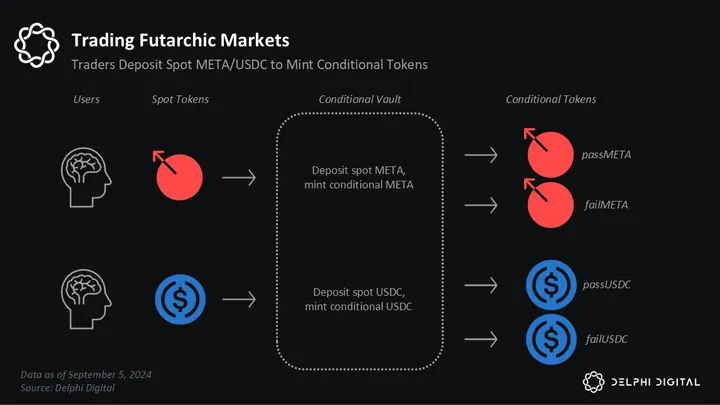
An alternative way to express this view is to sell fMETA. This would signal the same thing as buying pMETA. To sell fMETA, we first need to acquire some. We can do this by depositing spot META into the MetaDAO vault and minting conditional META tokens. Then we could sell our fMETA, which would express the view: “I think META will be worth $900 if this proposal fails.”
Think of coin futarchy as a kind of voting-through-action: “I am willing to increase my degree of membership in this community if X happens”
— vitalik.eth (@VitalikButerin) November 18, 2016
You might be wondering why there are three prices — spot META, pMETA, and fMETA. It’s confusing, I know. MetaDAO doesn’t have a Polymarket-style two-sided pool because the markets need to weigh the cost of not doing something. At a very basic level, every MetaDAO proposal considers the impact of doing a thing vs not doing a thing. With the Futard.io proposal, traders weighed the impact of building a new product vs the impact of not building it.
If there were only two prices — say, META and pMETA — there would be no way to measure the impact of not doing the thing in question. As a result, the pMETA and spot META prices would naturally converge over time as both price in the value of doing the thing — in this case, building Futard.io. So, the presence of a third price — fail META — ensures a spread between spot and pass META, which is necessary to determine whether or not to actually do the thing.
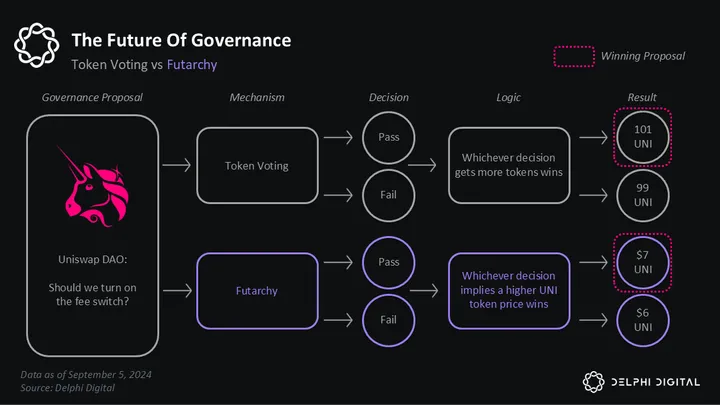
The Futard.io proposal traded for three days, as is standard, and ultimately failed. During this period, a time-weighted average price (TWAP) was used to determine the price of each market (pass and fail). For a proposal to pass, the pMETA TWAP must end at least 3% higher than the fMETA TWAP.
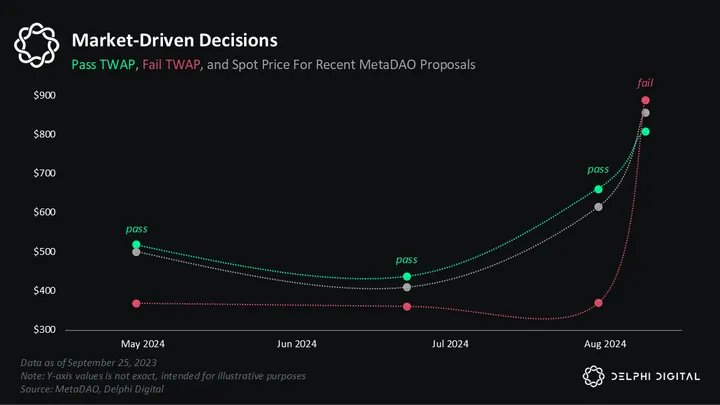
MetaDAO uses TWAPs to calculate prices to mitigate certain types of attacks. However, this approach introduces other issues. For instance, the TWAP values the first day of trading the same as the last. This is problematic because most people only pay attention toward the end of a proposal. In a perfect world, we would want to overweight the prices during active periods and underweight the prices during inactive periods.
The current mechanism is somewhat naive. A dumb but probably effective way to exploit the lazy TWAP is to trade heavily in the early hours of a proposal when no one is paying attention. You could lock in favorable prices and make it difficult to alter the outcome later in the trading period becomes hard.
We can see this “most people trade late” dynamic in the price volatility. The green and red lines are smooth at the beginning of the Futard.io proposal below, indicating little activity. But then the lines start to squiggle towards the end as people start trading. The only problem is in the eyes of the TWAP, the prices at the start count the same as those at the end.

A common question with MetaDAO is — can I make or lose money trading these proposals? Yes, you can. In this sense, trading decision markets is no different than trading on Coinbase. In both cases, you make money by trading at good prices (buying low and selling high) and lose money by trading at bad prices (buying high and selling low).
The only caveat with decision markets is your P&L only materializes on the market that wins. If a proposal passes, only your P&L from the pass market carries forward, and the reverse applies if the proposal fails. In either scenario, any losses in a settled market are as real as those in spot trading.