
TLDR
MNT trades like the buyback-and-burn is never coming. At ~$1.7B it carries none of the scarcity premium the market pays BNB and OKB for and that gap only makes sense if you assume the one mechanism that earned them that premium simply won’t arrive for MNT. That’s the mispricing because the business is further along than the price implies.
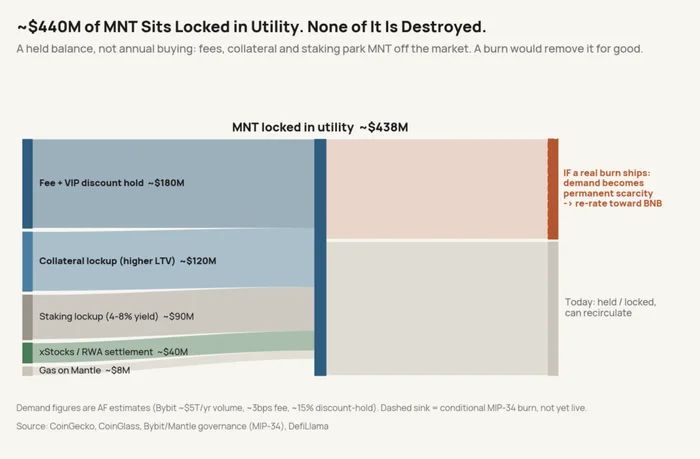
Here’s what you’re getting at this price. MNT already runs the same demand engine BNB does. Bybit pushes fee discounts, VIP tiers, and collateral through the token, and it now settles tokenized US stocks on-chain through xStocks, with Binance doing the same. I estimate around $400M of MNT is already locked up in all that, and none of it is being burned. On top of that, the DAO has already passed one burn-related proposal (MIP-34), and a treasury burn with real numbers attached is being discussed on the forum right now.
If the DAO ships a real, revenue-funded burn the re-rate is aggressive. Not because the scarcity math is powerful as on its own it isn’t, but because it moves MNT from “fee token” to “exchange token that compounds,” and puts a recurring buyer underneath a token that today only has soft, releasable locks. You’re paid to wait for a catalyst the market has priced at roughly zero.
Where We Are Today
BNB and MNT are fed by the same kind of demand: a top-tier exchange pushing fees, gas, settlement and collateral through the token. Only BNB permanently destroys supply on the other end. That difference is most of the valuation gap and imo closing it is the cleanest catalyst MNT has.
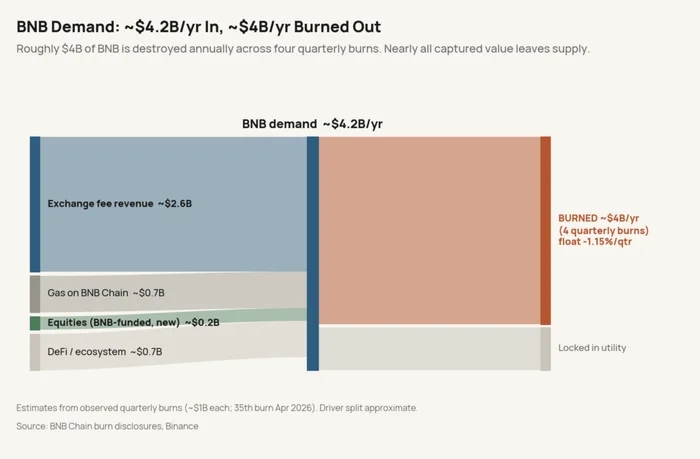
BNB is fed by several demand streams: exchange fee revenue, gas on BNB Chain and DeFi activity, and Binance just added a fourth. It launched trading in over 7,000 US stocks and ETFs, fundable directly in BNB, and previewed bStocks, a product that will let users mint tokenized versions of those equities natively on BNB Chain in the coming weeks.
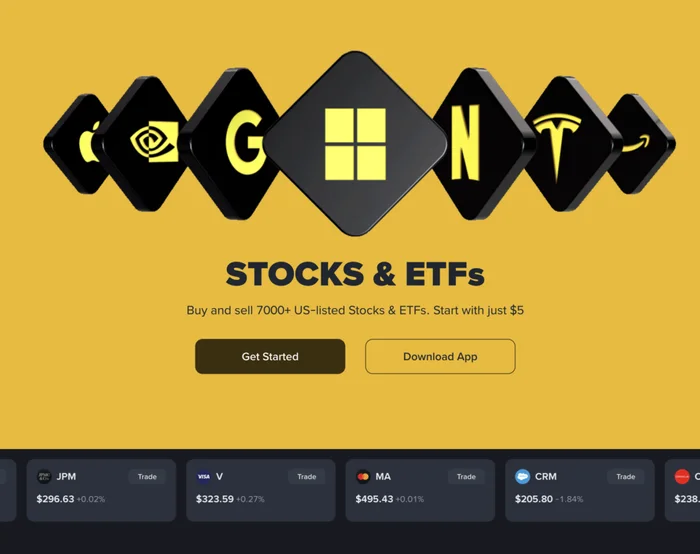
Every share funded in BNB and eventually every tokenized equity minted, traded and settled on BNB Chain, routes a slice of a multi-trillion-dollar asset class through the token as funding currency as gas / settlement rail. It is a new and structurally large demand stream stacked on top of the existing 3 and it is the same bet Bybit is making with xStocks.
The pattern is clear that these exchanges are turning their chains into the settlement layer for tokenized equities and their tokens collect the toll.
But demand alone is not what re-rated BNB. The decisive step is the sink – an automated quarterly Auto-Burn that sends BNB to a dead address. The last four 2026 burns run around $1B each with the 35th in April destroying ~1.57M BNB, so roughly $4B of value leaves supply every year, shrinking float ~1.15% per quarter toward a 100M target.
New demand flows in -> supply goes down and the market pays a premium for that combination.
MNT Pulls the Same Demand, but Holds Instead of Burns
The demand side already exists and it is not trivial compared to Binance.
Holding MNT cuts Bybit trading fees (25% spot, 10% derivatives) and lifts VIP tier, forcing active traders to hold the token. It can be posted as collateral at higher loan-to-value, an institution that could margin only 10% of a large MNT balance can now post 60%. Staking locks more at 4-8% yield. The same equity-settlement leg BNB just lit up is already live on Bybit via xStocks with 60+ tokenized US stocks settling on-chain.
Against Bybit’s roughly $5T of annual volume and the mechanics above, I estimate MNT has on the order of $400M locked in structural utility, held for fee discounts, posted as collateral and staked for yield. A burn would convert demand that merely parks supply into demand that permanently removes it.
Is the Burn Actually Coming?
Straight answer – not yet, but the path is real and active.
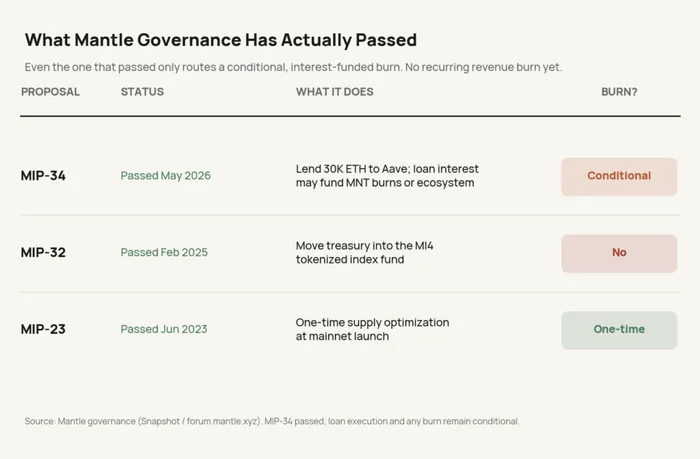
No recurring, revenue-funded burn has been approved, and Mantle’s published tokenomics still frame treasury MNT as something to deploy, not destroy. But this is well past “hinted at.” 2 things are already moving.
- MIP-34 passed in May 2026. It’s a credit facility lending up to 30K ETH to Aave after the rsETH exploit, and the proposal routes the loan’s interest toward MNT burns or ecosystem funding. Read the fine print though: it’s a loan whose interest might fund burns, the loan still has to execute on final terms with Aave, and “burns or ecosystem funding” isn’t even a commitment to burn. It’s burn-adjacent, not the engine.
- There’s a separate pre-MIP proposal live on the Mantle forum, a Phase-Based Treasury Burn of 3-8% of supply over 12-24 months, DAO-governed, drawing only on unallocated treasury MNT. That one’s a real burn, but it’s a one-time trim from the treasury, and it’s still at the discussion stage, not a passed vote.
So between the 2 neither is a recurring buyback-and-burn funded by exchange revenue. That mechanism still isn’t on the table as a formal proposal. The appetite is clearly there (Bybit is the largest MNT holder & votes its stake + Ben Zhou backed MIP-34 publicly), what’s still missing is the standing, revenue-funded engine that perhaps is delayed due to regulatory concerns – more on that later.
Why The Burn Isn’t On Yet
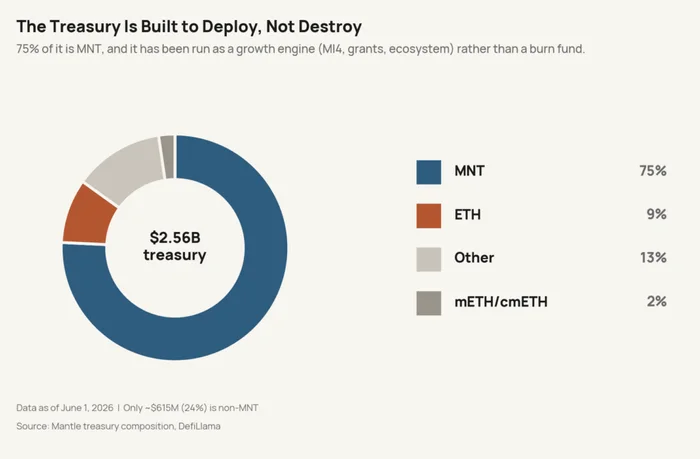
Here’s the thing that makes the discount strange. There’s no technical reason MNT can’t run BNB’s exact model.
Bybit actively generates real exchange revenue + Mantle generates its own protocol revenue; either could fund a recurring buyback-and-burn every quarter, the same loop that re-rated BNB and OKB. The switch exists but Mantle hasn’t flipped it (yet).
What’s flipped instead is a smaller adjacent lever.
The live governance proposal is a one-time treasury burn to destroy 3-8% of supply from idle treasury MNT over the next 1-2 years. That’s real and it helps, but it’s only a small order of effect as it fires once and it’s done.
The recurring, revenue-funded version is the one that actually matters and by every account it’s the single largest catalyst on MNT’s roadmap. It’s also the one that hasn’t been approved. Note that the treasury can’t be its funding source (a reserve that’s three-quarters MNT can’t sustainably sell MNT to buy MNT) but it was never meant to be. Revenue funds it, the same way Binance’s earnings fund BNB’s burn.
If The Treasury Burn Starts, How Much Could It Move MNT?
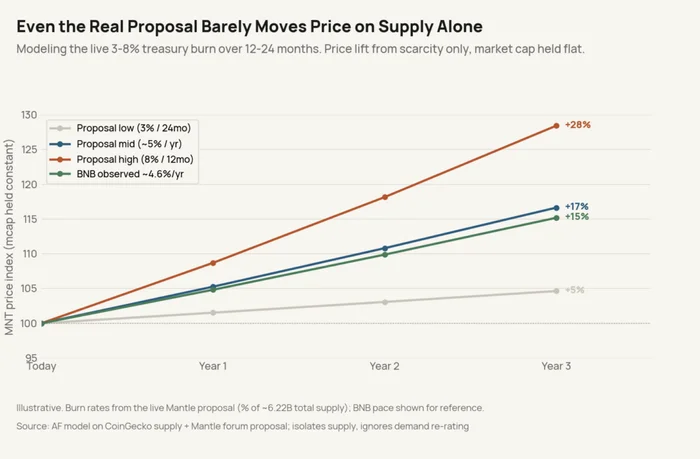
The mechanical effect of even the real proposal is modest.
Take the live 3-8% treasury burn and strip it down to pure scarcity with market cap held flat and the price lift runs from about 5% over 3 years at the low end (3% over 24 months) to 28% at the aggressive end (8% in a single year), with the middle of the range landing near 17%, roughly where BNB’s own burn pace sits. Even the proposal’s ceiling doesn’t 3x the token on supply alone.
The point i’m making is that the bigger levers for MNT aren’t in that chart.
A revenue-funded burn does 2 things the supply math misses.
- It puts a new recurring buyer in the market that wasn’t there before.If Bybit and Mantle routed even a few hundred million a year of revenue into buying MNT to burn, that’s a persistent bid worth a meaningful chunk of a $1.7B cap, every year regardless of sentiment. For scale, $200M a year of buybacks is about 12% of the current cap in annual buy pressure. That’s separate from the $400M already locked in utility. One is users holding MNT to use it; the other is the protocol spending its own earnings to shrink supply.
- It re-rates the multiple.A live, recurring burn is the signal that moves MNT out of the “fee token” bucket and into the “exchange token that compounds scarcity” bucket where BNB and OKB trade. That re-rating and not the burn arithmetic is where the real upside sits.
The Price Round Tripped… But The Business Didn’t?
MNT ran from a sub-~$1 base to $2.80 with a $8.8B market cap at the October 2025 peak and then rolled over~80% to about $1.7B. Circulating supply barely moved, ~3.3B throughout so the entire move was price and not dilution.
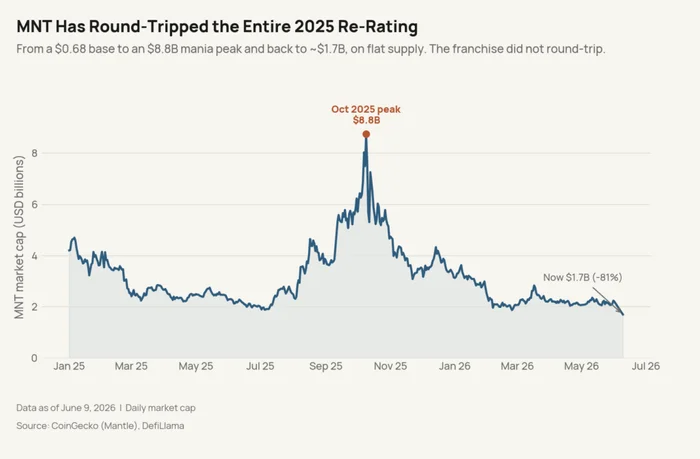
It is worth being precise about what drove that spike because it was not all just speculation
October 2025 run rode a cluster of real catalysts:
- Mantle launched its RWA tokenization platform at Token2049
- USD1 stablecoin brought a large slug of liquidity onto the chain
- Same period brought a Mastercard integration, the UR banking app + deepening Bybit relationship, all into a broad Layer-2 and RWA rotation
Fundamentals genuinely improved, but what overshot was the price. A +250% vertical move to a near-$9B cap, amplified by a jump in futures open interest ran well ahead of what those catalysts justified. When the leverage flushed and the rotation cooled the speculative premium unwound which saw a -80% loss in marketcap that followed after October 10th.
However none of the above developments went away when the price did.
The RWA platform, the Bybit fee and collateral utility, the treasury, the xStocks settlement are all still here and the equity leg is actively being pushed right now. So you’re technically getting the same business that was worth $8.8B a few months ago for $1.7B minus the hype that was never the reason to own it anyway.
Real Activity on MNT but Still Shaky
There’s still real activity on Mantle it’s just not as smooth.
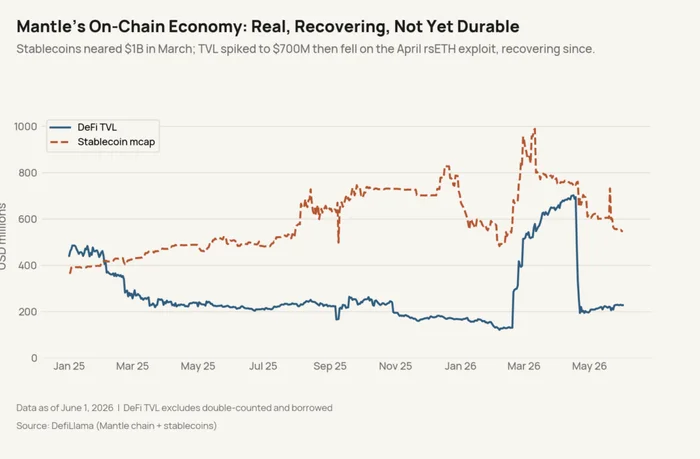
DeFi TVL on Mantle ran from about $130M in mid-February to nearly $700M by mid-April. That ramp wasn’t organic drift as it was Aave V3 launching on Mantle on February 11 with a 6 month treasury-funded incentive program. It pulled in over $290M in 12 days and the Mantle-Aave market crossed $1B in total size in under 3 weeks.
Worth being honest that a good chunk of that was mercenary. Low fees and thin volume meant that a lot of the capital was farming the incentives vs transacting organically.
Then it reversed fast… TVL fell about $360M over 2 days in mid-April.That drop wasn’t Mantle breaking, but rather an attacker exploited KelpDAO’s cross-chain bridge, minted $292M of unbacked rsETH and borrowed against it on Aave making it the biggest DeFi hack of the year. Aave’s own code held but to contain the damage it froze rsETH and WETH markets across several chains including Mantle and the liquidity sitting in those markets drained out. So the same Aave that built Mantle’s TVL is what bled it back out when the freeze hit.
Aave turned WETH borrowing back on May 18 and TVL has climbed back since, sitting near $228M on the strict measure (you’ll see higher numbers elsewhere that count borrowed and double-counted positions). The takeaway holds – real usage, recovering, just not yet the steady compounding you’d want before calling it durable. Stablecoins tell a similar story, near $1B in March before settling into the mid-$500Ms.
Why Should We Pay Attention to Mantle?
MNT already has BNB’s demand side. An estimated $400M of MNT is locked in exchange utility today, fees, collateral, staking, with tokenized-equity settlement now being built on top.
What it doesn’t have is the supply sink that permanently removes float. That gap is the entire discount and unlike most catalysts it’s binary and observable – either the DAO turns on a real, revenue-funded burn or it doesn’t. The supply math alone is modest.
The real prize is the re-rating it triggers off a deeply discounted base, moving MNT out of the “fee token” bucket and into the “exchange token that compounds” bucket where BNB and OKB trade.
Right now MNT is sitting back at its range lows at the same band it’s bounced from since late 2023.
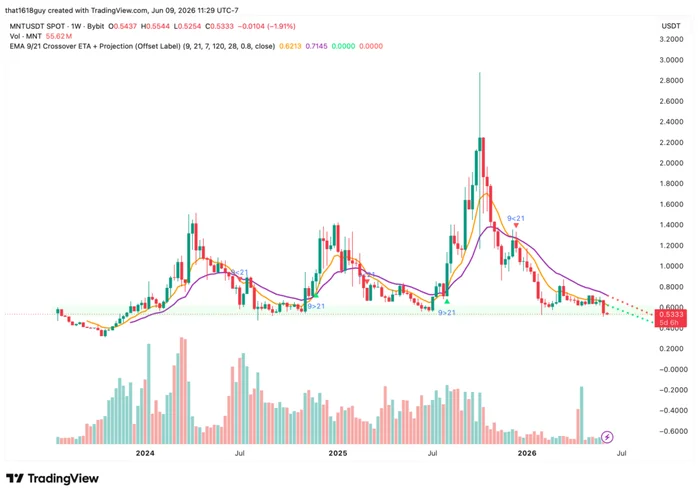
This is a catalyst trade not something you buy and forget. Buying MNT here is basically a bet that Bybit and the DAO eventually get in a room and turn on a real buy-and-burn.
The market’s pricing that as if it’ll never happen but there’s no real reason it can’t. None of the pieces are missing except the decision itself. You’re buying at range lows while the market prices that decision as near 0.
So Why Hasn’t It Happened?
The fair question is why they haven’t done it already. Imo the answer is probably a matter of sequencing and not inability – something that I will be exploring in more detail in a follow up Alpha Feed on MNT.
From a high level perspective:
Mantle spent the last year building the demand side first – collateral, fee discounts, RWA, on the logic that a burn only matters once there’s utility behind the token. The treasury has also been run as a growth engine, funding the MI4 fund, grants and ecosystem deals, and culturally that “deploy it” instinct competes with “burn it.”
On top of that, both Bybit and Mantle are courting institutions and leaning regulatory-friendly and a revenue-funded burn that exists to push a token price is exactly the kind of thing that invites scrutiny (there are still many calling BNB’s token a conflict of interest to Binance’s CEX model as there are some conflicts of interest). So the delay is rational.
But none of it is a permanent blocker and it’s a choice they can reverse which is the whole point.
There is also the regulatory piece in particular which may resolve on its own. The CLARITY Act (the market-structure bill that cleared the Senate Banking Committee in May) is working its way toward a full vote and if it lands it gives exchange-linked tokens the kind of clear rules that make a buyback-and-burn far easier to justify and turn on.
Closing Summary
Bottom line, you’re paid to wait here. Same franchise that carried an $8.8B tag, on sale at ~$1.7B, with the one catalyst that matters priced like it’ll never come. I don’t think that holds. When the burn flips on, this re-rates hard, and I’d rather be early than chase it.