
The Revenue Headline With Receipts
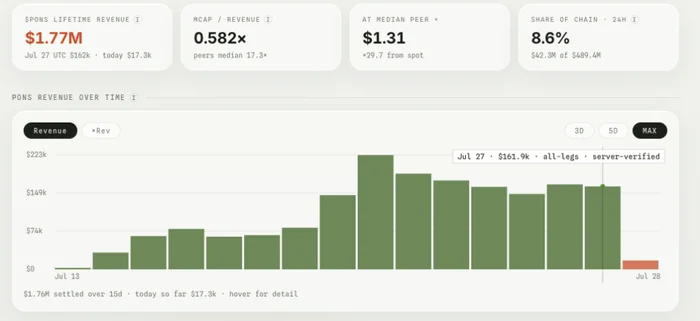
Traders paid $11.5M in fees through PONS in its first 14 days (July 13–26). That splits roughly 69/31: about $8.0M to token creators, $3.56M to the protocol, with about half of each paid out in the launched tokens themselves rather than ETH.
Run rate rn is $170-180k/day in ETH terms (~$1.8M total since launch). Annualize that and you get ~$64M/yr against a $40M market cap. The protocol earns its entire mcap back in about 7 months at current pace. Granted, this protocol is only 2 weeks in so these annualized numbers should be taken with skepticism until proven durable. Keep that number in mind for the valuation section later.
The Burn Mechanics
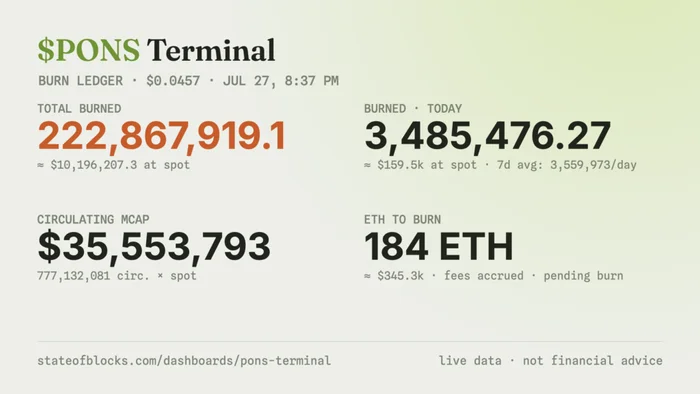
Every trade on Pons pays a 1% fee and the protocol’s cut gets used to buy PONS and send it to the dead address. Currently a manual activated TWAP all on-chain. An Automatic TWAP option is currently in the works according to PONS founder.
The flow math: $10,000 of volume generates $100 in fees, the protocol keeps ~$30 (70/30 split on the current factory, blended ~29% with the older 90/10 one), and 80% of that is earmarked for the buyback. So roughly 24 cents of every fee dollar becomes PONS buy pressure and about 69 cents pays the person who launched the token.
Total burned to date: 222,867,919 PONS tokens worth ~$10.2M at today’s prices against a fixed one-billion supply where everything not burned is circulating.
Why This Isn’t Pump.fun With A Robinhood Skin
The burn setup probably sounds familiar – fee funded buyback on a launchpad token is literally PUMP’s playbook. So is PONS just Pump.fun on Robinhood Chain?
Structurally the comparison falls apart in 2 places.
1. Pons has no migration event which removes the exploited moment in launchpad design.
Pump.fun puts tokens on a bonding curve and migrates them to a DEX at a threshold – snipe it, front-run the pool creation, dump into fresh liquidity. On Pons the Uniswap V3 pool exists from block one where the LP is locked at creation so there’s no unlock to snipe.
Fee-wise, Pump.fun charges 1.25% on the curve and keeps charging 1.25% after graduation as well. The rate only steps down toward ~0.30% as a coin’s mcap grows, so small caps pay the most. Pons charges one flat 1% across the whole lifecycle. Less extractive per dead token; whether that’s better depends on your view of churn.
2. PONS has no unlock calendar to trade against.
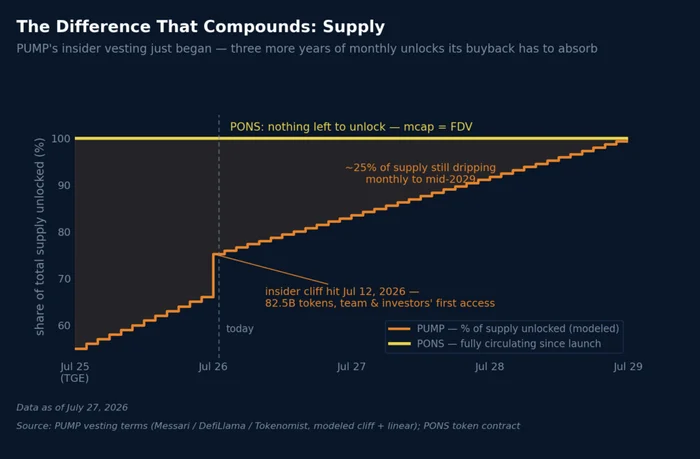
PONS launched on its own launchpad which means no VC allocation, no team allocation, no vesting – anyone who wanted tokens (team included) bought via the open market.
But the more impactful fact is that its market cap and FDV are the same number. PUMP is the reverse image: 20% to the team, 13% to investors, both behind a 12-month cliff and that cliff hit 2 weeks ago. July 12 was insiders’ first access which was a 82.5B-token unlock and it kicks off around~6.9B tokens dripping out every month until mid-2029.
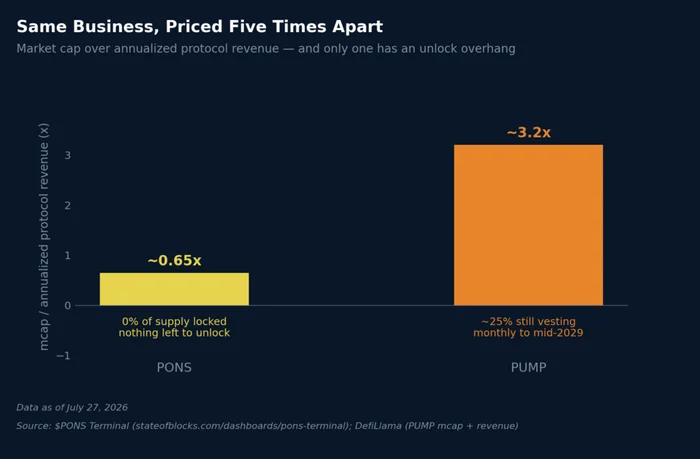
If we run the same math on both (mcap / annualized protocol revenue): PUMP sits around 3.2x while PONS is at ~0.65x.
Per dollar of mcap PONS is generating ~5x the revenue, and that’s counting only the ETH leg of Pons fees. If we add the token leg and the gap is closer to 7x. Plus the 3 years of unlocks PUMP’s buyback has to fight through don’t exist here.
The Actual Trade… PONS As The Robinhood Chain Proxy?
There’s no clean way to get exposure to Robinhood Chain itself as RH has no chain token. Meanwhile the chain is quietly going vertical: $770M total value secured, $483M in stablecoins (both charts basically straight up since June, per growthepie) and the whole thing pays about $665/day in rent to Ethereum.
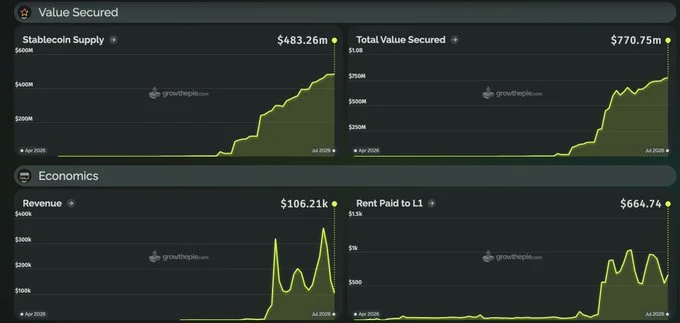
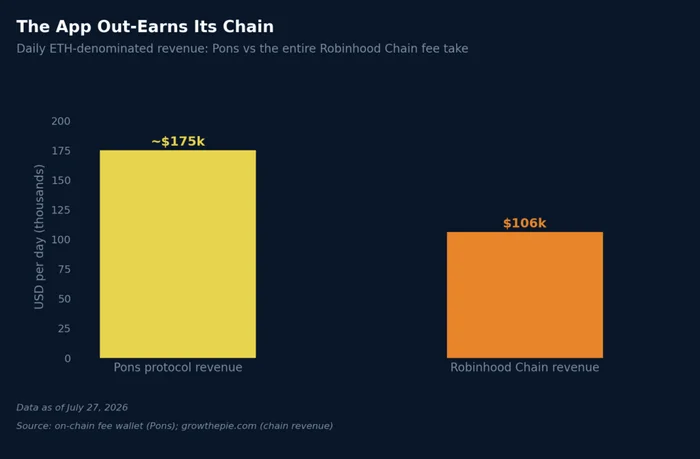
Funny enough this is the stat I keep coming back to – growthepie has Robinhood Chain’s own revenue at ~$106k/day.
PONS alone earns more per day than the chain it lives on.
And PONS is already ~13-15% of all DEX volume on the chain. If you believe Robinhood keeps onboarding normies into an L2 with a native casino, PONS is the most direct way to express that trade rn.
Remember the 7 month payback from earlier? Here’s what that looks like against the rest of the sector.
Using my dashboard’s own peer set: PONS trades at ~0.62x annualized revenue. Every other name on the board (pump.fun included) trades at least ~5x more expensive and the median sits around 18x. One of two things is true – either PONS revenue is unsustainable and will collapse or PONS is underpriced.
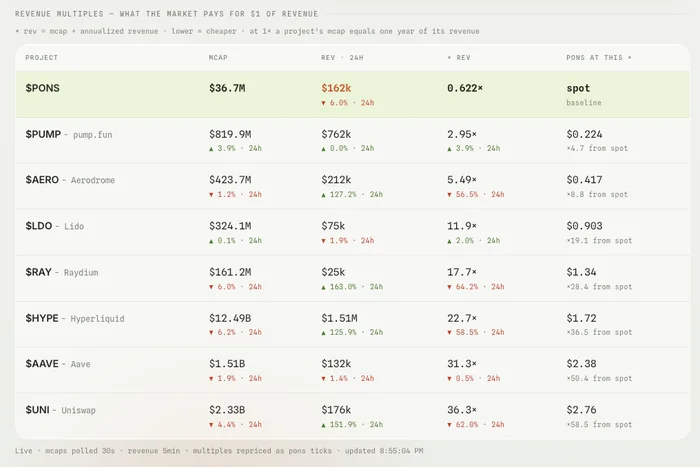
The last column is the one to look at regarding comps against other high revenue earning peers. Granted, these other protocols are much further along in its lifecycle so this table should be used for illustrative purposes only. It’s what PONS would trade at if the market gave it each peer’s multiple IF PONS can stay relevant and have its numbers persist.
Even at pump.fun’s 2.95x rev which is currently the most relevant comp on the board, that’s still a PONS priced at $0.22 vs where price is currently at $0.045 spot.
What Are The Risks Involved?
Time, volume and trust. Or one word… Persistence.
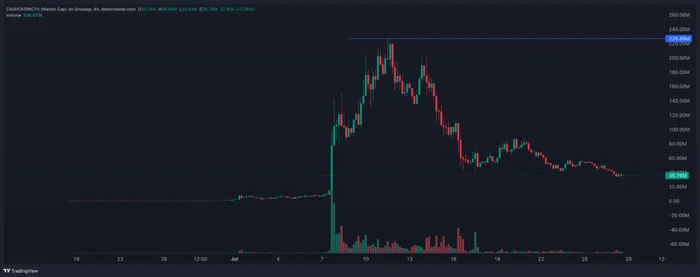
Two weeks of data is a small sample to annualize for a project this new and whether this amount of attention / hype can persist on Robinhood chain is the biggest question. This is memecoin churn on a chain that’s a few months old – CASHCAT went from $227M to $35M in 2 weeks on this same chain, so whatever produced the $170k days can un-produce them just as fast.
The buyback itself is a policy not a contract. The TWAP is manually activated and the docs are explicit that the amount is not immutable yet. To be fair the team has been consistent – buybacks have run like clockwork since launch – but until it’s automated and locked in, some team discretion is part of what you’re pricing.
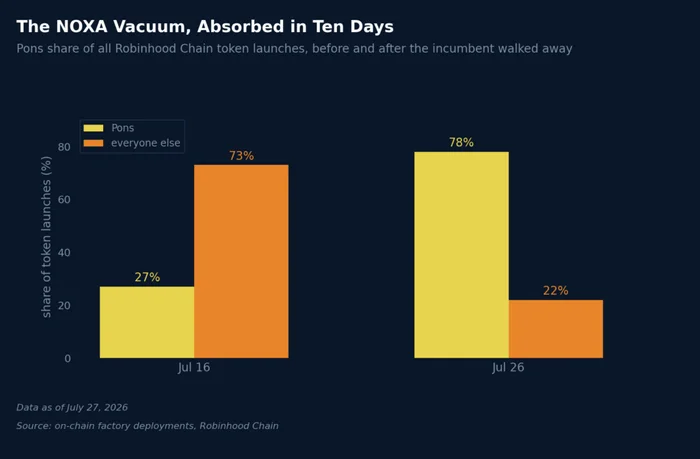
And launchpads have no moat on this chain (yet). NOXA ran 3/4 of all launches and out-earned pump.fun for 5 straight days, then went to a dark website in 4 days when the team walked.
PONS got its 78% by inheriting that vacuum, but so far it’s doing exactly what NOXA didn’t – the team is visibly active, listening to the community and shipping fast with V2 improvements to the current model already on the way. Dominance here belongs to whoever keeps showing up and right now that’s them.
Robinhood Chain loses relevance over time, hype fades and attention moves elsewhere. We have all seen the typical new L1/L2 launch hype. Volume goes vertical for a few weeks and then slowly bleed out as users compete to out farm each other and eventually there is no fresh liquidity entering the ecosystem. Or another new chain launches that vamps the attention from this one. Many examples here, think Sonic / Monad / Bera etc. the list goes on.
Still imo these risks are the price of admission for something this early.
What keeps me interested is if Robinhood Chain keeps attracting capital and attention, PONS captures most of it as the dominant launchpad on the chain.
And at current run rate the protocol earns back its entire market cap in about… 7 months. If that sustains, well then that’s the whole trade.
Disclosure: I hold PONS and built the $PONS Terminal dashboard referenced in this piece. All figures are independently verifiable on-chain. Not financial advice.
For more data on the protocol I built this dashboard that you can use to track PONS burn rate, TWAP monitor, comps, screener etc.