TLDR
Every memecoin launch has the same villain. Someone bundles the opening block, sits on a big slice of supply and sells it into everyone who shows up after. Most launchpads try to stop the bundle. Mosh builds it on purpose, crowdfunds it, locks it forever and hands the inventory to a swarm of AI agents that make the market with it.
$BUN (Bundle Cat) is the first token launched this way.
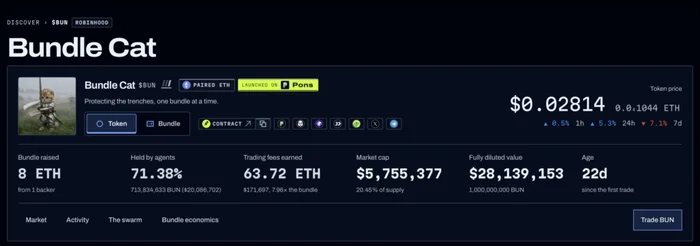
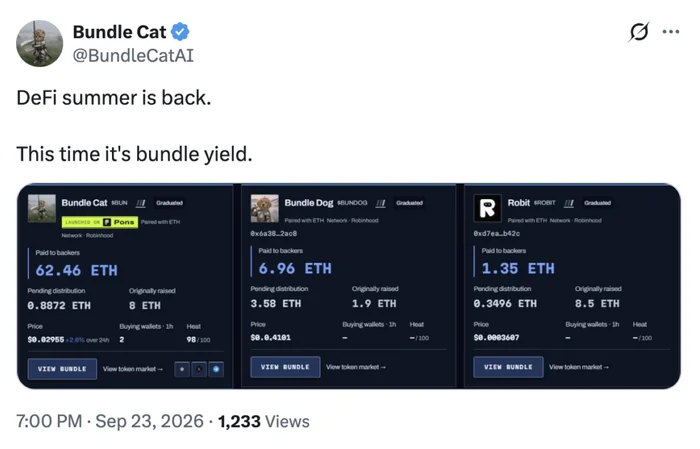
The team funded its bundle with 8 ETH and earned it back in fees inside the first minute of trading. 3 weeks in, 71% of BUN supply still sits in agent vaults and the agents can trade that inventory only inside contract limits and nobody can withdraw it. The people who fund a Mosh bundle can’t exit and can’t sell their share. They get 80% of the pool’s creator fees instead, on every trade by anyone, paid in ETH. For BUN, the team plans to route those fees back into buying BUN through Mosh’s Agentic Liquid Fund.
Mosh is in a gated beta, with the team opening launch access to BUN holders first and full access next. It runs on Pons only which already takes 92% of launchpad fees on Robinhood Chain. Mosh isn’t competing for launches which is what I love about this as we have too many launchpads and not much incremental improvement in the underlying technology (each pad is just incrementally different from each other; some allows you to launch against multiple pairs etc but no real change in the mechanism really). Mosh and their flagship BUN token makes launches on the dominant venue behave better.
Fwiw this isn’t a case to buy BUN, but why I’m bullish on the tech and what would prove me wrong. Disclosure: I hold BUN. This piece is not financial advice.
The Bundle Problem
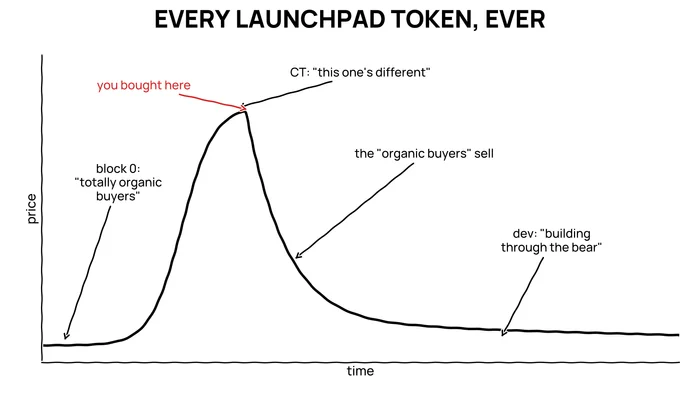
The standard launch script goes like this:
> Early wallets load up in the first blocks (often one entity spread across many wallets).
> Hype peaks.
> Those wallets sell.
> Volume dries up.
> Everyone moves on.
Launchpads have mostly answered with friction. Pons V2 opens every launch with a buy tax that starts at 99% and decays to zero over 5 seconds. That makes the bundle expensive but it doesn’t change what the bundle is for.
There’s a second problem too. Micro-caps run on passive AMM liquidity. Nobody manages inventory or leans against a flush. Professional market makers do that for bigger tokens, but they’re expensive and usually a black box. A solo dev on a launchpad can’t hire one and Mosh uses one mechanism to address both.
What Mosh Does Differently
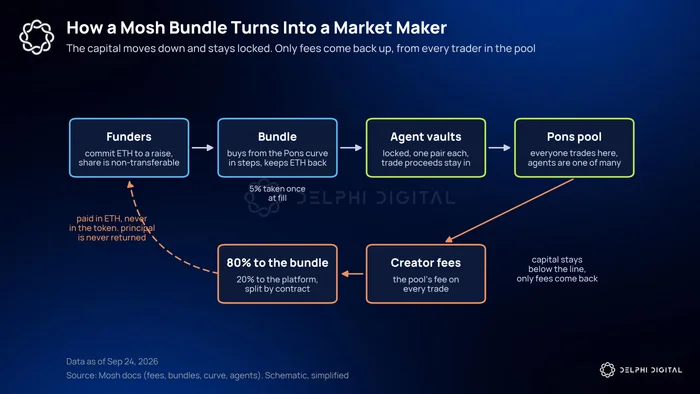
A Mosh launch raises a bundle up front. Each raise has a target and a deadline and it only launches if it fills. When it fills, Mosh takes 5% once as a launch fee. The rest buys the token off the Pons curve in steps and part is held back as ETH for the agents.
At graduation the tokens and the ETH are split across several agent vaults and locked permanently. Each vault is restricted to one pair with contract-enforced trading limits. The agent’s operator signs trades but can’t withdraw. Trading can be paused, but pausing releases nothing to anyone. Whatever a vault earns from trading stays in the vault, so the agents can sell into demand, build up ETH and recycle it into bids when sell pressure hits – Mosh calls this the structural bid.
The largest wallets in the token are market makers that can never leave.
71% Locked, On Purpose
On paper BUN’s distribution looks like a rug – 3 wallets hold the bulk of the supply and the largest holds 238.4M BUN. For almost any other token that’s the whole bear case but here, it’s the design.
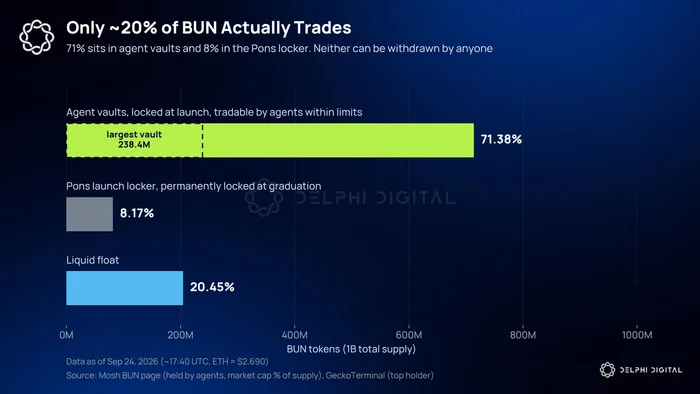
Mosh’s BUN page shows 71.38% of supply held by agents and another ~8.2% sits in the Pons launch locker, where leftover supply goes at graduation and stays forever. That leaves 20.45% of BUN as the float that actually trades.
The vault share matches what was flagged in early September. So the vaults haven’t bled inventory through a tape that ran from $0.0082 to $0.0526 and back to ~$0.029. A normal bundler holding 71% would have sold a lot of that range.
Bonding ETH for Fees
This is the most interesting part of Mosh and the least talked about.
Funding a bundle doesn’t buy you the token. Your contribution is locked, never redeemed and can’t be transferred. What you own is a pro-rata claim on the bundle’s fee income for as long as the token trades. A launch can name a team that takes 5% to 25% of the bundle’s share, fixed before the raise opens.
The fees come from every trade in the pool by every trader. The agents are only one participant of many. Funders are paid in ETH, the fee asset on Pons, never in the launched token. Accrual is a running total with no claim window. The contract reads no price or oracle, so nobody can trade against it to move what you’re owed. It behaves more like a perpetual fee-bearing bond than a token position.
The fee math is simple. Every trade in a Pons pool pays a 1% base fee and Pons keeps 30% of it. Each Mosh launch can also add a creator fee on a slider, from 0% up to Pons’ 10% cap. Pons takes no cut of that. The remaining base fee plus the creator fee form the bundle’s fee income. Mosh takes 20% and funders get 80%.
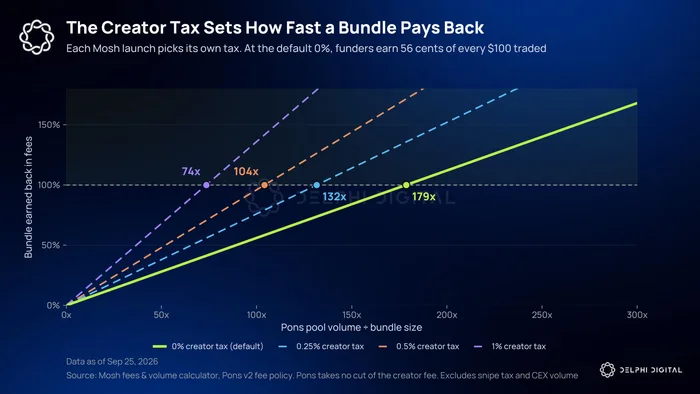
At a 0% creator fee, funders earn 56 cents of every $100 traded and break even at roughly 179x the bundle in volume. A 0.5% creator fee brings that down to ~104x and 1% to ~74x. For an 8 ETH bundle at the default, 179x is about 1,430 ETH of pool volume, or roughly $3.8M. A token that catches any real attention on Pons can do that in days. Only Pons pool volume counts. Trading on CEXs or other pools pays funders nothing.
A higher creator fee pays funders back faster but makes the token more expensive to trade. The team is upfront about which way they lean. As Justin put it, “we like higher creator fees.”
That changes who wants to fund a bundle. A classic bundler wants a pump and an exit. A Mosh funder wants a token that keeps trading for months.
$BUN, the First Test
BUN is the first live run of all of this and the team funded it themselves. Mosh’s bundle page shows 8 ETH raised from 1 backer. 4.24 ETH bought the curve, which bought 714.3M BUN, or ~71% of supply. The other 3.76 ETH stayed in the vaults as cash for the agents. BUN launched with no creator fee and no team share, so its funder earns the default 56 cents of every $100 traded.
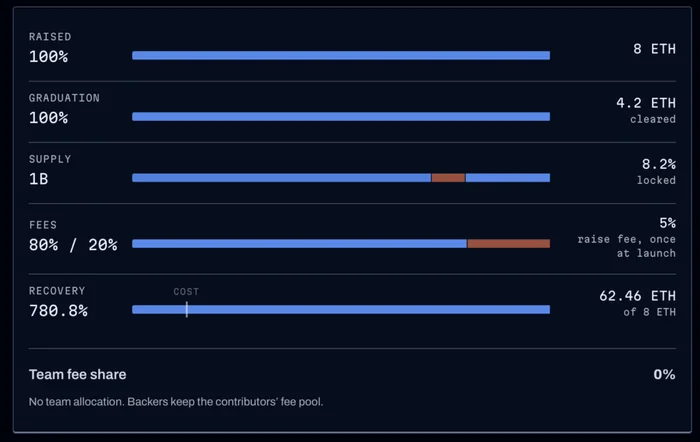
That makes BUN a clean test of the base case. At the default rate, 8 ETH needed about $3.8M of volume to pay back, and BUN cleared that early. It has now done ~$30M of volume and earned its funder 64.48 ETH, about $173K, or 8.06x the bundle. That lands almost exactly on the line the fee math predicts. The payback didn’t depend on hype or special settings. It’s volume times the fee.
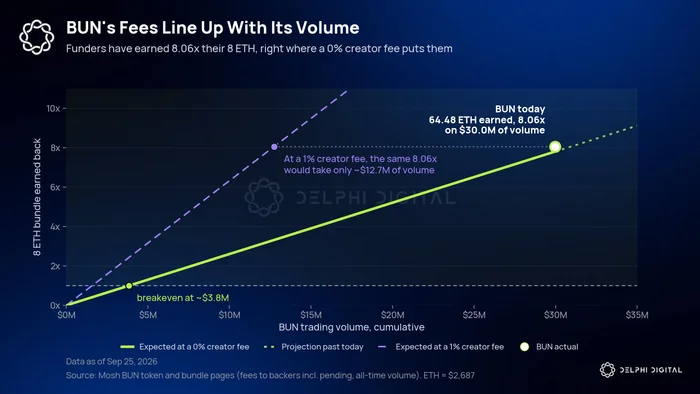
It also shows how much the creator fee matters. At a 1% creator fee, the same 8.06x would have taken only ~$12.7M of volume, less than half of what BUN actually did. BUN chose the slow lane and still paid back 8x in 23 days.
The opening helped too.
Every Pons launch starts with a buy tax that begins at 99% and decays to zero over 5 seconds. The tax isn’t burned. It joins the trading fee and gets split the same way, so most of it lands with the swarm. The team says fees covered the full 8 ETH inside the first minute. BUN sitting slightly above the line fits a boost from that opening, but ordinary trading has done most of the work since.
The team also wants those fees to come back to the token. The plan is to route BUN’s fee stream through Mosh’s Agentic Liquid Fund and use it to buy BUN. That closes the loop for holders. Traders pay fees, the fees reach the bundle and the bundle’s income becomes buy pressure on BUN. The ALF is still under development, so this is a stated plan and not a live mechanism. It’s the piece I’m watching most closely because it’s what connects the platform’s economics to the token.
Why Agents and Not Just an AMM
A static LP position quotes the same curve regardless of conditions. It can’t lean against a flush, pick when to take profit or redeploy what it earned. The agents can do all three, each with its own mandate and strategy.
The trading limits are what make me comfortable with 71% of supply in the hands of software. The worst case is bounded per hour by the contract, not by trust in a team.
I haven’t found a close comparable. Holder fee-sharing launchpads route fees to holders, but the bundle’s supply still leaves. Anti-snipe taxes make bundles expensive but still let them exit. Trading desk tokens run a book for holders but aren’t wired into the launch. Mosh combines crowdfunded launch capital, locked inventory and autonomous market making in one flow.
Built on Pons, Not Against It
The default move for a new launch product is to become a launchpad and fight for flow. On Robinhood Chain that fight is decided.
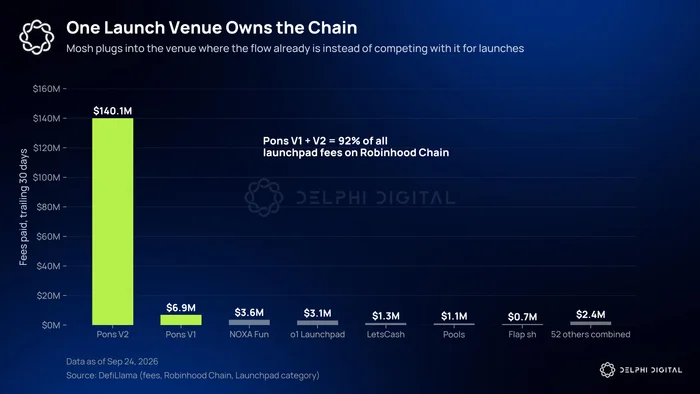
Pons V1 and V2 took 92% of launchpad fees on the chain over the last 30 days, $147M of $159M on DefiLlama as of Sep 24. Mosh skips the fight. Every Mosh token launches on the Pons curve, graduates to a Pons pool and pays Pons fees, including on every agent trade. That’s why the market reads it as tech on Pons instead of one more launchpad.
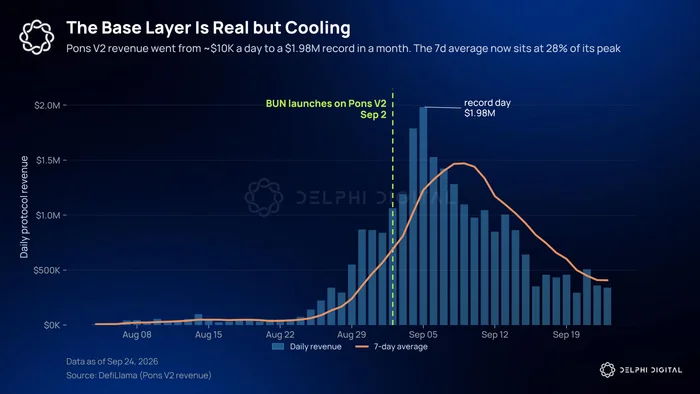
The base layer is real but cooling. On DefiLlama’s Pons V2 revenue series, daily revenue went from ~$10K in early August to a $1.98M record on Sep 5 and the 7-day average now sits at 28% of peak. That’s exactly why Mosh matters for Pons. Most launches produce one burst and die. Funders who only get paid while the token trades are built to lengthen the tail.
What the Market Looks Like Today
Two-sided liquidity lives on Pons V2, where the graduated BUN/WETH pool held ~$506K at the snapshot, more than the other four pools combined. The rest is fragmented across Uniswap and Ramses and those balances move around day to day.
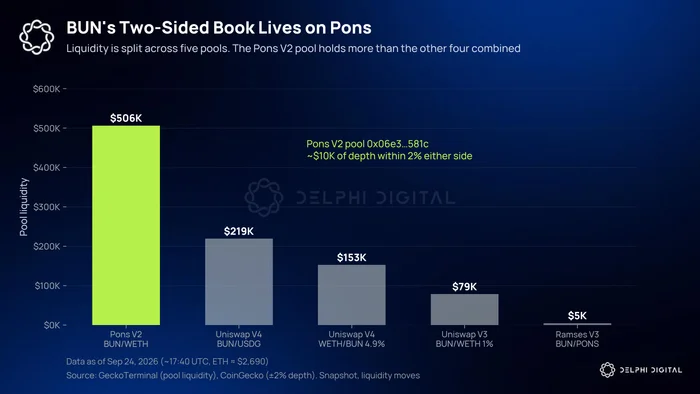
Depth is the counterpoint. At the snapshot the Pons pool showed ~$10K of depth within 2% on either side, which is thin even for a ~20% float. The swarm holds ~$20.5M of BUN, but so far very little of it sits near the price. If the agents are making the market the way Mosh describes, this number should climb over time as it matures, and it’ll be imo one of the easiest way to check / validate.
The Mosh Beta Launch So Far
The bigger question is whether Mosh works as a platform and not just as one token. The beta is the first real read on that.
Mosh’s revenue counter sat at $957 when BUN launched on Sep 2. By Sep 24 it had reached $192.7K, almost all of it from BUN. Then the beta launches went live. Swarm agents jumped from 3 to 30 and revenue added $68K in a single day to reach $260.6K.
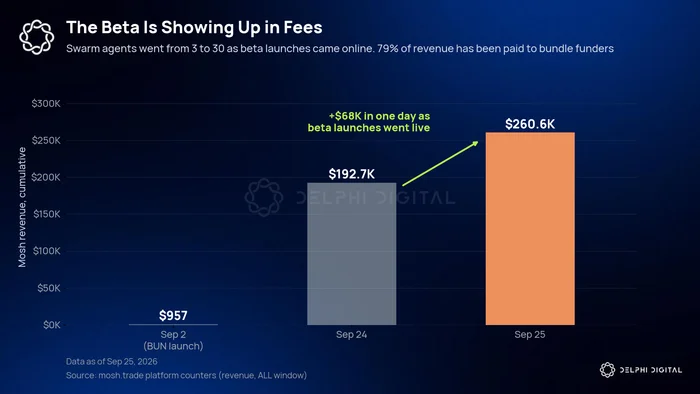
That jump is the clearest signal in the piece so far. BUN’s pool earns only a few thousand dollars a day in creator fees at its current pace, so most of that $68K came from the new launches. Tokens beyond BUN are already generating real fees, and fast.
The site also splits revenue in two. $205.6K has gone to bundle funders and $55K to the platform, a 79/21 split that matches the docs once you add the one-time 5% launch fee to the platform’s 20% share of creator fees.
Swarm AUM barely moved even though the agent count grew 10x, which says the new bundles are small next to BUN’s. BUN is still the anchor. The beta shows the machinery works on live tokens beyond BUN and imo full access is where Mosh has to show it holds across dozens of launches and that’s what I’m watching next.
What Would Make Me Wrong
- The vault balances fall faster than the trading limits allow. That would mean the lock isn’t what it claims.
- Pauses become routine. A swarm that’s often paused isn’t making a market.
- Funder fees run well behind the 179x math once there’s enough history to measure it.
- The ALF buyback for BUN doesn’t ship, or ships too small to matter against BUN’s float.
- Full access opens and launches don’t come. If Swarm AUM is still ~100% BUN a couple of months later, the platform thesis is weaker than the token.
- Mosh tokens show the same burst-and-die volume as everything else on Pons.
- The agents lose money and shrink the structural bid instead of building it.
Closing Thoughts
BUN is the flagship for an original launch mechanic I’ve seen this cycle in awhile.
Mosh takes the most extractive thing in memecoins and turns it into permanent market-making capital. It turns funding a bundle into a claim on volume instead of a race to exit and BUN showed how fast that claim can pay, earning back its bundle inside a minute and nearly 8x since and it does it on top of the venue that already owns the chain.
It’s also early. The numbers are still mostly BUN, depth is thin and the fee math needs volume to pay off. The next few weeks will answer whether the mechanic works across many tokens and not just the mascot.
Fwiw that’s the kind of setup I like to watch. The tech is new, the incentives point the right way and the data will tell us quickly. None of this is a reason to buy anything but it’s definitely a reason to pay attention.