
Introduction
The launch of Ethereum’s Shapella upgrade marks a significant moment that allows the withdrawal of staked ETH from the Beacon Chain, a feature that was previously unavailable. As highlighted in our earlier report on ETH staking, this newfound function paradoxically may not trigger a mass withdrawal. Instead, we anticipate growth in the amount of staked ETH as this upgrade offers clarity around withdrawal timelines and, consequently, lowers the overall risk for stakers. Since the Shapella upgrade, we have observed a significant increase in staked ETH, with total staked ETH exceeding 20M.
As an ETH holder, you might be contemplating staking your ETH holdings to earn yields. In this report, we delve into the diverse options available for staking ETH, the latest developments in ETH staking, and strategies that could amplify the compounding effects of your earnings.
Comparing ETH Staking Options
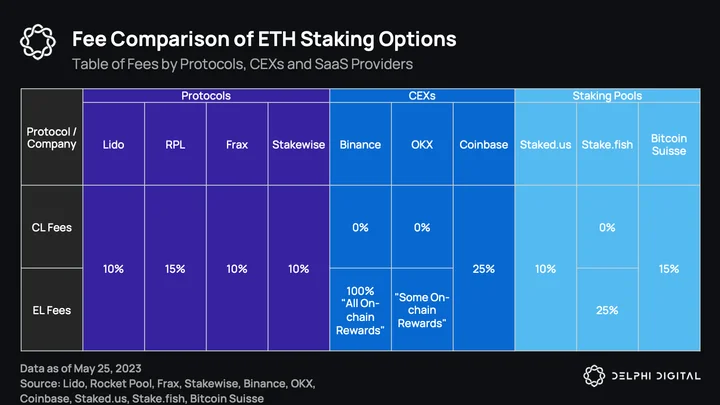
When choosing to stake ETH, you have a variety of avenues to explore, including liquid staking protocols, centralized exchanges (CEXs), staking pools, and solo staking. From an ROI perspective, it’s critical to understand the fee structures of each staking product to capture the highest upside.
Liquid Staking Protocols: (Target Segment: DeFi Natives)
Liquid staking protocols simplify the process of staking ETH to earn yields without any operational or technical requirements. When depositing ETH into these protocols, you receive a liquid staking derivative (LSD) token representing your staked ETH and associated rewards (e.g., stETH, rETH, frxETH). These can be redeemed for the underlying ETH upon withdrawal. These LSDs can be utilized in DeFi applications. Users can do things like provide liquidity on DEXs or lend it out on money markets. They have deep existing liquidity, which enables users to swap in and out of them at their leisure.
-
Protocols like Lido, Frax, and StakeWise impose a 10% fee on earned rewards, whereas Rocket Pool charges a higher 14% fee.
CEXs: (Target Segment: CEX Users That Are Unfamiliar With DeFi)
Leveraging their existing user bases, CEXs offer convenient ETH staking services directly on their platforms. These exchanges extract substantial fees from the yields generated.
-
Binance: Users retain all consensus layer (CL) rewards, while Binance retains all execution layer (EL) rewards or what are referred to by them as “All On-chain Rewards.” In addition, Binance provides BETH, an LSD for Binance staked ETH, with extensive use within BNB Chain and a recently launched liquidity pool on the wBETH-ETH Curve stable pool on Ethereum.
-
OKX: Users keep all CL rewards, while OKX “may retain some on-chain rewards,” effectively taxing stakers on EL rewards despite advertising as “no fees.”
-
Coinbase: Charging a flat 25% fee on all yields earned, Coinbase is the most transparent among its counterparts. They offer an LSD, cbETH, for their staked ETH, which is also the most entrenched CEX-issued LSD in DeFi.
Despite the indication of 100% on EL fees, it is noted that Binance and OKX’s rates fluctuate on their website, which is indicative that they do distribute some (albeit a small po
Read the full report
This report is part of Delphi Pro.
- 800+ Pro reports across every major sector
- Talk directly with our analysts
- Private community of funds and builders
Already a Pro member? Log in
0 Comments