
Introduction
In our report, “The Year Ahead for NFTs 2024,” we delve into the potential future for NFTs. We’ve identified Solana and Bitcoin Ordinals as two ecosystems poised for significant growth this year.
Our analysis reveals a shift in the NFT landscape: Ethereum, long the dominant force, is seeing its dominance wane. This change is driven by the evolution of NFTs from mere static images to interactive, dynamic units. Ethereum L1’s high transaction costs are increasingly seen as a barrier in this new context.
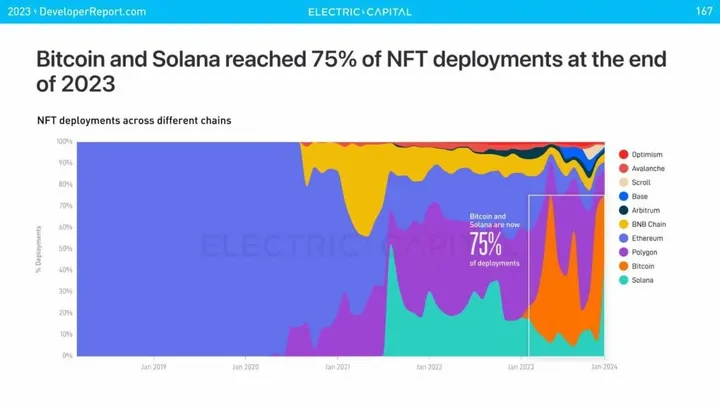
This shift is becoming palpable. Over the past 3 months, we can see that developer mindshare for Bitcoin and Solana NFTs has skyrocketed, reaching 75% of NFT deployments (source: Electric Capital’s 2023 Developer Report). Developer activity is often a leading indicator for innovation and capital flows.
We believe Solana is the “Dark Horse,” uniquely positioned to bridge this gap in NFTs. Its blend of community and scalability makes it an increasingly attractive option for NFT enthusiasts and creators.
In this expanded research on Solana, which follows up from our previous reports in February and April last year, we focus on newer NFT projects that merit attention. These NFT projects exemplify the innovation and potential that Solana brings to the table.
Why Solana
Every NFT ecosystem develops its own character and culture over time. Here’s how the major ecosystems stand out today:
- Ethereum: The hub for generative art and store-of-value assets.
- Bitcoin: Known for its fully on-chain digital artifacts.
- Polygon: A favorite among major brands for ‘Web 2.5 NFTs’, utilized by global names like Nike, Starbucks, Reddit, and even Donald Trump.
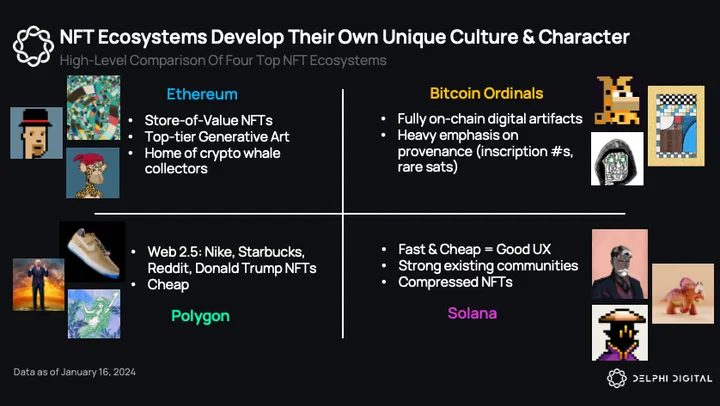
What about Solana? It’s pretty simple: Speed, Cost & Community
Speed: Ethereum NFT holders often express astonishment at the speed of Solana transactions when trying it out for the 1st time. The near-immediate processing, devoid of the sometimes minutes-long waits typical on Ethereum and Bitcoin, is a stark contrast. Solana’s efficiency eliminates the need for intermediate steps like token approvals, streamlining the user experience.
Cost: Solana stands out for its cost-effectiveness. Transaction fees are almost negligible, a significant advantage over the substantial costs on Ethereum and Bitcoin. For creators, launching a new NFT collection on Solana is both affordable and straightforward, where costs on other platforms can run into thousands of dollars.
Moreover, Solana’s use of state compression is groundbreaking. It enables the minting of one million NFTs for just $125 – that’s $0.000125 per NFT. This innovation opens doors for novel NFT applications, like free mints for user acquisition or for brands with extensive customer bases to explore NFTs with minimal financial risk.
Community: The Solana NFT ecosystem initially drew those who felt left behind by Ethereum, seeking more affordable avenues for trading and speculation. This led to an influx of PFP-type community projects. However, the community’s evolution is notable. It has weathered storms like the FTX collapse and emerged stronger, demonstrating resilience and adaptability.
Fast speed + Low cost = Great UX
And so we expect more experimentation, and consequently, innovative breakthroughs, to happen on Solana relative to some of the other blockchains.
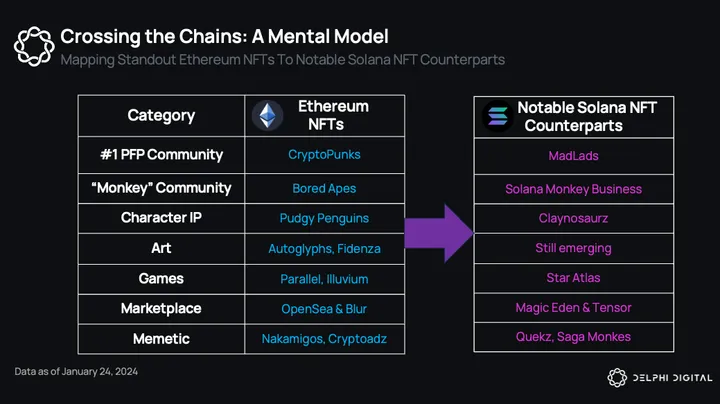
As we think about the future ahead for Solana NFTs, we consider how it could mirror key trends in the evolution of Ethereum NFTs.
For example: CryptoPunks are the top PFP collection on Ethereum because of its provenance and influential community. It has experienced significant price fluctuations but has shown a general upward trend over time. This pattern could be replicated in MadLads, currently viewed as the “CryptoPunks” of Solana.
Similarly, there are significant price differentials between Ethereum NFTs and their Solana NFT counterparts which reflects their earlier developmental stage. For example, Pudgy Penguins have a floor price of $35K today while Claynosaurz are at $2.5K. As Solana’s ecosystem matures, we believe this gap could narrow.
Solana NFT Data & Trends
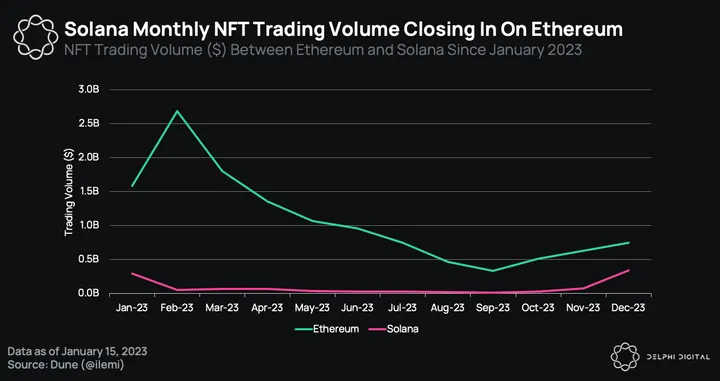
Solana has consistently been in the top 3 blockchains by NFT sales volume throughout 2023.
Ethereum experienced a sharp drop in NFT sales volume in 2023, falling from $2.68B in February 2023 to $750M by December 2023.
Solana’s NFT trading volume remained muted during Q1 – Q3 2023, due to the broader crypto bear market and risk-adverse sentiment. However, it saw a resurgence in November and reached a high of $346M in December. This is the narrowest gap between Ethereum and Solana thus far.
Note that this was partly due to a short-lived frenzy around SPL-20s, inscription-based collections on Solana.
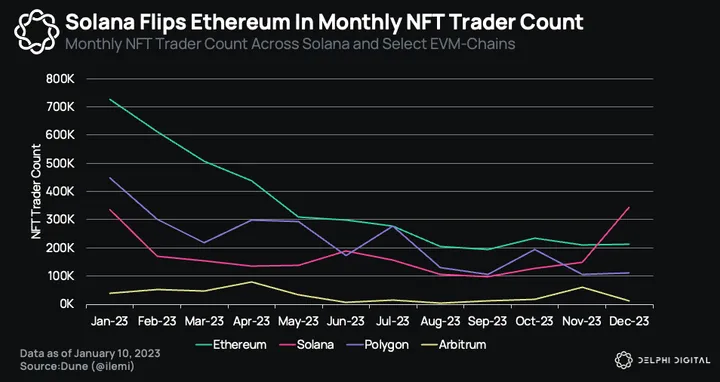
The “flippening” has happened — at least in terms of monthly NFT traders. Solana saw an uptick in NFT trader count in November, coinciding with the inception of SPL-20 inscriptions – with a peak of 343K NFT traders on Solana in December. In the same timeframe, Ethereum witnessed an 11% decline in NFT traders.
Will this trend continue? Quite possible, as long as there are new project launches bringing attention and mindshare to the Solana ecosystem.
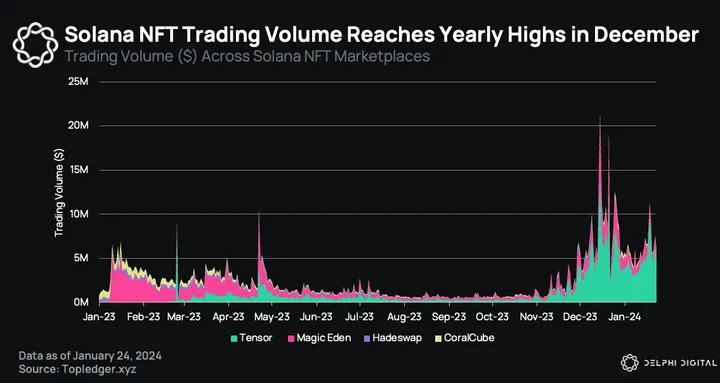
The majority of trading volume in Q4 was from Tensor (66.7%), with Magic Eden trailing far behind in second place (24.1%). A large part of the trading volume in the later part of the year was generated by a few collections, notably Froganas, Tensorians, and Open Solmap, and the rising popularity of SPL-20 inscriptions in mid-November.
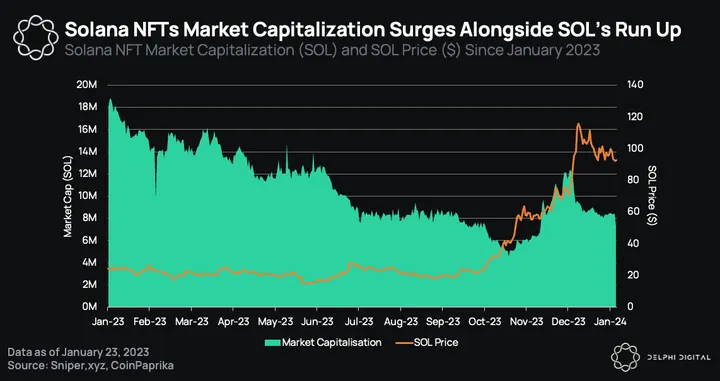
The total market cap for Solana NFTs has risen over the past few months, now at ~$800M after hitting a local peak of ~$1.2B in December. As you can see from the chart, this can be partly attributed to the run-up in SOL’s price. There is still a lot of room to run — Ethereum NFTs have a combined market cap of $12.9B, 10X larger than Solana.
We also note that the rise in market cap for NFTs lagged behind the initial rise in SOL price by about a month (Oct – Nov 2023). We could see the same trend happen during the next leg up for SOL, where NFTs could lag for a few weeks before catching up.
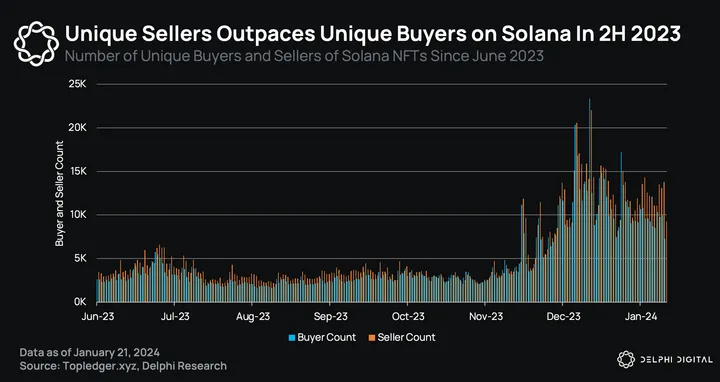
While trading activity has definitely improved, the number of unique sellers currently exceeds the number of unique buyers for the second half of 2023. If this trend starts to change, it may herald the start of another Solana NFT season.
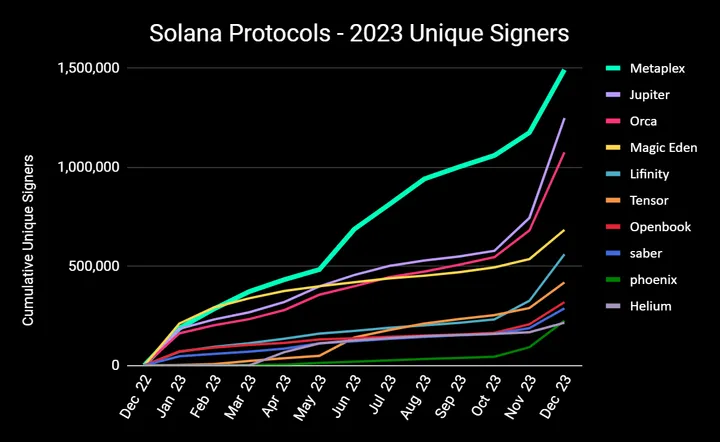
While many may still see them as useless JPEGs, NFTs are a fundamental part of the Solana ecosystem. NFT communities stayed strong during Solana’s existential crisis after the FTX collapse and Solana DeFi crashed and burned. Metaplex, the leading protocol for minting and launching NFTs, is the most used protocol on Solana today, measured by the number of unique signers.
Important Solana NFT Themes
Magic Eden vs Tensor
In the highly competitive world of NFT marketplaces, Magic Eden and Tensor have emerged as key players within the Solana ecosystem.
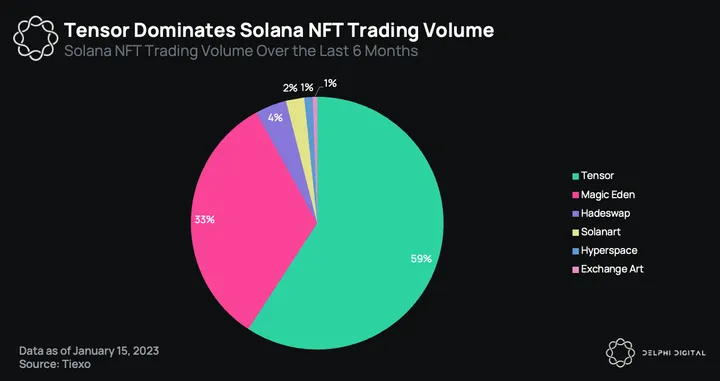
Despite the fierce competition amidst dwindling trading volumes during the bear market, Tensor overtook Magic Eden, securing a 57% market share compared to Magic Eden’s 32%. The rest of the marketplaces trail heavily behind.
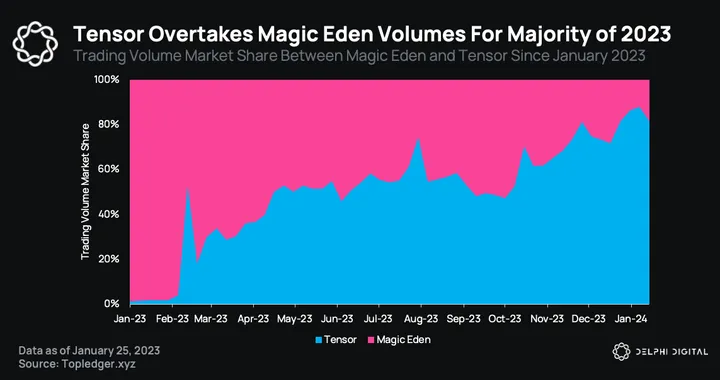
Magic Eden, the market leader prior to 2023, has seen its trading volume share erode with Tensor’s entry. Emulating Blur’s approach on Ethereum, Tensor has positioned itself as the “fastest NFT exchange on Solana,” resona
Unlock Access
Gain complete access to in-depth analysis and actionable insights.
Tap into the industry’s most comprehensive research reports and media content on digital assets.
Be the first to discover exclusive opportunities & alpha
Understand the narratives driving the market
Build conviction with actionable, in-depth research reports
Engage with a community of leading investors & analysts


0 Comments