A Frenzy Over Bitcoin Ordinals & Runes
FEB 29, 2024 • 35 Min Read


Introduction
Bitcoin is having its moment in the sun.
Once considered a boring asset within the crypto space, it is now experiencing a renaissance. Bitcoin’s resurgence is driven by several factors, including the recent Bitcoin ETFs, the anticipated halving in April, and the possibility of reaching new all-time highs, all of which are capturing substantial media attention.
Looking back, the launch of Ordinals in December 2022 was instrumental in energizing the Bitcoin developer community and has led to many downstream effects. High transaction fees from growing blockspace demand on the Bitcoin network driven by the popularity of Ordinals has catalyzed the growth of Bitcoin’s Layer 2 solutions and DeFi projects. These sectors have become focal points of discussion within the crypto space this year.
Bitcoin, the Trillion-Dollar “Casino”
While institutions and crypto natives continue to accumulate Bitcoin as a store-of-value and “digital gold,” there’s more brewing under the hood.
Bitcoin could emerge as the largest on-chain “casino” in the world.
From its early days with Satoshi Dice, the first gambling application on its network, Bitcoin has evolved to host newer and more interesting forms of speculation over the recent months. These include BRC-20 memecoins, Ordinals, Runes (soon), and new token launches.
The thesis for growing speculation on the Bitcoin network is simple:
- Bitcoin, a trillion-dollar asset, holds the strongest claim to be money among cryptocurrencies. However, until recently, much of the capital in Bitcoin has remained passive due to limited use cases.
- A segment of users will seek to leverage their capital for entertainment, speculation, and yield generation while wanting to remain within the Bitcoin ecosystem. They view it as hard money, unlike other cryptocurrencies.
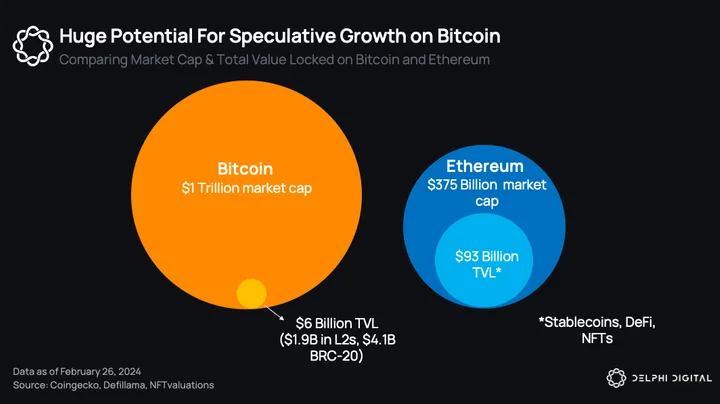
- Even a modest yet expanding portion of this capital represents a substantial sum. Despite having three times the market cap of ETH, Bitcoin’s locked value in L2s and BRC-20s (~$6B in total) remains a small fraction of Ethereum’s TVL (~$93B in stablecoins, DeFi & NFTs). This suggests significant growth potential.
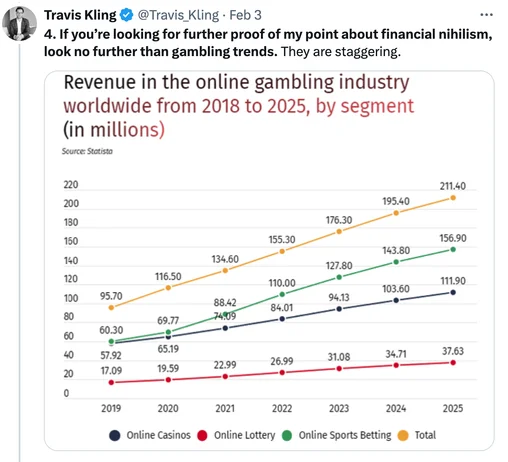
- The retail segment, already familiar with Bitcoin, is increasingly engaging in speculation. Videos circulating on platforms like X showcase how Chinese aunties are learning to buy BRC-20s. Financial nihilism plays a role, with limited upward mobility driving individuals to speculate for potential gains.
The convergence of these factors will lead to growing interest and capital flows into Ordinals, Layer 2 solutions, and other Bitcoin network applications. Bitcoin is positioned as an attractive hub for speculative activity
We’ve published several recent reports covering various aspects of Bitcoin:
- The State of Bitcoin, reporting on network metrics and top trends (February 2024)
- Bitcoin Gaming and the power of nano-Transactions (November 2023)
- The huge cultural opportunity with Bitcoin Ordinals (July 2023)
In this follow-up report, we delve into the latest developments surrounding Ordinals and Runes, and highlight specific projects worth noting.
State of Ordinals Today
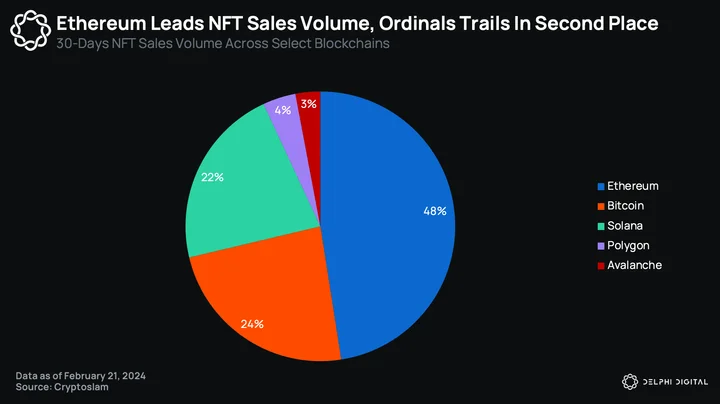
As far as NFT trading volumes are concerned, Bitcoin Ordinals is in a comfortable spot in 2nd place among NFT ecosystems with a 24% volume share. This is slightly more than Solana, which trails in 3rd place with a 22% volume share over the past month.
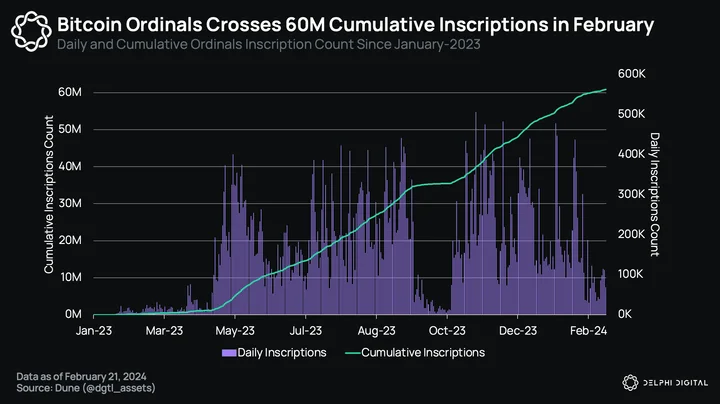
Inscriptions continue to be popular. The total number of inscriptions has tripled to over 60M since our last report and shows no signs of slowing down, still largely driven by BRC-20 tokens and the rising popularity of Ordinals-enabled wallets like UniSat, which allows retail to buy into Ordinals and BRC-20 tokens on-chain. While Ordinals took a breather between September and October 2023, activity picked back up in November as new token standards emerged.
Interestingly, the inscription mania that started on Bitcoin has spread over to other chains such as Polygon, Avalanche, Fantom, and Solana, which now have their own inscription protocols.
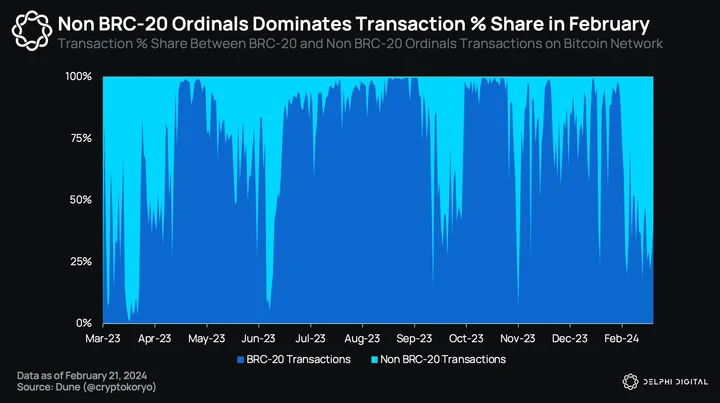
While BRC-20s still make up a chunk of Bitcoin transactions, non-BRC-20 Ordinals are also doing well and have a larger market share than most of last year. However, note that this includes newer experimental token standards like BRC-420, ARC-20, and bitRC-20. It is still too early to tell which token standards will stick over time.
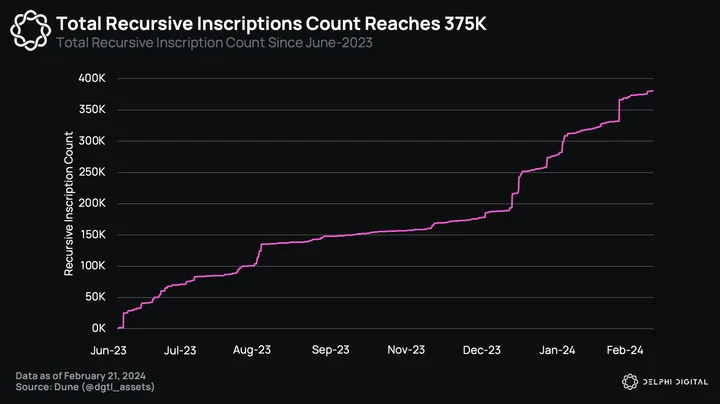
Since its inception in June 2023, recursive inscriptions have been slowly gaining momentum as builders start to learn and appreciate their benefits, mainly the ability to expand upon the 4MB data-capped constraints per Ordinals inscribed and allowing for greater interoperability and design space around Ordinals. As of February, there are already more than 375K recursive inscriptions on the Bitcoin network, and the momentum shows no signs of slowing down.
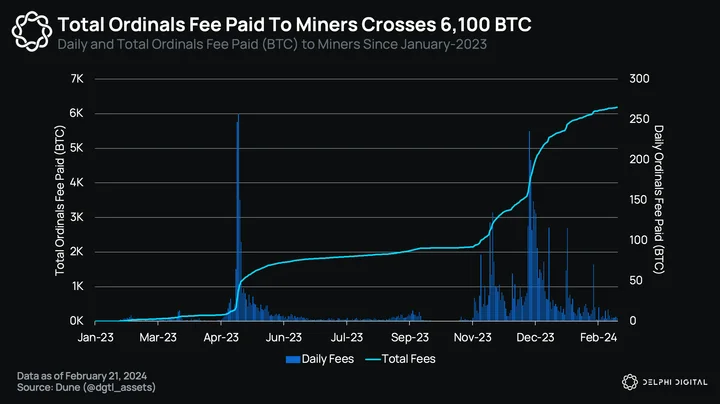
Ordinals’s importance to Bitcoin is often understated, as it introduces a new fee stream for miners. Including data in a Bitcoin block can be costly due to the correlation between file size and fees. Over 15 months, total fees paid to miners from inscribing ordinals have exceeded 6,175 BTC ($308.75M).
During the peak of Ordinals inscription activity in November to December last year, monthly fees paid to miners surged from 26.4 BTC in October 2023 to a staggering 2,095.8 BTC in December 2023, marking a remarkable 79x increase in fee revenue within two months. While the fervor may have subsided, Ordinals fees continue to climb steadily in February, albeit at a more moderate pace. Should this trend persist, it could help mitigate the issue of Bitcoin’s declining security budget.
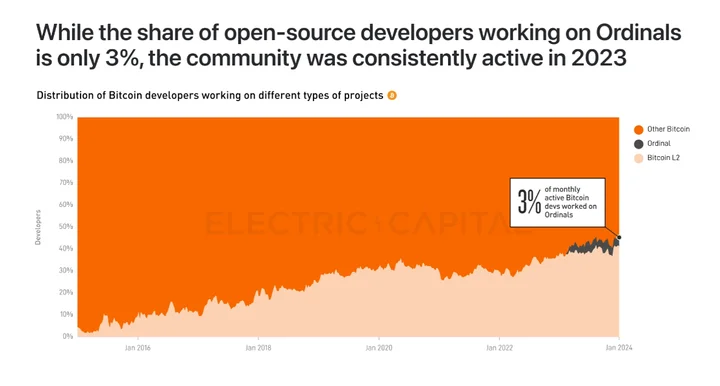
Source: Electric Capital Developer Report 2023
While the majority of Bitcoin developers focus on the main Bitcoin network and Bitcoin Layer 2 solutions, the Ordinals side saw consistent activity throughout 2023. Looking ahead to 2024 and beyond, we anticipate this momentum to persist and gradually expand. The Ordinals developer scene is passionate.
Marketplaces
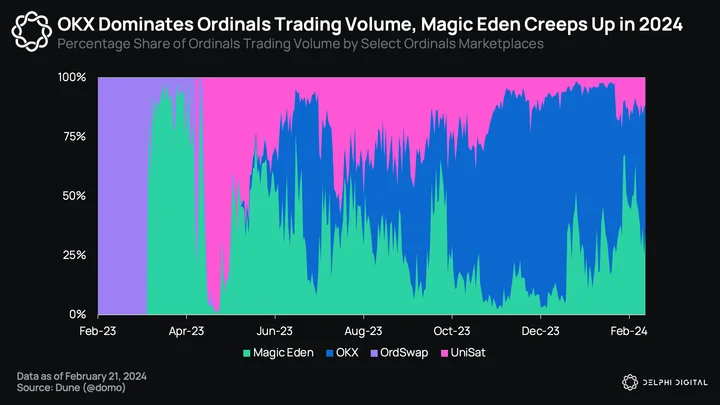
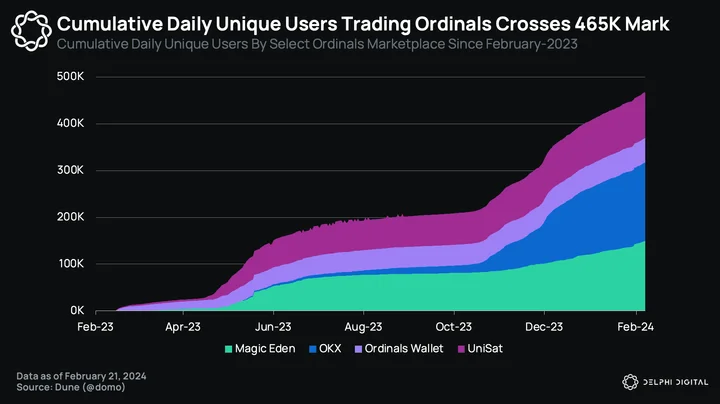
There is a noticeable oligopoly in Ordinals marketplaces, with both Magic Eden and OKX vying for market dominance throughout much of 2023. Magic Eden initially held an early advantage going into Q3 of last year but faced formidable competition from OKX starting in August. OKX eventually emerged as the frontrunner during the second wave of inscription mania from November to December 2023, securing 84% of the Ordinals trading volume market share during this period.
Presently, OKX maintains its position as the market leader with 53.5% of the trading volume, while Magic Eden follows closely behind in second place with a volume share of 31.1%. OKX boasts the highest number of Ordinals users, with 166.5K cumulative users. Magic Eden trails closely behind, with 146.7K. At the time of writing, the number of cumulative Ordinals users reached its highest point at 468.3K.
We anticipate fierce competition between these two marketplaces in 2024.
Runes: Native Fungible Tokens on Bitcoin
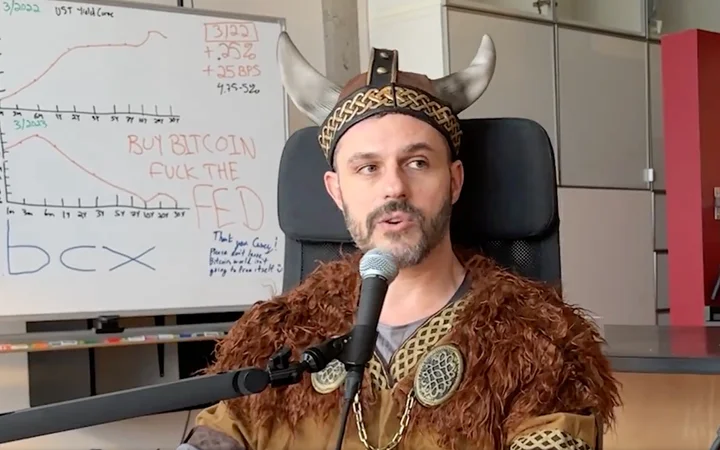
Casey loves his Viking costume
Ordinals introduced a groundbreaking method for creating non-fungible tokens (NFTs) on Bitcoin. Now, a new protocol called Runes is emerging to facilitate the creation of fungible tokens on the Bitcoin network, offering an alternative to the BRC-20 standard. Unlike Ordinals, which are not designed for fungible tokens, Runes utilize the OP_RETURN field instead of witness data, streamlining the process and potentially reducing clutter.
Runes operate on a UTXO (Unspent Transaction Output) basis, where during a Bitcoin transaction, the Rune balance on input UTXOs is by default transferred to a new UTXO upon the destruction of the one holding the Rune balance. There are also “Runestones”, which utilize data within the OP_RETURN field to include instructions on how runes are transferred within the output, specific transfer addresses and create new runes.
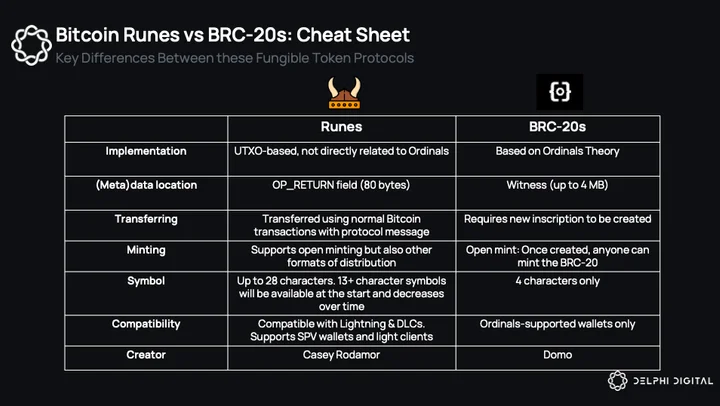
BRC-20s create a lot of unused UTXOs. In order to spend Runes, you have to destroy UTXOs, which is good for the system as a whole. It’s also beneficial for users, enabling simpler PSBT-based swaps. Since a UTXO can only be spent once, you can create a set of transactions and then out of those transactions, you can guarantee only one of those can be mined. BRC-20 transactions can’t do this.
Similar to BRC-20s, Runes can have an open mint and fair distribution. But they can also be created with the entire supply to a single address. There will be a thoughtful approach to the naming of Runes, with a maximum length of 28 characters. At launch, only 13+ character Rune names will be available, with a gradual release of shorter names (1 character less every 4 months) to prevent the squandering of valuable low-character names.
Runes incorporate a commit-reveal scheme for naming to prevent front-running, a common issue with BRC-20s. They are also designed to be compatible with SPV (Simple Payment Verification) wallets, making them accessible to users of lightweight Bitcoin wallets.
Each Rune token will be uniquely identified, similar to the inscription numbers for Ordinals, with the initial ten Runes (0-9) likely hardcoded into the protocol to ensure a fair launch without pre-mining. Runes go live on mainnet at block 840,000 (halving block, expected sometime around in 20 April). Already, hundreds of different runes have been etched on the testnet.
Notable Runes Projects
Runecoin (RSIC)
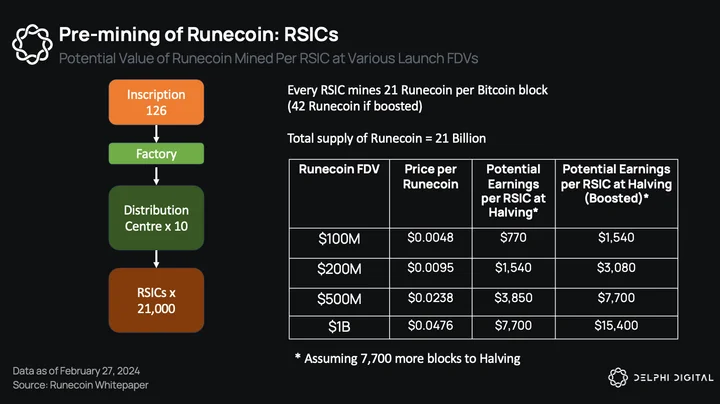
Runecoin emerged as an anonymous project striving to be among the first Runes created. Initially, 21,000 RSIC inscriptions were mysteriously airdropped to 9,211 wallets at no cost. Each RSIC is connected to 10 distribution centers, which in turn are linked to an early Inscription 126.
Every RSIC held in a wallet earns 21 Runecoin per block on the Bitcoin network. To boost RSIC rune earnings to 42 Runecoin per block, one can inscribe a byte-perfect copy of Inscription 60750020 in the wallet holding RSICs, which costs around $300. Holding this boost inscription upgrades all RSICs at the same address. The earned Runecoin can be monitored on Ordiscan. The total supply of Runecoin is set at 21 billion, and the launch is scheduled for when the Runes protocol goes live.
Among its gamification mechanics, Runecoin introduces a 24-runic symbol rarity system, ranging from 1 to 8192 symbols. Each symbol is assigned a hash value, with symbols turning orange if they match the latest block hash via JavaScript. Additionally, there’s a raffle where every RSIC held earns one ticket per block and will give five lucky winners a substantial portion of the Runecoin supply.
As of February 27, 2024:
- There are ~7,700 blocks left until the halving. Each RSIC bought today (floor price of 0.09 BTC = $4,950) would earn 161,700 Runecoin by the time of the halving — 323,400 if boosted.
- If Runecoin were to launch at a 1B FDV, that would be $0.048/Runecoin. In this scenario, each RSIC bought today could potentially earn $15,400
- Based on the current floor price of RSICs, there is an implied market cap of $160M for Runecoin at launch (21,000 * 323,400 / 4,950 * 21B = $160M)
- We calculate there to be a range between 5.9B – 10.1B Runecoin in circulation at the time of halving, depending on how many RSICs get boosted. For estimation purposes, we can take the mid-range of this = 8B
As one of the initial projects in the Runes ecosystem, Runecoin is a precursor to a broader wave of similar financial games anticipated to launch with Runes. There is a lot of capital on Bitcoin to participate in such games if it is made accessible and fun.
Runestones
Runestones is an initiative created by prominent Ordinals influencer Leonidas to reward individuals who participated in the first year of the Ordinals Protocol. This aims to fairly distribute Runestones based on participants’ on-chain activity, marking one year after Ordinals was released.
Initially, Runestones will be distributed as Inscriptions, with the goal of each eligible wallet receiving only one Runestone inscription, regardless of their level of involvement. They will all have the same artwork, there is no rarity or differences between them. This means there will be a market price for Runestones even before Runes launch.
When the Runes protocol launches at block height 840,000, holders of Runestone inscriptions will receive Runestone Runes based on the number of inscriptions held. Runestone inscriptions will serve as collectible keepsakes for year-one Ordinal supporters and do not have any utility or roadmap. The Runestone Rune will function as a collectible meme token and speculative coin.
Runestone boasts the title of the largest Bitcoin airdrop, with eligibility requiring participants to hold at least three inscriptions at a block height of 826,600. With over 2000 collections and 113,376 addresses, Runestone promises a fair launch for all participants. The airdrop has no team allocation and is entirely funded by community donations. Users can track their wallet eligibility here.
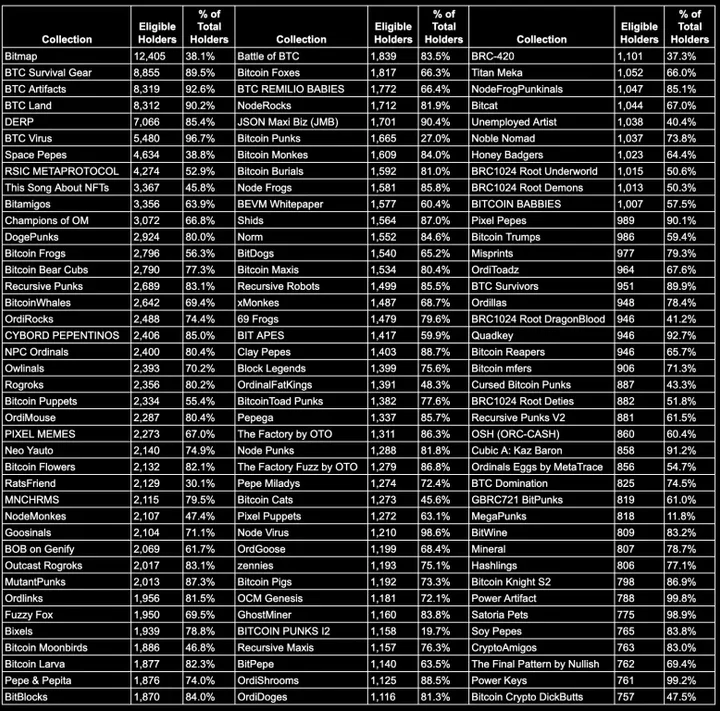
Distribution of Runestones to Ordinals holders
Our Perspective on Runes
Runes represent a fresh avenue for entertainment, speculation, and community-building, albeit without a distinctly new use case. We like the fact that it is built on Bitcoin, a solid foundational asset and store of value. When Runes launches, it could reinvigorate Bitcoin by attracting liquidity and attention, essentially transforming it into a bustling casino ecosystem capable of generating significant transaction fees.
While many new token standards have failed, we believe that Runes as a new fungible token standard will likely last because of the reputation of its creator (Casey) and an already high level of anticipation and acceptance within the Ordinals community.
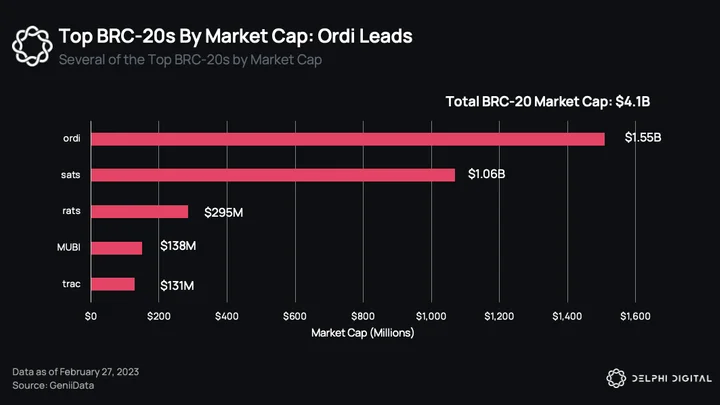
The current combined market capitalization for BRC-20 tokens stands at an impressive $4.1 billion, with the leading token, ordi, accounting for $1.5 billion of this market cap. This gives us a glimpse into the potential scale of the Runes market.
Runes could well pose a challenge to existing BRC-20 tokens. We expect a notable shift of capital from BRC-20 tokens like ordi and sats to Runes upon its launch, driven by the allure of shiny new tokens. Of course, this is contingent on there being no major hiccups with the technical deployment of Runes when it goes live.
A cautionary note: akin to memecoins, the majority of Runes may ultimately hold little value, trending towards zero. Only the ones that can generate attention and build a community around them will survive.
Ordinals Collections To Watch
Unlike on Ethereum, linking multiple inscriptions/NFTs to a single collection is less straightforward. Parent-Child provenance is the industry standard today used to create a collection of inscriptions with clear provenance. Danny (Onchain Monkeys) has an insightful tweet on this topic, showcasing the first ten collections utilizing this method:
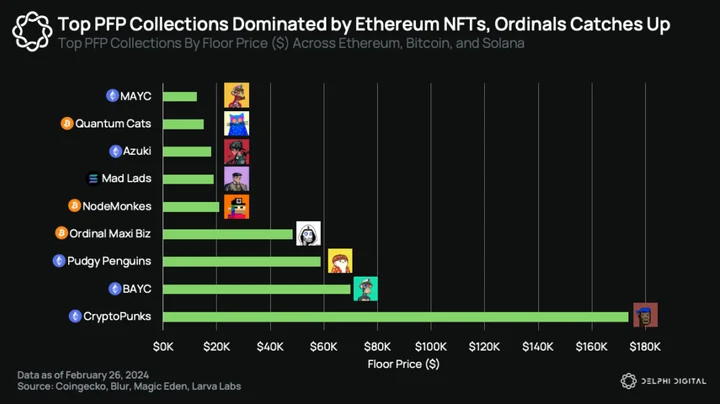
While the top PFP collections by floor price still consist mainly of Ethereum NFT collections like Punks and Bored Apes, Bitcoin Ordinals is catching up, with 3 Ordinals PFP collections (Quantum Cats, NodeMonkes, and OMBs) climbing into the top ranks.
If we consider the value of these top PFP collections relative to the total market cap of their native chain — Bitcoin has 3X the market cap of Ethereum, but Bitcoin’s top Ordinal collection is 1/3 the floor price of CryptoPunks. It is reasonable to believe that the top Ordinals collections have the potential to run significantly higher.
Quantum Cats
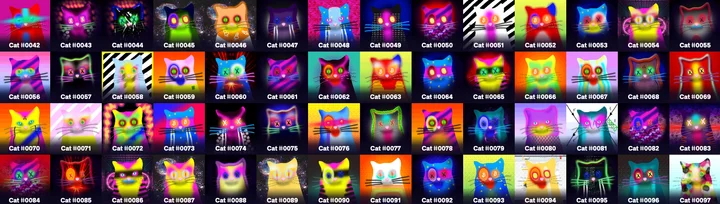
Quantum Cats is a collection of 3333 recursive ordinal inscriptions launched by the Taproot Wizards team. The collection pays homage to Satoshi, as it traces its origins back to the OP_CAT scripting function (included in the original Bitcoin codebase) that was subsequently removed by Satoshi Nakamoto in 2010 due to the perceived risk it posed to the Bitcoin network.
One objective of the Quantum Cat Collection is to resurrect the OP_CAT functionality, paving the way for secure cross-chain BTC transfers and enhancing the development and refinement of Bitcoin layer 2 networks. By leveraging Quantum Cats, the project endeavors to draw attention to the proposed BIP upgrade while also serving as an educational platform for the wider public.
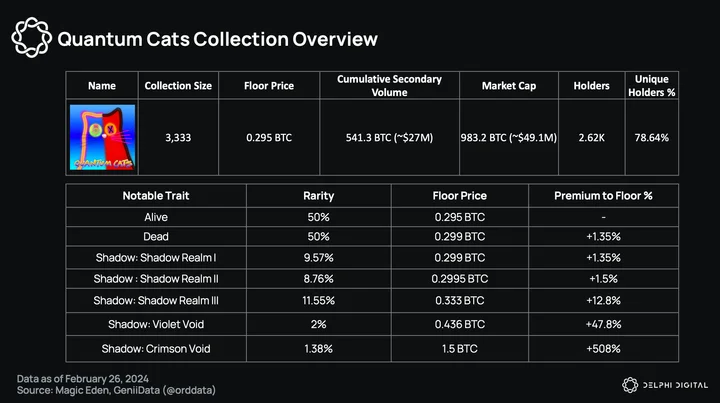
The Quantum Cats collection is set to gradually transform its artwork through a process known as “Evolving Inscriptions.” Various versions of Quantum Cats have been inscribed in advance, with the evolution encrypted by the team. These artworks will evolve in a deterministic manner, following the OP_Cat proposal process. It is uncertain if the newly evolved traits will affect rarity, so the current “rarity” and appearance of the Cats are subjective.
The collection is split 50/50 between two distinctive groups — “Dead” and “Alive” cats. The collection was initially minted for 0.1 BTC per NFT on February 7, raising a primary revenue of 300 BTC (~$13.3M) for the Taproot Wizards team.
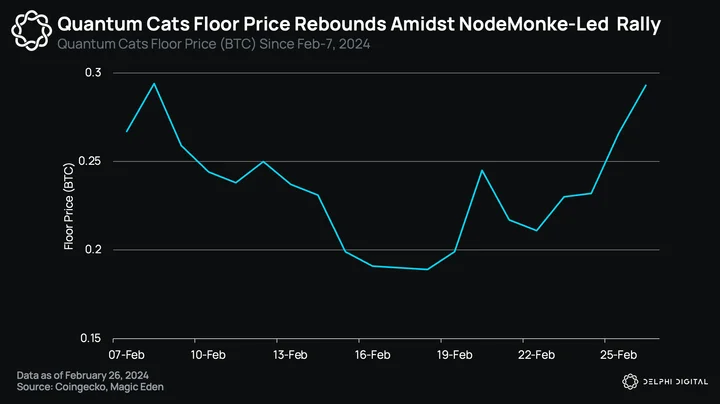
Given its origins and purpose, Quantum Cats could accrue value through its culture and community over time, especially if one believes that the Ordinals and Bitcoin ecosystem will grow much larger over the coming years. It brings together people who wish to participate in a collective movement to upgrade Bitcoin.
Holding a Cat may have benefits in the upcoming Taproot Wizards mint (no known date yet) since they are from the same team. In the meantime, its market value could act as a beta for Taproot Wizards until it launches.
Catalyst for 2024:
The BIP upgrade, if it happens, will see a Bitcoin soft fork that includes the revival of the OP_CAT function. There is still a long journey towards activation, but should the BIP proposal pass, we could see attention and a price bump in Quantum Cats.
Nodemonkes
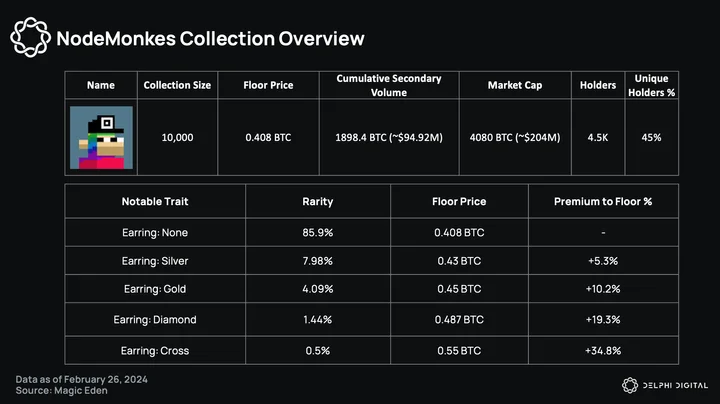
NodeMonkes is the first 10,000 Ordinals PFP collection to be inscribed on Bitcoin, with inscription numbers in the range of 83k–110k. While they were inscribed in February last year, the anonymous team behind the project waited till Ordinals infrastructure was more mature before launching in December 2023. The primary sale occurred via a Dutch auction, where 8000 NFTs were made available for collectors on December 21 last year. The final price for the Monkes settled at 0.03 BTC.
The collection includes a series of interesting traits, showcasing a blend of crypto-native inside jokes and memes intertwined with original creations. For example, traits are referencing famous CT memes such as Pepe, BTC maxi, laser eyes, and even Aliens on CryptoPunks. Collectors can use the Monkedex to check the official rarity of each NodeMonke PFP.
The narrative brewing around NodeMonkes is simple and left curve: Monkes are the CryptoPunks of Bitcoin. There is no roadmap or execution risk. It has been less than 2 months since launch and we think it is probably premature to crown the Monkes as the de facto CryptoPunks of Bitcoin — to truly earn the title, community members should go on to become influential builders and thought leaders in the Bitcoin space (as with Punks & Ethereum). But if enough people believe the narrative, it could become viewed as truth.
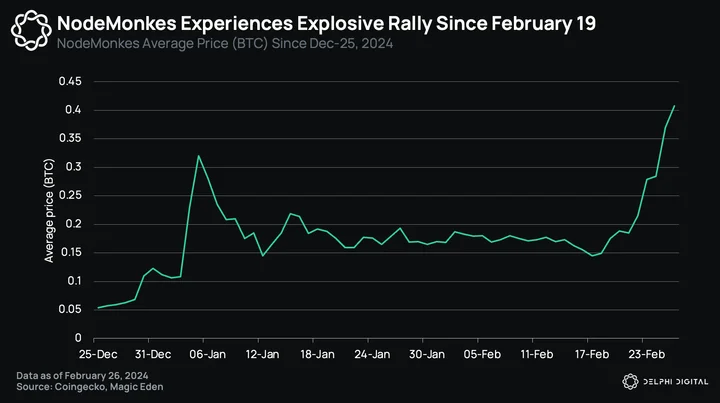
NodeMonkes saw frenzied trading activity after launch, with average prices peaking at 0.32 BTC on January 5, with a peak trading volume of 594 BTC (~$26.8M) during the first week of January. After a brief cool-off period, NodeMonkes experienced another run-up on February 19, which saw the collection rally from 0.15 BTC to 0.4 BTC on February 26. This was catalyzed by the project’s team mention of more Ordinals airdrops going to NodeMonke holders, and Twitter mentions from notable KOLs such as The Crypto Dog, Kevin Wu, and hentai avenger.
The team customized 400 honorary NodeMonkes to celebrate CT personalities such as Claire Silver, Grant Yun, and Batz. With a consistent visual language, the collection has become an iconic collection among the Bitcoin ordinals ecosystem, similar to Nouns glasses, which are instantly recognizable.
Bitcoin Frogs
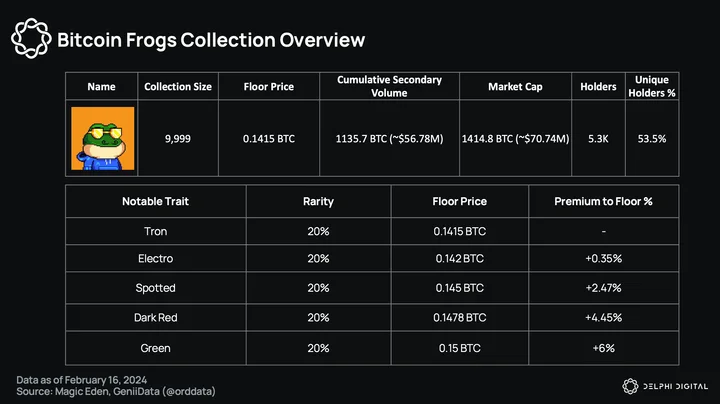
Bitcoin Frogs, launched on March 8, 2023, is a 10K PFP ordinals collection minted on Bitcoin through the Lightning Network. Created by Frogtoshi Nakamoto, each layer of traits within the collection boasts equal rarities. This fosters a subjective appreciation of aesthetics and satoshi-based rarities.
Bitcoin Frogs stands out as a fair launch (setting it apart from Nodemonkes), with the entire collection minted for free, excluding transaction fees. The project has cultivated a vibrant community on X, using expressions like “Ribbit!” and “Frogs follow Frogs” to showcase their unique culture. The frog PFPs also serve as social networks, with holders regularly tweeting their frogs to demonstrate their allegiance and affiliation.
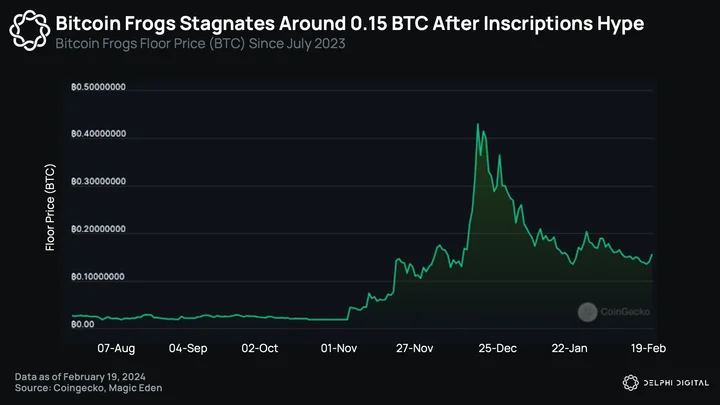
While activity dwindled after the May inscriptions hype, activity and attention picked up again in November when inscriptions started happening across major L1/L2s, and Bitcoin Frogs saw yet another resurgence in its floor price.
What makes Bitcoin Frogs desirable? Frogs resonate deeply with crypto culture, drawing inspiration from the popularity of Pepe the Frog. The collection also holds significance as one of the earliest Ordinal PFP collections and the first to be minted via the Lightning Network. Bitcoin Frogs can be seen as one of the cultural faces of the early Ordinals ecosystem, a symbol for participants to signal their status as pioneers.
OMB (Ordinal Maxi Biz)
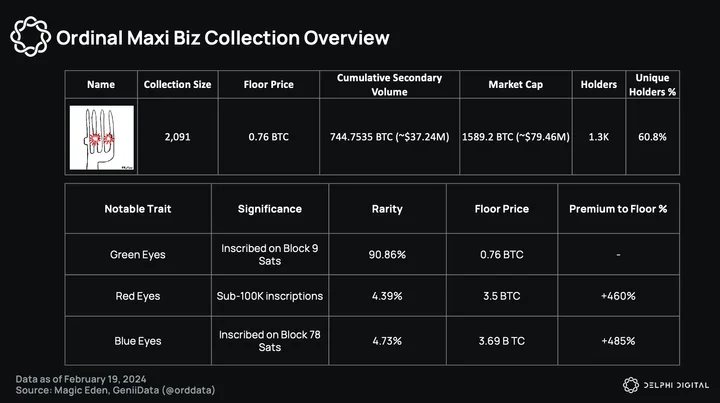
OMB is an Ordinals PFP project launched by the pseudonymous founder Zkshark, in collaboration with artists Tony Tafuro and Nullish. The collection features 2091 hand-drawn PFPs, each uniquely classified by eye color, including green, red, blue, and a newly introduced orange eyes trait.
The first to be inscribed were the red eyes, with 92 PFPs inscribed within the sub-100k inscription range. Blue eyes were inscribed next, consisting of 99 PFPs inscribed on Block 78 (”Hal Finney”) sats. Green eyes were inscribed last, with a total of 1900 PFP inscribed onto Block 9 sats.
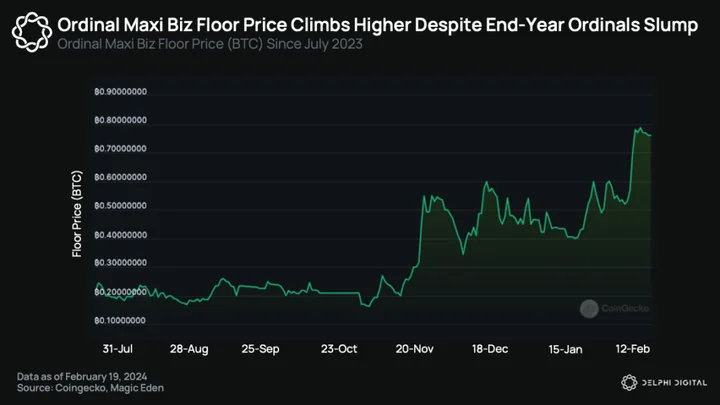
Among all Ordinals inscription collections, OMB commands one of the highest floor prices (0.76 BTC/$38,000) and sales volume. While many other collections have muted floor prices after the Ordinals hype in November last year, OMB’s floor price has been steadily grinding higher.
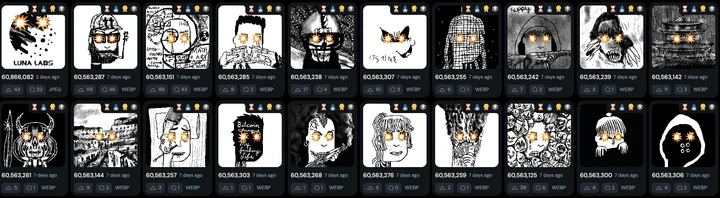
Notably, during Super Bowl 2024, over 3000 new OMBs were inscribed onto Bitcoin with the orange eyes trait, with some inscriptions occurring on some of the oldest Bitcoin sats. These have not yet been made available for sale, and it could pay to watch closely for announcements around this.
The project describes itself as a movement, bearing some similarities to Goblintown in terms of cultivating a dedicated community. Serious OMB collectors view these PFPs as more than just a punks derivative but as thoughtful artistic pieces espousing important political statements. For instance, OMB-themed graffiti advocating “Buy Bitcoin, Free Ross” has emerged in London streets, symbolizing a protest against the establishment. Collecting an OMBs may serve as a form of solidarity with this movement.
Additionally, OMB collaborates with Luxor Technologies to allocate a portion of its treasury to mine Bitcoin. The proceeds will be used to preserve the Treasury and fund OMBounties, rewarding developers, educators, and community members who contribute to open-source projects aligned with core Bitcoin values. Educational bounties will be exclusively rewarded to OMB holders based on effort and engagement. Holders are also encouraged to propose bounties for consideration.
Interestingly, there is no discord server for OMB, and all of its community coordination happens on Twitter.
Pizza Ninjas
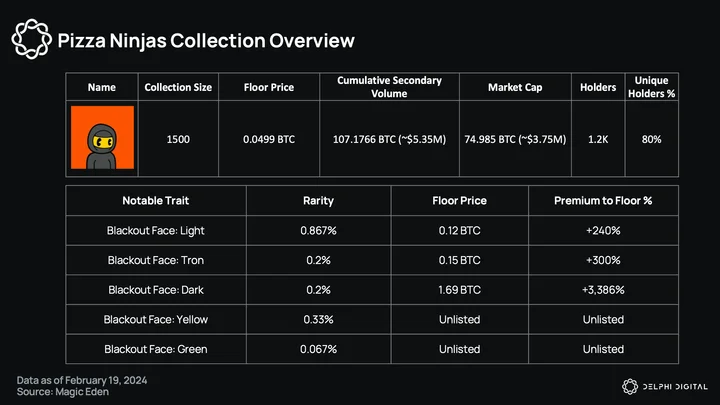
Pizza Ninjas was launched by the team behind Ninjalerts, a blockchain data insights tool for web and mobile applications that sends real-time push notifications for NFT-related activities. Trevor, the founder, is a well-known investor and influencer in the Bitcoin space and runs a popular bi-weekly Twitter spaces show.
The Pizza Ninjas collection comprises 1500 PFPs inscribed on rare pizza sats and was launched on January 17 at a mint price of 0.03 BTC. It’s noteworthy as the first Ordinals PFP collection to feature high-resolution 2000×2000 pixels, utilizing recursion, and boasting dynamic traits that change based on Bitcoin’s block height. We like that it is a very thoughtfully designed PFP collection, detailed in their design whitepaper.
Each Ninja PFP serves as an interactive app, offering features like a built-in animation editor, one-click social media stickers, and an on-chain Super Nintendo emulator for gaming within the PFP.
Owning a Pizza Ninja PFP grants a lifetime license to Ninjalerts’ Ordinal Portfolio Tracker and wallet-watching software. Additionally, the PFPs serve as membership passes for their alpha group, offering collaborations and allowlist giveaways to top projects.
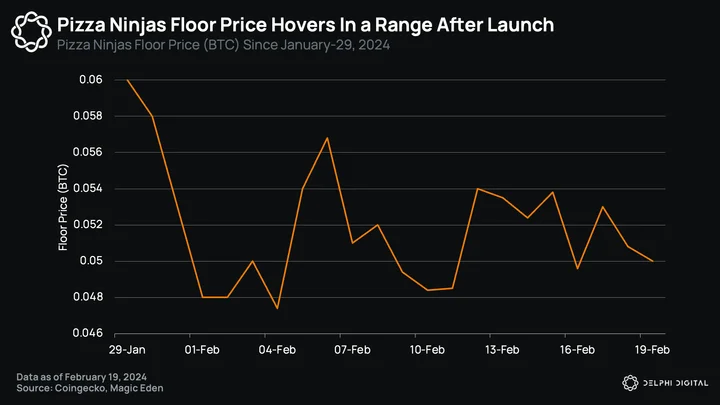
Despite its feature-rich offering, Pizza Ninja’s floor price is down from the initial days post-launch, currently hovering around 0.05 BTC (+66% vs. mint price). In the long term, the project aims to become the world’s top Bitcoin-native IP — an ambitious vision that will require significant time and effort to realize.
Catalysts for 2024:
- Ordinals go into a frenzied bull run. This drives demand for Ninjalerts’ product suite with its ability to facilitate early mint sniping and tracking of new project launches. Pizza Ninjas serves as the gateway to accessing this product suite.
- Collaborations and partnership launches
Bitcoin Art
In our conversations, many artists are observing the Ordinals space with keen interest. The fascination lies not only in the art itself but in the innovative processes behind it, such as recursive techniques and the remixing of existing artworks. Ordinals art is also fully on-chain, which sets it apart from most NFTs. This environment echoes the early days of digital art exploration on Ethereum, where boundaries are constantly being tested and expanded.
A striking example of the creative use of Ordinals comes from artist SpZjulien, who inscribed individual audio files of piano keys onto Bitcoin. This approach allows for the creation of fully on-chain songs through recursive inscriptions, demonstrating the vast possibilities for composability in on-chain art on Bitcoin.
However, Ordinals presents unique challenges for artists, particularly in terms of file size limitations, which directly impact the feasibility of creating and transacting high-quality, complex art. The cost of inscribing a 1MB AI-generated image on Ordinals, for example, can reach thousands of dollars, positioning such pieces as exclusive status symbols for the wealthy rather than accessible art forms.
The constraints imposed by Ordinals have led to a surge in p5js-based collections, with less emphasis on 3D art. Ordinals artists are increasingly drawn to art that reflects the Bitcoin network’s characteristics or integrates data from it, creating a unique blend of technology and creativity. Despite these innovations, the practical limitations of Ordinals compel artists to work within a restricted expressive range, particularly challenging for narrative art that demands substantial data bandwidth.
Rasterized art (pixel-based) or complex vectors become prohibitively expensive to inscribe due to these constraints, prompting artists and collectors to seek alternatives with lower fees. However, a narrative is emerging that early high-quality raster art could become highly valuable due to its rarity.
A creative workaround for these limitations is the use of recursion in generative art on Ordinals. Artists inscribe a core script, which subsequent artworks use as a foundation, adding unique data to generate diverse outputs. This method significantly reduces the size and costs of each inscription.
Despite these innovations, discoverability remains a challenge in the generative art space, highlighting the need for improved platforms that can showcase and promote Ordinals art.
FloraForms by Harto
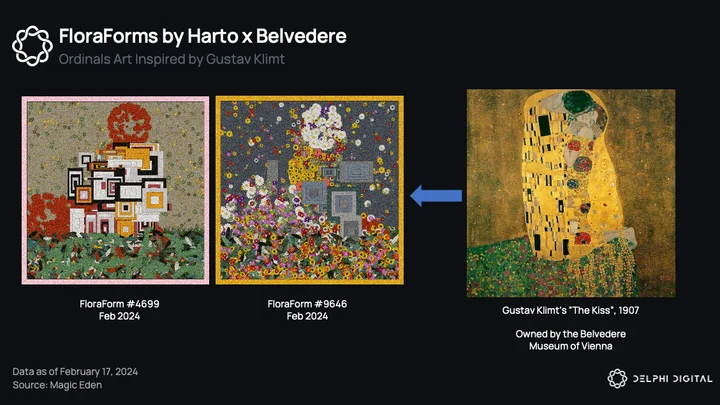
FloraForms is a 10K fully on-chain generative art collection by artist Harto and made in collaboration with the Belvedere Museum of Vienna. It draws inspiration from Gustav Klimt’s “The Kiss”, whose works have been said to also resemble generative art. It launched on 14 February for free (inscription fees only) and now sits at a floor price of 0.003 BTC ($150).
The collection uses Parent-Child Provenance, allowing for clear provenance of the collection on-chain. This benefits collectors, and future dapps, marketplaces, wallets, and explorers, with no need for off-chain references. The generative collection uses recursive inscriptions: each work is over 2 megabytes when downloaded, but the inscription is only 160 bytes. The parent recursive inscription is also efficiently created, using compression and is only 12 kilobytes.
Golden Ratio by Harto
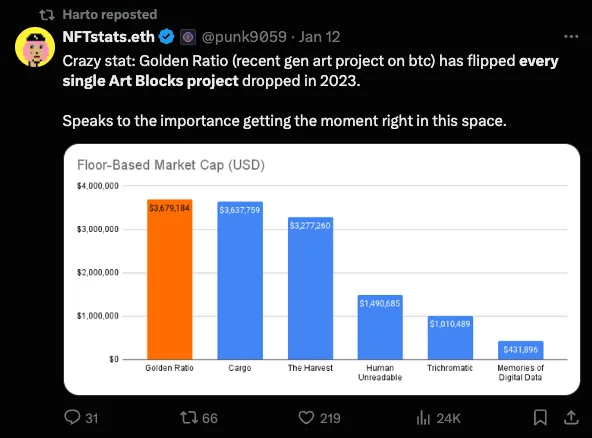
Another Ordinals art collection that has seen robust demand in recent weeks is Harto’s Golden Ratio, curated by VIVID Gallery. It was a free mint, with 420 supply, and is now sitting at a floor price of 0.1 BTC ($5,200). It’s probably one of the more interesting generative artworks on Bitcoin today.
Harto’s collection merges the Fibonacci sequence with recursive algorithms and fractal geometry, offering a glimpse into the harmony of numbers and nature. Inspired by the symmetry of the universe and chaos theory, each piece showcases the beauty of randomness and order. The collection’s aesthetic draws heavily from cryptography and the Bauhaus movement.
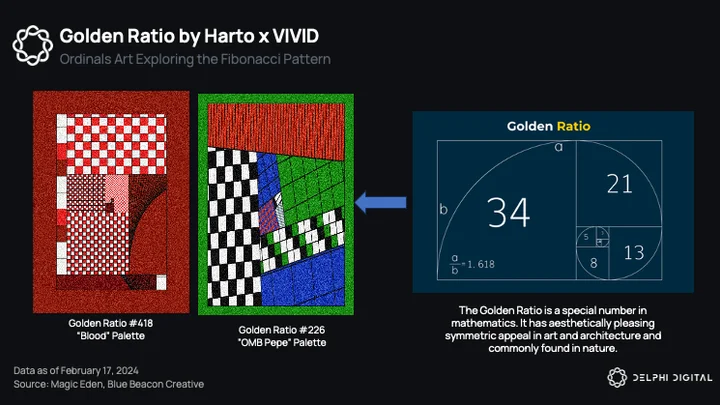
Golden Ratio stands out because it is both “recursive” and “cursed”. Recursive inscriptions enable referencing data from other inscriptions. It could become the “grail” of recursive collections due to its recursive artistry, beautifully expressing the golden ratio, a hallmark of natural proportionality.
“Cursed” inscriptions were a significant historical moment in Ordinals’ history and were previously overlooked by the Ordinals indexer, resulting in negative numbers. This has since been fixed with an update. Cursed inscriptions like Golden Ratio could hold a special place in the provenance of what is a growing Bitcoin art cultural movement.
0xfar’s FLARES
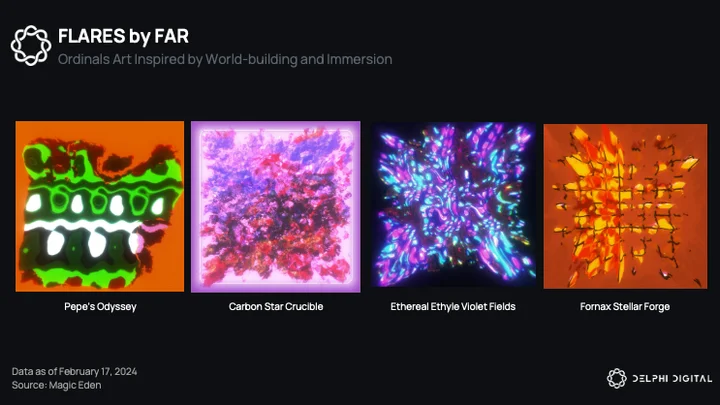
0xfar is known for being the artist behind Taproot Wizards and Quantum Cats, two of the most popular Ordinals projects. In February 2024, he introduced FLARES, a generative art collection of 512 pieces within the PARALLAX series.
FLARES explores world-building, terraforming and has atmospheric elements, and has 21 different types, each with a very different dynamic appearance. It was created through an algorithm using three.js. It premiered on Gamma through a Dutch Auction, swiftly selling out at a base mint price of 0.015 BTC.
Already, more OG crypto artists are experimenting and releasing some of their works on Ordinals. Examples include:
- Dutch-Canadian artist Ryan Coopman inscribed “The Origin”, a 1/1 dynamic artwork that transitions between day and night depending on the time of day using the Bitcoin clock.
- Jack Butcher, well-known for his Checks and Opepen collections on Ethereum, drops a series of 100 Ordinals Checks as digital artifacts on Bitcoin.
- Rare Pepe artist Rare Scrilla inscribed 100 high-resolution 1/1 artworks on Bitcoin, which cost him >1 BTC to do so.
Another challenge that Bitcoin art faces: it is fragmented today, with no platform or community having convincing emerged as the “Art Blocks” for Ordinals. This makes it harder for collectors to discover art they like.
- Inscribing Atlantis is a new platform for “digital artifacts on the Bitcoin megalith”. Its next launch is a 1/1 photograph collection titled ‘Fragmented Frames’ by Alex Kittoe and Nevin Johnson.
- Quadrillion art launched a Vol 1 collection comprising of works by 21 artists including Amber Vittoria and Dirty Robot. A Vol 2 collection could launch later this year.
- VIVID is a relatively new community initiative that invites generative artists to inscribe curated collections on Bitcoin. Harto and Cybersea are two artists on the platform.
Sotheby’s Auctions
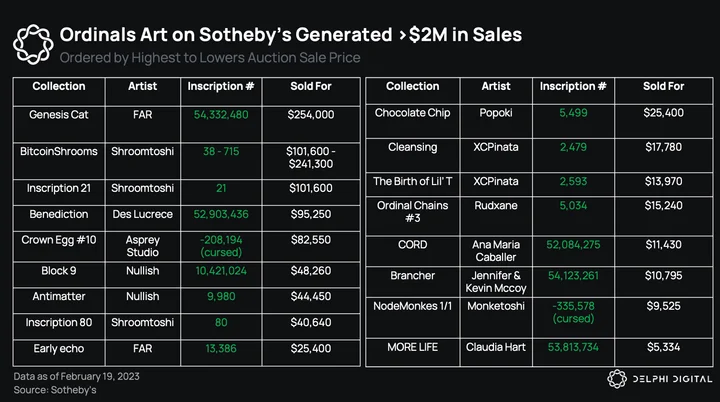
In a sign of robust demand for Ordinals art, Sotheby’s has conducted 2 successful Bitcoin Ordinals auctions in the past 3 months alone. The first was a series of 3 BitcoinShrooms, a pixelated recap of the first 13 years of Bitcoin and a homage to the 8-bit style of art. They were some of the earliest Ordinals, with inscription numbers <1,000.
Following the initial success, Sotheby’s auctioned off an array of artworks and rare sats, all of which were eagerly snapped up, often fetching prices well above their estimated values. The cumulative sales amounted to $2.4M, signaling a robust appetite for Ordinals art.
A deep dive into the auction results reveals some interesting trends concerning the valuation of these digital artifacts:
- Artworks with low inscription numbers are highly sought after, particularly those with numbers below 100. For example, an artwork inscribed simply as “Inscription 21” garnered a remarkable $101,000, largely due to its early provenance
- Even artworks with higher inscription numbers can achieve significant sale prices. The Genesis Cat stands out as the most expensive Ordinal sold at Sotheby’s to date, commanding a price of $254,000. Despite its high inscription number of over 54 million, its value was driven by its exclusivity as a one-of-a-kind piece within the Quantum Cats collection.
To sum it up, blockchain art is in its infancy. The unique attributes of Bitcoin provide a fertile ground for artists and collectors to explore and redefine the boundaries of digital art.
Bitcoin Metaprotocols
“Metaprotocols” has been a loosely defined term for protocols and token standards built on top of inscriptions. Multiple metaprotocols, like BRC-420, ORC-20s, BRC-69, have launched but all of them have been struggling to gain significant traction except for BRC-20. The release of Ord v1.0 marks a significant milestone by incorporating a formal metaprotocol field within the inscription envelope. This innovation streamlines the indexing process, enabling more efficient identification of specific metaprotocols without the need to examine each inscription one by one.
Aaron from our research team covered this in more detail in his Alpha Feed post
Examples of metaprotocols include:
- BRC-420 was developed by the Merlin Chain team and grants inscriptions a ‘royalty’ feature. Interestingly, the highest priced BRC-420 is a Blue Box which is a 10K collection at a 0.5 BTC floor price.
- BRC-1024 is designed to facilitate the creation of new metaverses on Bitcoin, placing a strong emphasis on metadata. This metadata, which provides detailed descriptions of virtual objects, is stored as text-based Artifacts on the Bitcoin blockchain. More details can be found on their website.
- BRC-100 extends the BRC-20 protocol by adding computing capabilities and states to tokens, thereby broadening their utility. This includes features like lending pools, airdrops, decentralized stablecoins, and governance protocols, with all BRC-100 extensions being interoperable across applications. Further information is available in their documentation.
Each metaprotocol is developing their own ecosystems, but it is early days with limited practical applications and usage so far. Other than Runes and BRC-20s, one such standard & community could be interesting to watch — Trac network
Trac Network & Tap Protocol
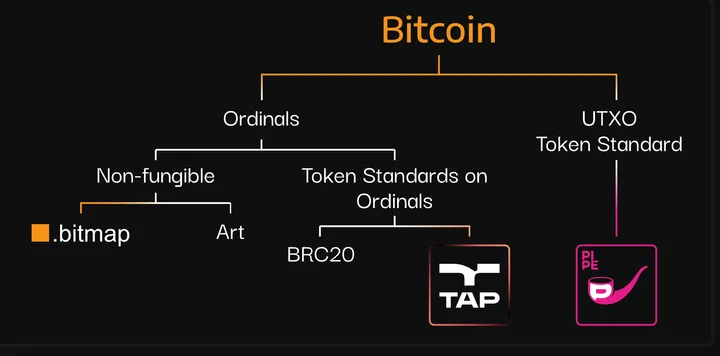
Source: Trac.network
Trac Network represents a comprehensive ecosystem of protocols and products, all emerging from a community rooted in the BRC-20 standard (TRAC, with a market cap of ~$100M) and spearheaded by the pseudoanonymous Bennythedev
Trac Core, the first product within Trac Network, aims to decentralize control of the Ordinals protocol by providing a decentralized indexer and oracle governed by TRAC holders. Ordinals and BRC20s heavily rely on indexers for functionality, with ord v0.9 being the predominant indexer. However, the introduction of ord v1.0, which disrupts BRC20s, has prompted many to stick with the previous version, underscoring the importance and challenges surrounding indexers.
Tap Protocol is the second product in the Trac Network. This protocol introduces the TAP token standard, aiming to simplify complex financial transactions within the Ordinals ecosystem without the need for Layer 2 solutions. Its unique “tapping” feature ensures the verification of transactions, thereby increasing both flexibility and utility. The Tap Protocol has also successfully secured $4.2 million in funding, with Sora Ventures leading the round.
The TAP protocol enables:
- Swapping and Staking: Facilitating the exchange and staking of assets.
- Liquidity Pools: Enabling the creation of pools for decentralized trading.
- Token Authentication: Allowing for the verification of tokens within platforms, which could be utilized as currency or items in games.
- TAP Art: Linking Ordinals with TAP protocol tokens to allow fractionalized ownership of valuable art pieces. This extension ensures the provenance of token deployment and Ordinal ownership is maintained.
- Multi-send Functionality: Offering users the ability to conduct multiple transactions simultaneously, streamlining the distribution of tokens for airdrops.
- Multi-asset Protocol: Supporting a variety of asset types beyond a single standard on the Bitcoin blockchain. It is also pioneering a new type of token called “Non-Arbitrary Tokens” or NATs
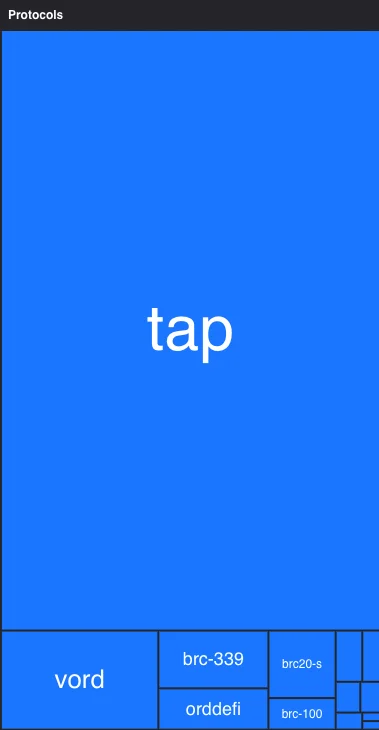
A look at GeniiData shows that amongst the metaprotocols besides BRC-20s and standard Ordinals, a majority of inscriptions minted each day are related to Tap. We also wanted to highlight trac & Tap Protocol because there are several airdrops happening:
TAP
Tap protocol will launch its token TAP via an airdrop over two snapshots. TRAC, the original ecosystem token, will receive 80% of the available airdrop allocation, while PIPE will receive 20%. Holders retaining their tokens between the snapshots will receive an additional 50% boost on the airdrop allocation.
The first snapshot is slated for February 28, distributing the airdrop on a pro-rata basis at the market launch of the TAP token. The second snapshot, planned for Q2 2024, will distribute a second batch of the TAP airdrop to TRAC & PIPE holders.
KARMA
KARMA is the token of the OnChainMonkey community, a prominent NFT PFP community on Ethereum that is migrating over to Bitcoin. It is uncertain what utility the token will have at this time. It is a vote of confidence that the OCM community decided to support TRAC and commits to being a validator in the decentralized sequencer. It is in the midst of its launch:
- 70% of KARMA tokens will be airdropped to OnChainMonkey NFT holders, TRAC and PIPE token holders
- 20% will be allocated for a token swap for TRAC. This was fully allocated and completed on Feb 20 and tokens will be available on Feb 26.
- 10% will be in the community treasury
For more detailed insights into Trac Network, we previously explored it here.
Other Noteworthy Projects
Liquidium: NFTfi on Bitcoin
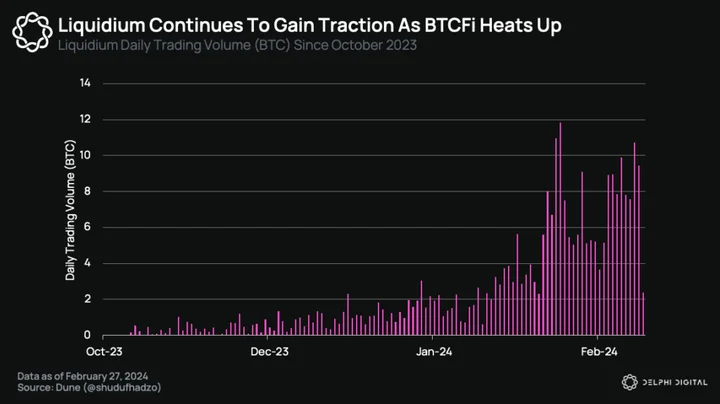
Liquidium is a peer-to-peer (P2P) lending protocol tailored specifically for Bitcoin, utilizing Bitcoin-based assets such as Ordinal inscriptions and BRC-20 tokens as collateral. This innovative approach is made possible through Partially Signed Bitcoin Transactions (PSBTs) and Discreet Log Contracts (DLCs), all executed on the Bitcoin network itself.
Similar to P2P lending platforms on Ethereum, borrowers have the flexibility to pledge their assets based on terms they find suitable, while lenders can choose to provide loans according to their risk appetite and time horizon. The platform operates with a take rate of 20% on borrowing interest.
Liquidium supports several popular collections on Ordinals, including Nodemonkes, Bitcoin Frogs, and OMBs. Lenders have the opportunity to earn a competitive yield on their BTC, with loan interest rates ranging from 65% to 100% APR.
Since its inception, Liquidium has facilitated a cumulative volume of over 201.5 BTC (approximately $10.49 million) across 4492 completed and active loans. Importantly, there’s a noticeable uptrend in daily loans, signaling increasing demand. A points program is currently underway, enabling users to earn points for participating in borrowing and lending activities on the platform.
BitSmiley – The MakerDAO of Bitcoin
BitSmiley is a Bitcoin DeFi protocol encompassing three DeFi verticals: stablecoins, lending, and derivatives. The protocol allows the minting of an over-collateralized stablecoin called bitUSD (based on the bitRC-20 standard), which introduces Bitcoin’s first native stablecoin, backed directly by BTC. The bitRC-20 standard offers greater functionality than the typical BRC-20 standard to support the operations of bitUSD. To mint more bitUSD, users must pledge BTC as collateral, similar to other collateralized stablecoins such as DAI on Ethereum.
Beyond stablecoins, the protocol is also aiming to launch:
- BitLending, which is a Bitcoin-native P2P lending protocol
- Credit Default Swaps (CDS) allow the bundling of loans and the evaluation of credit defaults based on various default rates.
Early inscriptions: Sub-10k
One final note: Historical provenance matters a lot on Bitcoin.
This is deeply ingrained in Bitcoin culture. The Ordinals protocol’s design underscores this cultural tenet, assigning a unique serial number to each inscription, thereby ensuring every digital artifact has a distinct and traceable history.
The genesis Ordinals inscription, with inscription number 0, was inscribed by Ordinals protocol creator Casey Rodarmor on December 14, 2022, which is part of a 9 piece Mexican-style pixel art called Dia De Pixales. It symbolizes the birth of the Ordinals protocol, marking a significant milestone in Bitcoin’s evolution.
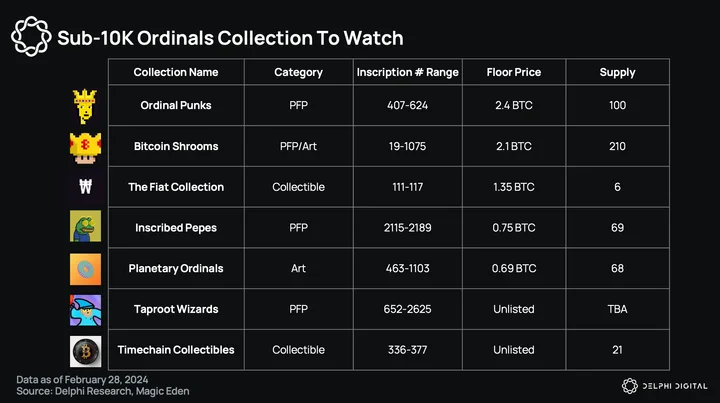
In the years to come, as inscription numbers go into the billions, grail collectors will likely be drawn to early inscription numbers due to their historical provenance. While a significant portion of sub-10K inscriptions consists of singular, random images, there exist several more cohesive collections among these early inscriptions that could attract collector interest.
These include (but are not limited to):
- Ordinal Punks: 100 Ordinals PFP inscribed within the first 650 Ordinals inscriptions
- Bitcoin Shrooms: 210 Pixelated mushroom art inscribed within the first 1075 Ordinals inscriptions
- The Fiat Collection: The earliest Ordinals collection to be inscribed onto Bitcoin, within the first 117 Ordinal inscriptions
- Inscribed Pepes: A collection of 69 1/1 “Pepe the Frog” inscribed within the first 2189 Ordinals inscriptions
- Planetary Ordinals: 68 On-Chain art collection inscribed within the first 1103 Ordinals inscriptions
- Taproot Wizards: 2121 Ordinals PFP inscribed within the first 2625 Ordinals inscriptions, led by Udi Wertheimer
- Timechain Collection: 21 Ordinals timepiece artifacts inscribed within the first 377 Ordinal inscriptions
To illustrate our point, Inscription #2, which depicts a dancing bird, was sold on February 28 for a whopping 24.48 BTC (~$1.4M), setting the record as the most expensive Ordinals inscription sold to date. It underscores the existence of serious collectors willing to invest heavily to own a piece of early Ordinals history. Looking ahead, it’s conceivable that modern art museums might begin to acquire and exhibit digital artifacts from Bitcoin that hold significant cultural and historical value.
A full list of sub-10k Ordinals collections can be found here. Additionally, our previous coverage of Ordinal Punks, Bitcoin Shrooms, and Taproot Wizards can be found here
Conclusion
There has never been a more exciting time to explore Bitcoin.
Despite Bitcoin’s status as a trillion-dollar asset, much of its capital has remained passive until recently. Yet, a growing segment of users is now actively engaging within the Bitcoin ecosystem.
Ordinals kicked things off, spurring development activity on a chain that was largely dormant. Today, Bitcoin’s landscape is vibrant and diverse, bustling with memecoins, digital art, profile pictures (PFPs), Layer 2 solutions, and DeFi offerings. It feels a lot like the explosive growth experienced on Ethereum between 2020 and 2021.
The spotlight on Bitcoin remains bright, with ongoing developments that will continue to keep it in the news. Builders are united in the pursuit of sustainable transaction fees for Bitcoin. The launch of Runes at the Bitcoin halving in April will be a key event to watch for.
Make no mistake: 2024 is poised to be a massive year for the Bitcoin ecosystem.
0 Comments