
Introduction
2023 will go down as one of the most important years in Bitcoin’s history. Bitcoin Ordinals kicked off an entirely new concept and Bitcoin sub-market. Bitcoin L2’s, sidechains, and scaling solutions experienced renewed interest from market participants. Traditional financial markets began to see Bitcoin as a serious and valid asset class, with firms submitting a dozen spot BTC ETF applications in 2023, with many ETFs approved at the start of 2024. Most importantly, however, Bitcoin looks to be climbing out of one of the worst bear markets crypto has experienced. Bitcoin has weathered the storm of the collapse of Luna, FTX, Voyager, and Celsius and emerged more robust than ever with renewed interest, vigor, and tech. In a word, the state of Bitcoin is exciting.
This report will focus on a few key trends and areas where we think Bitcoin has shined in 2023. Readers should not view this report as an exhaustive list of every Bitcoin development in 2023, as there were too many to count and track. There are thousands of individuals working on their own Bitcoin vision. Whether it be Bitcoin micropayments through Lightning, inscription marketplaces, a Bitcoin sidechain, or working on bringing BTC onto other chains, Bitcoin had a feverish level of development in 2023. The ossified Bitcoin we saw in 2021 and 2022 seems to be a thing of the past.
The Network
The first area we want to focus on is how exactly Bitcoin as a network is functioning. Crypto enthusiasts can be forgiven if we sometimes forget that Bitcoin is more than the price of BTC. Bitcoin is the world’s largest decentralized monetary network, so it’s important to monitor the networks’ health closely. On some level, purchasing BTC is a bet that Bitcoin’s monetary network absorbs more users and capital. Without growth, Bitcoin will fizzle. Thankfully, almost everything with Bitcoin’s network was up and to the right in 2023.
The hash rate in 2023 was a surprise. Because of Bitcoin’s relatively poor price performance in 2022, we were surprised to see the hash rate continually breach all-time highs through 2023. Since the beginning of 2022, Bitcoin’s hash rate has doubled. Bitcoin’s hash rate is important to watch for two reasons:
1. It is a proxy of how secure Bitcoin is. Generally, the higher the hash, the more secure Bitcoin is (assuming the hash is coming from new miners and not all existing just adding more).
2. A higher hash signifies miner confidence in the network. If mining were not profitable or soon to be, we would expect to see the hash rate decline.
The number of active Bitcoin addresses took a massive hit in 2021 from its peak of 1.15M addresses. More than 300K users disappeared in a few weeks as the price of BTC stalled out. Even hitting a new ATH in November 2021 didn’t bring back Bitcoin’s lost users. Active Bitcoin addresses remained flat throughout all of 2022. But in 2023, we saw an increasing trend of active Bitcoin addresses. However, going into 2024, the growing trend looks to have stalled out, with active addresses remaining steady at around 1M.
In 2023, we have seen an improvement in Bitcoin’s fee revenue. Bitcoin has a problem. The problem is that at some point in the future, Bitcoin’s fees will need to replace its block rewards to continue paying miners to secure the network. Unfortunately, Bitcoin’s fee revenue has historically been far too low to replace the block rewards. But 2023 brought some renewed hope in solving this challenge.
Inscriptions and renewed demand for blockspace have had massive effects on Bitcoin. First, we see a considerable fee spike at the beginning of the year. After the initial spike, fee levels calmed, but there is still a notable uptick in fees.
The significant development helping to solve Bitcoin’s fee challenge is inscriptions. We will discuss them at length later, but at the root, inscriptions allow users to store any arbitrary data on Bitcoin. Just like regular transactions, users must pay a fee to inscribe the data. This small technical development has led to an explosion in Bitcoin blockspace demand. In early 2023, people were inscribing thousands of sats with data. Then, people figured out how to create a simple token standard, BRC20, using inscriptions, which resulted in even more demand for blockspace. There has been such massive demand for storing data on Bitcoin that the mean block size nearly doubled in 2023.
We can easily see the demand for blockspace in Bitcoin’s mempool. Starting in Q1 2023, Bitcoin’s mempool exploded. The mempool was suddenly clogged with thousands of transactions trying to get their inscriptions inscribed on sats. Fees briefly plummeted again when a front-running bot killed off the ability of users to create BRC20s (more on that later), but the mempool is already getting crowded again. A crowded mempool could be a godsend for struggling miners, but it was greeted with dismay by those who were priced out of making small transactions. For some, the chain became nigh unusable.
Inscriptions pricing out smaller BTC transfers is almost certainly why we see Bitcoin transaction volume collapse after their release. Bitcoin’s tx volume, which measures the total amount of successful BTC transfers on the chain, is down to levels not seen since 2020 and looks to continue decreasing.
The increase in demand and fees from inscriptions has led Bitcoin to have the lowest FRM we have seen in a while. The FRM, or Fee Ratio Multiple, measures the multiple of fees a chain would need to replace its block reward. The lower the FRM, the better. In 2022, Bitcoin’s FRM hovered between 40x-120x, meaning Bitcoin would need between 40 and 120 times the fees to replace the block reward. A surge in inscriptions has begun to bring that number down. In 2023, the FRM plummeted from 80x to between 12x and 40x, closer to how Bitcoin was between 2020-2021. The lower FRM level is a lot more promising, and if you’re a long-term believer in Bitcoin, you want to see that downward trend continue.
Bitcoin’s network stats paint a vivid picture – primarily of heavy use. It seems like Bitcoin is evolving past the HODL meme into one people use often. When inscriptions first hit the market, we predicted we would see precisely what we see now. Blockspace demand for Bitcoin has created a new source of fees and users for the chain. Thanks in part to this new source of fees, the network is as secure and busy as ever. Despite some naysayers, in 2023, inscriptions have proved to be a boon for the chain.
However, we think it necessary to note that an FRM between 12x and 40x is still high. Bitcoin still faces challenges around its security model and what it will do when the block rewards end. But inscriptions are a step in the right direction. If the Bitcoin community can find a few more sources of fees, Bitcoin’s future looks promising.
Bitcoin Entities
Although one of the most decentralized cryptocurrencies, large entities and institutions still have an outsized effect on the chain. To get a complete picture of Bitcoin, we need to analyze how some of the largest BTC holders act.
Exchanges
One of the most common metrics analysts like to discuss is the exchange BTC balance. The reasoning is simple: Since nearly all of BTC trading happens on centralized exchanges, less BTC on exchanges means less BTC to buy, leading to a shortage of supply and presumably a BTC price increase. On that note, 2023 has continued a trend that began during the COVID-19 crash of 2020. Namely, BTC has been flying off exchanges. BTC on exchanges is around levels we have not seen since 2018, with just north of 2M BTC on them.
There have always been rumors of exchanges rehypothecating BTC. And after the implosion of FTX, BTC will likely continue to fly off exchanges as BTC holders become less willing to trust centralized entities with their precious coins. The explosion of ordinals also likely played a role in this trend as well.
Checking In On Miners
Next, we are looking at miners in our tour of Bitcoin entities. Bitcoin miners are a fundamental part of the Bitcoin ecosystem. Without industrial-scale mining, Bitcoin would be much less secure. But security doesn’t come cheap. The network pays miners in BTC for their security. Because of this, miners rely on BTC for OPEX, which can be a source of significant BTC selling pressure. Not only that but what miners do with their Bitcoin signals their market stance – if there is substantial selling, it could signal belief in a downward trend. If miners hold Bitcoin instead, they believe the price could increase.
In 2023, miners generally held more Bitcoin than they sold. Albeit not by much. Miners sold a significant amount of their Bitcoin during the collapse of FTX, but starting in 2023, they have begun to stockpile BTC again – although have been selling into Q4 of 2023 and Q1 of 2024.
Several large mining companies are publicly listed, and any analysis of the state of Bitcoin mining should look into these companies as well. If mining companies operate at significant losses, Bitcoin’s security will suffer as they shut down their machines.
Regarding miner performance and longevity, it is most important to look at their revenue. Bitcoin miner revenue consists of two separate streams – the block reward and fees. As we are sure readers know, Satoshi programmed Bitcoin to reward miners with BTC every block, which we know as the block reward. Roughly every four years, however, the block rewards halve. Known as the Halving, people often view the reduction in block rewards as a significant positive catalyst. Miners, however, are probably viewing this next halvening with some trepidation.
The majority of BTC miner revenue has always come from Bitcoin block rewards. Looking back to 2016, we see that miner revenue from fees is often a fraction of the block rewards. Fees sometimes account for less than 1% of miner revenue and have, since 2016, rarely been above 10%. Inscription fees probably give miners some hope, but it is doubtful that fees from inscriptions will solve Bitcoin’s fee struggles.
Unless the price of BTC increases dramatically, miner revenue will get hit hard. Bitcoin doesn’t yet have the fee pressure to replace the almost 450 BTC reduction per day that the Halving will hit them with. Since the last halving Bitcoin has only generated on average about 50 BTC per day in fees – 1/9th of what miners will lose in the Halving. In a very real way, the Halving will cut miner revenue in half.
Interestingly, the Halving makes inscriptions even more critical for Bitcoin’s long-term success. With block rewards getting halved around April of 2024, fees represent an even more significant portion of miner revenue than before – and as a new and significant source of fees for Bitcoin, inscriptions will be more important than ever. Since February of 2023, when inscriptions started to take off, they have come to represent a significant portion of Bitcoin’s fee landscape. On average, inscriptions alone accounted for about 13% of Bitcoin’s fees. Sometimes, during intense competition, inscriptions can account for more than a quarter of the fees. At one point in 2023, inscriptions even made up 60% of Bitcoin’s fees.
Given that Bitcoin block rewards are halving, inscription fees will become even more critical to miners looking to make ends meet. To that end, we expect miners to become strong advocates for the burgeoning inscription ecosystem.
Institutions and ETF Applicants
2023 saw the emergence of a new class of Bitcoin entities which people should be aware of: the traditional institution. 2023 was the year Bitcoin grew up. No longer just for anarchists, libertarians, degens, and rebels, well-regarded, reputable firms are lining up to bring Bitcoin to traditional markets for the first time in its history. For the first time, ‘serious’ investors consider BTC a reasonable asset.
In 2023, we saw significant developments between Bitcoin and institutions that we recommend people stay abreast of. We will expand on the Bitcoin ETF approvals and how they have been performing in a market memo for Pro subscribers this week.
For those who already hold spot BTC or have other crypto, a Bitcoin ETF may not seem like a big deal. However, a spot Bitcoin ETF trading on traditional stock exchanges could significantly impact the currency. The first ramification for Bitcoin is that a spot ETF is a strong signal that Bitcoin, and by extension, the rest of the cryptocurrency market, is a serious asset class. Before a spot ETF cryptocurrencies are in a sort of grey state. Many investors consider them a legitimate asset class, but many do not – Warren Buffet famously called Bitcoin rat poison. A spot Bitcoin ETF, managed by well-regarded firms like VanEck or Blackrock, is a strong signal that Bitcoin has transitioned from to a serious asset class at home in grandpa’s and grandma’s 401K. Interestingly, the CME overtaking Binance in terms of OI, is another signal that markets are taking this asset class more seriously.
Secondly, and more importantly to most, is that a spot Bitcoin ETF opens the doors to a flood of capital. As we mentioned, many capital allocators cannot invest in Bitcoin. Rules and regulations may preclude them from transacting with crypto exchanges, and existing custody solutions may not be suitable. But a spot ETF managed by reputable firms and trading on well-regulated stock exchanges opens the door to almost everyone. Investors can buy the ETF through a bank, financial app, a company 401K, and more. A spot Bitcoin ETF puts Bitcoin firmly in the mainstream and opens the coin up to a vast pool of liquidity.
Readers can see an excellent example of what a spot ETF could mean for Bitcoin in how the price of gold behaved after spot gold ETFs came to market. The first gold ETF entered the market in 2003 when gold was trading at around $650 an ounce. Gold ETFs opened the gates to a massive influx of capital, and now gold is trading at $2000 an ounce, an increase of more than 3x. A spot Bitcoin ETF could have the same effect on the price of BTC – hence why people are watching this process closely.
The Bitcoin [R]Evolution
One of the most interesting things to happen to Bitcoin in 2023 was Casey Rodarmor developing and releasing inscription tech onto Bitcoin. Inscriptions use taproot to allow users to store any data on Bitcoin, with the data tied/inscribed to a specific sat. Users can transfer the data by simply sending the inscribed sat with the data to a new address. The market quickly adopted inscriptions, and in early 2023, we saw users flocking to Bitcoin to inscribe sats with data – as of this report, there are more than 59M inscriptions on Bitcoin.
The Early Inscription Market
The early inscription market mirrored the Ethereum NFT market. Inscriptions are also colloquially known as Ordinals because of a quirk in the technology. Unlike the more well-known Ethereum NFT market, inscriptions are ordered; hence, they are sometimes called Ordinals. There is a 1st inscription, a 5th inscription, and a 5537th inscription. The ordered nature of BTC inscriptions led to a gold rush-like fever where people rushed to inscribe the lower-numbered inscriptions with anything possible. The inscribed data mattered less than the ordinal number in the early market, which led to many AI-generated images, copies of NFTs, and other data stored on Bitcoin. The initial stages of inscriptions were a fun, chaotic rush to get those early inscription spots.
The inscription rush had a few key psychological levels of inscription numbers before it petered out. The levels were 1K, 10K, 100K, and 1M. There are now north of 59M inscriptions, so the inscription’s order now matters less. Some market participants still believe that the first inscriptions will command a premium. Some collections were early hits, like Bitcoin Punks, an Ordinal copy of CryptoPunks on Ethereum that the team inscribed between 89 and 34,399. But, the fever for those early inscriptions has since been supplanted by BRC20s. That being said, those early inscriptions will always have a place. They could become future collector items or digital artifacts – especially if inscriptions become even more popular or important to Bitcoin’s future.
To that end, there have been some notable successes in Bitcoin’s Ordinal market that people should note. Sotheby’s, the famous auction house in New York, recently completed an auction of Bitcoin Shroom Ordinals. The three items sold for between $101K and $241K – 3x-5x what Sotheby’s estimated they would sell for. Other notable collections include Taproot Wizards, OCM, the first collection to use recursions, and Ordinal Maxi Biz. Taproot Wizards, particularly, seem attractive as they are capitalizing on an early meme of Bitcoin, namely the magic internet money wizard. Regardless, the Ordinal market has emerged as an exciting place for collectors, and NFT enthusiasts should pay attention to this area, even if BRC20s have mainly overshadowed it.
The BRC20 Chain?
Inscriptions came into their own when anonymous Twitter developer Domo pushed a simple token standard using Bitcoin inscriptions. Called BRC20s, this simple approach to tokens has created a subsector with a market cap north of $1B and has come to make up the vast majority of inscriptions.
BRC20s are super simple. They are JSON text files that users inscribe to sats that describe one of three token functions: deploy, mint, and transfer. Initially, a user deploys a token by inscribing a sat with the token parameters, including a four-letter ticker, amount of tokens, and mint amounts. Other users can then mint the tokens in clips specified in the deploy inscription. For example, if a user deploys a token with a 10K supply and a mint parameter of 1000, the first ten mint inscriptions will mint the entire supply. The market simply ignores any mint inscriptions above the supply cap. Finally, transferring tokens is a simple text inscription that specifies the ticker, token amount, and receiving address. From these simple functions, a billion-dollar industry has now emerged.
It is hard to overstate how much BRC20s have overtaken the rest of the inscription markets – they are not even in the same league. We can see in the chart above that BRC20 transactions far far outnumber other sorts of inscription transactions. On some days, BRC20 inscriptions even outnumber normal Bitcoin transactions.
For a brief period in late 2023, it looked like the BRC20 craze was over. New BRC20 mint and deploy transactions cratered to zero. However, the reason was not that the market didn’t want BRC20s. Instead, someone skeptical of BRC20 created a bot to front-run any BRC20 deployment transaction and set the total supply to 1. The bot essentially shut down all new BRC20 mints and looked set to kill the market. But, eventually, the bot ran out of BTC for transaction fees, and the BRC20 market exploded back to being just as popular as before.
The Fee Question
As we mentioned before in the article, Bitcoin miners and Bitcoin’s security are suffering from a lack of fees. And BRC20s are an important new source of fees for Bitcoin. But, as I am sure readers can surmise from the above graphic, one shouldn’t consider BRC20 fees a silver bullet to Bitcoin’s fee challenge. BRC20s and Ordinal fees still account for a small, but growing portion of Bitcoin’s fee landscape.
Unfortunately, BRC20s and Ordinals could be causing overall BTC transaction volume to decline. As we mentioned before, block demand has pushed the floor on fees upwards, which has priced out smaller transactions. As such, BTC transactional volume plateaued, even while the mempool explodes with high fee transactions.
BRC-20 Metrics
The BRC20 market has been an interesting one to follow through 2023. Over 56k BRC-20 tokens have been deployed. However, as each BRC20 token only requires a single deploy transaction, deploys are outnumbered by mint and transfer transactions. Mint transactions, in particular, make up a colossal part of the BRC20 market – which is not surprising. In general, mints are entirely free, except for the transaction fee. When someone deploys a token, they specify the amount users can mint in a transaction. $ORDI, for example, allowed users to mint them in groups of 1000. The nature of this minting process means whenever a new token hits the market, people rush to mint it as it’s free. Of course, as mints are the most popular transaction type, they account for most fees.
As mints are basically free and there is little downside to minting any new token, transfer transactions are the best barometer for activity in the BRC20 market. BRC20 transfers tx are essential to track as they denote some level of buying and selling. So far, BRC20 marketplaces function like auctions, so if tokens are purchased or sold, there will be a transfer transaction. Transfers become a marker for volume and activity. Transfers exploded with the first mini-bull market, with often more than 10K transactions per day. BRC20 tx volume died off in June but started recovering in November.
However, the transfer amount suggests BRC20’s a small market with participants focusing on minting and holding tokens. Minting transactions are roughly 10x transfer transactions. Those who mint tokens seem more interested in holding them than selling them for a quick flip.
A New Term: $ORDI Dominance
Although there are thousands of tokens and more if we include the various non-BRC20 standards, $ORDI dominates the market. Due to the particulars of BRC20 trading, accurate market caps are hard to find. Except for $ORDI, most BRC20s trade through auctions on marketplaces like Unisat. The auction mechanic creates an odd situation where we can get wildly inaccurate numbers if we extrapolate a token market cap by a few auction sales. As such, some websites claim the BRC20 market is an unbelievable $11.2T, or we see tokens with no volume at a market cap in the hundreds of millions. Thankfully, with $ORDI trading on Binance and OKX, we can get a more accurate market cap for $ORDI at $1.3B.
But, the market is bigger than $ORDI. Other popular BRC20s still trade primarily through auctions like $SATS, $MEME, or $DOMO, which we need to account for. Unfortunately, looking at them through a market cap lens is inaccurate. So, instead of market cap, we can get an idea of $ORDI’s importance to the BRC20 market by looking at popular transactions.
One of the trends in the BRC20 market is that someone will release a new token, which people will rush to mint. But once minting is over, transactions collapse, and no one trades it. There are 56K BRC20 tokens, with almost no transactional volume after the initial minting rush. These ‘dead’ tokens are of little importance. So, when we look at transactions, we see that $ORDI is one of the few tokens that has maintained any sort of transactional volume post mint. We can also look at the fees as another barometer for popularity. There have been 140K $ORDI transactions, and around 23 BTC has been paid in fees for this single token. The next comparable token is $MEME, where we see 114K transactions but only around 4.8 BTC in fees. The difference between those two is that $MEME transfers died off quickly after the initial rush to mint.
$ORDI’s popularity also meant it was the first BRC20 listed on CEXs. CEX listings are often a good sign for a token as they signal legitimacy and bring it to a much more liquid marketplace. After getting listed on Binance, $ORDI went on a legendary run to new ATHs. In October, $ORDI was trading at around $4. As of the writing of this report, $ORDI hit an all-time high of $82. Impressive performance for a token with no utility beyond memes and collectibility.
The performance of $ORDI is a strong market endorsement for BRC20s. CEXs are often fairly agnostic on technology – they care about fees. With $ORDI proving demand for BRC20 trading, more CEX BRC20 listings seem likely. Only time will tell whether it takes the form of other CEXs listing $ORDI or OKX and Binance listing more BRC20. But it looks like it’s coming.
The Ordinals Markets
Exchanges and marketplaces are areas where BRC20s and Ordinal Inscriptions offer some opportunity. BRC20s and inscriptions are proving to be popular. There is money to be made by exchanges and marketplaces. What we saw happen with ERC20 token trading and the competition between various DEXs and CEXs will probably happen with BRC20s – and to the victor go the spoils.
So, who is winning the Ordinal marketplace war? It’s too early to tell. Early Ordinal enjoyors used Discord OTC trading to swap these items. However, a few platforms like Ordinals Wallet, Ordswap, and Open Ordex quickly filled the gap with workable platforms. Newer entrants like Unisat, Magic Eden, and OKX have overtaken the early markets. OKX has been a smash hit here, but with Binance recently entering the BRC20 market, we guess they will overshadow them. So far, OKX has commanded the BRC20 market in terms of both raw transactions and volume.
One area where OKX is really outperforming its competition is in onboarding new users. OKX’s lead could change if Binance releases some data, but OKX has brought many people to the market for now. The normal trend we have been seeing for onboarding unique users to exchange is an initial user explosion, which quickly plateaus. Users flock to a new exchange, but there is little new growth once the novelty wears off. OKX, however, has been an outlier here. They are attracting users to the BRC20 ecosystem in leaps and bounds. Of course, onboarding users through a CEX will always be more accessible than something like Magic Eden or Unisat, which require wallets. For now, though, OKX is killing it – of course, Binance could change this dramatically.
Of course, there is room for more than one exchange in the market. In particular, the DEX landscape is still up for grabs by an ambitious project. Who will build the first Uniswap of BRC20s?
The Culture Question
It is important to point out that BRC20s and Ordinals are not without controversy. Bitcoin and Bitcoiners are famously skeptical of additions to Bitcoin core protocol. They are even more resistant to a new addition that alters Bitcoin’s primary purpose of being the world’s hardest money. Ordinals and BRC20s are no exception.
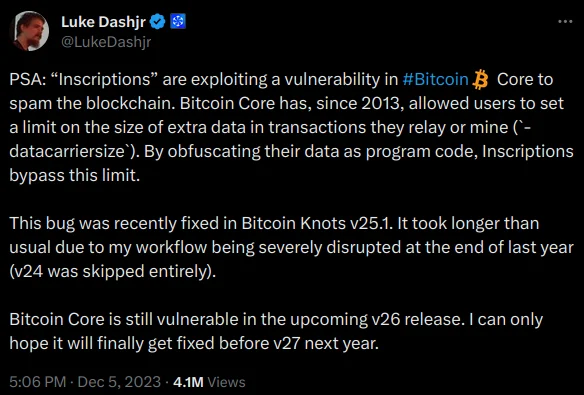
Ordinals a bug? Luke Dahjr thinks so.
Many Bitcoiners view Ordinal and BRC20s as spam, actively harmful to the chain, and a departure from Bitcoin’s core premise. However, despite their misgivings, Bitcoin is a neutral permissionless platform, and because it’s so decentralized, turning Ordinals ‘off’ is nigh on impossible without spending years convincing everyone that they are bad for the chain. And given that the market for Ordinals has quickly ballooned past $1B, Bitcoin ‘turning off’ the ability for Ordinals and BRC20s seems unlikely. Additionally, miners will probably become strong advocates for the technology with the halving coming and cutting block rewards in half. They will need to block demand and the ensuing fees to help make up for the loss of revenue.
Regardless, though, we expect Ordinals to remain controversial and some Bitcoiners to continue to hate them. But, because the incentives and market around them are so strong, they are probably here to stay. While drafting this report, the US government added Inscriptions to their National Vulnerability Database, reasoning that it is an exploit because Ordinals bypass data carrier limits by obfuscating data as code. Being in the Database doesn’t mean the market will instantly consider them as such, but this makes their future more uncertain.
Further, Ordinals have brought up an even more pertinent cultural debate for Bitcoin, one which, in retrospect, will probably be as monumental as the Blocksize Wars between 2015 and 2017. Ordinals have reignited interest and conflict about changes and development to Bitcoin. The debate around Ordinals goes to the core premises of Bitcoin. Is Bitcoin only for BTC transactions? Does Bitcoin’s permissionless-ness mean users can use it any way they want? Who makes decisions about how people can use it? Is it even reasonable to cut out certain use cases and prioritize others? There are no easy answers to any of these questions, and responses reflect someone’s values and perspectives around Bitcoin rather than any sort of special access to the fundamental ‘truths’ of the chain. Bitcoiners are unlikely to resolve this debate anytime soon, and we expect it to carry on well into 2025.
Bitcoin DeFi & Scaling
DeFi
For a deep dive on the state of Bitcoin DeFi and challenges we’re going to link our ZetaChain report from December. Be sure to give that section a read if you are interested in this particular area of Bitcoin.
Lightning
Lightning adoption stalled out in 2023 as the Bitcoin-as-a-neutral-payment-rail narrative petered out and never really came to fruition. Spending sats or BTC is a bit of a pain due to tax laws, conversion, and volatility – especially in a world with decent payment rails like Visa, Mastercard, e-transfer, USDT on Tron, physical cash, or a myriad of other approaches. Granted, Lightning tried to mitigate the challenges of BTC payment use with TARO and Lightning stablecoins, but it never really took off compared to different approaches. Lightning has been a decent product, but it has struggled to find a use case.
Because Ordinals and BRC20s push fees up, Lightning could find its product-market fit in basic BTC transactions, not as a payment rail. Lightning can easily handle smaller BTC transactions and could be the tech that allows BTC and Ordinal enthusiasts to coexist in relative peace.
As Lightning may become key to Bitcoin maintaining its Ordinary ecosystem and lower-cost transactions, we are curious about where Lightning stands after a year of ordinals and how it may change by the end of 2024. To that end, 2023 was a neutral year for Lightning.
Lightning has managed to maintain its overall capacity in 2023. At a high level, Lightning works by allowing users to create off-chain channels to transfer BTC without settling it on the main chain. Once the channel is closed, Lightning settles the transaction on the chain. Users must allocate a certain amount of BTC to the channels, giving Lightning a transfer capacity. In 2023, Lightning’s capacity – the amount of BTC in channels available for transactions- has remained relatively steady, which is a good sign for the network.
Secondly, the number of Lightning nodes that run the Lightning channels has started to recover from its lows in 2023. The more nodes, the more decentralized and secure Lightning is. Based on these stats, Lightning is well-situated to have a good year.
Rollups and More
Bitcoin rollups are seeing a lot of interest and funding recently. Today, we had the announcement of Citrea. This is a zk-rollup incubated by Chainway that uses the BitVM. We are sure to see more announcements in this area moving forward and it’s one we will dig further into in 2024.
Secondly, the renewed interest in Bitcoin scaling during 2023 brought about the reemergence of the Bitcoin Drivechain proposals. At root, Drivechains would allow people to temporarily lock their BTC on the main chain and then release it on a sidechain. Like other sidechains, drivechains could offer users low-cost payment transactions or smart contracts. Some experimental Drivechain projects are already in the works, like Zside, which brings privacy to BTC transactions, and ETHside, an Ethereum sidechain clone.
Onto 2024
Ordinals have shaken Bitcoin to its core. The Ordinal crypto sector emerged from nowhere early in the year, allowing users to store any data on a Bitcoin sat. From its humble beginnings with people inscribing PFPs and important Bitcoin cultural artifacts on the chain, the Ordinal ecosystem is now worth over $1B. It has supporting CEXs and marketplaces, a popular token standard, and protocols looking to build on top of the tech. However, not everyone is thrilled. Many Bitcoiners view Ordinals and BRC20s as a vulnerability and ‘shitcoinery.’ Skeptical Bitcoiners would prefer that developers patch away Ordinal tech and everything surrounding it. The community is still grappling with the debate around Ordinals, and we think it will likely continue well into 2024 and potentially into 2025.
Perhaps more important to Bitcoin was the range of ETF applications institutions submitted to the SEC in 2023. No less than twelve reputable firms asked permission from the SEC to offer spot BTC ETFs to traditional markets, and in Q1 of 2024, approved. The ETFs opened Bitcoin to many new inflows and market participants. Not bad for an asset that you used to be able to get for free and which began its life on some small cryptography forums.
2023 was a massive year for Bitcoin, and 2024 looks poised to continue these positive trends. We look forward to seeing where it goes.
0 Comments