🔍 Base by Coinbase
Last week, Coinbase launched the testnet for Base, a layer-2 network built using Optimism’s open-sourced OP Stack. The exchange can leverage its strong and trusted brand to introduce the on-chain experience to retail consumers, having already introduced crypto trading to more than 110M verified users. The exchange can also nudge its vast institutional clientele, having already onboarded 25% of the top 100 largest hedge funds by AUM.
To understand Base, you need to first understand Optimism (OP) – a layer-2 optimistic rollup chain. Okay, but what does that even mean? Optimism is called a layer-2 chain because it is built on top of Ethereum, using the latter as the base layer to settle transactions. This allows the chain to inherit Ethereum’s iron-clad security. Optimism is called optimistic because it cheerfully assumes that all transactions are valid unless challenged otherwise. Optimism is called a rollup because it bundles up hundreds of transactions before posting them all on Ethereum’s mainnet in a single transaction. This allows the chain to socialize gas costs and offer cheaper ways to transact.
Alongside Arbitrum, Optimism is one of the two largest layer-2 chains that aim to scale Ethereum as the base layer. Combined, they account for over 80% of the total value locked across all L2s. After launching in 2021, both L2s experienced a dramatic rise in adoption, recently surpassing Ethereum in combined daily transactions.
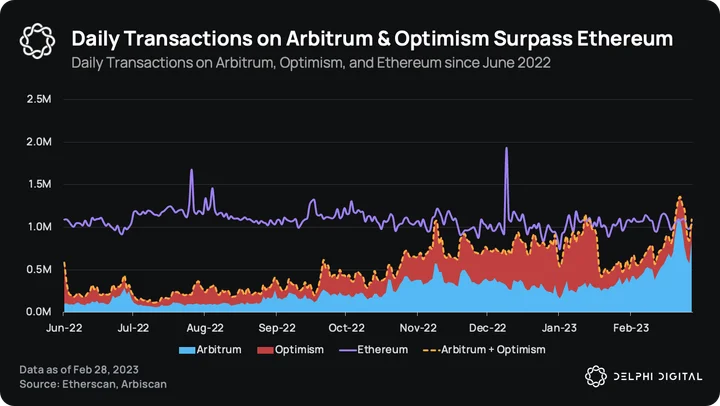
Combined daily transactions on Arbitrum and Optimism have surpassed Ethereum on five of the previous seven days. Daily transactions on Optimism have increased by 21% since the start of 2023, despite dropping by -60% on Jan. 18, 2023, when the Optimism Quests program ended.
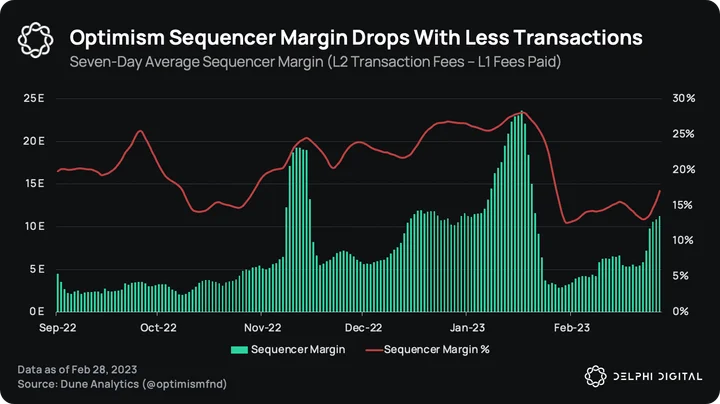
Optimism runs a sequencer, which does all the dirty work of rolling up transactions and posting them to Ethereum. The sequencer earns fees from L2 transactions and pays gas fees to settle them on the L1. The margin is the difference between the two. Alongside transactions, the sequencer margin is also down from a peak of 28% on Jan. 18, 2023, to the current 17%.
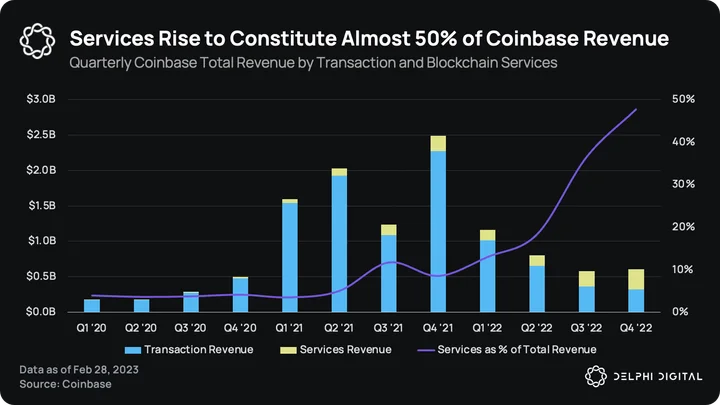
Now let’s examine Coinbase. Crypto exchanges are highly cyclical businesses that suffer during bear markets when asset prices are sliding and there isn’t too much activity. In its latest quarterly filing, Coinbase’s total revenue was down -76% year-over-year from $2.5B to $605M. However, the company has a lot going for it. For one, the FTX collapse has eliminated one of its largest competitors and the SEC’s recent actions against Paxos has Binance rethinking its US presence.
Although the company is largely recognized for the exchange platform, it also provides ancillary services such as delegated staking, the USDC stablecoin, payment service, debit card, and subscription services. In its latest quarterly filing, these ancillary services constituted 47% of the total revenue, up from 9% in the same quarter last year. In large part, this is a result of cratering trading fees from the exchange side in the face of a brutal crypto bear market. As interest rates increase, the risk-free yield earned on USDC balances has become a rather important component of the services revenue.
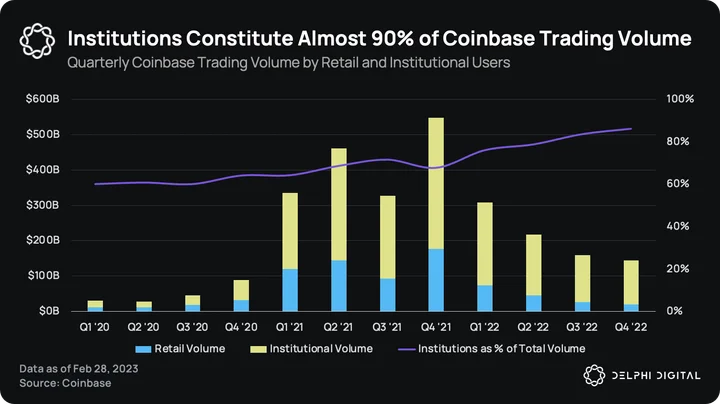
On the exchange side, the company’s business model depends on charging transaction fees to retail users. In its latest quarterly filing, retail users accounted for only 14% of the trading volume yet brought in 96% of the transaction revenue. This is a secular trend where institutions have been contributing a larger and larger share of the trading volume, rising to 86% from 68% in the same quarter last year.
Seven years ago, the company’s founder Brian Armstrong put out a masterplan that outlined the growth of crypto into four phases. These include:
- Develop new protocols like Bitcoin, Ethereum, etc.
- Build an exchange to facilitate trade
- Build mass-market interfaces for dApps
- Build the dApps to power an open financial system
The launch of Base falls somewhere between phases three and four. Coinbase will incubate Base by building open-source infrastructure and deploying applications on top. However, the chain itself will be permissionless, allowing anybody to deploy.
Base is a fork of the OP codebase. The Base team chose Optimism as the EVM offered the “path of least resistance” and OP’s codebase enabled a fast path to launch. The Coinbase and Optimism teams had already been working together for more than a year, and contributed heavily to the development of EIP-4844. Also called Proto-Danksharding, EIP-4844 will decrease L2 transaction fees by 10-100x. Coinbase is now a core contributor to the OP Stack as well, joining as the second core project team.
This furthers Optimism’s vision of being a super-chain, where the OP codebase is continuously forked to create new chains that are optimized for different use cases. These new chains, such as Base, will have seamless interoperability with one another since they all use the OP Stack. The OP Stack provides standardized, open-source modules for layer-2 chains to provide shared security, composability, and coordinated sequencing of transactions.
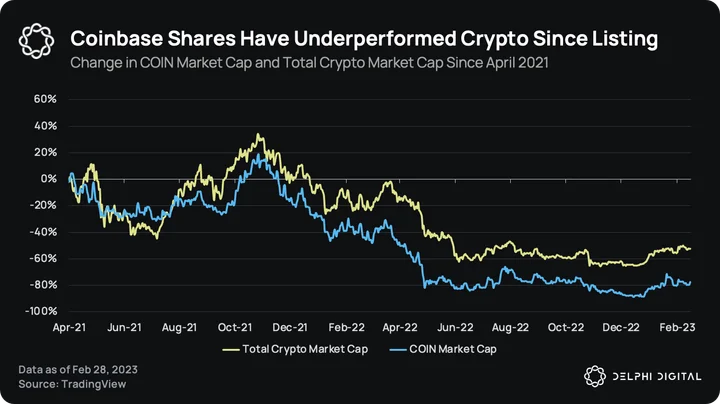
There is no plan for a BASE token. Coinbase doesn’t need a token to incentivize usage of its chain as it already has a colossal user base. ETH will be the native gas token of the chain, with plans for account abstraction enabling users to pay fees with whatever coin they want. However, there are COIN shares listed on Nasdaq. Since the company’s listing in April 2021, the stock has closely tracked and under-performed the total crypto market capitalization. However, the stock is up 82% since the beginning of 2023 while total crypto is up only 36%. Currently, the exchange trades at 3x the cash and cash equivalents reported in its latest quarterly filing.
📅 This Week in Delphi Research
Inside the Leading PFP Ecosystems
PFPs were among the earliest use cases for NFTs, designed to be used as online identities. Today, PFPs represent 70% of the total NFT market cap. But the success of a particular PFP collection extends to factors beyond just its aesthetic appeal. In this report, YH explores three major PFP ecosystems – Azuki, Clone X, and Doodles, and delves into how they are positioning themselves for success.
A Look at Convex’s Business Model and a Looming Catalyst
Convex has become a cornerstone protocol in DeFi, serving as the go-to platform for Curve LPs to optimize yield. Its unique business model enables Curve LPs to receive boosted yields in exchange for a portion of the yield earned, turning Convex into one of the top five protocols by TVL. In this update, Joo delves into Convex’s metrics, its current dominance on Curve, its business model’s performance, and how crvUSD could potentially catalyze further growth.
Arbitrum-native projects such as GMX have outperformed during the bear cycle and rekindled the spirit of composability. One such project is Gains Network, a synthetic derivatives platform. In this deep dive, Jordan breaks down the project’s design and compares the platform to GMX. While Gains is a great starting point for traders, it must continue to refine the trading experience if it wants to compete with CEXs.
Bull v Bear – Landing the Economy
Bull v Bear is our macro livestream with analysis from Kevin and Jason. They cover the charts of the week, the main market talking points and give their bullish or bearish takes on upcoming events. This week, they focus on whether we’re heading towards a hard or soft landing for the economy, or even avoiding recession entirely, and what each scenario means for markets.
📖 Delphi Reads
Checks by @jackbutcher are up 40,000% in just 7 weeks following their mint. Checks launched via an open edition, allowing participants to mint an unlimited number of NFTs at $8 for 24 hours. Users minted 16K NFTs, which currently have a floor price of $3.3K. We recently wrote a tweet thread about the project here that explores how a gamified race to chase status leads users to burn more and more NFTs.
Last weekend, Solana suffered a 19-hr outage. Network outages negatively affect DeFi protocols and their users. Money markets can be exposed to bad debt as liquidations can’t occur. DEXs get affected as LPs can’t update stale quotes, exposing them to toxic flow when the network restarts. Read more about how network outages affect DeFi in a tweet thread here by @0xShitTrader.
🔥 Meme of the Week
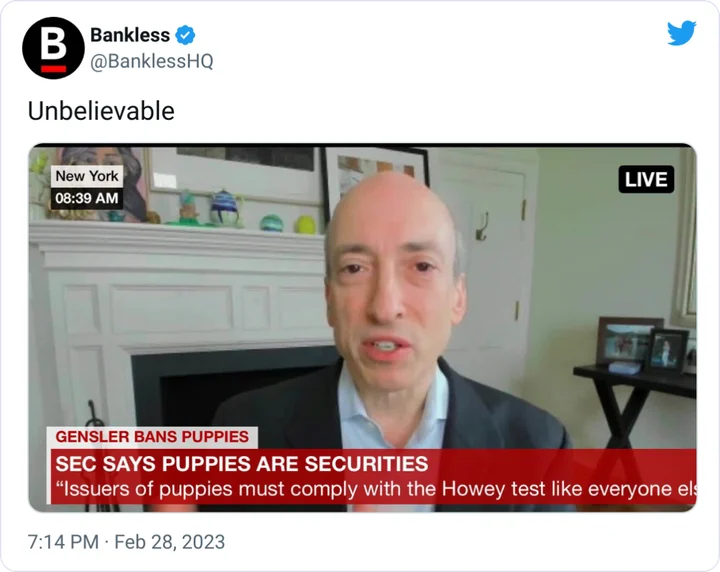
SEC Chairman Gary Gensler has said that every single token other than Bitcoin is a security. Read this thread here for quick thoughts by Gabe, Delphi’s General Counsel.
Meme via @banklesshq.


0 Comments