
🌅 Welcome!
Voyager Digital customers might get partially bailed out and an industry leader proposes introducing blacklists to DeFi protocols.
Today, we take a look into Hadeswap, a Solana-based NFT marketplace, and our Research team provides some insights on the company that sold “sneakers for the metaverse.”
This is the Delphi Daily. Let’s dive in.
🚨 In Case You Missed It

- Customers of Voyager Digital could recover 72% of their investments if a bid by FTX US goes through.
-
A group of 4.4K disgruntled investors is attempting to track down the location of Terra co-founder Do Kwon.
-
Norwegian Court rules that Craig Wright lied and cheated in his attempt to prove that he is Satoshi Nakamoto.
-
Sam Bankman-Fried draws fire after proposing regulations that introduce blacklists to DeFi protocols.
-
Fidelity‘s crypto platform will allow institutional clients to trade ETH.
📊 Is Hadeswap the Sudoswap of Solana?
-
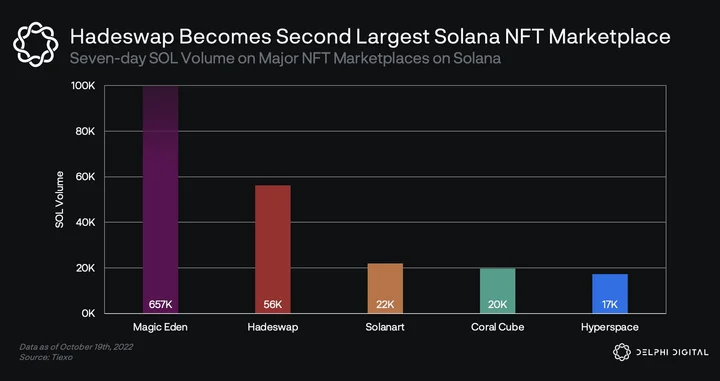
Hadeswap is an AMM-based NFT marketplace that launched on Sept. 26 on Solana. Since then, the platform has experienced outsized growth to become the second-largest NFT marketplace on Solana.
-
Over the last seven days, Magic Eden has done a total volume of 657K SOL. Hadeswap ranks a distant second with total volume of 56K SOL.
- Hadeswap has built features comparable to Ethereum-based Sudoswap. The protocol allows users to create liquidity pools by depositing NFTs and SOL. This allows holders to access instant liquidity by selling their NFTs to the pool.
-
Liquidity providers can earn fees by depositing NFTs and SOL. However, they also risk ending up with low-value NFTs and zero SOL in the pool.
-
Users can mitigate some of the risks by only providing liquidity to more proven NFT collections. Despite this, users must exercise caution since this remains a fairly new innovation in the NFT marketplace segment.
⚡ Why the Future of Fashion Is in the Metaverse
-
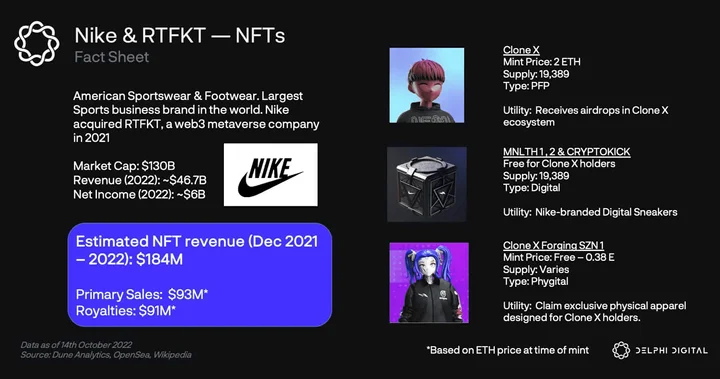
Nike’s foray into NFTs is entirely through RTFKT, which runs independently but leverages Nike’s brand labeling. It is an intelligent strategy.
-
The separation allows the parent company to focus on its core business while capturing this new trend’s upside. RTFKT is akin to Nike’s lab for experiments in NFTs & the metaverse.
-
RTFKT was founded in Jan. 2020 by Benoit Pagotto, Chris Le, and Steven Valisev. The startup creates limited-edition sneakers and digital artifacts using game engines and augmented reality.
-
Arguably, RTFKT is the most successful company in fashion NFTs. The company rose in cultural prominence quickly, widely gaining prominence as the company that sold “sneakers for the metaverse.”
-
Before its acquisition in December, RTFKT raised $8M in seed funding, led by a16z in May 2021. The same month as the acquisition, RTFKT’s flagship Clone X NFT collection was released to the public — a 3D digital PFP-avatar.
-
While the news of Nike’s acquisition was not publicly known before the mint, it was likely already committed to by then. After the mint, Clone X holders received several free airdrops, including Space Pods and MNLTH.
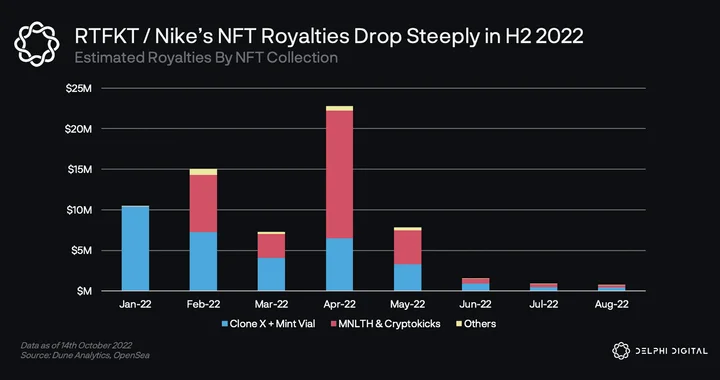
- Although Nike — RTFKT did not generate any primary sales revenue through these airdrops, they were able to rake in a massive amount of royalties from secondary sales, particularly with MNLTH.
- MNLTH began as a mysterious box with a Nike logo on its front. Over several months, the Clone X community worked together to solve quests, eventually leading to its reveal: a set of customizable digital sneakers (CRYPTOKICKS).
- The deliberately-planned gradual reveal generated a lot of hype about its contents and plenty of secondary sales. At a 10% creator fee, Nike — RTFKT fetched over $30M in royalties from MNLTH alone!
- Royalties can be significant during times of high interest and speculation, as we have seen earlier this year, but fall steeply when attention wanes.
- We are in a period of low attention (bear market), and brands should not rely on royalties as their main source of revenue.
- For more on the future of finance, Delphi members can read our Delphi Pro report here.
🐣 Notable Tweets
Azuki’s Physical Backed Token
Introducing the Physical Backed Token (PBT): an open source token standard tying a physical item to a digital token on the Ethereum blockchain.
– Azuki (@AzukiOfficial) Oct 17, 2022
NFT Finance Landscape
What’s going on with NFT Finance?
🔸 100s of millions of loans have been taken out this year
🔸 New utility being brought to NFTs
🔸 Leading protocol has just over $100M TVLWhy this sector has 50 – 100X growth potential 👇
0 Comments