On-Chain Indicator Presents Alluring Data for ETH, Intro to DeWi Wars
JUL 26, 2022 • 4 Min Read

🚨 In Case You Missed It
- Coinbase faces SEC investigation over allowing users to trade cryptocurrencies that may be securities.
- Tether, Bitfinex and Hypercore launch Keet, a platform for fully encrypted video calling.
- Ethereum Foundation publishes new use case for Ethereum called Decentralized Science (DeSci).
- Aptos Labs raises $150M in funding to build a layer-1 blockchain; round led by FTX and Jump Crypto.
📊 ETH Market Price Below On-Chain Cost Basis
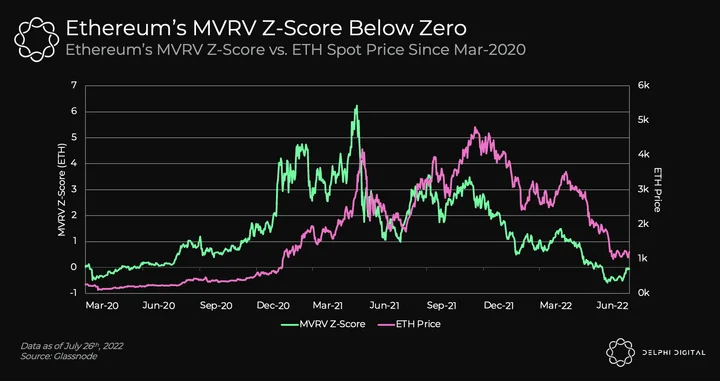
- MVRV Z-Score is an on-chain metric that is defined as the ratio between the difference of market cap and realized cap, and the standard deviation of market cap. Further, realized cap is a variation of market cap that uses the price at which tokens were last moved, instead of current market price.
- Simply put, when the MVRV Z-Score falls below zero, it means that majority of ETH is trading at a loss as the market price is now trading below the realized price. MVRV Z-Scores below zero have previously indicated market bottoms.
- More recently, the metric began trending below zero since June 10th of this year, reaching a low of -0.587 on June 18th. The metric has been trending upward this week, almost rising up to zero on July 24th.
- For perspective, the metric indicated a market bottom when it touched -0.459 on March 16th, 2020, during the coronavirus-induced flash crash. During the following months, we experienced the start of DeFi Summer and a corresponding rise in ETH price.
- Even as the MVRV Z-Score seems to indicate the formation of a market bottom, other indicators must be used in tandem to conduct a meaningful analysis. With a macro-driven market, further downside or consolidation period may be required to establish a proper bottom.
- For more on Ethereum’s technical underpinnings, Delphi members can read our Delphi Pro report here.
⚡Pollen and Helium: The Race To Bootstrap a 5G Network
- Decentralized Wireless (or DeWi) seeks to build out physical wireless communication infrastructure (5G CBRS antennas) through incentivizing individuals to deploy hardware at homes or businesses and backhauled through an ISP.
- Helium and Pollen are in a real estate competition across two vectors: (1) the real estate within one’s home or business to deploy a 5G node, and (2) to occupy the first eSIM slot on users’ devices.
How it Works: Traditional Telecoms vs DeWi
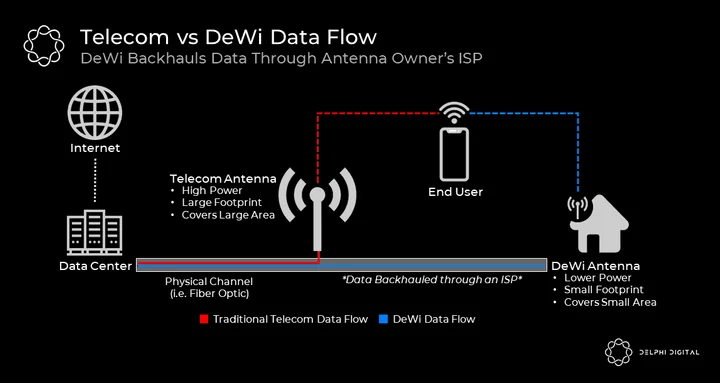
- The DeWi thesis is as follows: If one can properly encourage the general public to set up antennas in their residence or on their property then a fully functional wireless communication network can be deployed in any area regardless of population density and without a corporation needing to invest large sums of money into further physical infrastructure.
- Traditional telecom companies outsource their infrastructure needs to tower companies (e.g. American Tower – $120B market cap, Crown Castle – $75B market cap) who manage big, high powered antennas that can cover a large area to provide 3G and 4G. These antennas communicate with an end user’s device.
- Once the antenna receives communication from an end user, it relays it to a data center (such as Equinix – $60B market cap, Digital Realty – $36B market cap) and then ultimately the internet via a physical channel such as a fiber optic cable.
- DeWi works similarly except the 5G antennas cover less range (meaning more antennas are required to cover the same area as a traditional telecom antenna) and the data the antenna receives is backhauled to the internet through the antenna owner’s Internet Service Provider (ISP) as opposed to traveling through a telecom company’s channels.
- While data flows in these two models seem rather similar, DeWi initiatives make use of special parts of the spectrum, use unique protocols to secure their networks, and use third party technologies to transmit their data.
- For more information, Delphi members can read the full Delphi Pro report here.
🐣 Notable Tweets
Comparing Cosmos and Polkadot
I’ve wanted for a long time to compare both @cosmos and @Polkadot ecosystems. They are both considered to be third generation blockchains and share a similar horizontal scaling approach, as opposed to Ethereum and Solana who favor vertical scaling.
A thread 🧵
— Youssef Amrani (@youssef_amrani) July 25, 2022
Bytes Go Live On Lenstube
Bytes are now live on@lenstubexyz! 🤩 Go collect your favorite short-form videos like TikTok and Instagram Reels as NFTs on @lensprotocol🍿🎬
— LensProtocol.lens 🌿 (@LensProtocol) July 26, 2022
Intro to Sei Network
I am proud to see that our validator nodes @danku_zone w/ @daic_capital keep growing.
Our next goal: Mastering the Seinami.
We are on the @SeiNetwork testnet and I am excited about the design future of this new network.
Let’s deep dive 🧵👇
— danku_r (@danku_r) July 25, 2022
Get access to four research reports each week with key market coverage.
Sign up for Delphi Insights here.
0 Comments