Squads' Expansion from Multisigs to Crypto-Native Fintech Infrastructure
FEB 25, 2025 • 26 Min Read

Report Summary
Summary of “Squads Report”
The report explores Squads, a smart contract wallet infrastructure on Solana, and its role in onchain treasury management, payments, and financial automation. It highlights Squads’ evolution from a multisig solution to a full-stack financial suite, including the Squads App, Fuse Wallet, and Squads API.
Key Takeaways:
1. Solana’s Growth & Need for Strong Infrastructure
- Solana’s total value locked (TVL) has surged from $400M to $12B in just over a year, driven by DeFi, NFTs, and payments.
- Memecoins contributed significantly to Solana’s revenue, but sustainable growth depends on broader adoption of consumer apps, DeFi, and real-world payments.
- Key infrastructure needs include better wallets, multi-dimensional fee markets, and quantum-resistant security.
2. Squads Protocol: A Smart Contract Wallet Layer for Solana
- Squads enables programmable smart accounts with multisig verification, custom workflows, and access management.
- Secures over $10B in assets across 300+ teams, used by Jito, Kamino, Pyth, Drift, Helium, and Jupiter.
- Squads v5 Updates:
- Programmable Consensus: Custom transaction approval workflows.
- Real-Time Processing: Faster execution with multi-factor authentication.
- Tiered Permissions: Granular control over spending and security.
3. Squads Policy Network (SPN) for Compliance & Automation
- A decentralized policy enforcement network that verifies transactions before execution.
- Ensures compliance with sanctions, security policies, and automation guardrails.
- Uses Jito’s restaking for security, introducing a new layer of trustless transaction validation.
4. Squads App: Business-Focused Treasury & Payment Management
- Multisig treasury management with sub-accounts, spending limits, and trading tools.
- Integrated fiat on/off ramps (ACH, SEPA, Wire) via Bridge and Coinflow.
- Supports staking with Stakewiz, Jito, Marinade, and Solblaze.
- Payroll & recurring payments system, allowing direct USDC-to-bank transfers for contractors and employees.
5. Fuse Wallet: The First Smart Wallet for Solana
- Seedless, mobile-first, 2FA-secured wallet with account abstraction.
- Fuse Card (Visa) for real-world spending (in partnership with Stripe-acquired Bridge).
- Virtual Bank Accounts enable seamless fiat-to-crypto conversions with 0.1% fees.
- Gas abstraction via fuseSOL ensures users never need SOL for transactions.
6. Squads API: Embedded Stablecoin & Banking Infrastructure
- Allows businesses to integrate stablecoin-based banking directly into their products.
- Supports real-time payments (~$0.02 per transaction), escrow, and confidential transactions.
- Targets fintech, neobanks, payroll providers, and AI-powered finance.
7. Future Outlook & Challenges
- Security remains a top priority with audits from Neodyme, Trail of Bits, and Certora.
- Adoption of smart wallets is a key challenge, as even Ethereum’s push for smart accounts has been slow.
- Squads API could position itself as the bridge between stablecoins and traditional banking, driving mass adoption.
Conclusion
Squads has evolved from a Solana multisig solution to a full-fledged financial infrastructure. With Fuse Wallet, Squads API, and policy automation, it is positioned as a core player in Solana’s growing onchain economy. If successful, Squads could redefine how businesses and individuals manage digital assets.
Introduction
Solana has been the breakout L1 blockchain of the last couple of years. Let’s roll back the clock to Nov. 2023: Solana’s DeFi TVL held steady at ~$400M, daily DEX trading volumes peaked at $300M per day, and derivatives trading volume was a measly $20M.
A quick hop back to the present: TVL has grown to $12B (30x), daily DEX trading volumes have touched $25B (83x), and derivatives trading has re-emerged with more than $700M (35x) volume on most days. That is a monumental shift in the tide in just over a year.
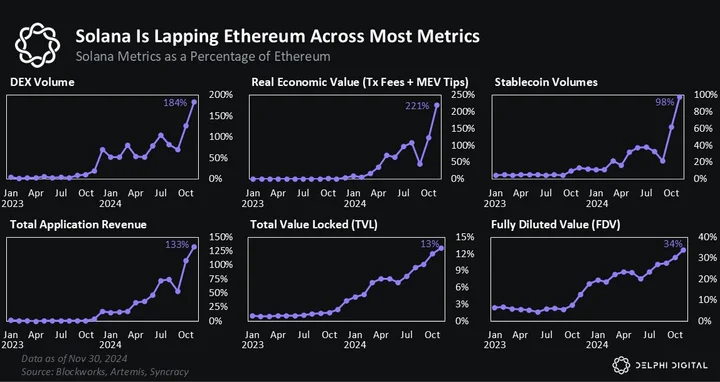
Solana has, over the course of the last 2 years, matched or outperformed Ethereum L1 across a wide variety of metrics. While Ethereum remains dominant in Total Value Locked (TVL), Solana has outpaced Ethereum in activity-based metrics, including DEX volumes, app revenue, and stablecoin transactions. This highlights a strong growth story for Solana as activity on Ethereum’s mainnet shifts to L2s.
Solana Ecosystem – Limited to Memes?
The “memecoin supercycle” has been a major contributor to Solana’s rising fee revenue. In fact, Solana reached a record $27.6M in real economic value (transaction fees and MEV tips) in November 2023, surpassing Ethereum for the first time. As memecoin trading on platforms like Pump.fun and Raydium surges, competition for transaction priority increases, with traders paying higher fees to secure faster processing.
However, it’s crucial to consider Solana’s long-term growth. While memecoins have been a significant driver of activity, this market is extremely volatile and high levels of activity could prove to be unsustainable. Solana will need to attract other kinds of applications with recurring user engagement to maintain its network’s health and bandwidth usage once the memecoin frenzy subsides. The health of an L1 ecosystem should be assessed based on the diversity of its applications, not just its trading volume.
The Need to Build Solana’s Onchain Economy
While memecoins have garnered attention, Solana’s success extends far beyond this niche. The network is seeing a surge of innovative applications across multiple sectors, including DeFi, NFTs, AI, consumer apps, decentralized physical infrastructure, and more. These developments are broadening Solana’s ecosystem, attracting new users, and driving economic activity.
In consumer apps, Drip stands out as an NFT collectibles platform with over 200M mints. The payment landscape is equally dynamic. Sphere provides crypto-fiat payment rails, Solana Pay integrates seamlessly with Shopify, and TipLink enables crypto transfers via email.
In the DePIN category, Helium is reimagining mobile networks through user-operated hotspots, Hivemapper crowdsources global mapping, and Render Network democratizes access to GPU rendering. The experimental frontier in Solana is equally exciting, featuring StakeNet’s decentralized stake pool management, as well as Blinks and ZK Compression for onchain state optimization.
Broader initiatives include the ongoing development of Solana’s mobile device Chapter 2, FORMA‘s Solana Economic Zone in Argentina, MetaDAO’s futarchy-based governance, and Ore – making Proof-of-Work more accessible. In the long term, these businesses will bring about a diversification of transaction activity which is ultimately healthier for Solana.
Infrastructure Requirements
Solana has made significant progress in developing its application layer, but there’s still work to be done to support upcoming internet-scale finance and businesses. Key infrastructure needs that are currently being addressed include:
- More diverse client infrastructure
- Improved wallet experiences
- Multi-dimensional fee markets
- Async program execution
- ZK compression
- Multiple Concurrent Leaders
- Quantum resistance
- End-to-end payments infrastructure
While all these developments are important, one of the highest ROI developments for Solana will be improving wallet experiences and building a comprehensive, end-to-end onchain payments stack. These upgrades will be critical in driving Solana’s adoption and long-term success.
End State of Onchain Wallets
Web3 wallets should have been designed to provide a seamless transition from the web2-like user experience most internet users are familiar with. The ideal wallet would offer features like granular portfolio tracking, key rotation, programmable spending limits, advanced scam detection, seamless multichain transactions, and end-to-end seed phrase management.
What I would love to see in a wallet:https://t.co/51zWXRVKrE
— vitalik.eth (@VitalikButerin) December 3, 2024
Almost a decade since the launch of smart contract blockchains, crypto wallets are still multiple iterations away from resembling their ideal end-state. While wallets like Phantom and Solflare serve Solana’s existing user base well—particularly in trading and portfolio tracking—they fall short in delivering the comprehensive functionality needed for the next generation of users. Hot wallets also cannot service the needs of an onchain business with multiple stakeholders.
That’s where Squads steps in by providing smart contract wallet infrastructure and products that can be tailored for the entire spectrum of onchain users. Squads has in the past few years built a portfolio of offerings to make asset management and operations secure and simple. These offerings include –
- Infrastructure: Squads Protocol
- Products: Squads App (for teams, enterprises) and Fuse Wallet (for individuals)
Squads Protocol
At its core, Squads Protocol is a collection of programs that implement smart contract-level account abstraction. Smart accounts are programmable accounts that enable customizable rules, workflows and custody management – coupled with a layer of multisignature verification. Squads Protocol is agnostic to the end users and can have products built on top that serve the needs for users varying from an onchain trader to digital businesses.
For businesses, smart accounts can facilitate collaborative protocol and treasury management where multiple stakeholders are required to approve transactions to ensure a higher degree of security and consensus. Whereas individuals users can benefit from more secure wallets, programmable spending and risk management made possible via smart accounts.
Built for the Solana Virtual Machine (SVM), it is used by Jito, Kamino, Pyth, Drift, Helium, Jupiter and another 300+ teams within the Solana ecosystem, securing over $10B of assets. The protocol’s design has evolved to become user-friendly yet powerful, catering to both enterprises looking for a secure multisig setup and individuals seeking to enhance their personal asset management through multi-factor authentication.
Unlike non-programmable “traditional” wallets – smart accounts enable customizable asset management. By separating account control from the account itself, these wallets can support dynamic rules for security, custody, and transactions —offering a more flexible and user-friendly experience than traditional private key-based wallets. Smart accounts represent an opportunity to win marginal new users to non-custodial wallets rather than CeFi or custodial wallet solutions like Telegram bots.
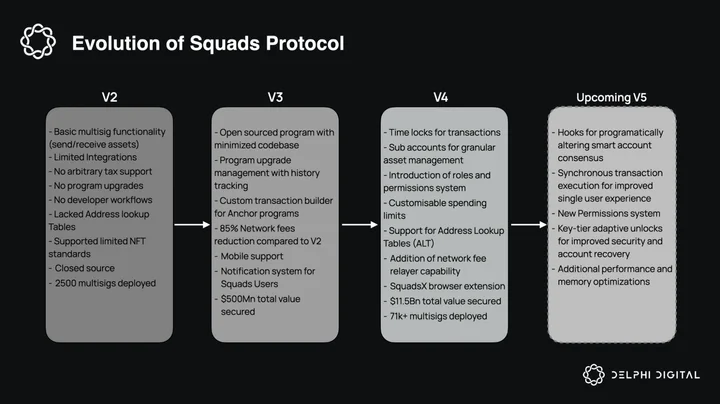
Squads is gearing up to launch v5, a significant upgrade that will further enhance control and flexibility for both developers and users. The update introduces vital features such as key-tier adaptive time locks, consensus customization using hooks and improved account recovery options. Squads has been built over four years of open-source development without any security breaches – a major feat in the Solana Ecosystem as one of the few open source protocols.
Key Features of Squads v5
Squads v5 introduces critical updates enhancing usability and security:
- Programmable Consensus: Custom rules and spending limits through hooks enable flexible security controls
- Real-Time Processing: Synchronous execution with multi-factor authentication support
- Tiered Permissions: Granular access management through key tiers and time locks
- Enhanced Performance: Optimizations to ensure compatibility with upcoming changes in Solana’s compute constraints
The permission system operates through three main roles:
- Proposers: Initiate transactions
- Voters: Sign transactions
- Executors: Execute approved transactions
Teams can customize these roles to match their operational requirements and security needs. Building on this foundation, Squads has developed a network for advanced policy enforcement, extending wallet capabilities and security features.
By careful selection and distribution of permissions between team members, Squads can become an organization management solution that allows teams to migrate a majority of their financial operations onchain.
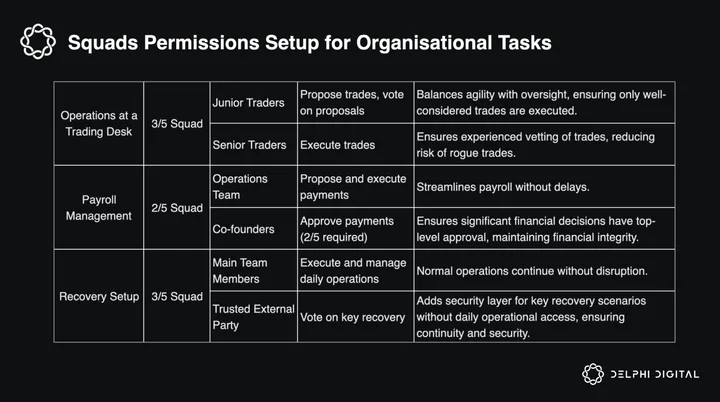
Building upon the ideas of granular permissions, Squads team is building a network for permissions and enhanced policy enforcement that helps extend the possibilities.
Squads Policy Network (SPN)
For the onchain economy to eat up activity from the off-chain world, enterprises and individuals need a reliable and intuitive way to self-custody assets. Many institutions are using outdated, centralized custody solutions to protect their assets. Hot wallets are risky single points of failure, whereas cold storage introduces greater security but lacks flexibility. Programmable onchain accounts are the solution to this dilemma.
Squads puts custody and financial workflow logic onchain, providing transparency, security, and liveness – in contrast to centralized servers that operate as opaque, single-party controlled systems. While not all smart account functionalities can or should exist entirely onchain, maintaining these auxiliary activities should be as trustless as possible with highest liveness guarantees.
This is where the Squads Policy Network (SPN) comes in – a decentralized infrastructure for advanced policy enforcement. It functions through a peer-to-peer system of registered nodes that interface with the Squads Policy Program and leverages Jito’s restaking for economic security and coordination. When transactions are initiated, the SPN acts as a conditional signer, verifying compliance with user-defined policies before providing authorization signatures.
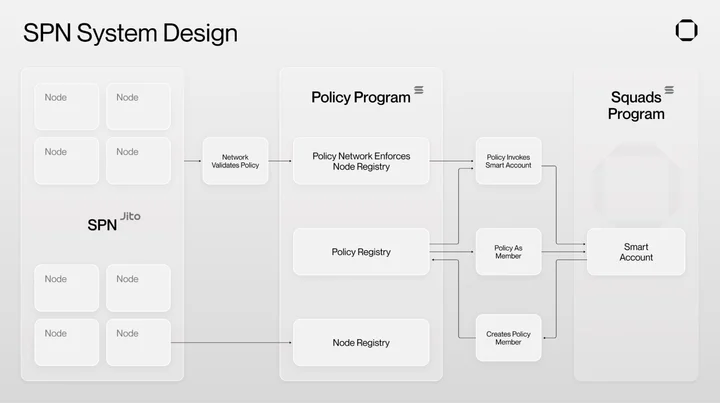
The network introduces critical benefits for smart account users, particularly in three key areas:
- Improved security through transaction simulation and malicious program detection
- Compliance management via jurisdictional requirement checks and sanctions monitoring
- Automation guardrails to enable secure portfolio management and scheduled transactions.
Compliance management involves off-chain work, whereas automation guardrails improve the user experience but the foremost priority of any multisig and wallet business has to be the security.
Security-First Approach
Security is paramount in crypto infrastructure, and Squads has taken a security-first approach to product development. This commitment is evident through several safeguards:
- Formal Verification Processes: Squads Protocol undergoes formal verification to ensure that its code is mathematically guaranteed to perform as expected under all conditions.
- Immutability Guarantees: Squads v3 and v4 are immutable and upcoming versions of the protocol will be made immutable as soon as feasible to ensure long-term security.
- Third-party Audits: Squads Protocol has been audited by top security firms – Neodyme, OtterSec, Trail of Bits, and Certora.
- Bug Bounty Program: Squads maintains an active bug bounty program, incentivizing security researchers to identify vulnerabilities with rewards of up to $300,000 in SOL for critical issues.
- Open Source Development: Squads codebase is and has always been open and available for anyone to review.
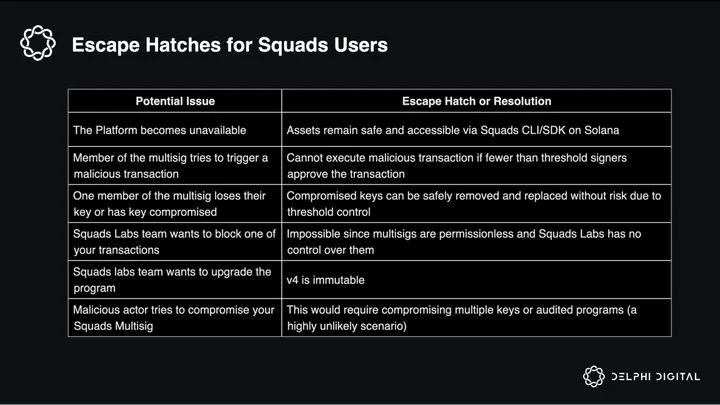
Beyond the work undertaken to ensure security of the protocol, Squads has provided a backup kit in order to ensure users can always access their funds independent of the continued operation of Squads Labs and the frontend. To end users, another critical need is the availability of escape hatches in case of an attack to their Squad internally or externally.
Businesses Oriented Product: Squads App
On top of Squads Protocol, the team built the first product – Squads App to provide teams with an intuitive user interface to manage their operations – like treasury assets, program upgrade authorities, admin keys, tokens, and validator keys.
If Squads Protocol is a secure operating system then Squads App is the application that uses that operating system to make asset management intuitive, cost-effective, scalable, and secure.
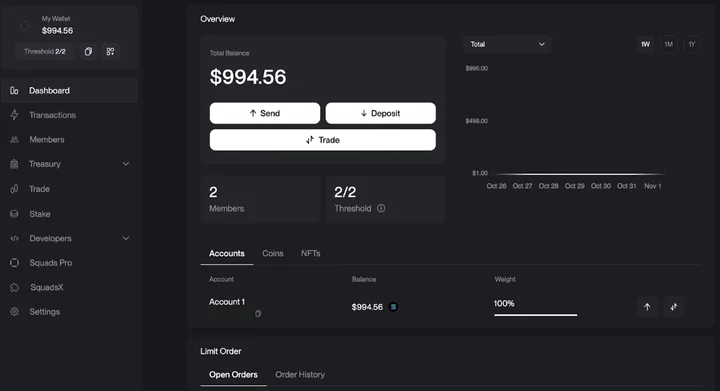
Multi-signature wallets are foundational for building secure, onchain businesses. The goal of smart contract-enabled blockchains is to support organizations to operate with security and scale in a growing onchain economy. Squads app is helping Solana teams with tools that assist in:
Treasury Management
Squads provides teams with a large toolkit for onchain treasury management. Teams can create sub-accounts for different business units, set spending limits for routine expenses, and ensure quick approvals.
It includes a dedicated trading interface that offers users market and limit order capabilities, powered by Jupiter’s routing. This module also features an order management system for monitoring open positions and canceling unfilled orders. This allows teams to manage their treasury diversification initiatives directly from the Squads app.
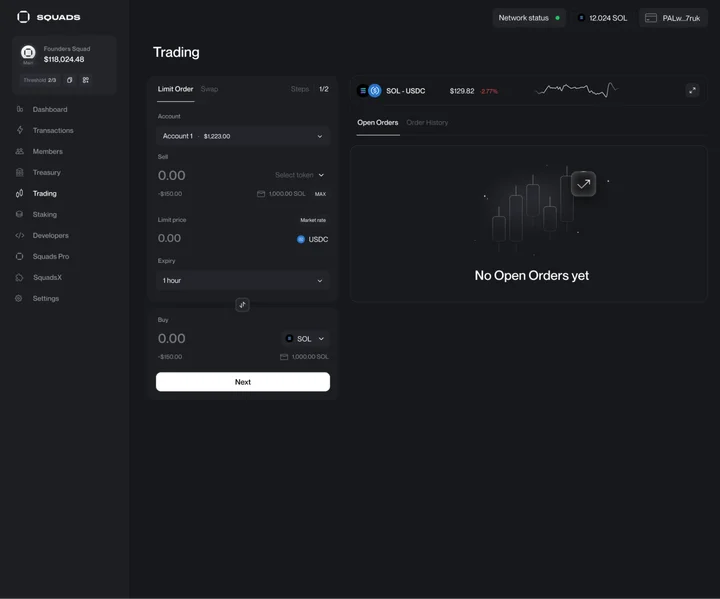
Future updates will introduce intent-based trading, allowing for sophisticated strategies like cross-venue execution and time-based orders, similar to traditional markets. SquadsX is a browser extension available to businesses that enables them to connect their multi-sig wallets to non-integrated Solana DeFi apps like Kamino, marginfi and more. This opens up avenues for teams to generate yield on treasury assets securely.
Squads are perfect for Revenue collection as products can provide a Squads multisig address for collecting protocol fees, referral fees or NFT royalties. Thereafter, the decision to spend collected funds can be made jointly by the team or passed on to the token holders via a vote.
Businesses can on-ramp FIAT directly using Squads virtual bank accounts made possible by integration with Bridge. Users can transact via Wire, ACH, and SEPA transfers for both USD and EUR bank accounts in a cost effective manner. For off-ramping, users have multiple options: they can utilize Squads’ integrations with Bridge and Coinflow, or utilize a Sphere liquidation address for direct transfers. US-based teams have another option with Coinflow’s 24/7 crypto off-ramping service, ensuring compliance and easy access to fiat.
Staking
Solana teams can access staking yield on their SOL-denominated treasury. Squads offers teams a variety of options from directly staking their SOL with a validator of their choosing (powered by Stakewiz), liquid staking through all major providers like Jito, Marinade, Fuse, Solblaze and marginfi. They can also opt for Marinade Native staking which utilizes a strategy to automatically rebalance the stake across the 140 best-performing validators and has no smart contract exposure.
Teams and individuals get a high degree of freedom in selecting their staking strategy across the risk spectrum from the Squads interface making it a no-brainer to stake SOL and earn on top of their SOL treasury.
Payments
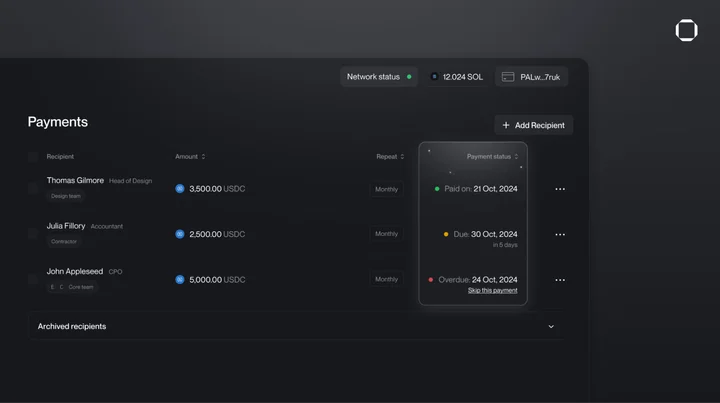
Squads Payments streamlines recurring onchain payments and payroll management through its Recipients feature. Users can set up automated payments by defining recipient details, token amounts, and customizable schedules (weekly, monthly, or specific dates). The system handles scheduling, reminders, and pre-filled payments automatically.
The platform offers comprehensive tracking with three status indicators: Due (5 days before payment), Overdue (missed payments), and Paid (completed transactions). Payment management includes options to skip specific payments while maintaining schedules, view payment history, and archive completed payment cycles. All transactions require appropriate approvals based on Squad thresholds, maintaining security while reducing administrative overhead through batch payments.
Squads helps structure business payments through an integration with Request Finance for invoice creation and management. The platform connects with Request and Integral to provide comprehensive payment tracking, automated categorization, and multi-network support, while syncing with accounting software like QuickBooks and Xero for seamless onchain financial operations.
But these benefits are not just limited to internal payments and transfers and can now be extended for third party payouts. Squads can initiate USDC payouts directly to bank accounts in USD or EUR through Bridge. Following a KYB verification, businesses can send payments to recipients in Canada, Europe, Asia, and other eligible regions. The feature handles international payments by automatically handling USDC-to-fiat conversion and bank transfers, making cross-border transactions as simple as managing regular crypto payments through the Squads dashboard.
Users can also use Tiplink to simplify token transfers by allowing them to send tokens to anyone via a link or QR code—no wallet required. Recipients only need an email address to receive assets, making it ideal for businesses paying contractors or service providers without crypto wallets. Additionally, senders using Squads will be able to recover TipLinks sent to the wrong emails or that are left unclaimed.
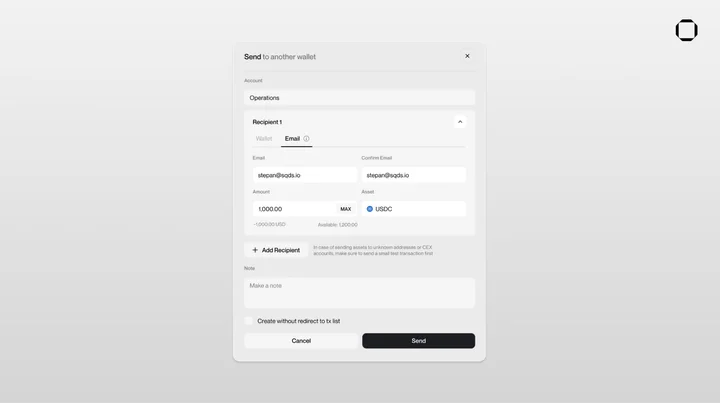
The next step in making the Payments offering more attractive to businesses is the introduction of corporate cards. The pace at which Squads is recreating the entire payments stack with stablecoins and onchain rails is staggering.
Program Upgrade Management
After the collapse of FTX, Serum, Solana’s leading orderbook-based DEX, had to be forked by the community because the upgrade authority was controlled by a single private key at FTX, putting the platform at risk. Today, Solana projects use Squads’ multi-signature wallets to manage contract upgrades, adding layers of security. With multi-signature control, the compromise of a single team member no longer jeopardizes the entire platform.
FYI, @SquadsProtocol is a high quality simple multisig thats perfect for managing upgrade authorities.
— toly 🇺🇸 (@aeyakovenko) December 16, 2022
Validator Management
Squads offers extensive validator management through the secure multisig interface. Once configured, teams can manage key validator operations including commission adjustments, rewards withdrawals, and authority changes – all protected by the Squad’s multi-signature requirements. Operators can transfer validator withdrawal authority to a Squad using either direct transfer or Safe Authority Transfer (SAT) for enhanced security. This enables validator teams to maintain operational efficiency while ensuring distributed control, preventing single points of failure in validator management.
Retail Oriented Product: Fuse Wallet
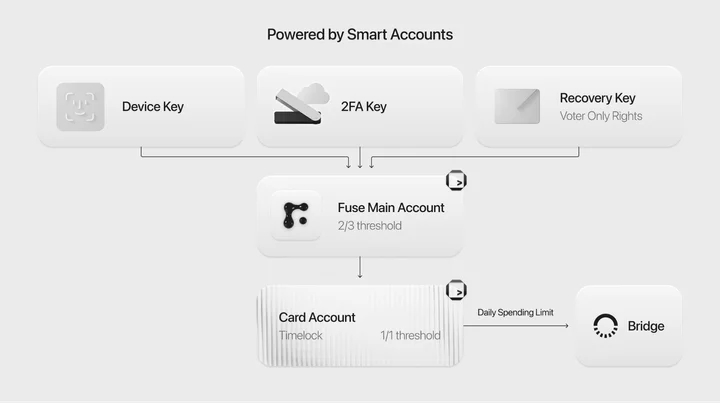
Fuse wallet has been developed with the needs of individual users in mind. It is Solana’s first smart wallet, built on top of the Squads Protocol leveraging account abstraction and smart accounts to provide the most secure mobile wallet experience. The smart account powering each Fuse wallet is controlled by two Active Keys:
- Device Key: Stored locally on device and shielded by biometric security
- 2FA Key: Encrypted and stored in a users’ iCloud or a cold wallet
This setup achieves a balance between ease of use and the ability to securely recover the wallet. Wallet recovery is possible as seed phrases are replaced by multifactor authentication and recovery keys. It also opens up the door for users to set up social recovery popularised by Argent.
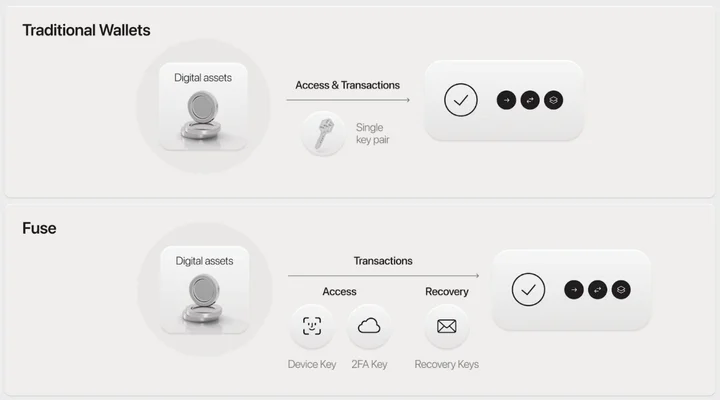
Fuse can be the start of the adoption of consumer smart wallets on Solana. It has been packed with innovative features and benefits for users in their onchain interactions. Smart wallet architecture allows creation of a user centric design through features like gas abstraction that removes the complexity of managing network fees, while the ability to set spending limits enables quick transactions for routine operations without requiring complete security verification.
Fuse takes a mobile-first approach, recognizing that mass adoption will come through everyday mobile users rather than institutions alone. While maintaining self-custody, it distinguishes itself by eliminating seed phrase dependency and offering comprehensive payment solutions including virtual bank accounts, Fuse Card, off-ramps, and bank payouts. This simplified yet powerful approach to crypto payments mirrors traditional banking convenience and aligns with industry trends, as seen with other Solana projects like Jupiter embracing mobile-first strategies.
Some strategy and product design features that make Fuse stand out compared to other Solana wallets includes:
Payments
The cornerstone of the Fuse offering is its Payments solution. The goal is to completely remove the barrier between on and offchain capital movement using stablecoins and abstracting away most steps involved in the process today. Teams opting to build multichain wallets will find it incredibly hard to build a complete payments stack comparable to Fuse as their focus is towards integrating blockchains with each other instead of integrating blockchain to the web2 world.
Fuse Card
One of the upcoming needs for onchain users is the ability to spend crypto with low friction and on expenses. Fuse Card is a virtual Visa card that enables everyday, real-world spending of stablecoins directly from the Fuse wallet. Fuse Card will launch in partnership with Bridge (acquired by Stripe).
Fuse Card eliminates the need to interact with traditional banking rails directly and narrows the gap between onchain and offchain payments. This creates a larger opportunity to fully participate in the onchain ecosystem – receiving payments, making purchases, and managing assets – without needing to link bank accounts or exit the onchain economy. Crypto cards will push the adoption of stablecoins and onchain payments while preserving the fundamental principle of crypto: self-custody.
The “Card Account” in Fuse is a separate smart account deployed with the “Main Fuse Account” as the sole signer. Users will be able to set daily spending limits and withdraw funds from the “Card account,” subject to a short-time lock. Fuse Card will initially only be available for users in the US and will go live with support for more countries later this year.
Virtual Bank Accounts
Fuse enables virtual US bank accounts, powered by Bridge, to simplify the process of integrating traditional banking with crypto. Fuse users can now receive USD payments directly into their virtual bank accounts, which are automatically converted into USDC in their Fuse wallets. This feature eliminates the need for intermediary services that charge high fees for conversion, as well as the complexity of navigating different exchange platforms to transfer and convert funds. Instead, with a straightforward bank transfer, users can get paid in USD and receive USDC in their wallet, all for a minimal 0.1% conversion fee.
Used the @fusewallet virtual bank account feature today
Sent a wire from my bank. Received USDC in my self-custodial @solana wallet a few minutes later
Absolute butter. A+ experience
Now earning 16% APY on the deposit
9Hctt58FHoADjvWeMUSwizevXSxEMS72ZCZZYPcm3fnT pic.twitter.com/QfaCecDIln
— Kyle Samani (@KyleSamani) December 27, 2024
With the addition of the upcoming Fuse Card, this setup not only allows for the seamless conversion of USD to USDC but also enables earning yield on USDC through Fuse Earn and spending USDC as USD. This creates a holistic financial ecosystem where users enjoy the benefits of cryptocurrency, including self-custody and global accessibility, without sacrificing the simplicity of banking transactions that they are accustomed to.
Fuse Off-Ramp completes the final piece of the puzzle by offering effortless conversion from USDC back to USD in the user’s bank account subject to a completion of the KYC process.
Paymaster and FuseSOL
Account Abstraction in the EVM ecosystem has continuously evolved – from EIP-4337 to EIP-3074, native AA on L2s to chain abstraction. There is no consensus on what the end-state for blockchain UX looks like, but one of the most important developments has been the introduction of Paymasters. A Paymaster contract facilitates transaction fee sponsorship and flexibility in the selection of payment tokens.
Traditional wallets require maintaining a balance of unstaked SOL to cover transaction fees, reducing staking rewards. Fuse solves this problem by combining a specialized LST – fuseSOL with Fuse’s Paymaster. Once activated, the Paymaster automatically converts fuseSOL to SOL for gas fees when needed, maximizing staking rewards and subsidizing fees with yield. In the future, users will be able to pay gas fees using any token, ensuring seamless onboarding to the chain with assets like USDC through virtual bank accounts.
Fuse Earn
Users can accrue native yield generation through Fuse Earn, a curated platform to earn yields on stablecoins without leaving the secure environment of the Fuse wallet. The feature integrates directly with leading DeFi protocols, with Drift as its inaugural integration. Users can deposit stablecoins into Drift’s lending markets through the Drift integration, automatically earning yields based on market demand and utilization.
What could be next for Squads?
In the immediate future, Squads and Fuse users will be getting passkey support for simpler and secure authentication. Passkeys are becoming one of the most popular sign-in processes on the Internet. In the near future we’ll be unlocking our digital assets with just a touch or a glance. Traditional key management, while familiar, is increasingly vulnerable to breaches and phishing attacks.
Squads and other smart contracts as they stand right now have limitations due to the Cross-Program Invocation (CPI) limits. But with the scheduled increase in these limits, Squads will be able to serve a wider net of use cases and existing ecosystem apps with improved UX.
Squads API
The most ambitious step in the Squads roadmap is the Squads API, which reimagines embedded finance for the web3 era. The embedded finance revolution of the late 2010s promised to let any software company integrate banking services into their products, creating seamless financial experiences within existing customer relationships. While companies like Shopify successfully transformed merchant dashboards into comprehensive banking solutions – offering payments, interest-bearing accounts, and lending – widespread adoption has been hindered by traditional banking infrastructure’s limitations.
Squads breaks through these constraints by leveraging stablecoins and onchain primitives. Through a simple API integration with a few lines of code, businesses can embed secure stablecoin accounts and banking services directly into their products. This makes every financial operation programmable, every transaction instant, and every service globally accessible by default. The infrastructure enables companies to improve customer outcomes, increase retention, and diversify revenue streams without the complexity and fragmentation of traditional financial rails.
Here is my public pitch to Klarna.
To power Klarna’s crypto ambitions at scale, Squads Protocol smart accounts combined with Squads API (proudly powered by Solana) is the infrastructure to meet the demands of 85M users and $100B in volume.
Here is why:
Security Guarantees… https://t.co/0YpUJUL9VJ
— Stepan – smart/acc (@SimkinStepan) February 9, 2025
Squads API isn’t just for crypto companies; it’s versatile enough to enhance any digital business with secure, scalable transaction infrastructure. By providing stablecoin-banking as a service, Squads empowers any internet-native, global, and scalable software company to build financial services that match their potential – like Shopify, Klarna, neobanks and many more.
If successful, Squads API could position itself at the heart of the stablecoin and payments stack, offering an invaluable bridge between crypto and traditional financial systems.
The Squads API encompasses three core modules:
- Security
- Multi-signer accounts with a high degree of access controls
- Distributed key management with key rotation and simple recovery options
- Enterprises can choose custodial or non-custodial accounts based on their compliance needs
- Programmable Banking
- Real-time payments at a fraction of the cost (~ $0.02 per transaction)
- Custom spending limits and sub-accounts for multiple users under the same enterprise
- Users can spin up Escrow accounts for transactions and also access confidential payments
- Networking
- Turn multistep onchain actions into a single API call
- Abstract away gas fees from end users and make the product frictionless
- Ensure transactions land on Solana for high-reliability
The stablecoin opportunity is large, and the entrance of incumbents like Paypal, Stripe, Robinhood, and Revolut are indicators that the entire world is becoming increasingly aware of this. We have written about the same in more detail as part of the Stablecoin Manifesto for interested readers.
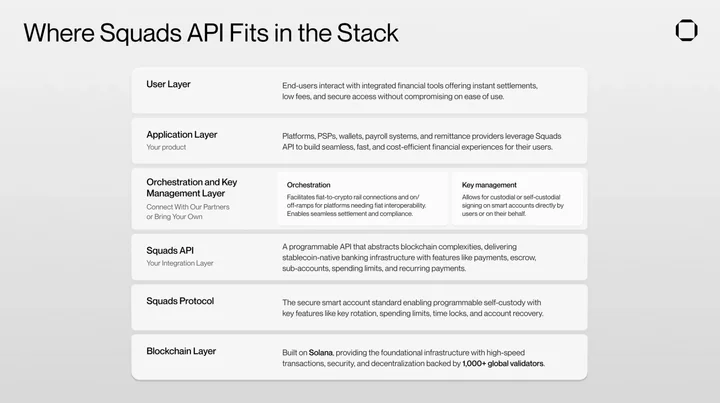
Squads API aims to occupy a foundational position in the stablecoin & payments stack – connecting key management (custodial and self-custodial signing) and orchestration layer (fiat to crypto conversions and compliance) with programmable custody (Permissions network) and transaction processing (the blockchain).
Squads API is designed for usage by Payment Service Providers (PSPs), Neobanks, digital wallets, payroll and remittance platforms, and e-commerce solutions as target customers. These entities can benefit from reduced transaction costs, programmable banking features, and the ability to offer instant, secure payments globally, thereby enhancing their service offerings.
Crypto x AI Opportunities
The emerging Crypto x AI landscape presents a strategic opportunity for Squads Protocol. As DeFAI agents evolve to execute sophisticated trading strategies, from specialized lending to optimal LP positioning will require programmable wallet infrastructure. The Squads API’s stablecoin capabilities are uniquely positioned to serve this need. Consider an AI-managed investment fund where multiple agents, controlling a Squads multisig wallet, must reach consensus before executing positions – exemplifying AI decision-making with secure asset management.
Beyond crypto, AI agents in banking, e-commerce, and home management can also adopt stablecoin rails. These agents can leverage Squads’ API and gas abstraction for seamless on and off-chain transactions. For individual traders, AI integration offers enhanced capabilities – agents can analyze market data and documentation to identify opportunities, while traders maintain control through sub-accounts with defined spending limits. This setup enables automated execution of smaller trades while preserving human oversight for significant decisions.
The intersection of AI and crypto remains largely unexplored, with vast potential for innovation. Squads Protocol’s comprehensive suite – including the API, secure multisig infrastructure, and policy network – is positioned to become the essential control layer for this emerging ecosystem.
Where Does Squads Stand Now?
Squads has dominated the Solana treasury and multisig market with token value secured exceeding $10B across 300+ teams. Stablecoin payment volume continues to grow, hitting a new ATH in December; however, some other metrics have recently tapered off, such as TVL as we’ve seen a drop in value of Solana assets with the recent sell off and the second jupuary airdrop distribution.
We think the Fuse wallet is a great complementary product offering as it can bring forth the next leg of Squads’ growth by onboarding individual users. Fuse Card, virtual bank accounts, and third-party payouts are all initiatives that help Squads carve out new user demographics and grow protocol usage. The focus on mobile-first experience in Fuse is indicative of Squads’ plan to focus on the next generation of crypto users.
Squads Protocol will play a major role in the stablecoin economy of Solana as it evolves. Teams using the app generated $546M of monthly stablecoin transfer volume in December with an average transfer amount exceeding $78k compared to the average transfer amount of $2.9k across all Solana wallets. Squads are utilized for relatively higher value payments and transfers.
Transaction frequency through the Squads app has a ceiling as recurrent usage for multisigs is unlikely. Transaction frequency for multisigs will be an order of magnitude lower compared to individual user wallets – 430k transactions executed across 71.7k Squads with an average of 6 transactions per Squad. Individual users transact more frequently. This is the type of activity that Squads can bring over to smart accounts through Fuse wallet.
At the same time, the team is developing products like the Stablecoin API and corporate cards that can grow the transaction volume exponentially and will further ingrain them deeply into the needs of businesses utilizing Squads. Squads API allows them to tap into the transaction flow from AI agents and businesses that can benefit from programmatic transactions. We expect this to be a large driver of transaction count, volume and activity in the future.
Conclusion
Squads has evolved from a simple multisig solution into the backbone of Solana’s treasury management infrastructure. The progression from Squads Protocol to the Squads App, and now the Fuse wallet, shows a team that understands how to execute and expand their vision.
The momentum is undeniable. By targeting both institutional and retail users through their product suite, Squads is positioning itself for three key trends: the explosion of mobile-first crypto, the mainstream adoption of stablecoin payments, and a key role in the burgeoning Solana ecosystem. The Fuse wallet and stablecoin API, in particular, are designed for high-frequency usage, setting the stage for transaction volumes that could dwarf their current multisig offerings.
However, there are a couple of major risks to their business. With over $10 billion in secured assets, Squads’ pristine security record is impressive. Any bug could damage the trust they’ve built over the last four years. The challenge of smart account adoption also is a major hurdle that Squads will have to navigate. Even Ethereum, with its mature ecosystem and push for smart contract wallets, has seen relatively modest adoption – just 22.5 million smart wallets and 105 million transactions over two years. For context, Solana processes that many transactions in two days.
But Squads isn’t just waiting for adoption to naturally happen. The upcoming Fuse Card bridges the gap between crypto and the physical world, while the Squads API opens doors to onchain banking solutions that could attract businesses well beyond crypto. These aren’t just products – they’re infrastructure plays that aim to catalyze the next wave of onchain apps.
As Solana’s ecosystem continues its push toward consumer-facing applications, Squads is uniquely positioned to also provide embedded wallet infrastructure. With continued execution, they can become the gateway that helps bring the next million businesses and their users into the onchain economy.
0 Comments