The House Always Wins: Why Speculation is the Theme of the Decade
OCT 20, 2026 • 56 Min Read

Speculation has always had two engines. For the first time in a long while both are running hard together, and the same technologies are feeding both.
The Scottish journalist Charles Mackay published Memoirs of Extraordinary Popular Delusions in 1841, and the line everyone remembers comes from its opening pages: “Men, it has been well said, think in herds; it will be seen that they go mad in herds, while they only recover their senses slowly, and one by one.” The book covered the Mississippi scheme, the South Sea Bubble, the Dutch tulip trade, witch hunts, alchemists and the Crusades. In the 185 years since, people have hung that sentence over railway scrip, radio stocks, internet names, houses, memestocks, coins and same-day options.
Mackay got the herd right and its status wrong. He wrote about crowd behavior as a holiday from normal life, something people fell into and eventually recovered from. In a market the crowd is normal life. When nobody knows the future, prices get made by people watching each other, and that has been true in every market that has ever existed.
Edwin Lefèvre, a financial journalist, said it with less sermon. His narrator in Reminiscences of a Stock Operator, a thinly disguised version of the trader Jesse Livermore, puts it plainly: “There is nothing new in Wall Street. There can’t be because speculation is as old as the hills. Whatever happens in the stock market today has happened before and will happen again.” The instruments change, but the way people behave around them mostly doesn’t.
People will speculate whenever a claim on the future can be bought and sold. What changes from one era to the next is how hard they do it and what they think they are buying. This piece started from a simple question: is speculation a social response to technological change, or to the decay of the political and monetary order? History says it can be either, and most of the famous episodes were driven mainly by one or the other. Either a new machine made the future look bigger than the present, or a strained fiscal and political arrangement pushed people toward a bet the system itself was selling.
Today both are running hard at once, and the same technologies are feeding both. That is the case for treating speculation itself as an investable theme, and for owning it through the venues that clear the bets rather than through the bets themselves.
I. The Specter of Speculation
Benjamin Graham, Warren Buffett’s teacher, learned the difference between investing and speculating the expensive way. The partnership he ran lost roughly 70 percent between 1929 and 1932, and he spent much of the rest of his career trying to stop the word “investment” from meaning whatever someone had just bought. The definition he and David Dodd put in Security Analysis in 1934 is still the standard one: “An investment operation is one which, upon thorough analysis, promises safety of principal and a satisfactory return. Operations not meeting these requirements are speculative.”
He knew the street would never use the words that way. “In the easy language of Wall Street,” he wrote later, “everyone who buys or sells a security has become an investor, regardless of what he buys, or for what purpose, or at what price, or whether for cash or on margin.”
Graham never treated speculation as a sin, though. “Outright speculation is neither illegal, immoral, nor (for most people) fattening to the pocketbook,” he wrote in The Intelligent Investor, and he went on to say that some speculation is necessary and unavoidable. Somebody has to hold the risks nobody can model away. His complaint was with the label. Fred Schwed, a Wall Street trader who lost much of his money in the 1929 crash, got the whole argument into two sentences in Where Are the Customers’ Yachts? (1940): “Speculation is an effort, probably unsuccessful, to turn a little money into a lot. Investment is an effort, which should be successful, to prevent a lot of money from becoming a little.”
John Maynard Keynes, who speculated heavily with his own money, cared less about the morality than the mechanics. In chapter 12 of the General Theory he compared professional investment to the newspaper competitions of his day, where readers picked the six prettiest faces out of a hundred photographs and the prize went to whoever came closest to the average of everyone’s picks. “It is not a case of choosing those which, to the best of one’s judgment, are really the prettiest, nor even those which average opinion genuinely thinks the prettiest. We have reached the third degree where we devote our intelligences to anticipating what average opinion expects the average opinion to be.” Some people, he added, practice the fourth and fifth degrees. Read that way, speculation is a view on other people’s views, and the cash flows are only one input into it.
Robert Shiller, the Yale economist who shared a Nobel Prize for his work on asset prices, later explained how those views spread. In Irrational Exuberance and again in Narrative Economics, he argued that stories travel faster than spreadsheets and that the ones that move prices tend to be “new era” stories: house prices only go up, the internet changes everything, a coin the state can’t print is better money. A story moves a price when it is easy to repeat, true or not.
George Soros, best known for breaking the Bank of England in 1992, made a career trading that loop, and he called it reflexivity. “Every bubble has two components,” he said in a 2009 lecture, “an underlying trend that prevails in reality and a misconception relating to that trend.” While the two feed each other, rising prices look like proof. The boom, in his description, “is long and drawn out,” and the bust “is short and steep because it is reinforced by the forced liquidation of unsound positions.” Until the turn, the crowd isn’t stupid in the way Mackay implied. It is taking part in a process that pays for a while, and often pays well, as Soros proved.
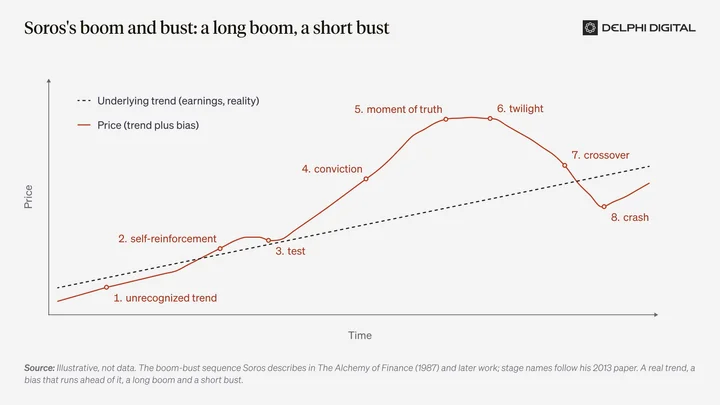
These four agreed about very little, but on crowds they ended up closer than their methods would suggest: in the short run prices are set by what people expect other people to do, and the crowd looks rational for as long as it is getting paid. What none of them settled is what gets a crowd moving in the first place.
II. Two engines
A crowd needs a reason to move, and the usual reason is a gap between the world as it is priced and the world as it might be. That gap has historically opened in one of two ways.
The first is technology. Railways collapsed the cost of distance and electricity rearranged the factory floor; a model that can read and write is now rearranging the argument about what white-collar work is worth. People disagree about timing and about who keeps the surplus, and a liquid market is how that disagreement gets settled. Call this construction speculation. Somebody is going to build the new map, status goes to whoever gets there early, and capital shows up fast and sloppy. This is how fiber gets laid and data centers get built, and it is also how a lot of capital gets destroyed along the way.
The second is political and monetary. A state under fiscal strain, or a policy regime with a goal of its own, starts selling the public a bet: convert your war debt into company shares, buy a house because homeownership is national policy, hold anything but cash. At the household level this shows up as the present no longer working as a path to a decent future. Money seems to buy less than the official numbers say, and a salary no longer turns into a house on the schedule the previous generation used. Call this lottery speculation. Patience starts to sound like advice from people who already own the asset, and what’s left is a ticket whose right tail would change a life and whose left tail looks a lot like the life the buyer already has.
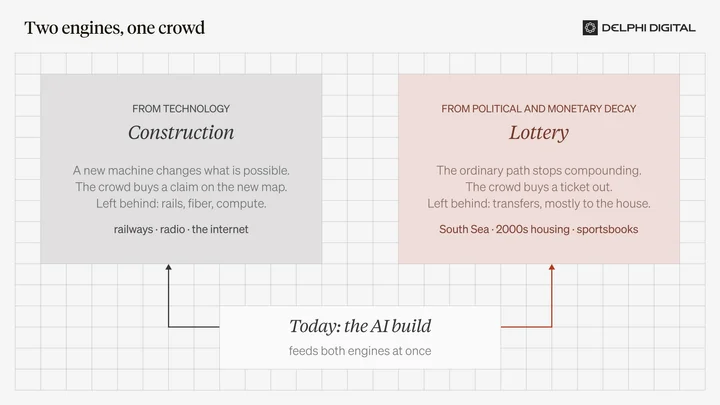
Two ways a crowd gets its story. Same behavior, different residue.
Neither label is an insult, and the labels describe why people show up rather than what they buy. A railway share in 1845 was a construction story with a lottery inside it. A sports parlay is a lottery that has learned to talk like a market. A perpetual future on an equity index can be either, depending on who is on the other side and why they came.
Mackay saw both engines without naming them. His chapter on the Crusades opens by saying every age has its peculiar folly, “some scheme, project, or phantasy into which it plunges, spurred on either by the love of gain, the necessity of excitement, or the mere force of imitation. Failing in these, it has some madness, to which it is goaded by political or religious causes, or both combined.” The love of gain attached to a project is construction, and political goading is the other engine. Imitation is the herd, which doesn’t much care which engine got it moving.
William Quinn and John Turner make the same split in Boom and Bust (2020). Their bubble triangle has three sides (marketability, money and credit, and speculation) and needs a spark, which is either a new technology or a government policy. In their account the bubbles that do the most damage are the ones banks finance, and the ones sparked by technology are the likeliest to leave something useful behind.
III. What the old crowds were doing
If Lefèvre is right that nothing is new, the best use of history is to sort each crowd by what started it, look at what it left behind, and notice how rarely both engines ran hard at the same time.
Tulips: a new object in a rich republic
The Dutch winter of 1636 to 1637 is the story everyone hears first, and it is the one historians have spent the most time correcting. The historian Anne Goldgar’s Tulipmania (2007) found a fairly small group of merchants and skilled craftsmen in Haarlem and Amsterdam trading a luxury good among themselves. “I couldn’t find anybody that went bankrupt,” she said later. The damage was mostly to trust and reputation. What did exist was a new object of taste, forward contracts on bulbs still in the ground, and a rich commercial republic with the legal machinery to trade promises.
Tulips weren’t a technology, but novelty is the small cousin of construction: a new object and a forward market were enough to produce a crowd inside a political order that was working fine. Most of what gets called a bubble in a normal bull market looks like this, and it usually does far less damage than the retelling suggests.

Semper Augustus, the most celebrated bulb of the 1636 to 1637 trade, from a seventeenth-century tulip book.
The South Sea and John Law: the fiscal state, sold as equity
1720 was a different animal, and technology had very little to do with it. Britain and France both came out of the War of the Spanish Succession carrying debts their tax systems couldn’t comfortably service, and both tried to refinance them through a trading company. In London, the South Sea Company offered to take government debt off the books by swapping it for company shares. A rising share price made the swap more attractive to debt holders, which pushed the price higher, which made the next swap easier. The stock went from around £128 in January to roughly £1,000 by late June, quoted forward while the transfer books were closed for the summer, and had given back most of it by the autumn.
In Paris, John Law went further. He tied a royal bank, paper money and the Mississippi Company into a single machine, and for a few months it looked as if a broken fiscal state had been refinanced by one clever Scotsman. Then the paper had to be made good in something other than more paper. France came out of it scarred worse than England, because its money itself had been part of the scheme.
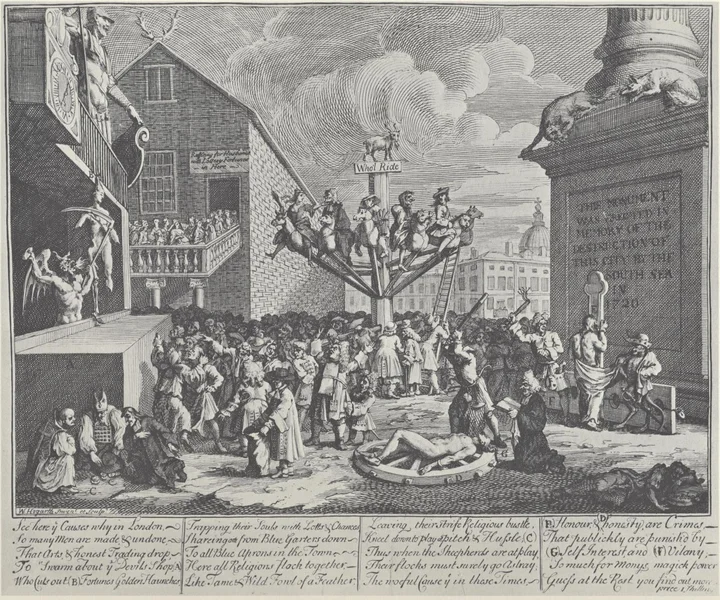
William Hogarth, Emblematical Print on the South Sea Scheme (made 1721, published 1724). Speculators ride a merry-go-round under the sign “Who’l Ride,” Villainy whips Honour, Self-interest breaks Honesty on the wheel, and the Monument is rededicated to the destruction of the city by the South Sea.
This is the template for the second engine. A public liability gets turned into a private upside, and the crowd is asked to hold the bag. Housing policy in the 2000s ran a version of it through mortgages. Crypto’s monetary story runs a version from the opposite direction, where the official unit leaks and so a different unit gets bid. You don’t have to accept the theology to see the structure. A crowd that stops trusting the official store of value will buy a story about a better one.
Railway mania: a real machine, cheap money and a willing Parliament
Britain in the mid-1840s is the ancestor of every technology crowd since. The locomotive was real; the Liverpool and Manchester line had been carrying paying passengers since 1830. Then money got cheap, the Bank of England cut its rate from 4 to 2.5 percent in 1844, shares could be reserved for a small deposit, and Parliament started authorizing new lines faster than anyone could survey them. By the count of Andrew Odlyzko, a mathematician who has spent years in the railway archives, it approved 805 miles of new railway in 1844, 2,700 in 1845 and 4,538 in 1846. By 1847 Britain was spending about £44 million a year building railways, against roughly £50 million for the entire budget of the national government. Dickens filled Dombey and Son with “railway hotels, office-houses, lodging-houses, boarding-houses; railway plans, maps, views, wrappers, bottles, sandwich-boxes, and time-tables.”
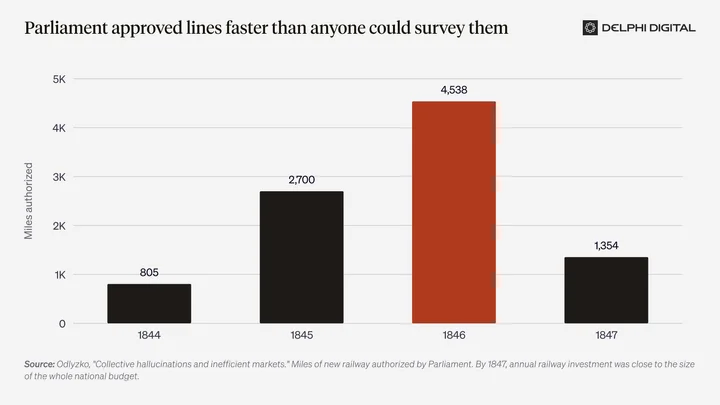
Miles of new railway authorized by Parliament, from Odlyzko’s “Collective hallucinations and inefficient markets.” By 1847, annual railway investment was close to the size of the whole national budget.
Mackay’s own part in this is one of the better ironies in financial history. Odlyzko went back to the Glasgow Argus, which Mackay edited from 1844 to 1847, and found that the author of the most famous book on crowd madness was “one of the most ardent cheerleaders for the Railway Mania.” In October 1845, close to the top, Mackay’s paper told its readers that “the alarmists are in error, and that there is no reason whatever to fear for any legitimate railway speculation.” When he revised his book in 1852, the greatest mania of his own lifetime got a single footnote. If the man who wrote the book on herds couldn’t see the herd while he was standing in it, nobody else should overestimate their ability to see the herd.
The rest of Odlyzko’s accounting is the part that matters now. Shareholders were, in his phrase, “grievously disappointed.” The network got built anyway, and it gave Britain what Odlyzko calls the world’s best transportation infrastructure. Capital was wasted in timing and route rather than conjured from nothing, which is construction speculation in its classic form. The lesson for AI isn’t that you should buy the labs because the railways worked out. It is that a general-purpose technology, cheap money and a political class eager to bless the build will produce too much capacity and a lasting network at the same time. The investment you pick may be a winner or a zero, but the buildout leaves useful physical infrastructure behind.
The 1920s: new machines on borrowed money
The 1920s ran the same engine with more leverage. Radio, cars, electrification and mass production were as real as the railways. RCA was the stock the new-era story attached to, and a handful of memory and semiconductor names, along with the frontier labs behind them, play that role today. Harvard economist John Kenneth Galbraith, writing The Great Crash, 1929 a generation later, refused to blame a boom that size on one Fed rate cut. What mattered more was the mood, a broad conviction that ordinary people were meant to be rich. Decades later he added two factors he thought were little noted: “the extreme brevity of the financial memory” and “the specious association of money and intelligence.”
The fuel was credit, and expensive credit at that. Brokers’ loans passed $8.5 billion, and call money touched 20 percent in March 1929. People paid rates like that because they expected the ride to return a multiple, and investment trusts bought each other’s shares and called the result value. Walter Bagehot, the Victorian editor of The Economist, had described the raw material seventy years earlier: “At particular times a great many stupid people have a great deal of stupid money.” In his telling the money goes looking for someone to devour it, which is “plethora”; it finds someone, which is “speculation”; and it is devoured, which is “panic.” The Dow fell 89 percent between September 1929 and July 1932. Today’s version of 1920s margin is leverage that never calls itself a loan: same-day options, perpetual funding, a ten-times position opened on a phone against collateral that is only notionally cash.
Afterward the official story usually wants a villain, whether that is short sellers, foreigners or central bankers, because admitting that a whole community ran a beauty contest is hard to square with the idea that money measures intelligence. The French thinker René Girard was fascinated with the idea of mimesis, and created the mimetic theory of culture around imitation and the scapegoat mechanism. Others have since carried it into economics. Peter Thiel, who studied under Girard at Stanford and became Facebook’s first outside investor, has described that bet in Girardian terms. The boom and bust cycle fits this idea well.
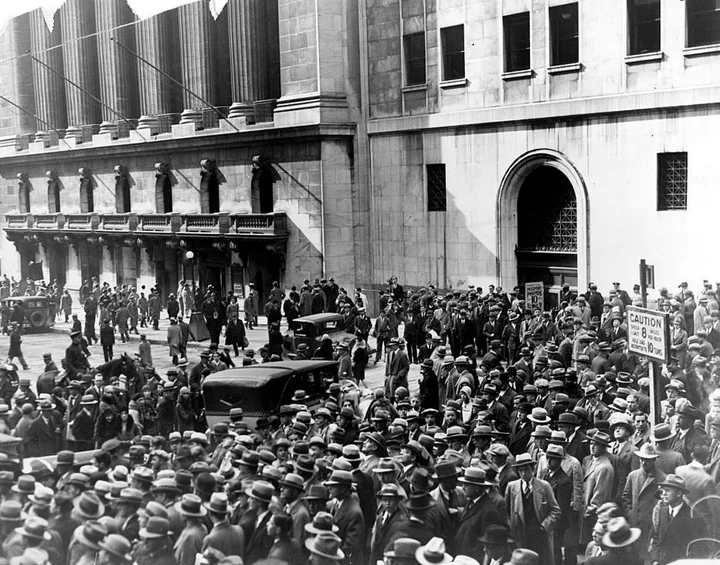
Crowd outside the New York Stock Exchange after the crash, 1929.
Dot-com and housing: one engine each
The late 1990s were the railway mania with a mouse. The internet changed things for good, and Shiller’s new-era story did the work Keynes described, with average opinion expecting average opinion to believe the old valuation tools no longer applied. The Nasdaq Composite fell 78 percent between March 2000 and October 2002 and most of the tickers died, but the fiber stayed in the ground. Amazon was a construction story that survived its own lottery phase. Pets.com was a lottery ticket sold with the same pitch. In real time a crowd can’t tell the two apart, and that uncertainty is exactly what a beauty contest feeds on.
The housing boom that followed ran on the other engine and was kept running by policy. Homeownership as national destiny was, in Shiller’s telling, a contagious story long before it was a structured product. The Fed eased after the dot-com bust, the government-sponsored mortgage giants and political pressure widened the funnel, and the banks and shadow banking system warehoused the leverage. National home prices rose about 85 percent from 2000 to the 2006 peak and then fell 27 percent. It is the clearest case of Quinn and Turner’s warning about bank-financed bubbles.
Crypto: both engines from the start
As an asset, crypto has run on both engines since the beginning. Bitcoin’s founding story is a protest against a monetary regime that made holding cash feel like a slow leak, and stablecoins have become the way people in Lagos and São Paulo hold dollars without an American bank account. We were making that case in May 2020, when we wrote that “the setup for broad-based currency debasement is playing out in front of our eyes,” and by December we called BTC “arguably the most levered asset to broad-based currency debasement.” Chainalysis counted about $220 billion of cross-border stablecoin flows in its latest annual report, up 78 percent, and stablecoins now make up 96 percent of the value moving peer to peer within countries. The technology underneath is a construction story in its own right, carrying about $300 billion of stablecoins and running order books that never close. The same ticker often carries both stories, and the argument over whether Bitcoin is a technology, a hedge or a religion never ends because the crowd never had to pick between them.
Crypto’s second role matters more for this thesis: it is also a technology for making speculation.
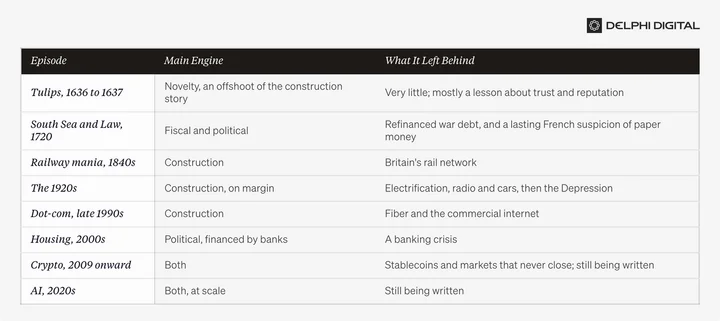
Laid out like this, each of the big episodes was driven mainly by one engine. Tulips, railways, radio and the internet were construction stories that played out inside political and monetary orders that broadly worked. The 1920s ran construction on borrowed money and ended badly. The South Sea, Law’s system and the housing boom were policy stories, with little new technology involved, and in each case the bet was sold from the top, by a state refinancing its debts or pushing homeownership. Crypto has run on both, but until recently it was small next to the economy around it.
Two things are different now. Both engines are running hard together, and the political and monetary one is being pushed from the bottom as much as from the top, by households who no longer see the ordinary path working. That second change is a big part of why the demand is so broad.
IV. Both engines at once
The lottery engine: houses, debt and jobs
After 2008 and again after 2020, policy taught a generation two lessons: cash leaks, and a falling asset market will be treated as a public emergency. Deficits stopped being an episode and became the regime. The federal deficit was $1.8 trillion in fiscal 2025, about 5.8 percent of GDP, in an economy that wasn’t in recession, and the Congressional Budget Office estimates it grew to about $2.0 trillion in fiscal 2026, which ended in September. Net interest on the debt now runs around $1 trillion a year, more than the country spends on defense.
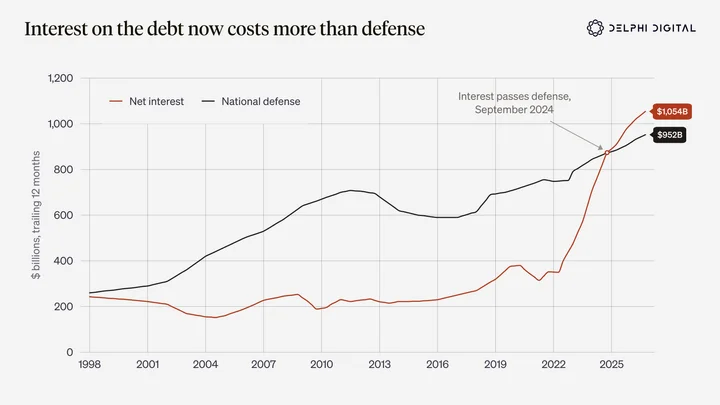
Federal outlays for net interest and national defense, trailing 12-month totals. US Treasury, Monthly Treasury Statement. Net interest first passed defense in September 2024 and has stayed above it since December 2024.
Through the 2010s consumer prices stayed tame and the excess showed up in assets: houses, long-duration stocks and anything scarce. After 2020 it showed up in both.
Zoning and undersupply are central to the housing story, and real rates haven’t been zero every year since 2008. The claim here is about what is left for a household whose wages no longer map onto a first home on the old schedule.
Pew Research Center’s measure is the cleanest. The median home value divided by the median income of households headed by someone under 40 sat near 2.5 from 1975 through 2000, hit 3.6 at the 2006 peak, eased to 2.9 by 2019, was back to 3.6 in 2022 and stood at 3.5 in 2024. Harvard’s Joint Center for Housing Studies, using sale prices against all households, puts the national median single-family home at 5.0 times median household income in 2024, and above 10 times in San Jose, Los Angeles, San Francisco and Honolulu. In the National Association of Realtors’ latest survey, first-time buyers were a record-low 21 percent of purchases and their median age hit a record 40.
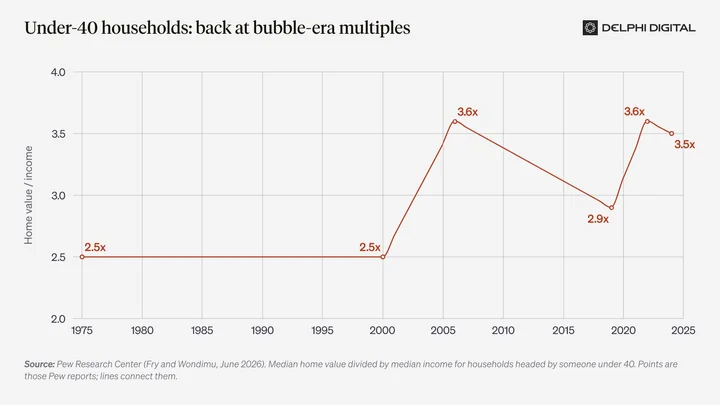
Median home value divided by median income for households headed by someone under 40. Pew Research Center (Fry and Wondimu, June 2026). Points are those Pew reports; lines connect them.
At prices like that the arithmetic of saving changes. Zero dollars and ten thousand dollars start to feel about the same, because neither gets you to a down payment, while ten thousand dollars and a house still feel very far apart. In many ways the old social contract (work, save, buy a home, let it compound) has been broken by political and monetary choices, and that changes which behaviors ordinary people consider rational.
The people who feel this most are young, and the young men among them are the ones filling up sportsbooks, options apps and prediction markets. Pew found that 36 percent of men under 30 bet on sports in the past year, against 22 percent of all adults. A FINRA Foundation survey found that 43 percent of investors under 35 had traded options, against 10 percent of those 55 and older. Biology and culture explain part of this, and young men were taking risks long before this monetary regime. A blocked path to ownership is likely part of why it scaled, alongside legalization and the phone. We described the same thing in May 2024, in the middle of the memecoin run: a generation “staring down crushing debt, unattainable housing, and wages that are insta-eroded by inflation,” for whom “the only way to win the new rat race is to hit 100x.” Asked why, people say so directly: in Northwestern Mutual’s 2026 study, 80 percent of Gen Z respondents drawn to high-risk assets said they were doing it because they feel financially behind. None of this means a whole generation has given up. The Urban Institute found that only 17 percent of Gen Z bet on sports in the past year and that most still save conventionally. The theme doesn’t need a majority, though. It needs a large, motivated minority with a phone.
Legal American sports betting handle went from $6.6 billion in 2018 to $166.9 billion in 2025, according to the American Gaming Association. Murphy v. NCAA changed the law in May 2018. The demand was already there, and the ruling gave it a legal channel and gave the states something to tax.
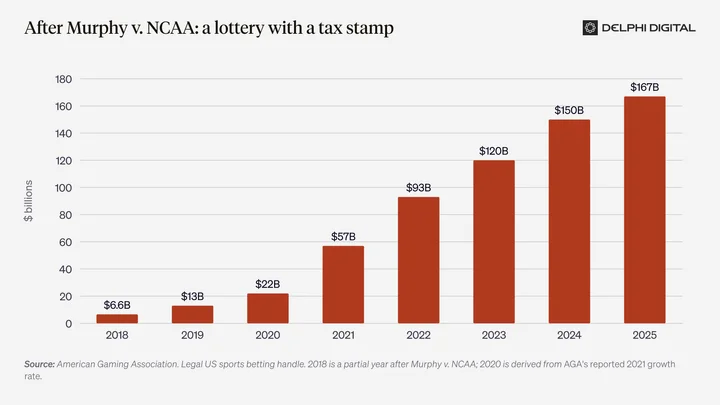
Legal US sports betting handle, American Gaming Association. 2018 is a partial year after Murphy v. NCAA; 2020 is derived from AGA’s reported 2021 growth rate.
The monetary piece weakened in the first half of the year, and the Treasury revived it on August 19, when it said it would at least double its “liquidity support” buybacks of long-dated bonds. Delphi’s Scott Freeman called it “the same consolidated-balance-sheet operation as QE, run out of a different building” the day it was announced. A JPMorgan note popularized the phrase “debasement trade” in October 2025, and gold crossed $4,000 days later. We had been writing about the trade since 2019, when our December macro outlook argued that “a new wave of global fiat debasement policy is in its early stages,” and in January 2025, with gold near $2,700, we called it “one of the best charts to watch right now.” Gold peaked near $5,600 in January 2026. Since then gold has given back about a quarter of its value, the Fed has raised rates for the first time since 2023, and the 10-year Treasury yield closed above 5.3 percent in early October, its highest in more than two decades. Cash pays something again, and anyone who read debasement as a one-way ride in gold has been corrected. Higher rates don’t reopen the ladder, though. They make a mortgage on a house priced at 3.5 times income harder to carry, and they land on a government running deficits near 6 percent of GDP at full employment, which now has to refinance at higher rates while a fast-growing wave of AI borrowing competes for the same savings. So the lottery engine today rests less on gold and more on houses, jobs and fiscal strain, and AI touches all three.
The construction engine: the largest private build in decades
The construction story of this decade has one name, AI. Or is it SI now? Regardless, Microsoft, Alphabet, Amazon and Meta spent about $416 billion on capital expenditure in 2025, up two-thirds from 2024, and their guidance for 2026 adds up to somewhere between $720 billion and $745 billion, with Oracle on top of that. That is spending equal to about 2.3 percent of US GDP, though some of it lands abroad and much of the hardware is imported. It is more than double the telecom boom’s peak of about 1 percent of GDP, in the range of American railroad investment in the 1870s and 1880s, and it runs through four balance sheets.
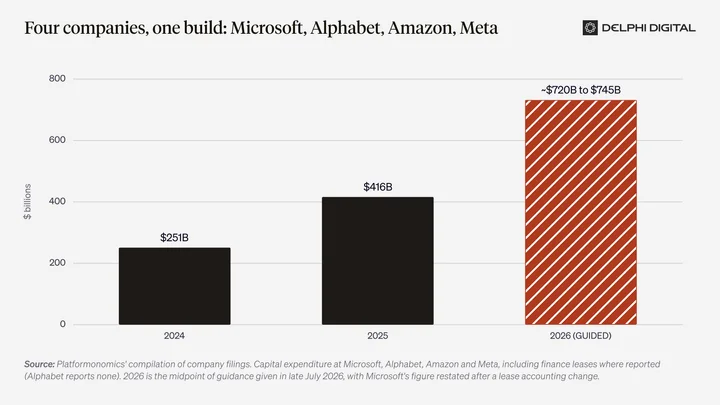
Capital expenditure at Microsoft, Alphabet, Amazon and Meta, including finance leases where reported (Alphabet reports none). 2024 and 2025 from Platformonomics’ compilation of company filings; 2026 is the midpoint of guidance given in late July 2026, with Microsoft’s figure restated after a lease accounting change.
The economist Jason Furman calculated that investment in information processing equipment and software accounted for 92 percent of US GDP growth in the first half of 2025. That number is gross. Much of the hardware is imported, and economists at Goldman Sachs and the Fed have argued that net of imports the contribution was far smaller. Either way the build has become large enough that the economy, the grid and the government all have to organize around it.
Soros would say there is a real trend here, the buildout of compute and power, and a possible misconception attached to it: that revenue will arrive on the same calendar as depreciation. Rising prices fund more building, and more building makes the story look true. Most of the equity expressions will probably disappoint the way railway shares did, and some of the capex will stay the way the rails stayed.
The obvious move is to own the build itself, meaning power, chips and whichever labs survive. That is the right instinct for what the boom leaves behind, and something we will cover more directly in our Year Ahead report series, but it misses what the boom does to everyone watching it. A technology that multiplies the number of plausible futures also multiplies the demand for contracts that let people bet on which future arrives. Perpetuals, same-day options and event contracts on chip stocks, rate decisions and AI headlines are how a crowd lives with not knowing which name in the build is Amazon and which is Pets.com.
Where the two engines meet
In past episodes the technology engine and the political engine mostly ran on separate tracks. The AI build is now big enough to drive both, and it does so through four channels: the power bill, the state, the bond market and the job market.
The power bill comes first. Data centers used about 4.4 percent of US electricity in 2023, and Lawrence Berkeley National Laboratory now projects close to 12 percent by 2030. The PJM grid, which serves about 67 million people across 13 states and Washington, D.C., runs an annual auction for future generating capacity. The clearing price was $28.92 per megawatt-day for 2024/25, jumped to $269.92 for 2025/26 and has sat at or near the cap of about $330 since. PJM’s independent market monitor said data centers added $9.3 billion to that first jump alone. Residential electricity prices rose about 40 percent nationally in the five years to March 2026, with grid upgrades and fuel doing much of that and capacity prices a growing share.
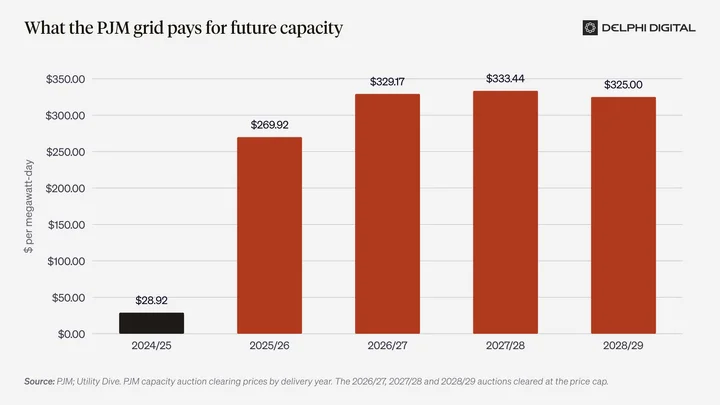
PJM capacity auction clearing prices by delivery year. The 2026/27, 2027/28 and 2028/29 auctions all cleared at the price cap. PJM; Utility Dive.
The bill became a political fact quickly. In November 2025, New Jersey and Virginia elected governors who ran hard on electricity costs, with Mikie Sherrill promising a “state of emergency on utility costs” and Abigail Spanberger promising that data centers would cover their own power costs. In January, after the president posted that Americans should not “pick up the tab,” Microsoft pledged to pay its full power costs and turn down local tax breaks. Virginia’s sales-tax exemption for data centers cost the state $1.6 billion in fiscal 2025. Local opposition is organized almost everywhere, and one tracker, Data Center Watch, counted about $130 billion of projects blocked or delayed in the first quarter of 2026 alone. On September 29, the Federal Energy Regulatory Commission approved only part of PJM’s backstop plan to buy new power for data centers and ordered changes to who pays, with its chair saying the commission “will not be forced into accepting a deeply flawed, eleventh-hour procurement mechanism with billion-dollar implications for consumers.”
The model is a private claim. The watts, the transmission lines and often the plant end up partly on a public or quasi-public book, paid for through ratepayers, tax abatements and credits, under a story that this is infrastructure for a national race. The South Sea ran the other direction, selling public debt to the crowd as private equity, but the family resemblance is a public balance sheet standing behind a private upside. Housing did it with mortgages, and this does it with the grid. There is pushback (AEP Ohio now makes large data centers pay for at least 85 percent of the capacity they reserve, and the PJM governors want data centers to carry the cost of new supply), so the fight now is over how much of the bill gets sent back.
The state has also moved from regulating the build to owning pieces of it. In August 2025 the federal government took a 9.9 percent stake in Intel, paid for largely with CHIPS Act grants that hadn’t yet been handed out. Nvidia and AMD agreed to give the government 15 percent of their revenue on certain chips sold to China in exchange for export licenses, and the cut was 25 percent when Nvidia’s H200 was approved in December. The administration called its Genesis Mission “comparable in urgency and ambition to the Manhattan Project,” ordered faster permitting for large data centers, and in December 2025 moved to challenge state AI laws in court after the Senate had voted 99 to 1 to strip a moratorium on those laws out of the budget bill. An AI industry super PAC, Leading the Future, launched with more than $100 million, and in a single New York House primary in June, groups on the two sides of the AI fight spent more than $27 million between them. A government that takes equity in chipmakers and compares the build to the Manhattan Project is telling markets it won’t let the build fail, which is close to a policy put on the construction story. It also makes AI a live issue on the ballot in every district with a data center.
The bond market is the third channel. The big tech companies sold about $220 billion of bonds in 2026 through early August, already more than in all of 2025, and the largest private credit deal on record, Meta’s $27 billion Hyperion data center financing, was structured to stay off Meta’s balance sheet. As the 10-year yield climbed past 5 percent this fall, AI corporate borrowing was one of the reasons the market gave for it. The Fed’s May financial stability report relayed market contacts’ worries that “capital expenditures are increasingly funded by debt, creating leverage in the system.” The private boom and the public debt are drawing on the same pool of savings.
The last channel runs through wages. In an August 2026 update of their “Canaries in the Coal Mine” paper, Erik Brynjolfsson and his coauthors at Stanford found that employment of 22- to 25-year-olds in the most AI-exposed occupations was 19 percent below where it would have been had it kept pace with their less-exposed peers, a result they describe as descriptive rather than causal. The New York Fed puts unemployment for recent college graduates at 5.6 percent, against about 4.2 percent for all workers. That gap started opening in 2019, before ChatGPT, so AI isn’t the whole story. Employers cited AI for about 120,000 announced job cuts in the first nine months of 2026, more than double the 2025 total, according to Challenger, Gray & Christmas, though some of that is surely companies dressing up ordinary layoffs. Dario Amodei, who runs the AI lab Anthropic, warned in 2025 that AI could wipe out half of all entry-level white-collar jobs. In a Pew survey this summer, 73 percent of adults under 30 said AI will mean fewer jobs.
No study yet ties AI job anxiety directly to sports betting or same-day options, so the link here is an argument built from separate pieces of evidence. They do point the same way. The build that hands the crowd its biggest construction story in decades is also raising household power bills, pulling the government into equity stakes and industrial policy, competing with the Treasury for savings, and telling a 23-year-old that the entry-level job that was supposed to start the ladder may not be there. In July, Delphi Ventures asked who will pay the liabilities of an aging, indebted world, and answered: “The most obvious, and likely, solution is a combination of debasement and a sprint for automation.” AI may be the first great technology boom that feeds the lottery engine as directly as it feeds the construction one.
Everything on one phone
What the nineteenth century couldn’t do was put the construction bet and the lottery ticket in the same place. A railway prospectus and a betting shop were different buildings in different parts of town. Today a 25-year-old can, between two notifications, take a view on a chipmaker, gold, a football match and a central bank decision, and experience all four as the same act of having an opinion that pays.
The products have moved to meet the demand. Cboe filled in daily expirations for S&P 500 options in 2022, and same-day contracts went from about 5 percent of SPX options volume in 2016 to 45 percent in 2023 and 59 percent in 2025, with a monthly record of 66 percent in July 2026. Cboe’s own estimates put individual traders at more than half of customer volume in those contracts. Part of this is mechanical, since once every weekday has an expiry, same-day contracts exist automatically. But Cboe added the days because the appetite was there to fill them, and in June 2026 regulators scrapped the $25,000 minimum for pattern day traders, which lowered the barrier again.
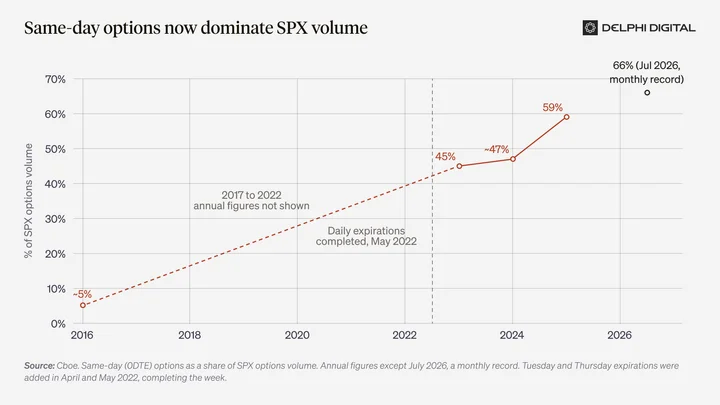
Same-day (0DTE) options as a share of SPX options volume. Cboe. Annual figures except July 2026, a monthly record. Tuesday and Thursday expirations were added in April and May 2022, completing the week.
Event contracts went further. Combined volume at Kalshi and Polymarket was about $2 billion a month in mid-2025. It was $25.7 billion in May 2026, $47.7 billion in June and $53 billion in July, according to Pew’s analysis of data from The Block, which made July roughly 25 times July 2025.
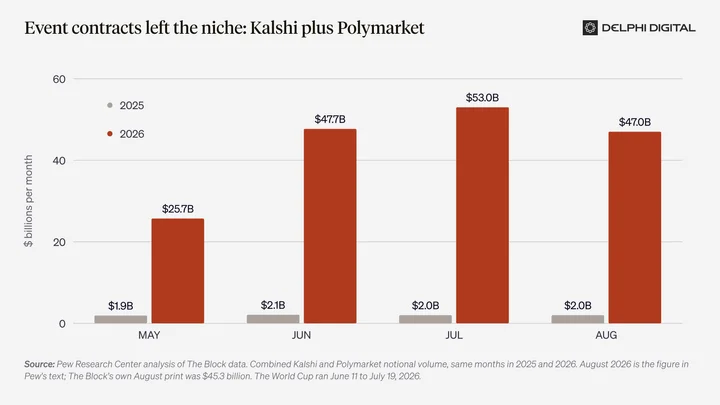
Combined Kalshi and Polymarket notional volume, same months in 2025 and 2026. Pew Research Center analysis of The Block data. August 2026 is the figure in Pew’s text; The Block’s own August print was $45.3 billion. The World Cup ran June 11 to July 19, 2026.
The newest apps go a step further and put the crowd itself on the screen. Fomo, a crypto trading app launched in May 2025, is built around a feed of other users’ verified trades: users follow traders, watch their buys, sells and realized profit and loss, and trade from the same screen. Its perpetual futures route through Hyperliquid, the largest onchain perpetuals exchange, so the social front end already sits on top of the onchain house. The company says it passed 600,000 users and $4 billion of cumulative volume by June 2026, when it raised $75 million at a reported $550 million valuation, and its payments partner Crossmint says about 68,000 first-time crypto buyers funded accounts through its Apple Pay checkout. Keynes’s beauty contest asked readers to guess what everyone else would pick. A social trading feed shows what everyone else is picking, as they pick it.
Sports betting, casino apps, social trading, memecoins and same-day options usually get treated as five separate moral panics. They read better as one demand, showing up in whatever form is closest to hand, at a moment when both engines are running and acting on either one takes a few seconds on a phone.
What crypto adds
If AI mostly gives people reasons to speculate, crypto gives them the means, and brings in new speculators along the way.
Start with the cost of making a bet. Creating a new tradable asset used to take lawyers, an exchange listing and months of work. On pump.fun, a Solana launchpad for memecoins, it costs less than $2. More than 19 million tokens have been created there since January 2024, and in late September about 33,000 more were launched on a typical day. About 1 percent ever trade past the launchpad’s starting curve, and most stop trading on the day they are created. Listing a market on anything has gone the same way. On Hyperliquid, anyone who posts a large enough stake can now list a perpetual future on almost anything.
That supply has spread well past crypto. Monthly volume in perpetual futures on stocks, commodities and currencies across crypto exchanges went from about $52 billion in January 2026 to about $268 billion in June, according to TokenInsight. Binance alone listed perps on gold, Tesla, a pre-IPO SpaceX contract and the Brazilian real. Builder-deployed markets swung between about a quarter and more than half of Hyperliquid’s volume over the summer. Tokenized stocks are still small, about $3.2 billion on rwa.xyz’s count, but growing. All of this happened while total crypto market value roughly halved from its 2025 peak by June, which suggests the demand is for the structure as much as for the coins.
Traditional finance is moving toward the same structure. CME began trading its crypto futures and options around the clock in May. The same month, the CFTC approved Kalshi’s Bitcoin perpetual and issued a policy statement on perpetual contracts, and Kalshi has since launched gold and silver perps in September and a stock index perp in October, and filed for single-stock perps. DTCC began clearing around the clock on weekdays in June, Nasdaq is scheduled to start overnight trading in December, and in September the SEC opened an exemption for trading tokenized stocks on public blockchains. Each of these moves a traditional market toward something crypto venues have offered for years.
Crypto also creates speculators. In a CFA Institute and FINRA Foundation survey published in 2023, 44 percent of American Gen Z investors said crypto was their first investment, ahead of individual stocks. A Bank for International Settlements study of 95 countries found that rising Bitcoin prices pulled new users onto crypto apps, about 40 percent of them men under 35. Airdrops do the same thing at a smaller scale: one recent study found that wallets receiving the BONK airdrop traded about 80 percent more on Solana than similar wallets that did not, and moved into more volatile tokens, even when the airdrop itself lost value. Gains inside crypto also tend to become the next round’s buying power. SOL went from about $20 in October 2023 to about $200 by March 2024, and the Solana memecoin boom grew alongside that run.
The loop also runs inward. Venues hand out tokens to attract traders, the traders pay fees, and the fees buy back the venue’s token, so Hyperliquid’s 31 percent airdrop in 2024 paid for the traders whose fees have since bought back more than $1.3 billion of HYPE.
The costs are just as visible. On October 10, 2025, crypto markets liquidated about $19 billion of leveraged positions across roughly 1.6 million traders in 24 hours, more than ten times the liquidations of the COVID crash. As of January 2025, only about 0.4 percent of pump.fun wallets had realized more than $10,000 of profit, and the BIS study estimated that by late 2022 about three-quarters of retail users had likely lost money on their first Bitcoin investment. Wash trading and incentive farming inflate reported volume across the category. CoinGecko’s share of profitable pump.fun wallets did rise in 2026, though it counts realized trades only and includes bots. And the Federal Reserve’s household survey still puts American crypto use below its 2021 level. As with sports betting, the case rests on a motivated minority, for whom crypto has made speculation cheaper, faster and more global, and the BIS data suggest that group grows when prices run.
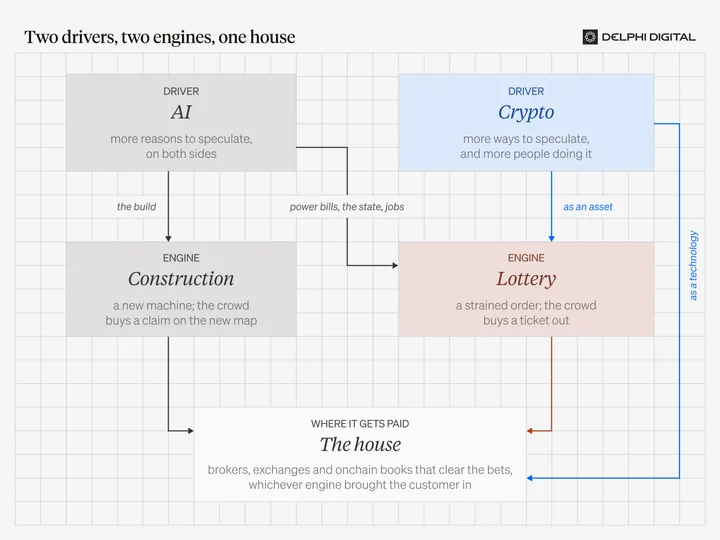
Two drivers, two engines, one house. AI mostly supplies reasons to speculate; crypto supplies the means and some of the people.
V. Own the house
If speculation is a social response to a gap, and both gaps are open, the objects people bet on will keep rotating. Last year’s construction name becomes next month’s lottery stub. The business that never has to pick the winner is the one that lists all of them.
A casino needs the wheel to spin, and it makes no difference to the casino whether the players understand the odds. An exchange needs disagreement, leverage and a take rate that survives competition, and it doesn’t much matter whether the listed story turns out to be true. Graham wanted the public to remember that it was speculating. The house gets paid whether the bets win or lose.
The fair objection is that “own the house” sounds too easy, and history agrees. Bucket shops, the storefronts that let customers bet on stock and grain prices without buying anything, lost in the Supreme Court in 1905, when it let exchanges cut off the price feeds they ran on, and state laws finished them off by the 1920s. Papertrade, which launched on Hyperliquid’s HyperEVM in October 2026 and has traders betting against a shared house pool, has already drawn the bucket shop comparison from critics. Island, the electronic order book that helped break the old Nasdaq dealer spread, ended up inside Instinet and then Nasdaq. FTX was a house. Commissions on stock trades were competed down to zero. Owning a venue only works when the venue is a franchise: distribution that is hard to take away, a book that is open when the others are closed, a product mix that can change with the crowd’s mood without losing the customer, and a take rate that isn’t just an incentive program in disguise.
The house also gets paid only while the crowd shows up, and venue revenue is cyclical. Hyperliquid’s fees averaged about $109 million a month in the second half of 2025 and about $71 million a month so far in 2026. Robinhood’s crypto revenue fell 38 percent year on year in the second quarter. Owning the house means owning that cycle, and price matters: a venue bought at a peak-volume multiple can be a bad trade even if the theme is right.
What owning the house means
It means owning the matching engines, the brokerage accounts and the distribution that turn an opinion into a fill, and staying away from the opinion itself. The easiest way to ruin this thesis is to fill the book with the things the venues list: the lab, the meme, the coin, the team. Those are what the crowd is for, and they are how the crowd goes broke.
The house has one more advantage right now, which is that it doesn’t care which engine brought the customer in. A regulated broker that sells an equity option at 10 a.m., an event contract at kickoff and a crypto pair on Sunday night collects from construction and lottery without having to say which is which. An onchain perpetuals exchange that lists crude while the conventional market is closed, alongside equity indices, gold and coins, does the same for a crowd that keeps no exchange hours. The thesis needs no forecast of the next story, only that stories keep needing a market.
Delphi’s edge is crypto, so the rest of this section leans that way as a primer for our upcoming Year Ahead reports, but the theme itself doesn’t care about asset class and the traditional houses belong in the picture. Cboe owns the SPX same-day options franchise. CME lists the contracts behind FanDuel Predicts, which went live in all 50 states in January. DraftKings moved its prediction product onto its own exchange in June. Coinbase routes prediction markets through Kalshi, and since buying Deribit for $2.9 billion in August 2025 it has owned the largest crypto options exchange. Interactive Brokers runs ForecastEx. These are durable businesses with strong moats. The onchain venues are interesting for a different reason. They can list almost anything, stay open around the clock and serve a global customer base, and in Hyperliquid’s case nearly all protocol fees go to buying back the token. That makes them a higher-beta way to own the same demand, with risks to match.
Robinhood: proof that the bundle pays
In the second quarter of 2026, Robinhood broke out event contracts as their own revenue line for the first time: $156 million, more than equities at $129 million and more than crypto at $100 million. Options were still the biggest transaction line at $342 million, and total net revenue was $1.31 billion. A year earlier, event contracts were bringing in roughly $10 million a quarter. Robinhood says close to 2 million of its 28.4 million funded customers have used the product, about 7 percent, a gap Morgan Stanley pointed to when it upgraded the stock in September.
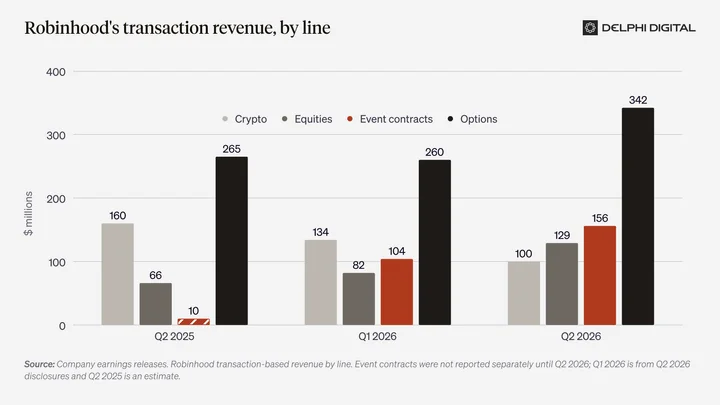
Robinhood transaction-based revenue by line. Company earnings releases. Event contracts were not reported separately until Q2 2026; Q1 2026 is from Q2 2026 disclosures and Q2 2025 is an estimate.
Customers wanted somewhere to put an opinion. Crypto was that place last cycle, options have been for years, and event contracts are this cycle’s version. If event contracts can keep bringing in about a fifth of transaction revenue while reaching under a tenth of the account base, there is a lot of room left to turn spectators into players. If crypto comes back, it adds to the same customer base. In the regulated world the house is a bundle, and you buy the bundle because you can’t know which part will be busy.
The legal fight is a real risk, and it is live. The Third Circuit sided with Kalshi against New Jersey in April. The Ninth Circuit went the other way in August, ruling in Kalshi’s case and a companion case brought by Robinhood that sports event contracts are not swaps and that Nevada can enforce its gambling law. The Sixth Circuit ruled against Kalshi in Ohio and Tennessee in September. New Jersey and Robinhood have each filed petitions asking the Supreme Court to take up the question. Robinhood has already stopped sports contracts in Nevada and agreed to stop new ones in Michigan, and Missouri’s attorney general sent cease-and-desist letters to six platforms in September. If the courts clip the event business, the same customers are still sitting on an options and brokerage stack, and the thesis gets more nuanced, but doesn’t die. The $156 million may also turn out to be partly a World Cup quarter. Robinhood reports the third quarter on October 27, and the next few quarters will show whether 7 percent penetration was the start of a product or the peak of a novelty.
Hyperliquid: the same idea without a listing committee
Onchain perpetual futures are what you get when a railway prospectus no longer needs Parliament. We made Hyperliquid a key theme of our Year Ahead for 2025, published eleven days after the HYPE launch, when we wrote that it “aims to become something synonymous with the phrase ‘onchain Binance.'” Traders paid about $972 million in fees on Hyperliquid in 2025 on roughly $3 trillion of volume, and DefiLlama counts $818 million of that as protocol revenue once builder fees and other payouts are excluded. Nearly all of the protocol’s share went to the Assistance Fund, which buys HYPE on the market and takes it out of circulation. Fees in the first nine months of 2026 came to about $643 million, a slower pace than the second half of 2025 and a reminder that venue revenue still rises and falls with crypto’s mood.
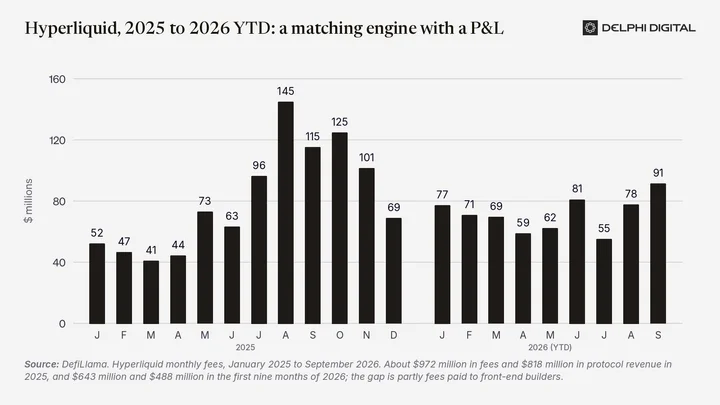
Hyperliquid monthly fees, January 2025 to September 2026. DefiLlama. About $972 million in fees and $818 million in protocol revenue in 2025, and $643 million and $488 million in the first nine months of 2026; the gap is partly fees paid to front-end builders.
HIP-3 is the part that fits the two-engine argument rather than a crypto-only story. Since October 2025, anyone who stakes 500,000 HYPE can deploy their own perpetual market on Hyperliquid and keep up to half of its trading fees. The largest deployer, trade.xyz, lists crude, Brent, gold, silver, equity indices, single stocks and pre-IPO names, and did somewhere between $47 billion and $58 billion of volume in the 30 days to October 6, depending on whose tracker you trust. When the United States and Israel struck Iran on Saturday, February 28, oil perps on Hyperliquid were trading while CME was shut, and JPMorgan later noted that daily oil volume on the platform had peaked at $1.7 billion. Traders found an oil market open on a Saturday and used it. If that holds, the venue’s cycle changes, because crypto perps move with risk appetite while a commodities and index book moves with the news and broader economic appetite.
The risks are ordinary. Take rates can be competed down, and HIP-3’s growth mode already cuts fees by 90 percent or more on new markets to attract volume. Volume can be farmed for theoretical points. One deployer can dominate (trade.xyz was about 95 percent of HIP-3 volume in the second quarter). Regulation can cut American customers off from the book. A token that buys back with fees is still not a share in the house. HYPE also sits on both sides of the first rule below: it is a claim on the house and, for most holders, a piece of the crowd’s inventory that trades with crypto sentiment. Hyperliquid belongs here because it is the clearest working example of a matching engine trying to become the everything exchange the two-engine argument implies.
Lighter and the case for more than one venue
One venue is a story about a company. Several venues are evidence of demand. On DefiLlama’s 30-day numbers in early October, Hyperliquid did about $203 billion, Variational $66 billion, Aster $60 billion and Lighter $56 billion, with a long tail behind them. Some of that is incentive farming, and DefiLlama pulled Aster from its rankings in October 2025 over data concerns related to trading volumes. Even after a haircut, the category is big enough for multiple winners.
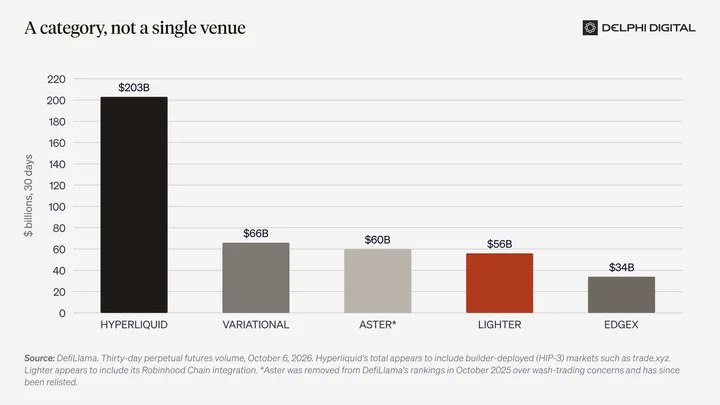
Thirty-day perpetual futures volume, October 6, 2026. DefiLlama. Hyperliquid’s total appears to include builder-deployed (HIP-3) markets such as trade.xyz. Lighter appears to include its Robinhood Chain integration. *Aster was removed from DefiLlama’s rankings in October 2025 over wash-trading concerns and has since been relisted.
Lighter is the clearest second bet. It runs an order book whose matching is proven with zero-knowledge proofs, charges ordinary accounts nothing, and lists stocks, commodities and FX next to coins. Robinhood invested in its November 2025 round, and since July the perps inside Robinhood Wallet, which are offered outside the United States, have run through Lighter on Robinhood Chain under a revenue-sharing deal. Its LIT token launched in December 2025. With retail trading free, Lighter’s take has to come from premium accounts, distribution deals and whatever the token captures. On September 20, a commit to Lighter’s prover titled “Binary options support” added outcome-style positions and settlement. Code in a repository won’t matter until there is liquidity on the other side of it, but it shows where the venue thinks demand is going.
Event contracts: the product built for a phone
A prediction market contract is a different claim from an option. You buy yes or no on a dated fact. The price reads as a probability, the most you can lose is what you paid, and there is no funding rate and no liquidation. Its social job sits close to the lottery engine: a crowd that already has an opinion about a game, an election, an inflation print or a price wants that opinion to pay before the fact arrives. It suits a phone better than any product before it, because the same account can hold a long-dated view and a Saturday afternoon bet.
When we first wrote about prediction markets in January 2023, Kalshi was still “preparing to launch” and Polymarket had just paid a CFTC fine and shut out American users. Kalshi is the licensed American venue and is reportedly raising at around a $40 billion valuation. Polymarket is the global one, which many people now read as a news source, and it relaunched in the United States in late 2025. Robinhood is the distributor that found event contracts could out-earn its crypto business. Together they show the demand reaches well beyond crypto.
The standard objection is that most of this volume is sports betting by another name. Pew’s breakdown of volume from July 2024 to April 2026 puts sports at 80 percent of Kalshi and 39 percent of Polymarket, and sports pushed higher still this summer, a jump Pew says was not simply a World Cup effect. If that mix holds, the category is a sportsbook with better branding and a federal regulator, and the house thesis still works as a thesis about gambling rails rather than information markets. The test is whether politics, macro and company markets grow once the sports calendar cools, and if they don’t, the position should be sized as sports rails. There is a quality question too. Kalshi is ending its volume incentive program after the Wall Street Journal reported that the CFTC was looking at wash-trading allegations, which Kalshi denies, a fair reminder that some of the volume everywhere in this category is paid for.
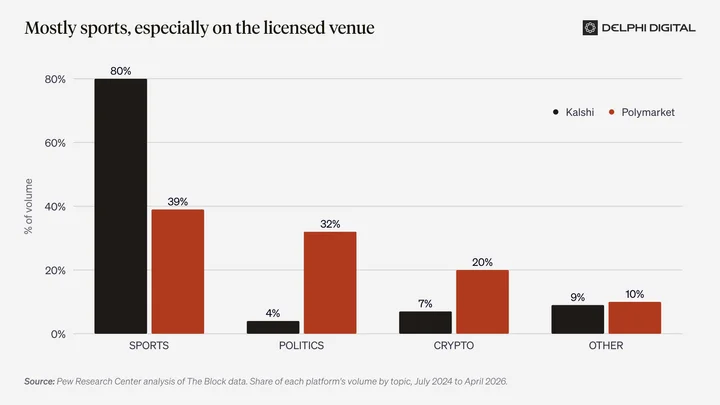
Share of each platform’s volume by topic, July 2024 to April 2026. Pew Research Center analysis of The Block data.
HIP-4, Hyperliquid’s market for event contracts, is the permissionless onchain version of the same contract. It lives on Hyperliquid next to the perps, uses the same collateral, and usually settles at 0 or 1. Curated markets went live on May 2, 2026, starting with a daily Bitcoin binary that settles at 06:00 UTC, and deployment opened to anyone on August 29, with a 500,000 HYPE stake that validators can slash if a builder writes a bad market or fails to settle it. Outcome, Skew and trade.xyz were the first deployers. Cumulative volume was somewhere between $317 million and $395 million by early October, depending on the tracker, and the 30 days to October 5 did about $45 million, against roughly $53 billion at Kalshi alone in September through the 29th. HIP-4 is a primitive, and treating its run rate as a second Polymarket is how a primitive gets talked into a finished business.
What HIP-4 adds is the shared account. A trader can be long the BTC perp and long a binary that pays if the same mark prints below a strike, in one book, against one margin balance, at three in the morning. The others are converging on the same idea: Polymarket added perps outside the United States in September, and Kalshi has listed them since June. As prediction venues and perps venues grow into each other, HIP-4’s lasting edge is permissionless listing. Fees are shared with deployers, so if one builder dominates the templates the protocol keeps the brand and gives up the take, which is the HIP-3 risk in a different contract.
Listed options: the unfinished surface
An option is a harder product to build than an event contract. It has a strike, an expiry, greeks and a volatility surface that somebody has to make and be willing to sell you the other side of, which is a different liquidity problem.
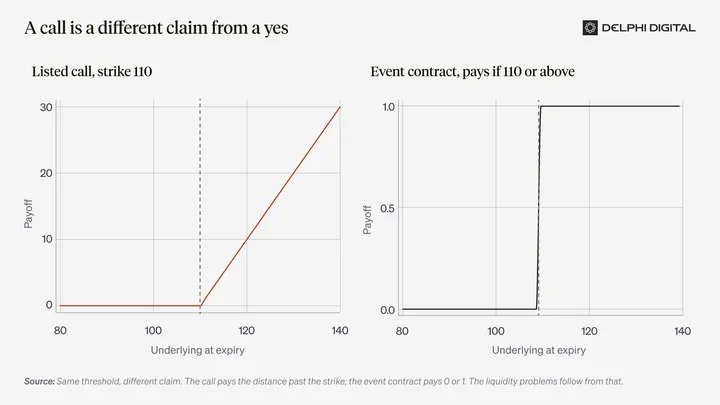
Same threshold, different claim. The call pays the distance past the strike; the event contract pays 0 or 1. The liquidity problems follow from that.
Retail has already shown how much it wants bounded convexity, between same-day SPX options and the $342 million options line at Robinhood. The lottery will pay for convexity, especially with the convenience of modern day venues.
Onchain, the serious books are still small. Derive has become the default onchain options venue, with about 87 percent of onchain options premium in 2026 through mid-September. On one reported day in September it did $163 million of options volume, against $3.56 billion at Deribit, which Coinbase now owns and which holds close to 80 percent of global crypto options open interest. Paradex, a venue incubated by Paradigm’s institutional trading network, wired in Paradigm’s RFQ engine in mid-September and saw options open interest rise 2.6 times to $202 million in four days. Put every onchain venue together and the total is a rounding error next to Deribit.
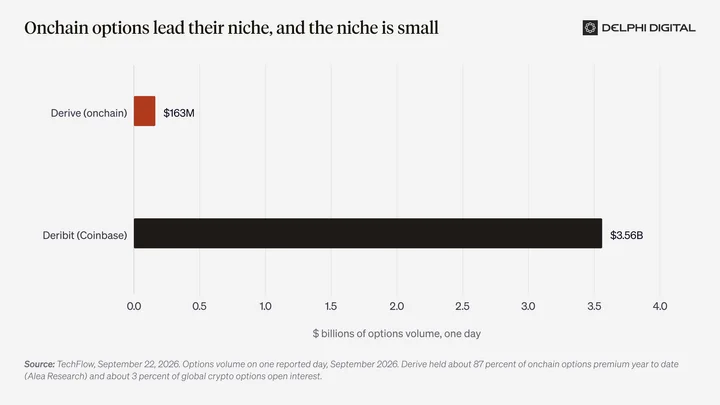
Options volume on one reported day, September 2026. TechFlow, September 22, 2026. Derive held about 87 percent of onchain options premium year to date (Alea Research) and about 3 percent of global crypto options open interest.
The reason the surface is thin is mechanical. A perpetual is one book per underlying, while an option is one book per underlying, strike, expiry and type, so liquidity shatters. Until a crypto venue can make an option as easy to trade as a same-day SPX contract, on a surface someone will actually hedge, listed options remain a sleeve with real demand and thin books, and Derive and Paradex are best treated as a cheap call on the surface filling in. The house already collects the easier convexity through same-day options at the regulated front and event contracts everywhere else.
Hyperliquid may be the first to try. Its founder, Jeff Yan, said in an interview on Blockworks’ Empire podcast in early October that options are the likely next step, and that HIP-4 gives builders a clear path to build options protocols that inherit Hyperliquid’s spot order books, portfolio margin and the ability to hedge delta on its perps markets. He gave no date. If someone builds them, the venue with the deepest onchain perps book becomes the most natural place for the options surface to fill in.
How to hold it
A sleeve built on this theme has four parts. The core is venues with real earnings or fee capture and distribution that is hard to take away. Satellites are newer venues where the economics are still being proven. Early bets go to primitives, like the onchain options venues, that could matter a great deal or not at all. Private venues that can’t be owned yet go on a watch list. And the crowd’s inventory, meaning the labs, memes, coins and teams the venues list, stays out. Weights and conviction are for the year-ahead reports.
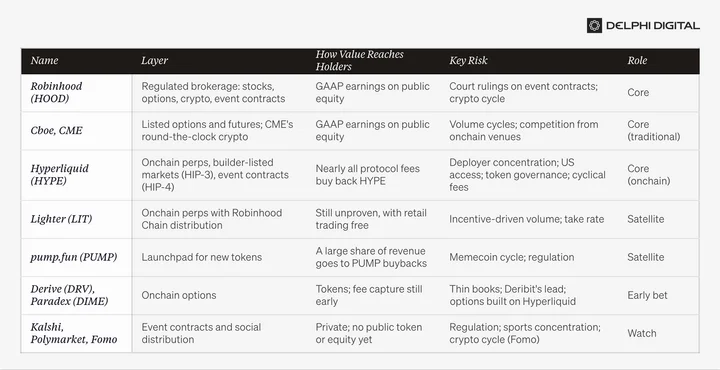
Five rules for running it:
- Keep the house and the crowd’s inventory in separate books. If a name’s revenue is a take rate on other people’s speculation, it is the house. If the name is the speculation, it is inventory. Some names, HYPE among them, are both, and should be sized knowing that.
- Watch take rate and mix, not only volume. Bagehot’s stupid money can inflate volume at a venue that is giving the product away. Hyperliquid’s growth mode, Lighter’s zero retail fees and Robinhood’s payment for order flow are different answers to the same problem, and each can fail in its own way. Volume that never shows up as captured revenue is just activity.
- Treat regulation as part of the structure. A licensed venue can be capped and still be a good business, the way state lotteries are. An unlicensed book can be pushed offshore and keep trading while American markets sleep. Owning only one side of that is a bet on a court.
- Prefer the closest thing to an equity claim on the rails. Robinhood reports GAAP earnings and Hyperliquid reports fees and buybacks. Those are different instruments with different governance and different tail risks, but they are closer to each other than either is to the things listed on the board.
- Size it for a culture rather than a quarter. Cultures fade when the gap closes: when a salary buys a house again, when entry-level jobs come back, when the new machine becomes as boring as electricity eventually did. Until then the wheel keeps spinning and the objects on it keep changing.
Where this ends
There are two main ways this can end. In the first, more and more of life becomes tradable: elections, rate decisions, the weather, a company’s next product launch, an athlete’s next game. The bets get smaller, faster and more frequent, and more of them are placed by software. An AI agent acting for a user could express a single view through dozens of contracts across several venues without the user ever opening an app, which pushes even more of the value toward whoever runs the matching engine and the settlement layer. On that path the intensity of speculation still rises and falls with the cycle, but the infrastructure keeps growing, and the house starts to look like a utility.
The second path is the one every crowd in this piece eventually took. Speculation on this scale has always ended in a bust, and there is no good reason to think this time is different. What matters is what survives. The railways are the template: shareholders lost heavily and the network stayed. The house isn’t immune either. FTX went to zero, and venue revenue falls hard when the crowd goes home. October 10, 2025 was a small test. On the largest liquidation day on record, Hyperliquid’s founder reported 100 percent uptime and no bad debt, though the exchange had to use its first cross-margin auto-deleveraging in more than two years. In a bust a well-run house loses income; the crowd’s inventory can go to zero.
The two paths aren’t exclusive, and the likeliest version is both: speculation busts at some point, and the infrastructure is still standing afterward, owned by somebody. The signals below are how we will tell which one is running.
What we’re watching
These are the signals we will track through the year, and put numbers on as we go.
- Market share. Whether onchain venues keep taking perpetual futures volume from the large centralized exchanges, or simply ride the category’s growth.
- Event contracts post World Cup. Whether they become a lasting part of how brokers make money once the sports calendar cools, and whether prediction markets broaden beyond sports.
- Traditional assets on crypto rails. Whether stocks, commodities and currencies keep moving onchain, and how fast traditional exchanges close the gap with round-the-clock trading and tokenized shares.
- The courts. Whether event contracts end up treated as futures or as gambling, and whether that splits the American and offshore venues.
- AI on the bill and the ballot. Whether the cost of the build keeps showing up in household power bills and elections, and whether the entry-level job market recovers.
What would make this wrong
Real rates that stay high would shrink the lottery engine if they came with a housing market that opens back up, and the Fed’s hike and a 10-year yield above 5 percent are testing that right now. An AI build that produces consensus instead of argument, or simply slows down, would shrink the construction engine. Take rates competed to zero, or volume that only exists because of incentive programs, would leave plenty of activity and nothing to own. A political decision to treat the whole category as a vice, and to enforce it, would leave a smaller set of licensed venues, and the Supreme Court may soon get a chance to start down that road. The two-engine frame is also too loose if every episode can be narrated after the fact as one or the other, so the test should be specific: the objects being traded keep rotating while the venues that clear them keep getting paid. The likeliest mistake is holding the crowd’s inventory and calling it the house.
VI. Our answer
Is speculation a social response to technological change or to the decay of the political and monetary order? It is a response to a gap, and either one can open it. Technology opens the gap from above and hands the crowd a construction story. A strained political and monetary order opens it from below and hands the crowd a lottery ticket. History mostly saw them one at a time, and when the policy engine ran, it was usually a state selling the bet from the top.
Today both are running, the lottery side is being pushed by households as much as by governments, and the same technologies are feeding both. The setting has changed too. Construction and lottery used to need a stockbroker and a bookmaker. Now they share a phone, a legal status that is still being fought over in court, and a decade and a half of policy that taught people the ordinary path doesn’t compound fast enough. The things being bet on will keep changing names. The crowd will keep needing somewhere to bet, and that is the part worth owning.
0 Comments