Volatility, Order Flow, & the Inelastic Market Hypothesis
NOV 02, 2022 • 24 Min Read

This is the third part of our Market Frameworks report series. The topics discussed below build on the foundations from our Reflexivity and Liquidity Cascades reports. If you haven’t already, we highly recommend checking them out, as they’ll give you a deeper understanding of the concepts and methodologies we discuss here. Enjoy!
Key Takeaways
Why does the stock market exhibit so much volatility? What is the origin of these seemingly random price fluctuations? How does the market regulate these price movements? What does this mean for traders and investors trying to get an edge? And how do these concepts translate to fluctuations in the crypto market?
A few interesting takeaways you’ll find in this report include:
-
Fluctuations in stock prices are driven more by changes in order flows than changes in the long-term fundamentals of an asset.
-
Flows and demand shocks are the bigger drivers of equity market volatility, especially due to the surprisingly inelastic nature of the stock market.
-
Inelastic markets are ones where demand is largely unaffected by changes in price.
-
Investing $1 in the stock market increases the market’s aggregate value by about $5, all while the corresponding decrease in demand is quite small.
-
There is strong empirical evidence supporting the notion that order flow and market microstructure dictate market price fluctuations across all asset classes, not just equity markets.
-
The crypto market is also driven by speculative capital flows, meaning many of the strategies that have been employed and studied in traditional markets have solid foundations for practical application within crypto as well.
Introducing the Inelastic Market Hypothesis
With the rise of electronic market making and high frequency trading dominating the liquidity providing landscape over the last 20 years, order flow analysis and its impact on markets has become a topic of growing intrigue. More specifically, many have wondered if analysis based on this new order flow data could provide insight into a topic that has stumped market professionals for decades: why does the stock market exhibit so much volatility, what is the origin of these seemingly random price fluctuations, and how does the market deal with these price movements?
The prevailing theory, known as the efficient market view, contends that the price of an asset is the net present value of all future cashflows. If this is true, theoretically, the value of the market should not change much at all. In practice, however, we know this is not the case.
Xavier Gabaix & Ralph Koijen Paper (GK)
Enter Xavier Gabaix and Ralph Koijen (known henceforth as “GK”), authors of a pivotal 2021 paper on modern market theory, “In Search of The Origins Of Financial Fluctuations: The Inelastic Market Hypothesis.” Through their analysis of equity markets, GK found equity markets to be surprisingly inelastic. Inelastic markets generally refer to the phenomenon of relatively little change in quantity demanded for an asset in the face of market price fluctuations. As such, GK was able to provide empirical evidence supporting the notion that market price fluctuations in the stock market can largely be attributed to the factors and determinants of capital flows (order flow) and demand shocks as opposed to fundamental value changes, as posited by the efficient market theory. This idea is known as the Inelastic Market Hypothesis.
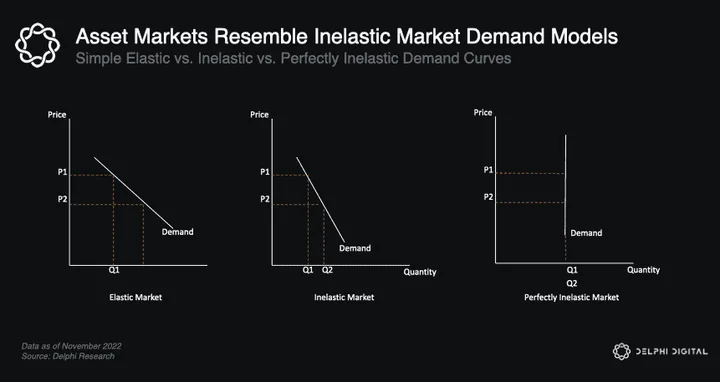
Core Findings of the Inelastic Market Hypothesis
The origins of the Inelastic Market Hypothesis (IMH) started with a surprisingly simple question: when an investor sells $1 worth of bonds and buys $1 worth of stocks, what happens to the aggregate value of the stock market?
Prevailing efficient market theory suggests, in the absence of fundamental news driving changes in the net present value of future cashflows, the sole action of buying/selling $1 of stock should theoretically have a minimal effect on the stock market. Through empirical analysis, however, GK has found this not to be the case.
Model Scenario
In order to answer the above question (re: the price impact on the aggregate market value due to the buying/selling of $1 worth of stocks), GK proposed the following model scenario and assumptions:
Market participants can invest in 2 types of funds, subject to the mandates and constraints of typical institutions. These funds are a 100% fixed income fund and a mixed fund. The mixed fund operates with a 20/80 fixed income/equity split (20
Read the full report
This report is part of Delphi Pro.
- 800+ Pro reports across every major sector
- Talk directly with our analysts
- Private community of funds and builders
Already a Pro member? Log in
0 Comments