ZKsync: Building a Trustworthy Settlement Layer for Institutional and Sovereign Finance
DEC 10, 2025 • 18 Min Read

Report Summary
Institutional & Sovereign Adoption Era – ZKsync has shifted from R&D to real-world deployment, with nearly two dozen chains covering tokenization, identity, DeFi, and sovereign networks.
Prividium Unlocks Regulated Finance – Pre-configured private chain infrastructure engaging 35+ major financial firms (Citi, Deutsche Bank), demonstrating private atomic settlement for repo markets.
GRVT Validates Hybrid CeDeFi Model – $70B trading volume exchange proving institutions want privacy + verifiable settlement, backed by sovereign fund ADQ with $19M raise.
Sovereign Deployments Prove Real-World Readiness – ADI Chain (UAE with regulated AED stablecoin), US Government data feeds via Chainlink, and Argentina’s CNV equity tokenization demonstrate global trust.
Airbender + Atlas Create Performance Breakthrough – 15,000+ TPS, 1-second ZK finality, sub-$100/day proof costs on single GPU make cryptographic settlement cheaper than traditional finance.
ZK Gateway Solves Fragmentation – Trustless router connecting all ZKsync Chains with 200ms blocks and Web2-like UX, turning sovereign chains into one unified ecosystem.
$ZK Token Gains Economic Utility – 100% of network revenue (on-chain + enterprise licensing) directed to buybacks/burns and staking, creating self-reinforcing economic loop tied to usage.
2026 Execution Phase – Success depends on converting pilots to long-term adoption and capitalizing on ZKsync’s moat: privacy on demand, Ethereum security, hyper-scale performance, and sovereign-grade flexibility.
Introduction
Blockchain has an issue with confidence.
The fundamental challenge for blockchain technology today remains the difficulty of balancing security, the non-negotiable trait of a decentralized network, with the scalability and privacy demanded by regulated financial systems. Overcoming this systemic trade-off is the necessary precursor for global institutional adoption. A gap that the ZK Stack is successfully addressing.
Recent months have marked a key turning point for ZKsync and the Elastic Network. After spending years building out the tech and ecosystem, ZKsync moved from ZK infra feat to a leader in the maturing appchain space. From building Airbender, the fastest RISC-V prover, to developing Prividium, a turnkey privacy solution for institutions, this period was a culmination of milestones.
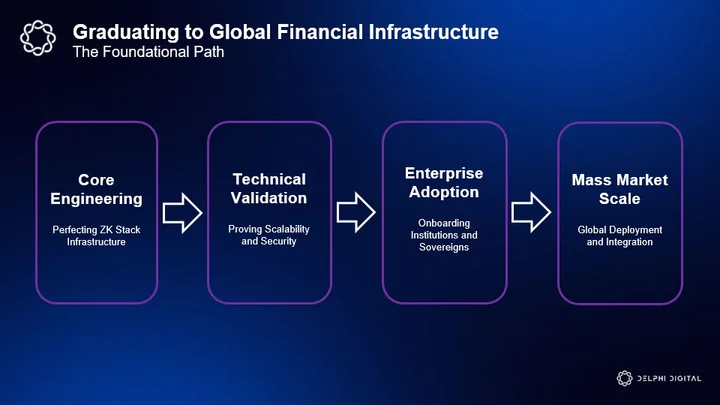
With the foundation in place, ZKsync made a recent strategic shift. The work of refining the ZK Stack is coming to an end, shifting the primary focus from core engineering to large-scale adoption. The legwork to onboard global financial and sovereign enterprises is in full swing. And ZKsync is already seeing tangible success rooted in its core value proposition: providing financial infrastructure with cryptographic guarantees and privacy on demand.
ZKsync Chains in a Nutshell
What started with ZKsync Era has evolved into the Elastic Network, a rollup cluster of ZKsync Chains. Each ZKsync Chain leverages the ZK Stack, a modular framework that gives developers the freedom and flexibility to pick and choose from different building blocks.
The problem with blockchains today is not scale, but how to retain the security of a decentralized network while enabling privacy to onboard regulated institutions. For enterprises to come onchain, they need auditability, privacy on demand, and confidentiality for financial data.
The ZK Stack covers all three non-negotiables while inheriting Ethereum’s security by posting ZK proofs to the Ethereum L1. We have covered the underlying components and architecture in great detail in our initial deep dive, a great read for anyone who wants to learn more.
The bottom line is simple. The ZK Stacks’ modular architecture delivers a system that can keep data confidential while providing verifiable finality. For institutions, this matters because they face a longstanding dilemma.
They can build private blockchains that are fully controlled and compliant but isolated from the broader financial ecosystem. Or they can build public blockchains that offer openness and interoperability, but at the expense of privacy and data control. Deploying a ZKsync Chain means taking the best of both worlds, retaining full operational control, enabling privacy and auditability, and enjoying interoperability with the rest of the Elastic Network.
Institutional Momentum and Sovereign Adoption
This moat has materialized and an increasing number of enterprises choose to build with the ZK Stack. The Elastic Network has grown to include almost two dozen ZKsync Chains, spanning institutional tokenization, permissioned private blockchain solutions, gaming, and consumer applications.
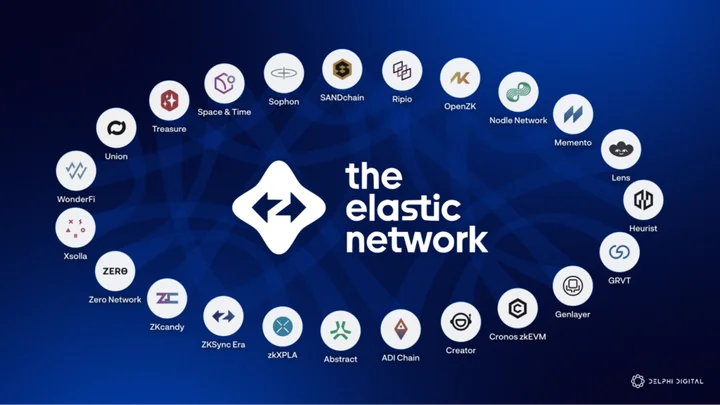
Let’s look at some of the key highlights from recent institutional and sovereign adoption.
The Prividium Breakthrough
Prividium represents ZKsync’s answer to the institutional configuration problem. Previously, institutions used to face the hard job of configuring bespoke chains from scratch. The only support they got was a fragmented toolbox of modular components to assemble themselves.
Prividium solves this by offering a pre-configured, turnkey solution built on the ZK Stack. It bridges the gap to enterprise readiness by baking in essential requirements (privacy, compliance, and permissioned access) from day one. This strips away the usual infrastructure and regulatory cost, allowing institutions to focus entirely on deploying products rather than architecting chains. for institutions. For a deeper dive into how Prividium works, check out our previous memo on the platform.
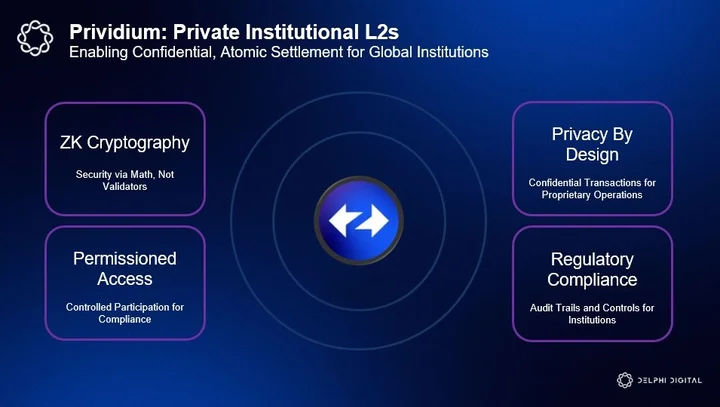
Recently, ZKsync facilitated a major Prividum engagement involving direct workshops with over 35 financial firms, including Citi and Deutsche Bank. The goal of this initiative, called The Prividium Breakthrough Initiative, was to demonstrate to the financial industry how Prividiums can enable confidential, near-instant settlement across independent, bank-operated chains.
The firms evaluated the platform against complex financial use cases, such as automated, atomic settlement for repo transactions (the bedrock of short-term lending in capital markets). All of this while maintaining the necessary privacy, regulatory compliance, and audit trails required for financial market infrastructure. The subsequent release of a Prividium whitepaper formalizes this opportunity for institutions. It provides a blueprint for how traditional finance can finally move complex operations onto a cryptographically secure foundation.
GRVT: The Hyper-Scale ZK Exchange
Across the industry, DEXs have dominated mindshare all of 2025. GRVT is the Elastic Networks duck in the race, leveraging the ZK Stack to carve out a structural advantage.
The platform operates as a CeDeFi exchange that couples an off-chain orderbook with onchain trade settlement. This architecture aims to deliver the best of both worlds: it can support 600k trades per second and deep liquidity by matching orders instantly off-chain. Comparable performance to a traditional, centralized exchange. However, GRVT ensures self-custody by settling funds directly onchain. Users enjoy a familiar, fast-trading experience without their assets ever leaving their personal smart contract vaults. Even though the exchange matches the trade, it cannot touch the assets.
This model is already proving itself at scale. Since launching its mainnet alpha in late 2024 on ZKsync, GRVT has processed $70 billion in total trading volume. The exchange also maintains approximately $66 million in open interest.
In September 2025, GRVT raised $19 million in Series A funding. This was in an effort co-led by ZKsync and Further Ventures, an investment firm backed by the sovereign wealth fund ADQ. The platform is pursuing licenses across many regions. This includes the EU’s MiCA license, Dubai’s VARA license, and the ADGM capital markets authorization. This regulatory focus is what distinguishes GRVT from DEXs, demonstrating the ZK Stack’s flexibility for compliance-focused applications.
More importantly, this investment also signals a shift in institutional demands. Investors are betting on ZKsync’s ability to solve the ‘transparency dilemma.’ Public chains, where large trades are visible, are easily exploited by MEV bots. Because GRVT uses ZKsync to instead process data privately and off-chain, institutions can trade without showing their hand. One of the many use cases where the ZK Stacks’ privacy-reserving infrastructure shows its value.
ADI Chain Launch: A Sovereign Commitment
The introduction of the ADI Chain in the United Arab Emirates is best viewed as a testbed for sovereign chain technology, not a final product. It represents the first public blockchain built with ZKsync Airbender technology. Airbender is a ZK prover and the fastest open-source RISC-V zkVM in production today. In our previous memo, we showcased how Airbender outperforms competitors by wide margins across benchmarks. This performance translates to major milestones for real-time proving:
- Sub-second proofs for ZKsync blocks
- Proofs produced in under 3 seconds for ZKsync blocks using a single GPU
- Ethereum blocks proved in under 35 seconds using a single GPU (17 seconds without recursion)
Generating Ethereum proofs used to require centralized server farms. By scaling this requirement down to a single GPU, ADI Chain demonstrates that a nation or institution can run a high-speed, secure blockchain entirely on its domestic infrastructure, without relying on foreign cloud providers. Sovereign hosting is finally made viable.
Backed by regional banks, ADI Chain is developing a stablecoin regulated by the UAE Central Bank. By offering UAE residents a digital currency that feels as safe as a bank account, the ADI Chain aims to drive mass adoption among non-crypto natives. This influx of real-world users and capital further validates the Elastic Network thesis: that sovereign chains can operate independently (compliant and private) while remaining interoperable with the broader ZKsync ecosystem. Ultimately, every Dirham (AED) tokenized on the ADI Chain represents real-world liquidity that can potentially flow across the ZK Stack, transforming ZKsync from a crypto-niche into a global financial backbone.
US Government Data and CNV Argentina
The past few months saw further sovereign recognition marked by a shift in the way the United States Government interacts with the blockchain industry. The Trump Administration recently began publishing official government macroeconomic data via Chainlink, with ZKsync as one of the supported networks.
This data is the lifeblood of modern financial markets. By publishing it on-chain, it allows developers to build automated financial contracts (like inflation-protected bonds or derivatives) that trigger automatically based on official government numbers. This is in contrast to relying on manual entry or third-party data feeds. It creates a “single source of truth” that bridges the gap between Wall Street and DeFi.
In South America, CNV Argentina, the country’s national securities commission, working together with the Milei Administration, moved forward with a regulatory sandbox initiative. This program focuses on the tokenization of equities and CEDEARs, certificates that allow Argentines to invest in foreign companies.
ZKsync’s involvement here positions its technology to help bring traditional, regulated securities onto an efficient, modern ledger in a major Latin American economy. By tokenizing these assets, Argentine investors could eventually trade global stocks 24/7 with instant settlement and lower fees, bypassing the slow, paper-heavy bureaucracy of the traditional banking system. It signals a move from “crypto as speculation” to “crypto as the backend for national stock exchanges.”
Technical Achievement and Performance
While institutional adoption dominated the conversation for ZKsync for the past several months, technical execution laid the groundwork. The improvements were not incremental fixes but systemic leaps aimed at resetting the performance ceiling for rollup scalability.
The Atlas Upgrade
The Atlas Upgrade represents the culmination of this technical work. It has directly resolved the long-standing trade-off between speed and security by integrating the Airbender proof system. Atlas delivers two headline achievements: a sequencer that can handle 15,000+ TPS and one-second ZK finality.
Everyone understands the feat of unlocking 15,000+ TPS, but achieving one-second ZK finality is an underappreciated tech feat. It means that counterparties receive cryptographic assurance of execution almost immediately. In contrast, traditional global payment rails, like most credit card transactions, can take days to fully settle. With Airbender, ZK proofs can now verify correctness almost immediately.
And the Airbender proof system achieves this performance while decreasing the cost barrier. The Airbender prover, built on a RISC-V zkVM, can sustain over 1 million transactions per day for less than $100 per day on a single, high-spec GPU. This moves the cost of cryptographic security from a theoretical expense to an operational detail, making near-zero transaction fees a reality.
The Atlas upgrade maintains a fully EVM-equivalent execution environment, enabled by the Airbender prover. This capability is vital because it means that complex smart contracts and entire dApps written in Solidity can run on the ZK Stack with the same reliability as on Ethereum. The performance gains come with hyper-scale throughput and near-instant finality. Developers no longer have to rewrite or compromise code to achieve this level of performance.
Solidity Compiler Improvements
The Solx Compiler saw critical improvements that directly streamline the developer experience and increase the efficiency of Solidity code execution. A key fix was the elimination of the “Stack too deep” error.
This error occurs when a function in Solidity tries to access too many local variables. As a result it exceeds the EVM’s stack limit. This has plagued Solidity developers for years, often forcing them to rewrite clean code into clumsy workarounds.
By fixing this failure without altering contract semantics, developers can now write cleaner, more complex code without having to resort to manual workarounds like splitting functions or manually moving variables.
The Solx compiler has been shown to produce better runtime gas efficiency than the industry-standard solc compiler using the –via-ir –optimize flag.
This is especially true for computation-heavy tasks like sorting algorithms, where gas usage was reduced by as much as 64% in certain benchmarks. In addition, the updated solx compiler in beta can now optimize smart contracts to a better degree, with tests showing a 13% reduction in smart contract size, compared to the previous industry standard.
These improvements are not abstract. They translate directly into lower operational costs. Making for a vastly more efficient, simplified coding environment for builders across the entire ZK ecosystem.
ZK Gateway Milestone: Unifying the Network
With the Atlas architecture in place, the ZK Stack moved to solve the industry’s most persistent problem: fragmented liquidity across chains. The ZK Gateway milestone achieved this through protocol-level interoperability across the Elastic Network.
The ZK Gateway is best understood as the “shared router” for the Elastic Network. It is a system of smart contracts and middleware that facilitates native, protocol-level connectivity between all ZK Chains. This system’s main component is a contract that registers all ZK Chains and aggregates their proofs. It does so without relying on any trusted third-party intermediary.
Because all chains in the Elastic Network inherit the same security guarantees from Ethereum via ZK proofs, the Gateway ensures asset transfers are atomic and trustless. Critically, assets moving between ZK Chains remain native and fully fungible, as they are securely locked within the same shared contract on Layer 1. Era, ZKsync’s largest chain, recently migrated to the ZK Gateway. Settlement and cross-chain communication now route through the gateway.
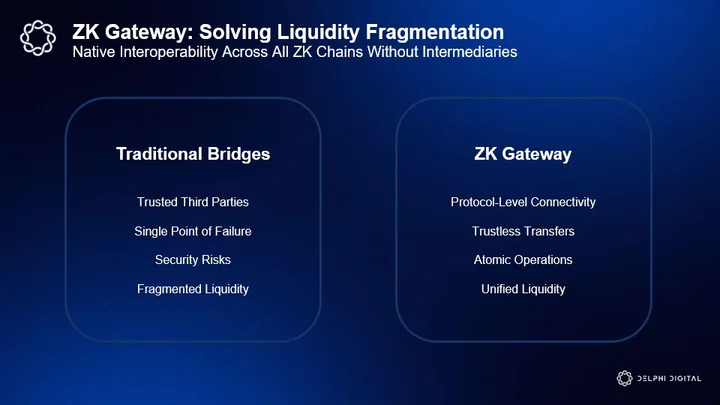
The cross-chain implications are practical. The Gateway transforms a collection of independent, sovereign L2s into a single, cohesive ecosystem where liquidity can flow across ZKsync Chains. Fragmentation, the silent killer of ecosystem growth, is functionally eliminated.
The September 1 deployment of Interop Messaging and Fast Subjective Finality to the mainnet delivered a new standard for speed and security. Fast Subjective Finality is a commercial feature that allows exchanges and dApps to instantly confirm transactions, which is vital for use cases such as high-frequency trading.
Instead of relying on slow, risky third-party bridges, all connected ZK Chains can trustlessly share data and liquidity at the protocol level via the ZK Gateway. And simultaneously achieving 200ms block times means the network delivers transaction latency that rivals traditional Web2 apps, allowing cross-chain data transfer to operate like a centralized database. Without the traditional drawbacks
Ecosystem Expansion and Token Recalibration
Architectural shifts came alongside an ecosystem expansion phase that began with a change to the network’s economic engine.
The $ZK Token’s Pivot: From Governance to Utility
A significant development was the restructuring of the $ZK token from a governance tool into the economic engine of the entire ZKsync network.
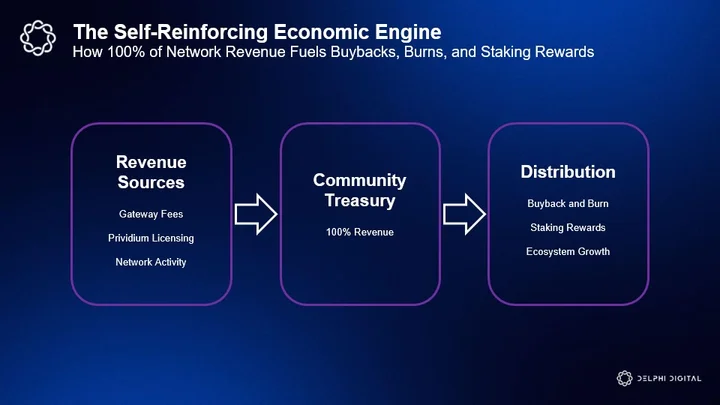
The thesis of the just-released proposal, titled “From Governance to Utility,” is simple. When the Elastic Network is used, the ecosystem must benefit. The new model directly links the token’s value to network activity by routing 100% of the revenue generated from two primary sources:
- On-Chain Fees: Cross-chain messaging, transfers, and interoperability through the ZK Gateway
- Off-Chain Revenue: Licensing fees from enterprise Prividium chains
This revenue will be distributed to fund the long-term sustainability of the network. The distribution will be through token buybacks and burns (to create deflationary pressure) and through supporting staking incentives.
A self-reinforcing economic loop is created. Increased adoption by institutions and users would translate into sustainable value accrual for $ZK token holders and, thus, continuous improvement in funding and decentralization for the network.
While the full utility model is slated for implementation in Q1 2026, the community has moved quickly. A pilot staking program (TPP-12) went live in early November 2025, and a separate proposal (ZIP-14) to enable the permissionless token burn function was submitted on-chain for vote.
Key Partnerships and New Chains
Along with this economic announcement we have seen ecosystem expansion, new key partnerships, and the onboarding of new ZKsync Chains built on the ZK Stack.
Strategic Partnership with Tokenized Asset Coalition (TAC)
This cryptographic security provided the necessary bedrock for simplified institutional adoption. The strategic partnership with the Tokenized Asset Coalition (TAC) began bearing fruit, aligning the ZK Stack with the explosive growth of real-world assets (RWA). The core of this RWA push is Prividium, ZKsync’s compliance-focused framework.
To meet regulatory demands, new core features like Selective Disclosure and a role-based Permissioning System were deployed. These tools allow institutions to verify assets and balances while keeping sensitive transaction data completely confidential.
Core Infrastructure and Performance
The push for enterprise adoption requires a verifiable high-performance computing layer. Space and Time delivered that recently by open-sourcing Blitzar, a C++ library designed to accelerate ZK proofs using the GPU. Blitzar was created to accelerate Proof of SQL, a zero-knowledge proof system for SQL operations.
The new performance metrics are impressive. Using Blitzar’s GPU acceleration, Proof of SQL can execute analytical queries on over 1 million rows of data in less than a second. The open-source release allows the broader ecosystem to build GPU-accelerated ZK proofs using proven infrastructure.
This commitment guarantees that every data operation within the ecosystem can be cryptographically proven, ensuring the underlying network’s commitment to an internet of verifiable truth.
Introducing Blitzar.
The GPU acceleration framework that got Proof of SQL to sub-second proofs on a million rows of data is now available to ZK developers everywhere in open source. pic.twitter.com/x4WQnEbPtX
— Space and Time (@spaceandtime) July 23, 2025
New Chains: The Ecosystem Launches
Ecosystem growth in recent months did not stagnate, either.
SANDChain‘s launch, designed for the creator economy, is notable because, above all else it tackles the problem of income volatility for creators and their limited access to capital.
SANDChain offers a full financial suite built around the SAND token. This includes a three-tiered system of SANDpoints, Creator Points, and Creator Tokens designed to turn passive fandom into active ownership.
The system introduced “Patron Vaults,” allowing fans and backers to fund creator loans, which are repaid predictably through a “Creator Vault.” SANDChain leverages the ZK Stack’s foundational promise to support large scale, handling the volume of micro-transactions expected from millions of users.
Abstract leveraged the ZK Stack and EigenDA to optimize onboarding for its consumer app. The new building blocks lower costs, improve the DevEX, and simplify governance mechanisms, streamlining access and lowering entry barriers for mainstream users.
Introducing https://t.co/UZDS3LWwxM
A collection of all the building blocks you need to create consumer apps faster than ever. pic.twitter.com/0Q9JoSsMMM
— Jarrod Watts (@jarrodwatts) August 19, 2025
Lens Chain, on the other hand, illustrated how technical upgrades can create composable social graphs and content ownership not bound to a single application.
Through Grove, Lens delivers onchain permissioned storage that enables users to manage, modify, or delete content based on cryptographic keys, rather than the dictates of a platform. The architecture, leveraging the ZKStack across several EVM-compatible chains, achieves content access with latency as low as 30ms globally, making content ownership meaningful and usable for the average participant.
In institutional finance, a ZKsync Chain’s deployment through Project Guardian and the DAMA 2 protocol provides privacy, compliance, and the throughput required for fund tokenization. The use of multi-layer architecture enables public-permissioned transactions.
The ZK Stack integration is important here, enabling necessary compliance checks like AML and sanctions screening at both protocol and application layers. This allows real-time, scalable fund servicing that bridges traditional and decentralized finance.
Looking Ahead
Over the course of this year, ZKSync and the ZK Stack went from a technical infrastructure feat to a proven, viable settlement layer for institutional and sovereign finance.
The core thesis underlying ZKsync’s approach is simple: that ZK proofs can enable a new model of financial infrastructure. One where verification comes from mathematics rather than intermediaries. Where privacy and compliance coexist. And where sovereign systems remain connected to global liquidity.
The Atlas Upgrade and Airbender prover finalized the technical foundation, eliminating the security-speed trade-off by achieving 15,000+ TPS and one-second ZK finality while driving proving costs to near zero.
This high performance has validated key milestones: the Prividium Breakthrough Initiative workshop with financial firms showed strong enterprise engagement. The ADI Chain deployment in the UAE demonstrated the feasibility of sovereign hosting. GRVT’s trading volume confirmed the market’s want for private, compliance-focused infrastructure.
The ZK Stack’s moat rests on this combination of privacy on demand and its robust Ethereum security anchor. The remaining distance to the Elastic Network Endgame, as outlined in our initial deep dive, is defined entirely by execution and distribution at this point.
In our view, future success hinges on two critical factors. First, a sound cryptoeconomic framework makes or breaks an ecosystem. With the new $ZK token proposal, it’s time to pay close attention to how this new token framework fares. It could become a major driver in establishing a self-sustaining economic loop that translates to sustained ecosystem growth.
Secondly, with the Prividium rollout and the ZK Stack finalized, the iron must be struck while it’s hot. The moat of the infra is there, and this structural advantage must be leveraged to onboard a diverse, global base of token issues and enterprises. BD momentum must continue. Should ZKSync fall asleep at the wheel, competitors will close the infra gap.
So to summarize, 2026 will determine whether the institutional pilot efforts convert to sustained, global adoption. The Elastic Network’s trajectory as a whole will hinge on the quality of execution, both on the institutional sales front and the tokenomics front.
0 Comments