ZKsync Prividium – Compliant, Private, Turnkey Blockchain Infra
JUL 21, 2025 • 17 Min Read

Report Summary
Summary
This Q2 memo outlines how ZKsync’s new Prividium framework positions the Elastic Network to meet the rising institutional demand for private, compliant, turnkey blockchain infrastructure. Prividium chains are private, permissioned Validiums built on the ZKsync Stack — combining Ethereum’s security, modular access controls, and confidential execution to help banks, asset managers, and enterprises deploy production-ready, regulatory-grade chains without the headaches of building custom infra from scratch.
Key Takeaways
1. Institutions Want Private, Auditable Rails
-
The wave of institutional adoption — spot BTC ETFs, tokenized RWAs, Circle’s IPO — shows TradFi is onboarding.
-
But they demand private, permissioned rails, not public blockchains.
-
Prividium solves this with built-in compliance, auditability, and privacy.
2. What Prividium Provides
-
Production-ready chains: Out-of-the-box compliance, private execution, customizable access.
-
Private Validiums: Use ZK proofs for Ethereum settlement while keeping transaction data off-chain.
-
Role-based controls: Plug into corporate ID providers (Okta, Azure AD) for enterprise-grade user management.
-
Private block explorers & RPCs: Full internal oversight with selective external disclosure.
-
Interoperability: Seamless atomic swaps with the Elastic Network — no centralized bridges.
3. First Major Use Case: Deutsche Bank + Memento
-
Deutsche Bank’s DAMA 2 project uses Prividium to build a secure, compliant tokenization platform.
-
It combines Ethereum for settlement, Memento ZK Chain for privacy, and Axelar for cross-chain distribution.
-
Shows how banks can issue, service, and move tokenized assets globally.
4. Big Institutional Design Space
-
Prividium unlocks more than tokenization:
-
Intraday repos between banks.
-
Fully onchain dark pools for block trades.
-
Private cross-border payrolls and payments.
-
RWA collateral mobilization with compliance guarantees.
-
-
The focus is removing the old friction: privacy vs regulation vs usability.
5. Major Tech Upgrades in Q2
-
Three-Way Proving: Now supports TDX (Trusted Domain Extensions) alongside ZK proofs & SGX, adding fallback security layers.
-
solx Compiler: LLVM-based Solidity compiler that optimizes gas use and works plug-and-play with EVM tools.
-
Full EVM Equivalence (ZIP-9): Deploy standard Ethereum contracts to ZKsync without rewriting or retooling.
-
Airbender Prover: New fastest open-source RISC-V zkVM — sub-second proofs, huge efficiency gains, real-time onchain proving becomes practical.
6. ZKnomics: New Token Model
-
ZKsync introduced ZKnomics, a revamped economic design for the $ZK token.
-
Goals:
-
Align protocol revenue with usage.
-
Fund staking and governance incentives.
-
Burn supply via sequencer & interop fees.
-
-
Clear ZIP roadmap: permissionless staking, fee switches, public burn mechanism.
7. Looking Ahead
-
ZKsync’s institutional moat is clear: plug-and-play privacy + Ethereum finality.
-
With ~$2.3B in RWAs already onchain, the Elastic Network is well-placed but needs broader issuer adoption.
-
Execution is key: shipping Airbender, Prividium, and ZKnomics shows capability — but delivering tokenomics and onboarding more institutions will define the next growth phase.
Conclusion
ZKsync’s Prividium is a big bet on the institutional wave: a turnkey bridge between traditional finance compliance and blockchain’s cryptographic guarantees. By removing the trade-off between privacy, auditability, and Ethereum-grade security, Prividium positions the Elastic Network as the enterprise default for RWAs, secure payments, and confidential transactions.
The roadmap is clear — the next chapter depends on two things:
– Executing the ZKnomics token revamp to reward usage and decentralize growth.
– Winning more banks, asset managers, and fintechs to expand the Elastic moat.If they nail it, ZKsync could own the institutional Validium lane — a category that barely existed until now.
-
Intro
The institutions are here. The debut of spot Bitcoin ETFs truly flipped the script. For the first time it’s no longer delusional to say that crypto is crossing the chasm into mainstream adoption. The headlines we see nowadays were unimaginable a few years back. On a weekly cadence, we witness the biggest financial players getting crypto-pilled.
J.P. Morgan is leading blockchain banking with Kinexys. BlackRock teamed up with Securitize to tokenize RWAs at scale. Deutsche Bank is building digital asset management with Memento on ZKsync. xStocks just tokenized over 50 equities on Solana. Robinhood is building its chain on top of Arbitrum. Acquiring digital assets has become a capital strategy for public companies. And just last week, the U.S. passed the first major national crypto legislation, the GENIUS Act, carving out a new regulatory framework for fiat-backed stablecoins.
But institutional rails demand a different blueprint than public, permissionless blockchains. They need private & permissioned rails – compliant, auditable, and streamlined to mirror existing workflows. This is where appchain solutions have found a new PMF, offering modular infrastructure that can be tailored to institutional needs.
Vying for market share, appchain hubs have spent the last years sharpening their toolkits. The results are sophisticated offerings with plug-and-play features where enhanced UX and DevEX have become the universal north stars.
Yet, offering customization, interoperability, and unique privacy features has become table stakes. Meanwhile, the race to onboard financial players and global institutions hungry for blockchain solutions is heating up.
We’ve covered ZKsync Chains & the Elastic Network in our deep dive and Q1 memo – architecture, design benefits, and its ecosystem were the focal points. With the latest launch of Prividium, the Elastic Network has gained a measured, competitive advantage on the institutional side. Time to take a closer look.
ZKsync Prividium – Turnkey Blockchain Solution for Institutions
Prividium in a Nutshell
Previously, institutions received a toolbox and a manual outlining all available blockchain features. The manual explained how to assemble & deploy your bespoke chain. But institutions were still left doing the heavy lifting.
With Prividium, they get a production-ready product. Whether the idea is to tokenize RWAs or unlock private cross-border payment rails, all core features – confidentiality, compliance, and fine-grained access permissions – are built in.
From a tech perspective Prividium’ bridges the gap between “customize-your-own” and “enterprise-grade ready”. Prividium is built for institutions, enabling both confidentiality and auditability. And unlike the current offerings, they strip away configuration and regulatory overhead. Using Prividium, built with the ZKsync Stack, institutions can focus on product development, not infrastructure building.
Architecture Broken Down
Without going off on a lengthy architecture tangent, let’s quickly talk about the design to explain its benefits. At a high level, Prividium inherits all necessary private, permissioned, and compliant features of the ZKsync Stack. Minimal expertise or modification required.
They are private, permissioned Validiums – ZKsync Chains deployed within the hosts’ infra. The stack features a sequencer, prover, and off-chain DA, posting ZK proofs to Ethereum. Meaning the validity of transactions is still verified onchain, while transaction processing and proof generation happen confidentially. This gives institutions the flexibility to use their own secure database.
The hosting institution retains all access controls, configuring user-level privacy and visibility at will. Any details that should remain confidential, such as user data, account balances, or trade information, remain confidential. And since ZK proofs are settled on Ethereum, Prividiums benefit from Ethereum’s security guarantees.
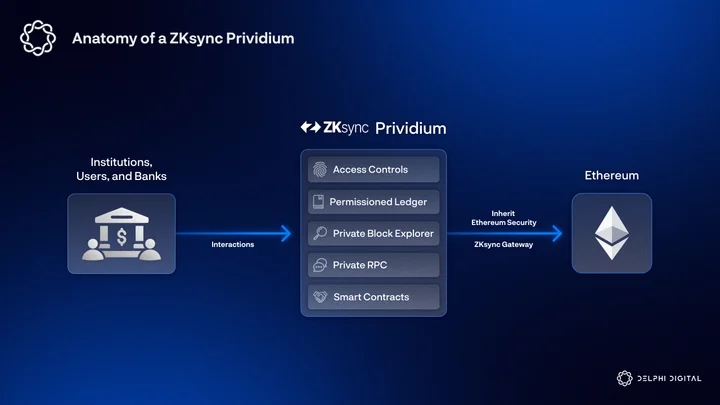
To make this possible, the design combines several moving parts:
-
- Access Controls are role-based and compatible with corporate identity providers (Okta, Azure AD, Ping Identity, etc.). The host defines who can view and interact with the Prividium. Access is gated to authorized entities only.
- Block Explorer is a self-hosted interface with an external and internal version. The external version has privacy settings enabled by default. Sensitive information always stays off the public record. The internal version ensures that network state, blocks, and transaction data (+ history) are visible only to authorized users.
- Private RPC restricts access to the system. Authenticated JSON-RPC endpoints apply internal access policies to every request. All traffic goes through this proxy and is automatically filtered, so only legitimate requests are processed. The host retains full control over data access and interactions.
- Permissioned Ledger allows the host to selectively disclose information to third parties, i.e. regulators or auditors.
-
- ZKsync Gateway enables interoperability with ZKsync Chains and anchors security to Ethereum. It receives ZK proofs from the Prividium, posts commitments to Ethereum, and finalizes state updates.
- Smart Contracts automate on-chain processes and enforce application logic. Remaining customizable, they enable things like atomic swaps and tokenization and serve to streamline workflows.
Key Benefits of Prividium
Prividium bundles private execution, enterprise-grade access control, and Ethereum security guarantees into one stack – no more tradeoffs between confidentiality, auditability, and interoperability. But enough of the buzzword salad, let’s break down the benefits one by one:
- Compliance & Auditability with Composable Privacy
Institutions operate under strict regulatory frameworks that demand visibility, traceability, and selective access. Compliance and auditability are non-negotiables. Prividiums deliver exactly that.
Every transaction input, calldata field, and full state snapshot is tucked away off-chain in the hosts’ private database. Only cryptographic commitments, state roots, and ZK proofs are posted to Ethereum. Data integrity can be verified without revealing the underlying data inputs.
The private RPC, permissioned ledger, and private block explorer ensure that all sensitive data remains private. However, these features also allow the hosting entity to aggregate logs and integrate analytical software.
On demand, the host can select and share specific data slices or export snapshots. This allows auditors to do their job and institutions to stay compliant, without compromising user privacy.
- Interoperability with the Elastic Network
As a ZKsync Chain, Prividiums can opt into ecosystem-wide interoperability with the Elastic Network. ZKsync Chains share the same proof system, no matter if configured as a private or public network. This, along with shared settlement, enables assets to move atomically across all ZKsync Chains. No need for a centralized middleman. On the UX side, users no longer need to use expensive third-party bridges or initiate calls on the destination chain. Chain operations for Prividiums always remain private.
Most importantly, this interoperability allows entities to transact with each other trustlessly. That’s because ZKsync Chains, including Prividiums, can read and verify the ZK proofs posted by other ZKsync Chains. And thanks to these cryptographic proofs, verification happens without revealing any of the underlying information.
This opens up new design space. For instance, two banks each operating a Prividium can trustlessly and securely conduct intraday repos. The first bank locks collateral on its Prividium and generates a ZK proof for this action. The second bank can validate this action by verifying the ZK proof.
After confirming that the collateral has indeed been locked, the second bank can release the funds executing an atomic transfer. No intermediaries and no risk of revealing sensitive information (i.e. repo terms such as value, duration, and legal agreement) to outsiders. More on use cases and the newly unlocked design space later.
- Ethereum’s Security Guarantees
Prividiums, like other ZKsync Chains, inherit Ethereum’s security guarantees. That’s because each transaction batch is finalized on Ethereum with the help of ZK proofs. Under the hood, the finalization flow works as depicted below.
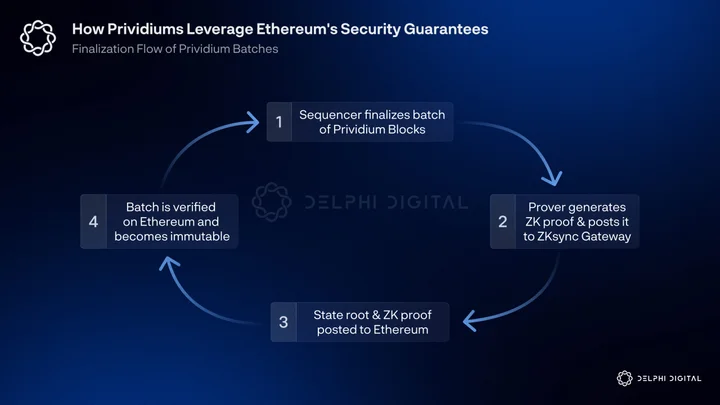
With step four, the batch is cryptographically verified on Ethereum and added to Ethereum’s blockchain – the most decentralized and censorship-resistant L1. Transactions in the batch are now “immutable”. They are irreversible unless Ethereum’s network state is challenged.
That’s why Prividiums and ZKsync Chains inherit Ethereum’s security guarantees. The result is tamper-proof security without settlement risk, and without revealing confidential information.
- Customizable Access Controls
Developers can define access policies on JSON Web Tokens (JWTs), which are entirely customizable. The hosting entity can define and separate roles within this configuration. Such as users, KYC’d users, institutions, regulators, auditors, etc. And as briefly touched on, all traffic must pass through a proxy RPC. Traffic is only routed through if it matches the access policy.
Blocked RPC calls are logged and can be retroactively audited. And to make institutions feel at home, corporate identity providers (Okta, Azure AD, Ping Identity, etc.) can be used for authentication.
Deutsche Bank & Memento Pioneer The first Prividium Chain
Deutsche Bank, in collaboration with Memento Blockchain (ZKsync Chain) and the Axelar Network, published their litepaper for the Digital Asset Management Access (DAMA) 2 project on June 18, 2025. DAMA 2 serves as an institutional blueprint for the groups’ planned full-stack tokenization platform.
The goal: enable asset managers to easily issue and service tokenized assets. The focus: secure and compliant tokenized issuance, distribution, and servicing across blockchains and financial networks.
As a result, DAMA 2’s design leverages both Ethereum and the Memento ZKsync Chain, utilizing the Prividium features. Ethereum will serve as the secure settlement layer for this tokenization platform. The Memento Prividium will provide all privacy and compliance components. It will also host a smart-contract-based application marketplace. That application layer will serve to streamline the workflow for tokenized assets.
The last component of DAMA’s design equation is the Axelar Network. As a cross-chain interoperability protocol, it facilitates communication and asset transfers across blockchain networks. Both EVM and non-EVM. Axelar’s role? Connect the tokenization platform to over 70 blockchains, supercharging distribution.
Institutional Design Space Opening Up
This initiative, led by Deutsche Bank, is a neat example of what’s possible with Prividium. But tokenization is just the tip of the iceberg. Prividium is capable of much more. Switching mental gears, there’s a lot of open design space. Prividiums can mobilize assets (and by extension collateral), facilitate cross-border payments, provide 24/7 global payroll solutions, and more.
Previously, institutional adoption was constrained by the degree of onchain privacy and alignment with regulations. If you didn’t want to risk legal issues by operating in regulatory grey zones, none of the above was possible. Prividiums remove this caveat, streamlining compliance and enabling privacy for any fintech and payment use case.
It’ll be interesting to see which institutional player will adopt Prividium next and what they will build. In our book, fully onchain dark pools remain one of the biggest design gaps in Web3. Any takers for a vastly improved trading experience tailored to institutions seeking efficient block trade execution? Start here.
Development Highlights – Q2 2025
Launching Prividum wasn’t the only milestone in Q2 for the Elastic Network. There were a handful of other relevant developments within the tech stack.
Three-Way Proving
In ZKsync & The Elastic Network Endgame we talked about ZKsync’s multi-layered security. Although ZKsync always posts ZK proofs to Ethereum, the network can also use trusted execution environments (TEEs) such as SGX (Intel Software Guard Extensions) for proving. SGX remains the most widely adopted confidential computing solution in production today, enabling better security while preserving data privacy and control.
Why does this matter?
Integrating TEEs into the network provides a practical safeguard. It acts as a fallback option in case of bugs with ZK proofs, which could lead to protocol vulnerabilities. In early Q2 2025, ZKsync added a third way of proving: TDX.
TDX (Trusted Domain Extensions) is a newer version of TEEs that complements the multi-prover system in a nutshell. Today, ZKsync is the only L2 in production that can be proven in three different ways.
{ solx }
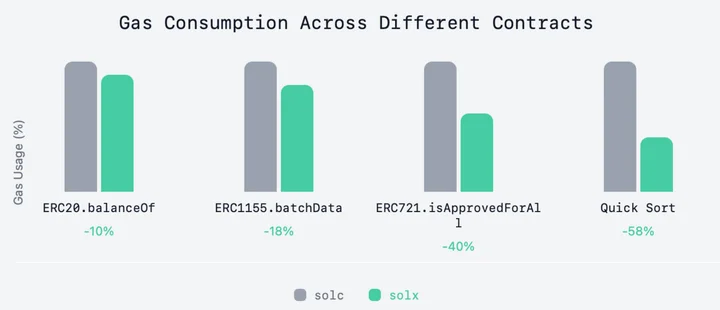
In May 2025, ZKsync released solx – a smarter Solidity-to-EVM compiler that utilizes LLVM to achieve gas optimizations. LLVM is a compiler framework used by major coding languages (C++, Rust, Swift) to produce optimized code.
Solx brings this Solidity compiler framework to all EVM chains, including ZKSync Chains. Devs want code optimizations without breaking their workflow. Solx unlocks that, it:
- Lowers gas usage across contract functions
- Fully supports Foundery and Hardhat – no config changes, no modifying code
- Simplifies debugging via LLDB and native VS code integration
- Eliminates the need for handwritten assembly
Source: ZKsync Blog
In short, Solidity becomes portable. Devs can now keep their tools and coding style. Less legwork for devs and better optimizations for EVM contracts.
Full EVM Equivalence
Another key upgrade followed the successful passing of ZIP-9: V27 EVM Emulation Upgrade. On May 5, ZKsync Era integrated v27 and achieved full EVM equivalence.
This made building on the ZKsync Stack more straightforward than ever. Devs no longer need to rewrite test suites or deployment scripts. EVM tools now work right off the bat.
In practice, existing EVM contracts can be deployed to ZKsync using standard compilers. Meaning EVM dev tools like Hardhat, Foundry, and Remix now run unmodified. Recompiling standard contracts before deployment is a nuisance of the past.
Under the hood, EraVM still powers execution. But with the EVM Interpreter live standard EVM bytecode is now fully supported. Contracts deployed with EVM bytecode are marked and calls to those contracts are automatically routed through the interpreter. At runtime, this interpreter “translates” EVM opcodes into EraVM instructions.
Bottom line: contracts run exactly as they would on Ethereum, making development on ZKsync feel indistinguishable from any EVM chain.
ZKsync Airbender
In late June, one of the most impactful infrastructure updates was revealed at Permissionless IV: ZKsync Airbender. If you’ve read our deep dive, you’ll recall our coverage on ZKsync’s custom Boojum proof system. As a proof system, or prover, it generates the ZK proofs that attest to the correctness of each transaction. Airbender is ZKsync’s new and improved proof system.
As of today, Airbender is the fastest open-source RISC-V zkVM.
RISC-V is a modern instruction set architecture that enables huge performance gains. Vitalik Buterin even published a proposal in April suggesting that Ethereum replace the EVM with RISC-V. His argument is based on two major benefits: (1) massively improving the efficiency of Ethereum’s execution layer (a major bottleneck), and (2) simplifying the execution layer itself.
After more than a year of building ZKsync Airbender in stealth, benchmark data now demonstrates its performance gains. In the benchmark tests, Matter Labs compared Airbender to Risc0 and SP1 Turbo, two leading zkVM proving systems.
Using a standardized Fibonacci program, benchmarks were measured on Nvidia L4 and Nvidia H100 GPUs. L4s are more affordable hardware, offering power- and cost-efficient inference performance. H100s, by contrast, are more powerful GPUs that deliver massive compute and high-bandwidth memory.
Testing was done in two stages. The initial stage measured the first round of proof generation (“Base Proving”). The second stage measured the follow-up rounds, which consisted of aggregating proofs into one or a few final proofs (Base + STARK Recursion). The metric “Effective MHz” shows how many millions of cycles were proven per second.
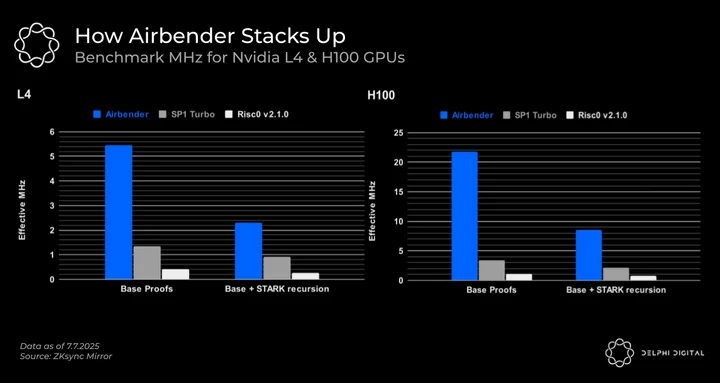
ZKsync Airbender stands out as the most-performant amongst its peers on both GPUs, by a wide margin.
On L4s, Airbender reached 5.4 MHz, compared to just under 1.4 MHz for SP1 and 0.4 MHz for Risc0. On a single H100, Airbender pulled even further ahead, achieving 21.8 MHz versus 3.45 MHz for SP1 and 1.1 MHz for Risc0. That’s 6.3x the performance of SP1 and nearly 20x that of Risc0 under identical conditions.
This performance translates to sub-second proofs for ZKsync blocks and approximately 3-second proofs using a single GPU. ZKsync Airbender can prove Ethereum blocks in roughly 17 seconds without recursion, and 35 seconds with recursion. This brings real-time proving on a single GPU within striking distance for the first time. It makes individual participation in proving not just possible, but practical.
Downstream, the Elastic Network benefits as a whole. Faster proofs mean faster finality, lower costs, and more efficient proof generation. Compared to Boojum, Airbender is more than 10x cheaper, with proving costs per transfer around $0.0001.
With proving costs for the average transaction going to $0.0001, and L2 proving times going to <1s on commodity GPU, you could run a chain as large as Base which is getting to 100 TPS (~260M transactions over 30 days) for just $26k/ month in proving costs…
…if you’re a major… https://t.co/ouRn25nqGd
— Omar (@Ozhar) June 24, 2025
Any ZKsync Chain that migrates to Airbender unlocks these performance and efficiency gains. For new enterprises building ZKsync Chains, Airbender reduces upfront capital requirements. With lower latency, high-performance applications – like AI inference, gaming micro-transactions, or high-frequency trading – can execute with greater precision.
ZKnomics – New Roadmap for the ZK Token
At the beginning of this year, we highlighted the ZK token’s main utility function as a governance token. Primarily to explain the ZKsync governance structure. But we also speculated on future utility driven by the introduction of the Elastic Network.
The underlying infra has undergone multiple key upgrades since then. From the ZKsync Gateway, unlocking faster interoperability and lower settlement costs, to the launch of Airbender, the Elastic Network is setting the stage for its endgame. Ripe for change the team published a proposal in June introducing a new token economic framework: ZKnomics.
ZKnomics aims to align the ZK token with the Elastic Network. To support long-term health and sustainability, this new framework rethinks how protocol revenue is used. The goal: drive network usage to generate protocol revenue and use the revenue to (1) incentivize growth and (2) decentralization through staking and governance participation.
Key features of ZKnomics include usage-driven revenue and programmatic distribution to make this a reality. In practice, this means collecting fees from the sequencer and ZK Gateway. Fees are then allocated to burn supply and distributed as staking rewards supporting decentralized liveness.
Prior to this, it felt like changes to the ZK token were written in the stars. Hints were dropped and posts published that outlined potential future plans for ZK. But until ZKnomics the substance was missing.
Now there is a concrete roadmap. To implement these changes onchain governance approvals will be needed. Here, the proposal already outlines several ZIPs (ZKsync Improvement proposals) to achieve the revamp:
- Authorizing permissionless staking
- Upgrading the token contract with a public burn mechanism via protocol upgrade
- Enabling sequencer and interop fee switches
- Finalizing allocation rules via governance proposal)
Looking Ahead
The value proposition of a first-of-its-kind institutional turnkey solution is hard to overstate. Prividium meets core institutional demands for both confidentiality and compliance, while stripping away infrastructure headaches. Teams can zero in on product and market fit without the burden of technical configuration or regulatory overhead.
Considering this, institutional adoption of the Elastic Network is poised to accelerate. The network has formed a clear competitive advantage and aligned institutional incentives. Focus should now shift towards onboarding institutions hungry for blockchain integrations.
ZKsync is already a powerhouse in private credit. With $2.3B in total RWA value onchain, it ranks second behind Ethereum across all networks. That said, over $2B of that comes from Tradable’s tokenization effort.
With Prividium, there is a huge opportunity that must be capitalized on: broaden the issuer base. Time to kneel into the BD work and bring more institutions onchain. The moat is clearly there, it just needs to be expanded.
After covering ZKsync and the Elastic Network over the past year, it’s clear their head is in the right place. Initiatives like The Onchain Exchange demonstrate their strong sense of direction. It’s a quarterly event series co-hosted by ZKsync for the digital asset community. Tailored to bring more enterprises onchain.
But as time has shown in our space, sustained growth requires a sound cryptoeconomic framework. One that’s still largely under wraps. The ZKnomics proposal is the first right step in changing course, removing much of the uncertainty that oscillated around a revamped token design. No doubt, programmatic fee distribution, permissionless staking, and a transparent burn mechanism sound promising on paper. Still, what matters will be execution.
How will this new token framework fare in production? In our view, it’s likely ZKnomics will emerge as the linchpin for overall ecosystem growth and adoption – one that either slows down progress or becomes the catalyst that pushes the network into its next phase of growth.
So looking ahead, execution remains the north star. Shipping key upgrades relentlessly this H1, the team has shown that it can execute in the past. The introduction of Airbender, Prividiums, and ZKnomics proves their ability to deliver.
Their priorities are straight, the momentum exists, and the roadmap is clear. Now the team must continue to deliver. The Elastic Network’s trajectory will hinge on the quality of execution. Both on the institutional and tokenomics front.
0 Comments