
Report Summary
1. Aptos’ Infrastructure Is No Longer the Bottleneck
-
Sub-50ms block times (Velociraptr, Dec 2025) make Aptos the fastest major L1 on mainnet.
-
Predictable low latency under load (Baby Raptr) is critical for trading and payments.
-
Storage sharding lifted sustained TPS from ~14k → ~25k, with theoretical capacity far higher.
-
Average usage (~45 TPS) vs. peak capacity (~22k TPS) shows ~490× unused headroom.
The network is overbuilt relative to current demand — infrastructure readiness is proven.
-
2. Aptos Is Positioning as “Financial Internet” Infrastructure
Aptos is not chasing a single use case; it’s targeting three high-impact adoption vectors simultaneously:
-
Trading – CEX-like execution speeds, onchain custody (Decibel)
-
Payments & Stablecoins – near-zero cost global settlement
-
Data & AI Infrastructure – decentralized hot storage (Shelby)
This mirrors how successful L1s historically broke out (Ethereum via DeFi, Solana via high-frequency trading).
-
3. Trading: Decibel Is the Flagship Bet
-
Decibel targets sub-20ms block times and up to 1M orders/sec.
-
Fully onchain spot + perpetuals with cross-margin, multi-collateral accounts.
-
Competes directly with CEXs on speed while preserving self-custody.
-
X-Chain Accounts + gas sponsorship aim to eliminate onboarding friction.
Risk: Liquidity bootstrapping in a crowded perp market (Hyperliquid, Lighter).
Success depends less on tech and more on whether speed + UX can attract traders at scale.
-
4. Stablecoins Are Aptos’ Strongest Product-Market Fit Today
-
$0.00003 transfers vs ~$12 traditional remittance fees → 400,000× cost advantage.
-
Stablecoin market cap hit $1.8B (3× YoY growth).
-
Live real-world deployments:
-
Yellow Card: gas-sponsored transfers across 20 African countries (54M users).
-
Bitso: LATAM payments with 9M users.
-
-
Major issuers onboarded: PayPal (PYUSD), Paxos (USDG), World Liberty (USD1).
Aptos already works at consumer scale for payments — not theoretical, but live.
-
5. Shelby Is a Non-Obvious but Potentially Breakout Infrastructure Play
-
Solves blockchain’s weakest area: fast, repeated data reads.
-
Targets AI, media streaming, gaming, DePIN — workloads blockchains historically fail at.
-
Combines:
-
Sub-second reads
-
<2× replication overhead
-
Pay-per-read incentives
-
-
Chain-agnostic, with Aptos as coordination and settlement layer.
If Shelby matches Web2 performance at scale, this could unlock an entirely new class of onchain apps.
-
6. Move 2 Makes Aptos More “DeFi-Native” Than Before
Key developer unlocks:
-
Signed integers → proper financial math (debt, PnL, funding rates).
-
Higher-order functions → modular, upgradeable DeFi logic without redeployments.
-
Lower gas costs via VM, compiler, and indexer optimizations.
Move is no longer just “safe”; it’s now expressive and capital-efficient.
-
7. Onboarding Friction Is Being Attacked at the Protocol Level
Two critical adoption unlocks:
-
X-Chain Accounts: Users onboard directly from Ethereum/Solana wallets (no new wallet, no APT needed).
-
Gas sponsorship: Apps can fully abstract fees.
-
Confidential Transactions: Encrypt balances/amounts while allowing audit access.
This makes Aptos viable for institutions, enterprises, and mainstream users — not just crypto natives.
-
8. Institutional & Enterprise Adoption Is Real and Growing
-
BlackRock BUIDL: ~$350M on Aptos, second only to Ethereum.
-
PACT Protocol: ~$1.9B in cumulative loans, tokenized private credit.
-
NBCUniversal: fan engagement + media infrastructure.
-
Reliance Jio: potential access to 500M+ users in India.
Aptos is becoming a serious venue for regulated, large-scale deployments.
-
9. Ecosystem Shows Signs of Revenue and Usage, Not Just Incentives
-
KGeN (VeriFi): $59M annualized revenue, highest transaction activity on Aptos.
-
DEX volume: $45B+ spot, $30B+ perps.
-
Aave V3 chose Aptos despite a full non-EVM rewrite — a strong validation signal.
This isn’t just speculative activity; some apps have real business models.
-
10. 2026 Is the Proving Year
-
2025 = building the rails.
-
2026 = proving they matter.
Three live experiments will define Aptos’ trajectory:
-
Decibel – can speed + UX beat entrenched trading venues?
-
Shelby – can decentralized infra match Web2 performance?
-
Stablecoins – can real-world payments scale beyond pilots?
If even one of these hits mainstream adoption, Aptos graduates from “high-performance L1” to critical financial infrastructure.
-
From Infrastructure to Adoption
Aptos is proving itself as the infrastructure layer for the financial internet. In December 2025, Velociraptr delivered sub-50 millisecond (ms) block times for the first time, the fastest block production across major blockchains on mainnet. At 50ms, trading platforms can compete with centralized exchanges on execution speed while payment systems achieve near-instant settlement.
The infrastructure is ready. For 2026, the defining questions shift from technical capability to user growth. The technical groundwork is in place, but can the application layer leverage this performance headroom and accelerate demand at a similar pace? What needs to happen to firmly push Aptos into the mainstream?
Successful L1s share common denominators. All have scalable architecture, deep stablecoin liquidity for frictionless capital movement, and breakout applications that drive adoption to scale.
The precedent is clear. Ethereum gained traction through DeFi protocols in 2020, when infrastructure finally supported composable applications. Solana grew through memecoins in 2024 when sub-second finality and fraction-of-a-cent gas costs made high-frequency speculation attractive. Hyperliquid attracted traders by delivering CEX-level execution speeds and liquidity depth via its onchain matching engine. Each network found its moment when infrastructure met the right application.
The Aptos ecosystem is building across multiple adoption vectors simultaneously. Through 2025, development focused on three application categories:
- Decibel: a fully decentralized exchange built for speed, scale, and composability, supporting perpetuals and spot trading through a single cross-margin account,
- Shelby: decentralized hot storage infrastructure built for fast reads across AI, Media, and enterprise data, and
- Comprehensive stablecoin infrastructure for payments, remittances, and DeFi activities.
Each offers a distinct value proposition. Decibel targets sub-20ms block times, which would rival centralized exchange execution standards. Shelby aims for decentralized hot storage without the usual trade-offs, like slow reads or limited access control. Stablecoin infrastructure establishes Aptos as the most cost-effective payment and settlement channel, with transfers up to 400,000x cheaper than on traditional remittance rails. The performance advantage isn’t incremental, it’s categorical.
Beyond these three tracks, the broader ecosystem showed momentum. Institutional capital deployments, enterprise partnerships, and DeFi protocol expansions collectively strengthened network credibility and liquidity. Now, the question is how all these pieces work together to drive adoption.
Technical Infrastructure
Aptos’s 2025 infrastructure improvements eliminated performance bottlenecks that constrain latency-sensitive applications. Three development tracks require specific technical capabilities: sub-second finality for high-frequency trading, scalable storage for data-intensive workloads, and high-throughput parallel execution for payment processing. The infrastructure upgrades that follow built this foundation.
Consensus and Execution Throughput
Baby Raptr: Cutting Latency by 20%
In June 2025, Aptos mainnet deployed the year’s biggest upgrade, Baby Raptr. It is the first production-stage component of Raptr, Aptos’s next-gen BFT consensus protocol.
The upgrade cut validator finality latency by 20%, reducing it by 100-150 milliseconds. How? By lowering the consensus path from six network hops to four.
The improvement tackled a critical inefficiency in the consensus architecture. Previously, the system combined Jolteon, a latency-optimal consensus protocol, with Quorum Store for distributing transaction batches from validators. However, this design introduced a latency penalty under network congestion.
Under low load (fewer than 100 transactions per block), the system bypassed Quorum Store and proposed blocks in four network hops. However, under medium to high load, it got messy.
Proposals were constructed from Quorum Store batches. Proposers had to first collect a ‘proof of store’ certificate from participating validators before including batches in the block proposal. This two-phase process added two extra network hops, increasing latency when the network was congested.
Baby Raptr addresses this bottleneck in AIP-106 by integrating Quorum Store’s certification into the consensus protocol, establishing an optimized four-hop path. The upgrade eliminates conditional branching between low- and high-load paths, delivering predictable latency regardless of transaction volume.
For trading applications like Decibel, predictable low latency under load is critical. Millisecond-level execution variations lead to price slippage that compounds across high-frequency trading (HFT) strategies.
Velociraptr: 40% Block Time Reduction
Building on Baby Raptr’s latency gains, Aptos Labs announced Velociraptr (AIP-131) in September 2025. The consensus upgrade aimed for a 40% reduction in block time from ~100ms to 60ms, which was achieved in December 2025. The upgrade introduces “Optimistic Proposals,” a mechanism that allows validators to propose a new block every network delay rather than every two.
Under the previous Raptr architecture, validators followed a two-step process: propose a block, wait for validators to vote and certify it, then propose the next block. This required two network communication rounds per block, one for the proposal and another for collecting votes. Validators had to wait for full confirmation of the previous block before moving forward, creating a built-in delay.
Velociraptr’s Optimistic Proposals eliminate this holdup and allow validators to propose new blocks every network delay before receiving full certification from the previous round. This pipelines the consensus process, similar to how modern CPUs achieve higher throughput by overlapping instruction execution.
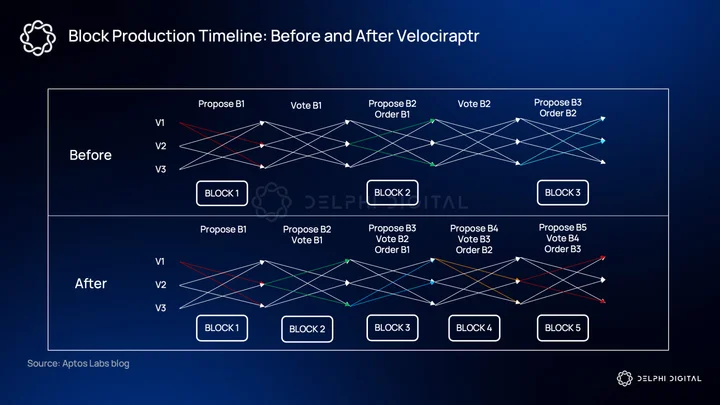
The efficiency gains become evident when comparing block production timelines. Under the previous two-network-delay system, the network would produce three blocks within a given timeframe. Velociraptr, however, produces five blocks by proposing every network hop rather than every two rounds.
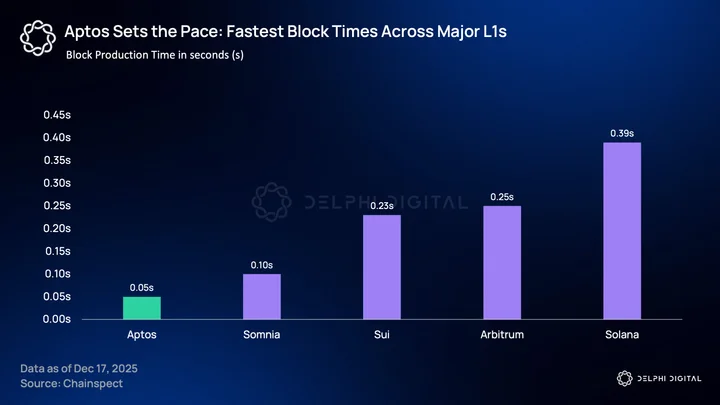
At 50ms block times, Aptos produces blocks faster than any other major Layer 1 blockchain on mainnet. With this low-latency execution, HFT becomes more viable and competitive onchain.
Storage Sharding Deployment
Fast consensus alone isn’t enough. High-throughput applications also need storage that can keep pace. Payment processors handle thousands of stablecoin transfers per second. Trading platforms update order flow state every millisecond as fills execute. Storage sharding addresses the database bottleneck that could constrain these use cases.
In September 2025, Aptos Labs rolled out AIP-97, bringing storage sharding to the mainnet. Sharding changes how the network manages state.
Before we jump into the upgrade, let’s do a primer on the storage system. As a blockchain processes transactions, it constantly reads from and writes to a database that stores the network’s current state (account balances, smart contract data, etc.). Old-school setups use a single database instance with two main parts:
1) The key-value store, which handles transaction execution and reads/writes, and
2) the Merkle database, which manages the cryptographic verification state.
As activity picks up, that single instance turns into a real chokepoint. Picture one cashier handling checkout during a supermarket rush.
Storage sharding shakes things up. It splits state storage across 16 separate database instances (RocksDB shards). Each shard holds portions of both the key-value store and Merkle database, because a bottleneck in either would limit overall throughput.
As a result, validators can process far more transactions in parallel. The new sharded storage design delivered a 79% throughput gain (sustained TPS increase from 14,000 to 25,000) in mainnet-scale controlled setups. Shardines, an execution sharding extension in testing phase, further distributes transaction processing across shards to achieve higher TPS.
Aptos’ current mainnet utilization averages 45 TPS, with a peak of 22,032 TPS (per single block). This 490x gap between demonstrated mainnet capacity and average current utilization indicates that network throughput is no longer the binding constraint. The infrastructure is ready, and the focus will shift to demand generation and application-layer adoption.
Shelby: Decentralized Hot Storage for Real-Time Data
Consensus and storage sharding optimize transaction processing, but data-intensive applications such as AI training, DePIN sensor feeds, video streaming, and gaming require sub-second data access. Blockchains excel at writes (storing data permanently), but these applications need continuous, high-frequency reads (retrieving data instantly and repeatedly).
Aptos Labs and Jump Crypto unveiled Shelby in June 2025 to address this gap. The decentralized hot storage protocol went live on devnet during the Aptos Experience event, with its testnet debut anticipated in early Q1 2026.
Shelby targets a different market than existing decentralized storage. Centralized providers like AWS S3 and Google Cloud Storage (GCS) deliver Web2-grade performance but sacrifice decentralization. They offer dedicated fiber networks, low replication overhead (the ratio of stored data to the original file size), and 4K streaming throughput.
Decentralized alternatives like Filecoin, Arweave, Walrus, etc., preserve censorship resistance but carry 3-15x replication overhead. These protocols lack dedicated infrastructure and cannot support real-time streaming workloads.
Shelby positions itself as the first protocol combining sub-2x replication overhead, 4K streaming capability, and full decentralization with incentivized reads.
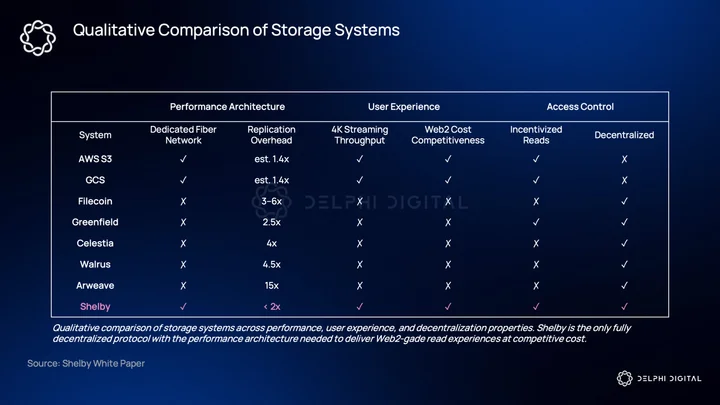
The economics flip traditional decentralized storage incentives. Providers earn base fees for holding data chunks. They also earn usage rewards per read served. This shifts incentives from idle capacity to high-demand access. Creators can collect micropayments on every view or stream. Data becomes an ongoing revenue stream.
Architecture-wise, Shelby runs on a decentralized global network of high-performance servers linked by dedicated fiber-optic infrastructure on DoubleZero, with edge caching that keeps hot data near users to minimize latency. The system uses Clay codes, an advanced erasure-coding method that splits data into smaller parts with built-in redundancy.
These parts are distributed across multiple storage providers. The original file can be reconstructed from any valid subset of pieces. When users request data, RPC nodes pull the required pieces, reconstruct the file, and deliver it with sub-second latency.
Aptos serves as Shelby’s coordination layer for core functions like storage commitments, audit verification, and economic settlement, leveraging the network’s sub-second finality and ultra-low fees.
However, Shelby is designed to be chain-agnostic, with React and Solana SDKs now available on Devnet with planned support for other blockchain environments. This design choice is notable: rather than building Shelby as Aptos-exclusive infrastructure to maximize ecosystem lock-in, Shelby is positioned as neutral infrastructure for the broader crypto ecosystem, with Aptos acting as its coordination and settlement layer.
The chain-agnostic design enables dApps on any blockchain to pull live data from Shelby, pay for on-demand storage access, and integrate access logic into their smart contracts. Early projects interested in Shelby include NBCUniversal, NEAR Protocol, and Story Protocol. Use cases span AI, NFT infrastructure, intellectual property management, and decentralized physical infrastructure networks.
Move Language Evolution
Infrastructure performance creates technical headroom, but sustained ecosystem growth requires seamless onboarding and experience for developers building on top. Move 2’s evolution addresses this through performance improvements and expanded language capabilities.
Move 2 evolved through four updates in 2025, delivering both execution-level optimizations and new language features.
Execution-Level Optimizations
Throughout 2025, performance enhancements reduced gas costs through improvements across the stack.
The Move VM got faster. The system now caches execution structures instead of recomputing them for each transaction. Transactions execute with less overhead. Memory usage dropped through smarter loading patterns. The result? Lower computational cost per transaction.
The compiler generates leaner code. New simplifier rules eliminate redundant operations. Smart contracts deploy with smaller bytecode. Less complex bytecode means lower gas consumption per transaction.
The REST API added features that developers needed. Apps can now handle signed integers in transaction arguments. Encrypted transaction filtering improves privacy. Building financial applications got simpler.
The Indexer became more efficient at querying onchain data. The system skips unnecessary work when reading tables. Redundant cloning operations were eliminated, reducing memory overhead. Apps querying historical data see faster response times.
What does this mean in practice? Trading platforms process more transactions per second at lower costs. Payment processors handle higher volumes without requiring proportional infrastructure scaling. DeFi protocols can build more complex logic within the same gas budget.
Language Features
Beyond optimizations, Move 2 introduced core language capabilities that fundamentally expanded what developers could build. Two enhancements stand out as foundational unlocks for DeFi applications.
Signed Integers
Move 2.3 added signed integer types: i8, i16, i32, i64, i128, and i256. These handle negative numbers natively.
Why does this matter? Financial contracts constantly work with negative values. Debt positions, funding rates, profit and loss calculations, and price movements all require representing numbers below zero.
Before signed integers were introduced, developers built workarounds. Those workarounds added gas costs and introduced potential bugs. Native support eliminates both problems.
Consider a lending protocol tracking debt. A negative balance represents what’s owed: let debt: i64 = -500_000; net_balance = 1_000_000 + debt; result: net_balance = 500_000. The math works intuitively without custom logic.
Signed integers support standard arithmetic operations: addition, subtraction, multiplication, division, and negation. Move’s safety checks catch errors that could corrupt financial calculations.
Higher-order Functions
Aptos adopted higher-order function support to the mainnet in October 2025 via Aptos 1.35. The key innovation: the store ability, which allows functions to be saved onchain as data that contracts can reference and execute dynamically.
So what are higher-order functions anyway? They treat functions as values that can be passed as parameters, returned from other functions, or stored for later execution. With this update, function values are now first-class citizens on mainnet. Functions become values just as integers, structs, and other data types.
A good analogy is vending machines. Traditional ones have all dispensing logic hardcoded at the factory. Want to change how it dispenses something? Rebuild the machine. Higher-order functions are like modular vending machines that accept interchangeable instruction cards, allowing operators to add new product configurations without rebuilding the core machine.
Onchain, this means that with Move 2, contracts can build smart registries. Calls are routed to the appropriate function without hard-coding dependencies up front. The contract will continue to store hundreds of function values, but only the ones needed for each transaction will be loaded into memory. And execution fees are charged only for the functions invoked in each transaction, making large function libraries economically viable.
DeFi applications that require flexibility in handling diverse asset types and transaction patterns benefit from this approach. Consider a decentralized exchange that must support tokens with special mechanics, such as rebasing, fee-on-transfer, or complex pricing algorithms.
In traditional architectures, adding such token-specific logic would require redeploying core contracts. With higher-order functions, developers register the custom logic as storable functions, leaving the core exchange contract unchanged. The exchange dynamically executes the appropriate registered logic for each swap.
Developer Tooling and Experience
From testing to deployment to backend setup, smoother workflows mean faster shipping and iteration. Move 2 unlocked the ability to compose logic dynamically. Tooling determines how quickly builders translate that into production applications.
Transaction Simulation Sessions: Real-World Testing at Mainnet Scale
Testing blockchain apps presents real challenges. Developers get stuck manually mocking DEX liquidity, pricing mechanisms, and data structures. Local nodes provide real execution environments but chew through resources and need resets after every test. Testnets have the deployed contracts and real data, but state changes persist, making iterative testing cumbersome.
Aptos Labs introduced Transaction Simulation Sessions in November 2025 to improve the app testing experience, with two modes tackling different pain points.
Network Forking Mode enables testing against real network data. Developers fork any remote network’s state (devnet, testnet, mainnet) and run simulations using actual protocol deployments, real liquidity conditions, and authentic user data.
This approach eliminates the need to download the entire chain state and avoids resource overhead. Clean Genesis Mode, on the other hand, provides isolated environments for new contract deployments or continuous integration testing.
Simulations run locally with zero onchain modifications. Developers can test transactions repeatedly, simulate failure scenarios, and debug against mainnet conditions without waiting for testnet blocks to confirm or manually resetting state.
VS Code Extension for Move
Aptos Labs launched the official “Move on Aptos” extension for Visual Studio Code (VS Code), Microsoft’s dominant code editor, in August 2025. The extension offers intelligent code assistance for Move smart contract development, including autocomplete suggestions, code navigation (jump to definitions, finding variable references, etc.), and real-time error diagnostics that catch issues before compilation. These capabilities reduce friction during development with large codebases. By integrating into VS Code, Move development fits into familiar workflows.
Geomi Platform Evolution
Geomi, which rebranded from Aptos Build in August 2025, is a developer platform that provides infrastructure tools to streamline backend operations for developers building on Aptos.
Geomi’s core capability is indexing: organizing onchain data for application use. Traditionally, accessing onchain data such as token transfers, governance votes, and order book updates has required writing custom indexing code, designing database schemas, and maintaining infrastructure to track and store everything in a queryable format. That’s tedious work, and it pulls focus from building the actual product.
Geomi automates everything through a no-code visual interface. Developers select which data to track, and Geomi handles data collection, storage, and API delivery via GraphQL endpoints.
The use cases are compelling: Trading platforms tracking order flow can query data without building an indexing infrastructure. Payment systems monitoring stablecoin transfers get real-time data out of the box.
Reducing Friction: X-Chain Accounts and Confidentiality
Beyond core consensus, storage, and language improvements, protocol-level features that reduce user friction directly impact adoption velocity. Two barriers commonly prevent the adoption of new chains: onboarding friction stops users, while a lack of privacy stops institutions. Users need new wallets and gas tokens. Institutions can’t operate when every trade and treasury movement can be tracked onchain. Aptos tackles both at the protocol level through X-Chain Accounts and Confidential Transactions.
X-Chain Accounts
Getting users to try a new blockchain is hard. They need new wallets, new seed phrases to manage, and native tokens for gas fees. Most people stop before they start.
Aptos adopted X-Chain Accounts (via AIP-113) to eliminate this friction. Currently in testnet, X-Chain Accounts will enable developers to onboard Ethereum and Solana users directly into Aptos applications without requiring new wallets.
X-Chain Accounts enable users to create Aptos accounts using their existing wallets from other blockchains. When a user connects their Phantom (Solana) or MetaMask (Ethereum) wallet to an Aptos application, the system derives a unique Aptos address by combining their wallet’s public key with the application domain.
The user signs an authorization transaction via their existing wallet to control this derived address. They can then bridge assets such as USDC from their source chain to the new Aptos account via Circle’s CCTP.
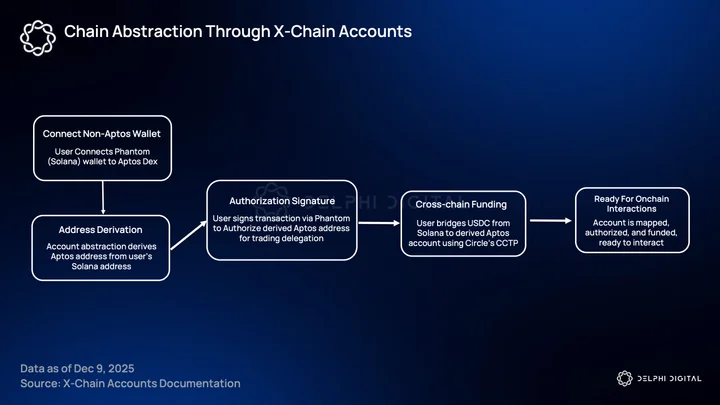
The same wallet produces different Aptos addresses for different applications, similar to having separate logins for different websites. This isolation provides security. If one application is compromised, other accounts remain unaffected. All account derivations are deterministic, ensuring the same wallet-application combination always generates the same address.
To complete the onboarding experience, X-Chain Accounts leverage Aptos’s native gas sponsorship feature. Applications can pay transaction fees on behalf of users.
Combined, these features eliminate two major barriers to cross-chain adoption, solving the cold-start problem. For instance, Decibel’s trading platform can onboard Ethereum traders without requiring them to bridge assets, set up new wallets, or acquire APT before executing their first trade.
Confidential Transactions
Enterprise and institutional players face a potential problem when interacting with public blockchains. Regulatory compliance demands identity transparency. Competitive dynamics demand confidentiality. Public blockchains make all transaction details and financial strategies visible. This creates significant challenges for institutional operations.
Aptos Confidential Transactions (ACTs) address this tension. Launched on devnet in June 2025 through a partnership with Distributed Lab, ACTs allow token issuers to encrypt token balances and transaction amounts onchain while enabling selective disclosure to authorized auditors for compliance.
ACTs don’t hide sender and recipient identities. The feature focuses solely on the confidentiality of amounts and balances. This creates a middle ground. Identity transparency remains intact to ensure regulatory compliance, while transaction amounts remain confidential.
ACTs combine two cryptographic techniques. Homomorphic encryption enables validators to verify mathematical operations on encrypted amounts without seeing the underlying values. Zero-knowledge (ZK) proofs allow senders to prove transaction validity without revealing amounts.
Consider a simple transfer to see how these techniques combine:
Alice’s balance is encrypted onchain as E(100). When Alice sends 30 tokens, she creates a transaction that encrypts the transfer amount under three keys: the recipient’s, the auditor’s, and her own key.
She generates a ZK proof demonstrating the transfer is valid. Validators verify the proof, then use homomorphic encryption to update balances. Once validated, Alice and the recipient can each independently decrypt amounts using their respective keys.
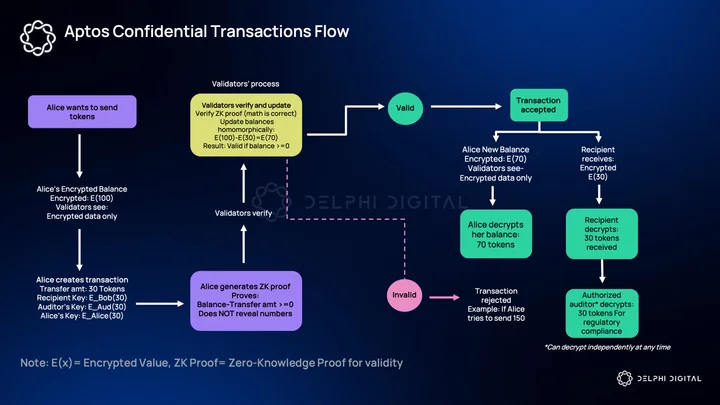
For regulatory requirements, ACTs support authorized auditors that token issuers designate. The auditor’s key grants authorized parties independent access to decrypt and verify transaction amounts. As a result, required regulatory oversight can be achieved without exposing transaction amounts to the broader network.
This capability opens the design space and makes several enterprise applications finally viable. Examples include payroll disbursements without revealing employee compensation, institutional trading of tokenized assets with confidential amounts, B2B payments where amounts represent competitive intelligence, and DeFi participation without exposing position sizes or strategies.
Ecosystem Growth
Core Development Tracks
Stablecoin Infrastructure
Aptos stablecoin market cap reached an all-time high of $1.8 billion in December 2025, representing nearly 3x growth since the start of the year. This growth coincided with comprehensive infrastructure development across payments, remittances, and DeFi integration.
For payments and remittances, Aptos’s $0.00003 transfer fee provides a significant advantage. Traditional rails charge approximately $12 on a $200 transfer (6.4% average fee). That’s a 400,000x cost difference.
Remittance Payments
Remittances are a $900 billion global market running on broken infrastructure. Traditional rails charge an average fee of 6%, with 3-5 day settlement. Recipients wait through weekends and bank holidays for funds to be credited to their accounts. The costs hit hardest in developing regions, where Sub-Saharan Africa pays the highest fees globally at 8.2%.
The problem is structural. Traditional remittances route through correspondent banking networks and SWIFT. Multiple intermediaries each take a cut. Banks operate during business hours. Pre-funding requirements tie up capital. The further a payment travels from Western financial centers, the more intermediaries are involved, which compounds both costs and failure points.
Stablecoins eliminate these inefficiencies. Take USDT as an example. A sender converts local currency to USDT. The stablecoin transfers across blockchain networks in seconds. The recipient can convert back to local currency or keep digital dollars. The entire process happens without correspondent banks, SWIFT connections, or business-hour limitations.
Aptos makes this model viable at the consumer scale. Although traditional remittance fees vary widely and are often reported as high as $50, the commonly cited $12 figure is a conservative benchmark. Even against that baseline, Aptos delivers up to 400,000× cost advantage. This enables near-zero-fee consumer experiences.
Live Deployments
Aptos Labs partnered with Yellow Card in July 2025 to launch gas-sponsored stablecoin transfers across 20 African countries. As a result, Yellow Card’s 54 million users can transact in USDC and USDT with zero fees for small-business payments, cross-border payroll, and more.
Sub-Saharan Africa processes nearly $100 billion in remittances annually, with fees at 8.2%. The cost advantage is substantial even after converting to the local currency. If merchant acceptance grows and users can spend stablecoins directly, the friction drops even further.
Bitso announced a strategic partnership with Aptos in August 2025, bringing Latin America’s largest crypto exchange into the ecosystem. With over 9 million users across Mexico, Brazil, Argentina, and Colombia, the partnership aims to enable near-zero-fee settlements for cross-border payments. What’s encouraging is that stablecoins already represent 46% of Bitso’s transaction volume. The demand exists. Aptos provides infrastructure that makes serving that demand economically sustainable.
Economics of Fee Subsidization
Aptos’ transaction economics enable zero-fee experiences when platforms choose to subsidize. Yellow Card’s campaign demonstrates this approach, covering network fees on behalf of users. A provider processing 10 million monthly transfers incurs only $300 in total network gas costs. At that scale, gas subsidization transforms from a cost burden into a customer acquisition lever. That $300 monthly spend becomes a competitive advantage, not overhead.
Traditional payment processors can’t compete on economics. Banks charging $12 per transaction can’t subsidize their way to zero-fee consumer experiences. Applications on Aptos can.
This structural cost advantage makes large-scale partnerships (like Yellow Card) economically viable.
Stablecoin Integrations
Three major stablecoin issuers expanded to Aptos in Q3-Q4 2025.
PayPal announced a collaboration with Aptos in September 2025 to onboard PYUSD0 via LayerZero. The planned deployment will make Aptos the first Move-based blockchain to support PayPal’s stablecoin. Similarly, Paxos also announced USDG0 deployment via LayerZero in November 2025. Both collaborations strengthen Aptos’ institutional validation. Furthermore, PayPal’s payment network and Paxos’s regulatory compliance track record add credibility to the Aptos ecosystem.
Another stablecoin that integrated with Aptos is USD1. World Liberty Financial chose Aptos as USD1’s first Move-based chain. And the ecosystem mobilized quickly, with $33 million USD1 onboarded in less than two months since deployment.
Within days, five DeFi protocols integrated USD1: Echelon Market, Hyperion, Thala Labs, Panora Exchange, and Tapp Exchange. Several major wallets, including Backpack and OKX, added support.
The real push, however, came through ecosystem incentives. Echelon offered $200,000 in rewards for net deposits. Hyperion ran a trading contest with $10,000 worth APT in prizes. Thala Labs put up $100,000 to bootstrap USD1/USDC liquidity on ThalaSwap.
Beyond DeFi protocols, Bybit added native USD1 deposits and withdrawals on Aptos with zero gas fees through January 2026 to drive adoption. These campaigns aim to remove cost barriers that typically hinder cross-platform stablecoin circulation in DeFi.
StableFlow Integration
DapDap launched StableFlow, a cross-chain stablecoin bridge built on NEAR Intents. NEAR Intents operates through the NEAR Multi-Party Computation (MPC) Network, which distributes cryptographic key management across multiple independent parties to eliminate single points of failure. Aptos’s joining the MPC Network enabled StableFlow to add Aptos support.
StableFlow charges a 0.01% fee with minimal slippage for transactions up to $1 million, using a competitive solver-based architecture in which independent solvers compete to execute each bridge transaction and automatically select the optimal route and pricing.
The integration enables bi-directional stablecoin transfers between Aptos and nine networks: Ethereum, Arbitrum, Polygon, BNB Chain, Optimism, Avalanche, Solana, NEAR, and Tron.
Users can now bridge stablecoins cost-effectively from top chains onto Aptos or move capital off Aptos to other ecosystems.
Initially launched with USDT support, StableFlow’s roadmap includes expansion to USDC and USD1.
This expansion in payment infrastructure and cross-chain connectivity built the foundation for broader stablecoin adoption. Stablecoins also gained traction in Aptos DeFi, as covered in the Ecosystem Growth section later.
Trading Infrastructure
Decibel Launch
Decibel is a decentralized perpetual trading protocol being launched on the Aptos blockchain. The platform supports spot, perpetuals, and yield strategies. Developed by Aptos Labs in collaboration with the Decibel Foundation, Decibel launched on devnet in August 2025.
Decibel is in a position to become the execution layer for Aptos’s “Global Trading Engine (check out our ecosystem report for the deep dive), targeting tokenized, 24/7 capital markets.
Following the August invite-only DevNet access, Decibel opened the public testnet on November 20, 2025. Mainnet launch is expected in Q1 2026.
Decibel operates with sub-125ms block times. Future upgrades target 1 million orders per second and sub-20ms block times. Combined with Aptos’ near-instant finality, this infrastructure aims to deliver order-execution speeds competitive with those of standard centralized exchanges. Trades execute and settle fully onchain. Users maintain custody of their funds, eliminating the counterparty risk of centralized exchanges.
Decibel uses a multi-collateral cross-margin system. They can use multiple asset types (APT, USDC, BTC, ETH, SOL) as collateral for leveraged positions. Users can also deposit assets into vaults that run market-making strategies to provide liquidity and generate yield. The same assets simultaneously serve as collateral for trading positions.
This dual-use capital structure maximizes DeFi capital efficiency, though layered capital reuse also compounds liquidation risks under market stress. The recent October 10, 2025, market crash demonstrated this vulnerability.
The testnet roadmap includes a cross-chain risk engine, gas-free cross-chain deposits, and an encrypted mempool for MEV protection. Through X-Chain Accounts, users will onboard directly from Ethereum or Solana without bridges, wallet switching, or paying APT gas fees, addressing the persistent cold-start problem of navigating an unfamiliar blockchain ecosystem.
Decibel also creates strong incentives for developers. Its architecture supports permissionless development through Builder Codes, which offer a simple revenue-sharing model. Developers earn fees based on the trading volume their applications generate. This structure enables monetizable custom trading interfaces and supports automated strategies built directly on Decibel’s infrastructure.
Backpack Integration
Beyond native trading infrastructure, third-party exchange integrations expand accessibility to Aptos, creating additional liquidity and user on-ramps.
Backpack Exchange integrated Aptos in August 2025. The exchange offers spot and perpetual futures markets, with APT available as collateral for perpetual contracts. Through its “Interest-Bearing Perpetuals” architecture, Backpack combines a borrow-lend market with perpetuals trading. APT and other eligible collateral earn yield via ‘Auto Lend’ while simultaneously serving as margin. Capital stays active across spot, margin, and perpetual positions.
Backpack also provides fiat on- and off-ramps and offers 1:1 USD-USDC swaps on Aptos with zero fees. In October 2025, Backpack Wallet added Aptos staking support, enabling non-custodial APT staking directly from the wallet.
Broader Ecosystem Activity
Beyond the three core tracks, significant ecosystem momentum emerged across institutional partnerships and DeFi integrations.
Institutional and Enterprise Integration
Institutional Fund Deployment
BlackRock’s USD Institutional Digital Liquidity Fund (BUIDL) expanded to Aptos in November 2024. BUIDL provides institutional investors onchain access to cash yield through tokenized short-term U.S. Treasury exposure.
In October 2025, the deployment scaled past $500 million, making Aptos the second-largest host for BUIDL after Ethereum. Even after rebalancings, BUIDL sits at $350 million as of December 2025, with the network’s RWA market cap just shy of $1 billion. In under 12 months, Aptos has effectively gone from “no RWAs” to a nine-figure institutional-grade RWA ecosystem that’s still compounding.
PACT Protocol Migration from Celo
PACT Protocol, a permissioned lending platform for licensed lenders, migrated from Celo to Aptos in February 2025, bringing over $1 billion in onchain assets. By November 2025, PACT reached $1.9 billion in cumulative loan issuance and $600 million in active loans, ranking fourth-largest globally in tokenized private credit.
PACT brings the full lending lifecycle onchain, including origination, payments, warehousing, and securitization. Each loan gets issued as an NFT under the Aptos Digital Asset Standard. The NFT represents the loan agreement and travels with it from origination through repayment or resale. For institutions, this means transparent loan tracking and the ability to trade loans in secondary markets.
BitGo, which serves over 1,500 institutional clients, handles custody for both the onchain loan NFTs and the off-chain collateral backing them. For a deeper dive into PACT’s architecture and how its NFT-based loan system works, see our dedicated PACT Protocol report.
NBCUniversal Integration
Aptos’ enterprise adoption extends beyond financial services into media, entertainment, and consumer engagement. NBCUniversal formalized a multi-year strategic partnership with Aptos Labs, extending prior NFT collaborations on Hollywood films into broader blockchain-based fan engagement and media distribution infrastructure.
Backlot Club, the partnership’s first product, launched in October 2025 as an interactive entertainment platform built on the Aptos blockchain. The platform debuted at Universal’s Halloween Horror Nights and powered onchain scavenger hunts in which guests collected digital medallions redeemable for both digital collectibles and physical rewards. Each reward claim is verified and recorded on the blockchain with a timestamp and metadata. The functionality creates a transparent connection between digital engagement and real-world experiences. The platform demonstrates how media companies can leverage blockchain infrastructure beyond traditional collectibles to create unified rewards systems across digital and physical touchpoints.
Backlot Club operates on Watchee, Aptos’s decentralized media operating system built atop Shelby. Watchee provides smart contract functionality for content rights management, release scheduling, and viewer access controls. By enabling producers, distributors, and developers to build on shared infrastructure, Watchee positions itself as open media infrastructure. If successful, this would address coordination challenges that fragmented media systems create. The platform opened for waitlist registration in October 2025, with full launch expected in Q1-Q2 2026.
Reliance Jio Integration
Reliance Jio, India’s largest telecommunications company and the world’s third-largest mobile network operator, is expanding its Web3 ambitions through a new partnership with Aptos Labs and the Aptos Foundation. Together, the organizations will explore blockchain-based solutions for Jio’s more than 500 million telco customers.
Announced in October, the collaboration underscores how established global enterprises are turning to the Aptos network to deliver real-world blockchain applications that operate at scale.
For Aptos, serving as the technical backbone to a telecom ecosystem of this scale serves as both a stress test of its architecture and an entry point into regulated, mass-market deployment. If successful, it could influence how telecom operators globally integrate blockchain into digital infrastructure.
DeFi Infrastructure
DeFi Volume & Trading Activity
DEXes on Aptos have generated over $45 billion in cumulative all-time volume, while derivatives platforms have processed approximately $30 billion in perpetual trading volume.
Leading DEXs include ThalaSwap, and Hyperion, and Aptos’ premier DEX Aggregator, Panora, which all contribute to spot volume. Merkle Trade dominates the derivatives segment with over $29 billion in cumulative trading volume and over 160,000+ unique traders who have accessed the platform in their web or iOS app.
Aave V3 Launch and Other Integrations
Aave V3 launched on Aptos mainnet in August 2025, marking the protocol’s first deployment on a non-EVM blockchain. Because Aptos uses Move rather than Solidity, the integration required a full rebuild of Aave’s codebase. For a protocol that manages billions in deposits across multiple chains, this was a major decision.
Move’s security guarantees and formal verification capabilities were strong enough to justify the engineering investment for Aave. The deployment underwent audits by Zellic, Ottersec, SpearBit (Cantina), and Certora, supported by a $500,000 bug bounty program.
At launch, Aave supported four assets: USDC, USDT, APT, and Ethena Staked USDe (sUSDe). The CCIP integration enabled immediate cross-chain deployment of Aave assets as cross-chain tokens (CCT). Aave’s GHO stablecoin launched on Aptos as a CCT, while Bedrock’s uniBTC and brBTC became bridgeable via CCIP.
By December 2025, total deposits on Aave surpassed $75 million.
Upshift and Merkle: Simplifying Yield Access
Upshift Vault launched in November 2025 to solve a real user problem. Ethereum users see 10%+ yields on Aptos Aave markets. The same stablecoins earn 3-5% on Ethereum. The problem? Getting funds to Aptos requires bridging assets, acquiring APT for gas, and navigating unfamiliar interfaces. Most people won’t bother with that friction. While X-Chain Accounts promise to simplify this, they’re not yet available on mainnet.
Upshift automates the entire process. Users deposit USDC or USDT on Ethereum. The vault bridges funds via LayerZero and deploys capital to Aave on Aptos. Users earn roughly 8-12% APR.
Merkle Trade took a different approach to enable higher yield access for its users. Merkle Trade integrated one-tap access to Aave yields into its interface. Users can earn approximately an APR of 8% through simplified Aave deposits directly in Merkle’s app, enabling traders to earn yields on idle collateral without leaving their primary trading interface.
Thala RESERVE Auction: Oversubscription and ThalaLaunch Reboot
Thala’s RESERVE token auction via ThalaLaunch concluded on November 2, 2025, with a 782% oversubscription. The platform raised $1.3 million in deposits within 48 hours, marking the relaunch of Thala’s liquidity bootstrapping platform.
RESERVE operates as the first fully onchain Digital Asset Treasury on Aptos. Like MicroStrategy’s Bitcoin treasury strategy, but entirely onchain. The protocol collects fees from RESERVE/APT trading and automatically converts them to APT. 50% flows directly to the Echelon RESERVE-APT isolated pool. The remaining 50% deploys across treasury strategies: yield generation, leveraged APT positions, and validator revenue.
Unlike MicroStrategy’s off-chain Bitcoin purchases via capital markets, RESERVE’s treasury accumulation, fee conversion, and book-value mechanics execute automatically, and entirely onchain, creating transparent, verifiable APT accumulation.
AI-Driven Security Agents
Aptos partnered with Almanax in May 2025 to introduce AI-driven security agents for the Move programming environment. Move’s security-first design eliminates many language-level vulnerabilities, but developers still need audits for protocol logic and economic attack vectors.
The Almanax agents automatically detect routine Move-specific issues such as resource misuse and incorrect access control, reducing the manual burden on auditors. With these lower-level checks automated, human auditors can focus on complex logic and potential attacks that require expert judgment. This division of work shortens audit cycles and strengthens overall security.
KGeN (VeriFi Protocol) Launch and Revenue Generation
KGeN, an identity and compliance infrastructure protocol, generates $59 million in annualized revenue and is also the most active application on Aptos by transaction volume. The protocol, valued at $500 million at a less than 10x multiple, raised $13.5 million in October 2025, bringing total funding to $43.5 million.
KGeN’s VeriFi protocol provides identity verification infrastructure for AI, DeFi, and gaming platforms. Its Proof of Gamer Economy system aggregates biometric verification, on-chain loyalty activity, and marketplace participation into a privacy-preserving reputation score. Developers can integrate these scores directly into their applications for identity, anti-bot protection, or user qualification, without building their own verification stack. The protocol’s rising transaction volume reflects strong network effects.
As more platforms adopt VeriFi, its value to new developers increases because users already carry portable credentials within the system. This creates a defensible moat. Developers typically face switching costs when migrating to alternative identity solutions, and users would otherwise end up with fragmented identities across incompatible platforms, making any competing system harder to establish.
ShurikenTrade
ShurikenTrade integrated Aptos support in 2025 and formed partnerships with Panora Exchange, Booster.fun, Tapp Exchange, and Hyperion. The multi-chain trading platform operates via a Telegram bot and web app, enabling onchain trades with automated sniping, MEV protection, and AI-assisted trading.
Telegram-based bots abstract blockchain interactions into chat commands, lowering barriers for mobile-first markets where app downloads could face storage and data constraints. ShurikenTrade provides non-custodial trading experiences, along with gamified “Shuriken Stars” rewards for trading, referrals, and engagement.
AllScale
AllScale partnered with Aptos Foundation in May 2025 to build stablecoin payroll infrastructure with an aim to replace slow cross-border banking with instant, self-custody transactions. AllScale is a multi-chain platform that helps businesses and global teams manage payments, invoicing, and payroll using stablecoins. In December 2025, AllScale raised $5 million in seed funding led by YZi Labs (formerly Binance Labs) with participation from Aptos Foundation. The funding will be used to improve the product and expand into underbanked markets like Latin America.
Goblin Finance
Goblin Finance is a DeFi protocol on the Aptos blockchain focused on yield optimization through automated vault strategies and liquid staking. The protocol operates GoVault for liquidity management and GoAPT, a liquid staking token that delivers enhanced yields by distributing protocol fee revenue to stakers. In December 2025, Goblin Finance raised $1 million in strategic funding led by OKX Ventures, Gate Ventures, and BlockBooster, with participation from the Aptos Foundation and Aptos Labs CEO Avery Ching.
Ecosystem Development and Funding
Innovation-Enabling Source Code License: Strategic Technology Sharing
In November 2025, the Aptos Foundation introduced the Innovation-Enabling Source Code License framework for Foundation-developed technologies. The license makes source code publicly available for auditing, research, and experimentation, but restricts commercial and production deployment for four years from publication. After four years, the license automatically permits unrestricted commercial use. The restriction period creates a strategic window for native developers to build using Foundation code without immediate competition from developers on other chains who could fork the same technology.
This approach mirrors the Business Source License (BSL) models adopted by protocols such as Aave, Uniswap, and EigenLayer. The Foundation reviews commercial use requests during the restricted period on a case-by-case basis, and approved arrangements may include licensing fees directed to ecosystem development.
Aptos Assembly: From Prototype to Product Traction in Four Weeks
Aptos Foundation launched Aptos Assembly in October 2025 as a four-week sprint program for founders building products on the Aptos network. The program addresses a critical conversion gap: early-stage products, whether from hackathons or Web2 backgrounds, often stall without structured support and ecosystem connections. Assembly provides the framework to help these products gain traction.
The structure spans product validation in Week 1, followed by guided execution with weekly mentor sessions to advance development and refine go-to-market strategies in Weeks 2-4. The program culminates in a Demo Day where participants present to Aptos Foundation stakeholders, investors, and ecosystem partners. Throughout the program, participants connect to Aptos ecosystem resources, including grants, partners, and distribution channels.
Payments Grant Track
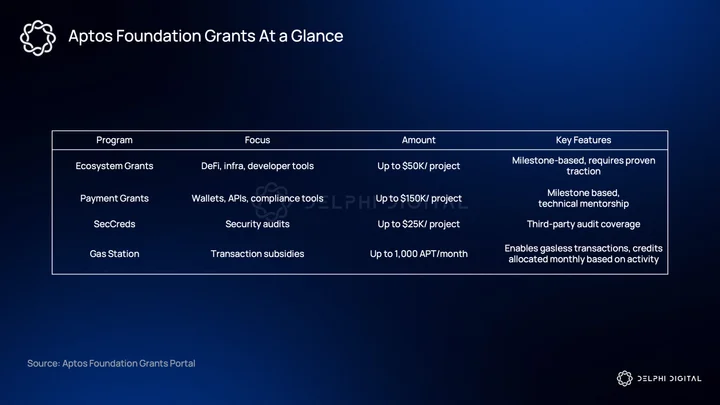
In July 2025, Aptos Foundation announced the Aptos Payments Grant track, offering milestone-based funding up to $150,000 for teams building payment infrastructure, including wallets, APIs, compliance tools, and related services. Grantees also receive Gas Station credits for abstracting gas for user transactions, security audit support, technical mentorship, and marketing amplification through various channels. The track targets teams addressing both traditional payment infrastructure gaps and crypto-native use cases- from replacing legacy systems and enabling stablecoin commerce to building novel applications like streaming payments and agent-to-agent transactions.
Complementing this, the Foundation’s Grants program includes the broader Ecosystem Grants track (up to $50,000 for projects with proven traction).
For early-stage teams, the ecosystem support infers a structured progression. Hackathons for initial ideation, the Aptos Assembly program to advance concepts to MVP, followed by grants for teams demonstrating measurable progress. Beyond grants, the Foundation offers accelerator programs for maturing projects and the LFM program for teams approaching a Token Generation Event.
Move Club: Local Action, Global Impact
Aptos Foundation launched Move Club as a regional support network providing community resources, funding, and mentorship for builders, an initiative similar to Solana’s Superteam regional model. Move Club launched in 2025 with inaugural chapters in India, Vietnam, China/Hong Kong (powered by MoveMaker), and LatAm.
The program blends virtual infrastructure with localized support. Builders can participate in monthly Power Sessions to share progress and troubleshoot challenges. Founder Clinics provide peer guidance from experienced builders. The Assembly Program offers a month-long sprint for early-stage teams.
Select participants receive grants and ongoing mentorship from the Foundation. Beyond individual support, the Foundation acts as the initial catalyst for new chapters, providing funding and operational support by recruiting and onboarding regional partners to sustain local ecosystems.
Regional Accelerators and Specialized Programs
The Foundation’s support extends through regional accelerators, infrastructure initiatives, and specialized programs. A multi-tiered approach, unlocking a strategy of localized ecosystem development combined with network-wide infrastructure investments.
Regional accelerators address market-specific needs. Centralized infrastructure projects, such as the Move Base Library, reduce duplication of development across the network and provide shared resources for builders globally.
Looking Ahead
Today, activity on Aptos typically runs at ~45 TPS, which is a fraction of what the network is built to handle. On mainnet, Aptos has already hit 22,032 TPS, with testing pushing theoretical capacity past 1 million TPS. That ~490x gap between everyday load and proven throughput isn’t just headroom, it’s an open lane. Applications that actually need high throughput finally have room to run. 2025 was about building the rails. 2026 is about proving they matter.
Multiple launches converge across trading, storage, and payments. Each explores how Aptos’ technical advantages translate into something users actually care about.
Decibel’s Q1 mainnet aims for sub-20ms block times for perpetuals trading. The infrastructure is designed to match centralized exchange execution speeds while remaining non-custodial. What’s encouraging is that potential adoption friction gets addressed through ecosystem-wide developments. Gas sponsorship removes transaction costs. X-Chain Accounts will enable users to trade directly from Ethereum and Solana wallets without bridging or buying APT. These aren’t minor features, they’re the difference between users trying the platform and abandoning it before they start.
The perpetuals market is crowded. Dominant players like Hyperliquid and Lighter already have liquidity and traders. Decibel’s shot at gaining ground comes from execution speed and removing barriers. Success hinges on bootstrapping sufficient liquidity, which must precede sustained inflows of active traders. The question is whether execution speed and accessibility advantages are compelling enough to pull liquidity and traders from established platforms.
Shelby’s projected H1 2026 mainnet tackles something blockchains have historically struggled with: reads. Blockchains are good at writes, storing data permanently. But AI training, video streaming, and enterprise applications need continuous high-frequency reads. That’s where Shelby comes in. Sub-second data retrieval with sub-2x replication overhead, and a model that pays providers for serving reads, not just storing data. High-demand content could generate sustained revenue. The chain-agnostic design lets applications on any blockchain access Shelby’s storage layer. The competitive test is straightforward: can decentralized infrastructure match centralized cloud storage performance? Early enterprise interest suggests there’s demand if the technical claims hold at scale.
Stablecoin infrastructure is where Aptos’ cost advantage becomes undeniable. USDT transfers on Aptos cost $0.00003, compared to $12 on traditional remittance rails. That’s not an incremental improvement, it’s a structural shift. Aptos Labs partnered with Yellow Card to launch gas-sponsored transfers across 20 African countries, targeting a market that processes nearly $100 billion in remittances annually at an average fee of 8.2%. And there’s a compounding effect: increased stablecoin activity improves on-chain liquidity depth, strengthening DeFi trading conditions across the ecosystem.
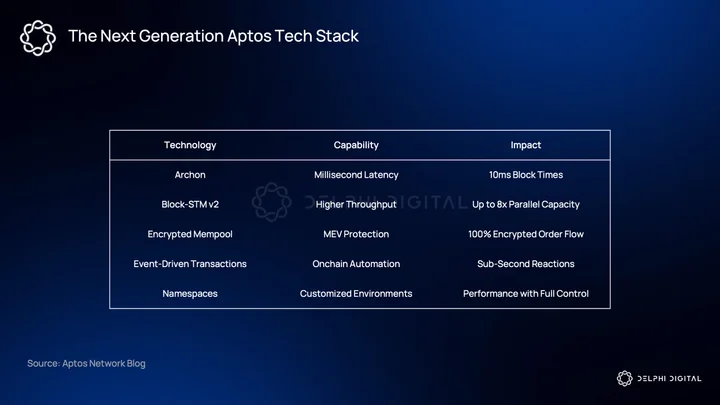
And Aptos isn’t slowing down. Its technical arc keeps pushing the envelope:
- Block-STM V2: Enhanced parallel execution capabilities for higher transaction throughput,
- Archon: Ultra-low latency operations targeting ~10ms block times that approach centralized exchange performance,
- Encrypted Mempool: Native MEV protection through transaction batch encryption that hides transaction details until execution, preventing front-running of large capital movements,
- Event-driven Transactions: Enable smart contracts to trigger actions based on onchain events without external bots or keepers,
- Namespaces: Customizable execution environments with application-specific gas markets and consensus parameters without network fragmentation.
The infrastructure is ready and continuously improving, and applications are beginning to leverage it. Decibel explores execution speed in competitive markets, Shelby benchmarks decentralized performance against Web2 standards, and stablecoins test cost economics in real-world payments. Each path opens a different route to mainstream adoption. 2026 will show if applications can translate Aptos’ infrastructure advantages into meaningful user growth.
0 Comments