BTC Production Cost, Bitcoin as Inflation Hedge, and Fuel Deep Dive
JUL 18, 2022 • 6 Min Read

Disclosure: Delphi Ventures and members of our team are invested in BTC, ETH and SOL. Delphi Venture
Chart of The Day: BTC Price Bounces After Hitting Production Cost
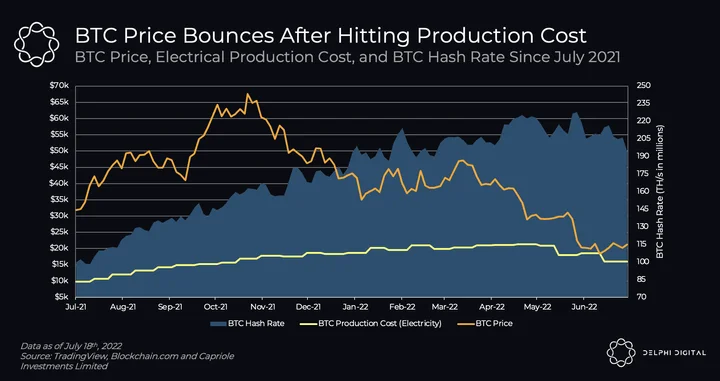
 Over the past 5 years, the electrical expenditure to mine 1 BTC has consistently represented a price floor for Bitcoin. Indeed, BTC price has only matched the electrical cost of production (excluding all other costs of mining) 3 times within the past 5 years: in Dec-2018, Mar-2020, and most recently, in Jun-2022.
- Currently, the estimated electrical cost of production stands at just over $16k, with the estimated total cost of production hovering around $26.6k. These estimates and the historical data depicted in the chart above are based on calculations proposed by Capriole Investments Ltd.
- Although most studies use data from the Cambridge Bitcoin Electricity Consumption Index (CBECI), estimates for the cost of production vary across the industry, depending on how other inputs are utilized. Last week, JP Morgan released their updated electrical cost of production estimate to $13k, which they attributed to more power-efficient miners hitting the market.
- Despite these variations, what remains clear is that the profitability of Bitcoin miners remains a challenging environment. Since Jun-2022, the Bitcoin network has experienced a 17% decline in hash rate, the largest monthly decrease since Jun-2021.
Bitcoin Is Not An Inflation Hedge
[Excerpt from a Delphi Insights report]
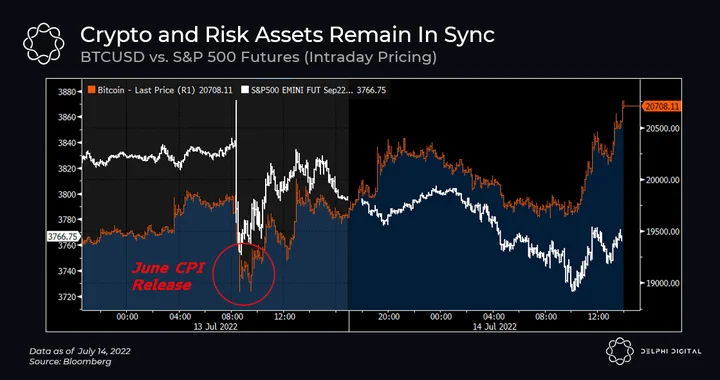
- It’s easy to point fingers in hindsight. But to be fair, these detractors have a good point (whether they know it or not). There’s an important difference between inflation (as is commonly measured by indicators like CPI) and currency debasement. Bitcoin is a hedge on the latter, but the former can actually create serious headwinds for asset prices, as we’ve seen firsthand this year.
- We talked about this distinction back in early January. At the time, many were still holding onto the narrative that BTC was an inflation hedge, even as CPI started to accelerate. We explained that consumer price inflation and currency debasement are two sides of a similar coin, but their impact on asset prices can differ. At a certain point, price inflation can have an adverse impact on markets as rising consumer prices start to curb spending, eat into savings, and slow demand. Higher CPI prints didn’t equate to higher asset prices. Today, we’re seeing this exact dynamic play out.
- Those banking on the currency debasement narrative are also hurting as the dollar has only gotten stronger – not weaker – over the last 12 months.
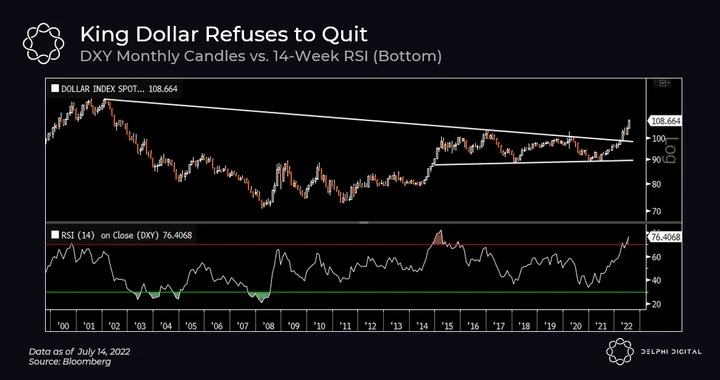
- The almighty dollar continues to throw cold water on markets, which we know does not bode well for BTC and crypto either.
- In our latest chartbook, we noted the dollar’s latest rally has come at the expense of the EUR and JPY, both of which are seeing material long-term technical breakdowns. EURUSD is trading at its lowest level in 20 years as the outlook for the euro area continues to weaken relative to its cross-Atlantic trading partner.
- The aggressive hawkish stance taken by the Fed has also given the greenback a boost and the hotter-than-expected CPI print increased the likelihood of an even bigger rate hike at the July FOMC meeting in just two weeks. At one point yesterday the market was pricing in an 80% chance of a 100bps hike. The odds have since dropped back down to ~25%, which is still higher than the low-single-digit probability a week ago.
- For more information, Delphi members can see read the full Delphi Insights report here.
Is Fuel The Best Modular Execution Layer?
[Excerpt from a Delphi Pro report]
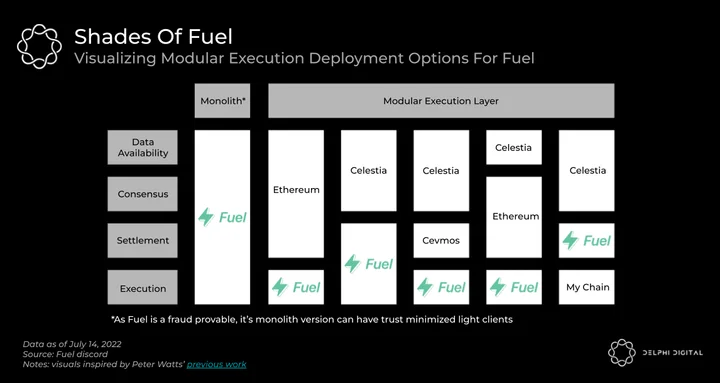
- You may have heard the Fuel pitch; the fastest modular execution layer ever. Bold claim. Unfortunately, as the Fuel chain is not live yet, we can’t put this claim to the test. Besides, that would take away the fun part anyway. Instead, in this post, we stress-test this promise by diving into Fuel’s design.
- First, it’s worth noting what is meant by modular execution. A core pillar of modular execution layers is to be verifiable. This can be done through the use of fraud or validity proofs. Fuel’s current execution is designed to be fraud provable by the EVM, making it suitable to be run as a rollup on Ethereum. However, modular execution layers encompass a broader definition than rollups as they don’t subscribe to any particular data availability, consensus, or settlement configuration. As such, we can see Fuel getting deployed as a rollup, celestium, or even a side-chain / L1.
- The biggest differentiator of Fuel from today’s optimistic rollups is that it runs a brand new VM architecture coined FuelVM with its toolchain and language. FuelVM carries traits from WASM, EVM, and Solana’s SeaLevel. Potentially the most striking aspect of FuelVM is that it executes over a UTXO-based data model.
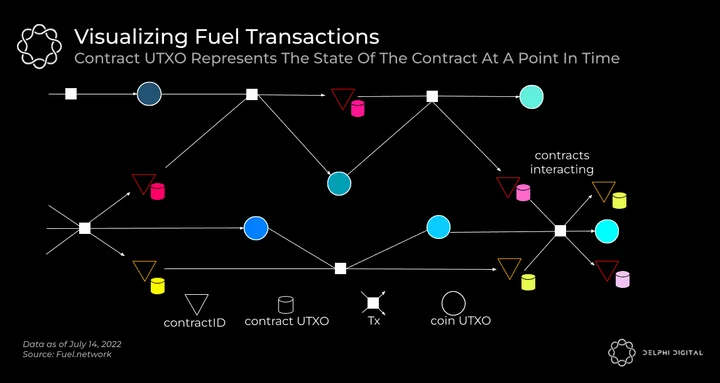
- As mentioned before, Fuel adopts a UTXO data model. Smart contracts with UTXOs are long believed to not be practical.
- The skepticism regarding smart contracts on UTXOs has been largely owed to the notorious contention problem that made the news with Cardano’s first AMM implementation.
- The problem with this particular implementation had to do with forcing users to sign over contract UTXOs. Notice that in a popular dapp like an AMM, there could be many txs within a block trying to swap into the same pool. In this case, this translated into multiple txs trying to spend the same contract UTXO. As the first tx consumed the UTXO, all the subsequent txs targeting the same contract UTXO failed because the said contract UTXO no longer existed.
- So how does Fuel get around this problem? The trick has to do with having two parties sign over different parts in a tx. When initiating a tx, users sign over the contract ID and not the contract UTXO. This way, users simply indicate which contract they want to touch, but don’t force the contract to be in a particular state before and after execution. This is intuitive because users don’t actually know the state of the contract at the time of execution as the final order isn’t determined by them. Instead, it’s block producers who determine which exact contract UTXO a tx is going to spend.
- For more information, Delphi members can read the full Delphi Pro report here.
Notable Tweets
Lido Adding stETH to Layer-2
Lido is launching stETH on Layer 2 🏝️
Ethereum is scaling, and so is Lido.
Lido stakers will soon be able to use their stETH assets in DeFi on Layer 2.
— Lido (@LidoFinance) July 18, 2022
Coinbase to Offer Free Web3 Usernames
Coinbase offers free Coinbase-managed Web3 usernames to its users built on top of the ENS infrastructure
— Blockworks (@Blockworks_) July 18, 2022
Binance Holds Most BTC of Any Centralized Exchange
The flippening: Binance has surpassed Coinbase for having the most BTC of any exchange
— Will Clemente (@WClementeIII) July 18, 2022
0 Comments