
Introduction
Blockchain-based virtual land projects garnered industry-wide attention in late 2021/early 2022. The average price per NFT plot of land hit $18k in January 2022 and total secondary trading volume reached $2B by Q3. Much of this speculative demand was unsubstantiated, with very few playable games available and even fewer players. We went into a lot more depth about the performance of land-based virtual worlds in our Guide to Web3 Games report as well as our deep dive into The Sandbox.
The majority of this hype was centered around “the metaverse” and the development of virtual experiences and social platforms, with a large focus on user-generated content (UGC). However, there are a number of projects taking a different approach to NFT land-based games. Instead of taking inspiration from Web2 incumbents such as Roblox, Minecraft, or popular MMOs, these projects are designing curated experiences with fixed gameplay loops that mostly fall within the genre of farming simulators and base-building games. The implementation of blockchain technology and NFTs in these games introduces more complex in-game economic systems where on-chain resources can be produced, traded, and used throughout multiple games within one ecosystem.
As we move into the new year, a number of these projects have launched in early access, providing users with the opportunity to start testing out this emerging subgenre of Web3 gaming. This report will outline how blockchain assets interact with the games, the implications for players and the rest of the ecosystem, and the likelihood that these games will be able to attract a wider audience. Needless to say, none of this is financial advice, and is purely an exercise of exploration to determine what is currently on offer and whether or not it matches the high expectations set by the market.
Illuvium
Illuvium: Zero (IL:Z) is the last of three initial titles to be included in the Illuvium ecosystem or Illuvium IBG (Interoperable Blockchain Game). The game is currently available on PC and will launch on mobile devices in the future. It resembles other city-building/resource-management games such as FarmVille and will have players build, manage production lines, and produce and trade resources. What’s fairly unique about IL:Z is that not only can landowners produce NFT resources that can be openly traded for real-world money, but these resources can also be used in other games within the ecosystem such as Illuvium: Arena (a PvP auto battler) and Illuvium: Overworld (an open-world adventure game), which launched their public betas on September 28th and December 12th, respectively.
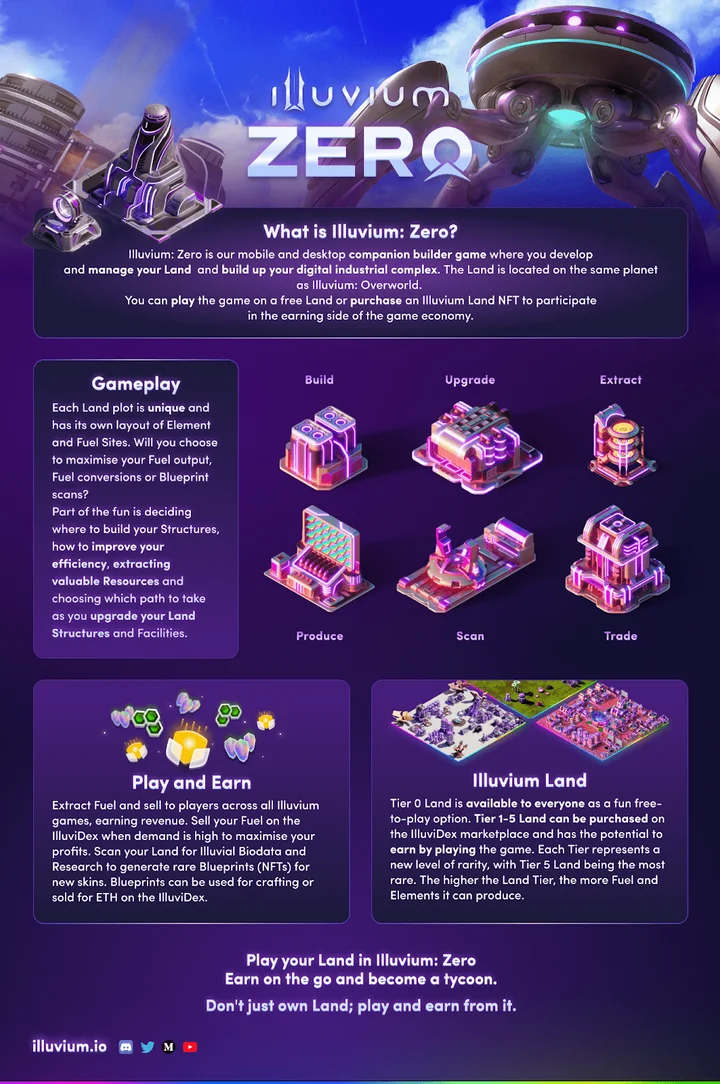
Season 0 of the IL:Z beta launched on January 6th, lasts for six weeks, and is only available to Illuvium landholders. There will be a free-to-play option in the future which will introduce exactly the same game mechanics, but players will be unable to produce NFTs or trade resources in an open economy. We will mainly focus on the pay-to-play version of this game.
Illuvium land has a total fixed supply of 100,000 and is divided into seven regions with five different tiers of land plots. Tier 1 plots provide a basic level of resources, which increase the higher the tier. Tier 3-5 plots feature landmarks that “significantly boost output.” Additionally, tier 5 land plots will feature Legendary Arenas that can host official Illuvium esports events, allowing the selling of name rights and the collection of stadium fees and sponsorships deals. Note that free-to-play players will get access to tier 0 land plots that are equivalent to tier 2 NFT plots, minus the NFT part.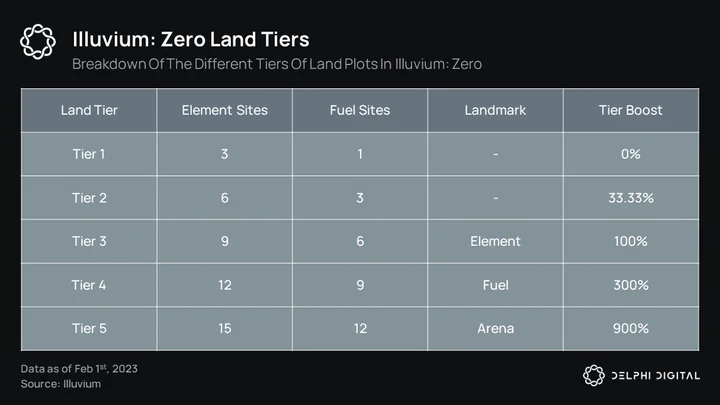
The first sale of 20,000 plots commenced on June 2nd, 2022 and lasted for three days. The NFT sale was conducted via a Dutch auction for tiers 1-4, with starting prices of 2 ETH, 6 ETH, 20 ETH, and 80 ETH, respectively, with prices dropping 2.5% per minute. This first sale also featured two tier 5 land plots that used an English auction format. Tiers 1-4 could be purchased with either ETH or sILV2 (tier 5 plots were only purchasable with ETH), and a total of 19,969 plots were sold, raising a reported $72M (4,018 ETH and 239,388 sILV2). It is important to note that sILV2 is awarded to stakers of the ILV token and can be used to make in-app purchases within the Illuvium ecosystem (alongside ETH and Fuel). By deducting land sales in sILV2, which were essentially free for ILV stakers, we arrive at a more accurate calculation of 4,018 ETH (~$7.2M at the time of the sale) for the actual revenue generated from the last land sale.
Some other interesting metrics from the sale include the fact that all sILV2 used to purchase land NFTs was burnt (2.39% of supply), and all ETH purchases will be converted into ILV and proportionally redistributed to ILV stakers. The lowest prices paid per tier were 0.3 ETH, 0.97 ETH, 3.67 ETH, and 13.6 ETH (tiers 1-4). Land plots are now trading at floor prices of 0.4 ETH, 1.1 ETH, 3.5 ETH, and 12.7 ETH for tiers 1-4, respectively.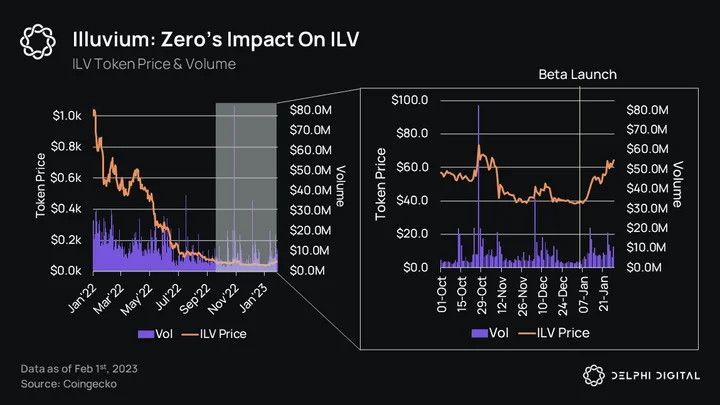
ILV is down more than 96% from the all-time highs seen in early December 2021. The downward pressure experienced throughout the year can be largely attributed to the overall market sentiment and is a trend shared by most gaming-related tokens. Interestingly, the Illuvium: Arena and Illuvium: Overworld betas had little impact on the token’s price. However, when we zoom in on
Read the full report
This report is part of Delphi Pro.
- 800+ Pro reports across every major sector
- Talk directly with our analysts
- Private community of funds and builders
Already a Pro member? Log in
0 Comments