


Introduction
On the surface, 2023 may seem like a pretty uneventful year for DeFi. The chaotic global macro environment and bloodbath of insolvencies from centralized entities in mid 2022 extinguished capital from on-chain finance. The collapse of FTX in Nov. 22 was a cruel final stroke, from which DeFi has been licking its wounds throughout 2023. But DeFi is far from dead.
In a vacuum, the DeFi sector performed well in 2023. Many tokens rallied over 100%, with few tokens registering a loss on the year. Pendle showed aspirations of becoming this bear market’s LINK/SPELL, turning in a 20X and resurrecting the forgotten yield stripping niche. 2023 gave us an expected yet inconclusive bounce off of 2022 lows.
The year was plagued by widespread lethargy as rising interest rates muted on-chain activity. DeFi had never experienced a rising rates environment before. The highest fed funds rate since 2001 proved an insurmountable hurdle for depressed DeFi yields. By and large, fundamentals were disconnected from price. There were rarely any injections of fresh capital or hype around a new project, token, or design.
2023 was a relatively quiet year for spot DEXs, and market share was understandably stable. Spot DEX volume made up ~8% of the top 5 CEXs. The biggest storyline involved the expiration of Uniswap V3’s BSL and a shift in focus towards the upcoming Uniswap V4. 2024 is shaping up to be much more eventful.
The area in which DeFi made the most progress is decentralized perpetuals. As discussed in our DYDX Valuation Analysis & DEX Perps Comparison, 2023 was the most eventful year yet for DEX perps. Rollups and appchains have allowed for a greater variety of orderbook protocols. dYdX v4 is transitioning to Cosmos appchain, Aevo is pioneering the OP rollup stack with a unique offering of pre launch markets, Vertex has pushed DEX UX to new heights, and RabbitX has come out of nowhere to bootstrap usage on Starkware. The peer-to-pool model transformed as well. Synthetix and GMX have implemented risk management measures establishing peer-to-pool as a truly viable perps model for the first time.
These breakthroughs have thus far failed to move the needle against CEX dominance. DEXs have a ~3% market share of the top 4 CEXs. The use of top 4 CEXs for comparison skews results in favor of DEXs. The all-in DEX market share is closer to 3% and 1% for spot and perps, respectively.
Given the tailwinds for DEXs heading into 2023 and the progress that was made, DEX perps’ lack of traction demonstrates DeFi’s apathetic atmosphere in 2023.
 Heading into 2024, the positive energy is palpable. There is volatility on the horizon and a slew of potential catalysts. It is clear that we have entered the Early Innings of a New Cycle. But even during broader market uptrends, DeFi has been treading water relative to other crypto sectors since its peak in Sep. 2020. DeFi has emerged on the other side of a three year bear market with new faces, new ideas, and a new meta.
In this report, we offer you a comprehensive briefing on the themes we believe will dominate the narrative in 2024, and will get you caught up to speed if you’re just tuning back in.
Theme 1: Competition Between LSDs and the Restaking Economy
Liquid staking has been widely implemented within various L1 ecosystems to make staking easily accessible. Protocols like Lido help enhance the liquidity of staked assets while allowing the underlying to continue earning rewards and providing economic security to the network.
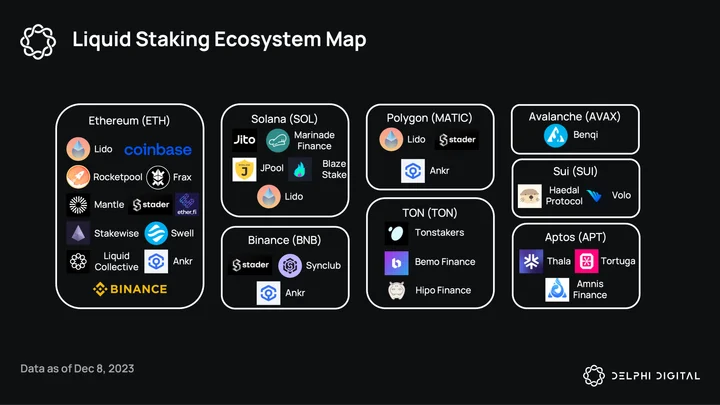 As the largest L1 blockchain, Ethereum presents a highly competitive environment with numerous protocols vying for market dominance. In contrast, other L1 ecosystems face less competition, with only a handful of protocols competing.
Protocols such as Lido, Ankr, and Stader, despite their expansion across multiple L1 blockchains, haven’t achieved significant market presence compared to native protocols on these blockchains. For instance, Lido’s success in the Ethereum ecosystem hasn’t been replicated in the Solana ecosystem, leading to a phase-out from Solana.
Here, we’ll focus primarily on the liquid staking landscapes in Ethereum and Solana — as these have seen the most substantial adoption and development — as well as the most important development across the staking landscape, restaking.
State of Ethereum Liquid Staking
Ethereum staking saw significant growth in 2023, primarily driven by the Shapella upgrade, which allowed for withdrawals from the Beacon Chain. The quantity of ETH staked rose substantially, from around 16M ETH at the beginning of the year to 28.6M ETH by December 2023, marking a year-to-date increase of 79%.
This represents a staking rate of 23.7% against the total supply of 120.2M ETH. As noted in our previous liquid staking report, staked ETH is gradually approaching the estimated target of 33.5 million ETH, or 27% of the total ETH supply, which is considered optimal for robust network security.
Furthermore, the adoption of liquid staking derivatives (LSDs) has also expanded, with ~44% of all staked ETH now in these protocols. This growth is fueled by yield-hungry ETH holders and the increasing utility of LSDs in DeFi. Liquid staked ETH is being deeply integrated into money markets and DEXs. We’ve also seen the emergence of aspiring L2s like Blast and Mantle leverage LSDs to offer native yield-earning opportunities for users.
The growth in Ethereum staking has shown signs of slowing, with the monthly ETH stakes experiencing a downward trend since May 2023. A notable spike in growth was observed around May 2023, coinciding with the implementation of Ethereum’s Shapella upgrade which allowed staked WTH to be withdrawn. This addressed the duration risks that previously existed and kept many ETH holders from staking their tokens.
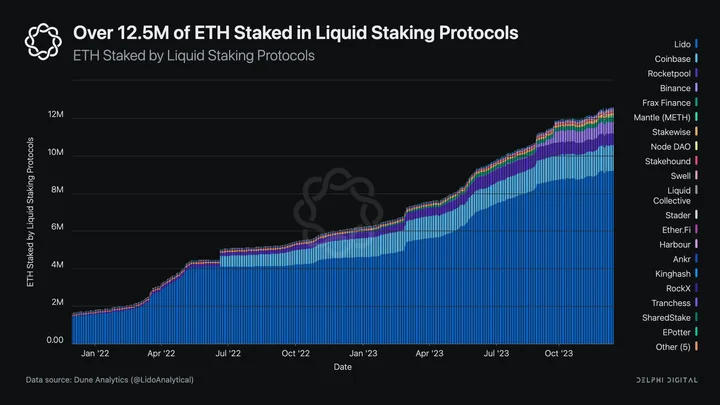
As of now, the amount of ETH in liquid staking protocols has reached over 12.5M, doubling from 6.25M at the beginning of 2023.
Lido stands as the predominant leader in this burgeoning market, with 9.2M ETH staked. This is followed by Coinbase’s cbETH, with 1.35M ETH, and RocketPool, which has 630K ETH staked. Lido maintains its market dominance and exhibits the most significant growth among these platforms, with an increase of 4.57M ETH, representing a 99% rise since the year’s start. In comparison, Coinbase and Rocketpool have seen 348K ETH (a 34.4% increase) and 294K ETH (an 88% increase) added respectively.
Lido remained resilient even as the competitive landscape expanded, underscoring its strong network effects via stETH integrations. The enhanced utility of stETH, compared to other LSDs, gives it a massive competitive advantage. Since most LSDs offer similar yields, stETH stands out due to its higher secondary market liquidity and broader utility in DeFi. This competitive edge is crucial since the underlying yield is similar, making liquidity and utility the key differentiators.
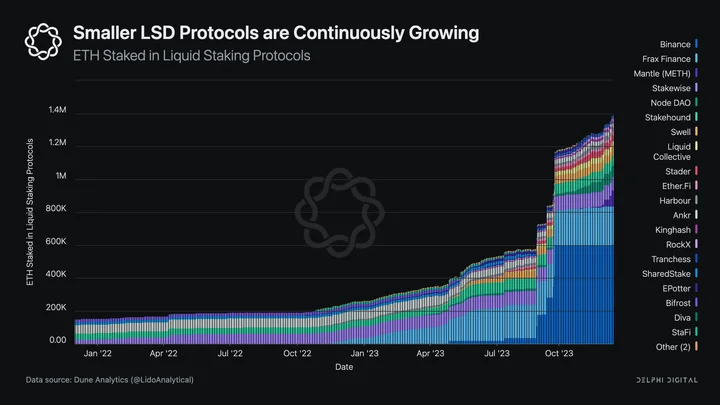
Excluding the major players like Lido, Coinbase, and Rocketpool, there have been developments from smaller LSDs in the Ethereum ecosystem:
- Frax has displayed steady growth, expanding from 38K to 233K ETH staked in 2023. Frax’s edge lies in its innovative sfrxETH design and integration within its ecosystem, notably in Fraxlend.
- Binance has been experiencing a significant influx of ETH into Binance’s bETH, likely from new stakers opting to stake directly through the centralized exchange.
- Mantle has leveraged its protocol-owned ETH to bootstrap its mETH offering. The mETH from the protocol is intended to generate yield for Mantle and facilitate liquidity on DEXs.
- Emerging protocols in the liquid staking space have struggled to capture significant market share, often not exceeding the 100K ETH mark. Notable examples include ether.fi and Swell, which have introduced various incentives for stakers.
- Ether.fi and Renzo are new projects implementing liquid native restaking on EigenLayer, allowing ETH to earn multiple forms of yield, including native points and EigenLayer points.
The liquid staking market on Ethereum is highly competitive and saturated, making it challenging for new, non-CEX-affiliated LSDs to gain substantial market share. The absence of strong network effects and limited adoption in DeFi ecosystems are significant hurdles. To succeed, these protocols must not only offer innovative features to attract depositors but also strive to integrate their LSDs into established DeFi protocols like Aave to gain traction.
LSDfi
As liquid staking brought in a new wave of innovation to the DeFi product stack, LSDfi started to cement a story as the shiniest new thing. However, many of these projects lost traction as their incentive-driven high yields compressed. Select few, like Prisma and Lybra, seem to be finding their footing as liquid staking centric DeFi legos.
The total value of LSDs held across DEXs, CDP protocols, and lending protocols has reached $7B. This growth has occurred in tandem with the expansion of LSDs, fueled by the increasing availability of DeFi applications.
Distinct leaders have emerged within each sector of LSDfi: Curve dominates the DEXs, MakerDAO is at the forefront of CDP protocols, and Aave leads in the lending category.
Given that stETH from Lido holds the majority market share among Ethereum LSDs, it’s expected that stETH constitutes the bulk of the TVL in LSDfi activities. On the other hand, frxETH from Frax, despite having a smaller supply, boasts a higher TVL in DeFi compared to rETH.
This can be attributed to two main factors, Frax’s influence in Convex which allows them to direct incentives towards frxETH and deepens frxETH liquidity and its integration within Fraxlend. These aspects provide frxETH with a distinct advantage over other LSDs, offering it greater utility and making it a more competitive option in the DeFi space.
Overall, it’s difficult to expect any material changes to the core liquid staking landscape on Ethereum. Lido will probably continue to enjoy the lion’s share of the market, while other protocols vie for what remains. There is one major development that will undoubtedly change the Ethereum staking landscape over the next year or so — restaking.
Restaking: The Biggest Staking Development of 2024
EigenLayer is a protocol that expands the utility of staked ETH by using it to not only secure Ethereum, but also other pieces of infrastructure like bridges, appchains, rollup sequencers, and data availability networks. It is essentially an external protocol that rehypothecates staked ETH and utilizes the underlying economic value to help secure a third-party network — commonly called Actively Validated Services (AVS).
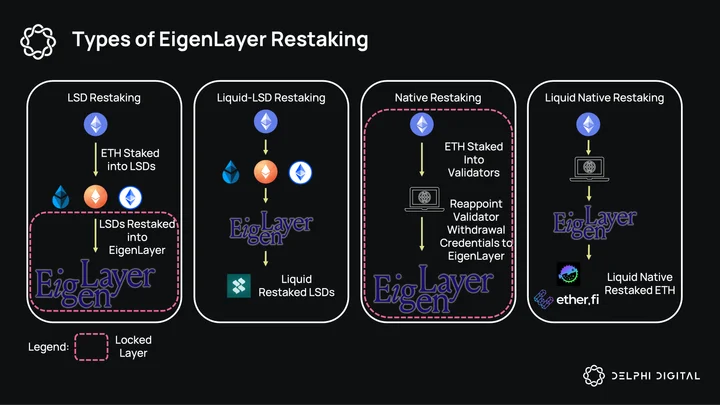 EigenLayer offers two primary restaking options – LSD restaking and native restaking. The current landscape of EigenLayer restaking can be categorized into four distinct types:
- LSD Restaking (EigenLayer Native): This involves depositing an asset like stETH into the EigenLayer smart contract, thus enabling them to be used for restaking.
- Liquid-LSD Restaking: Targeting the locked layer of LSD deposits in EigenLayer smart contracts, protocols like KelpDAO aim to unlock liquidity for restaked LSDs. This approach allows depositors to enjoy greater liquidity and provides the flexibility to exit restaking by swapping out their positions. However, this is currently constrained by EigenLayer’s LSD deposit limits.
- Native Restaking (EigenLayer Native): For restaking staked ETH on the Beacon Chain, validators need to redirect their validator withdrawal credentials to EigenLayer. This is done through an EigenPod smart contract, which manages the balance and withdrawal status of validators.
- Liquid Native Restaking: Differing from LSD restaking, which depends on the underlying LSD, liquid native restaking offers a comprehensive service encompassing both staking and restaking of ETH. This model is advantageous for protocols as EigenLayer doesn’t impose limits on native restaking amounts. Protocols adopting this method can also accrue fees from the staked ETH, making it a potentially more profitable option.
EigenLayer has quickly garnered traction, evidenced by how quickly the deposit caps fill up. There are currently $250M of LSDs restaked with EigenLayer as of Dec. 17 (before the deposit cap was increased).
At the current moment, restaking ETH through EigenLayer does not introduce additional risks associated with securing other applications. Realistically, it simply presents an attractive opportunity to earn EigenLayer points for a potential airdrop in return for bootstrapping the protocol’s managed asset base.
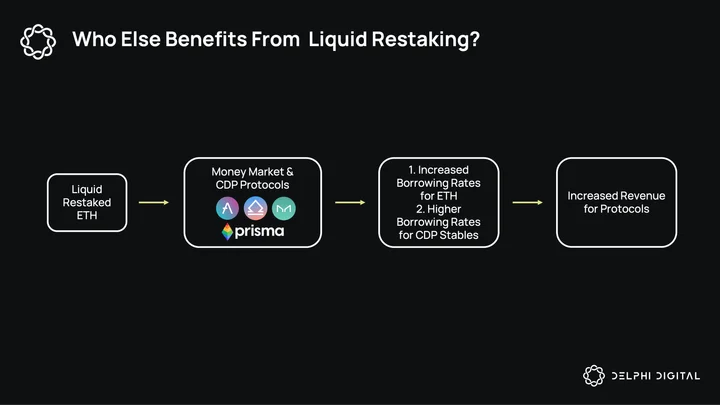 As liquid restaking cements its role in the market, money markets and CDP protocols stand to benefit from it. Liquid restaked ETH, offering higher yield rewards than traditional staked ETH, positions these protocols advantageously to impose higher borrowing fees.
As we’ve seen from stETH, where users looped by lending stETH and borrowing ETH to stake, the same can happen for liquid restaked ETH.
MakerDAO has been consistently increasing borrowing rates for ETH over 2023 as LSD yields subsidize the net cost of loans. With liquid restaked ETH pushing ETH yields higher, it is likely that CDP protocols will be able to capture part of it through higher borrowing fees.
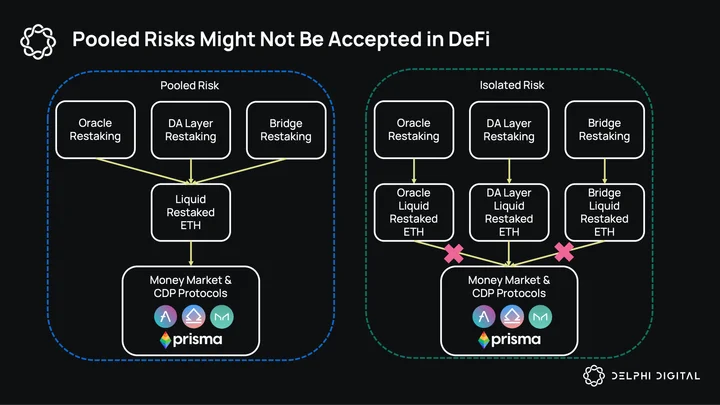 However, as each restaked layer offers a differing risk profile, this presents a nuanced challenge for DeFi protocols, particularly concerning their willingness to integrate certain types of liquid restaked ETH exposed to pooled risks. For instance, bridges have been notably vulnerable to exploits and have suffered significant financial losses; protocols may be hesitant to adopt liquid restaked ETH with exposure to bridges.
Protocols might be more inclined to include liquid restaked ETH that has siloed exposure towards networks they perceive to have lower risk, as this would minimize the chance of a large slashing event. A cautious approach is required when considering integrating liquid restaked ETH, especially as restaking goes live and more AVS allocation strategies launch.
However, this differentiation in risk profiles could result in a future where not all restaked ETH assets are perceived equally, leading to a fragmentation not only in how these assets are implemented across various DeFi protocols but also in their liquidity. Such a scenario could create a complex landscape, where the value and utility of restaked ETH vary significantly based on their associated risks.
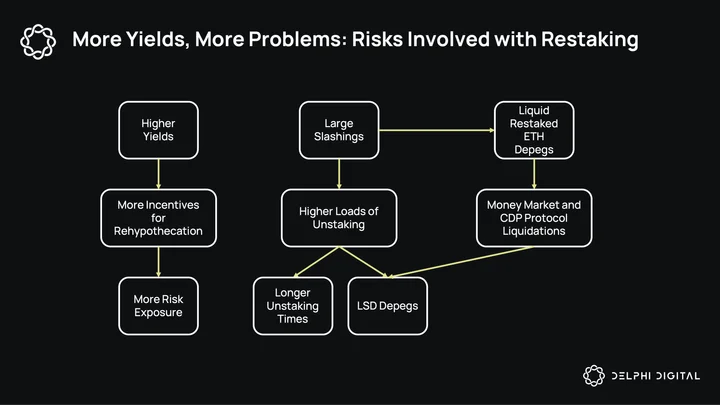 Restaking carries larger risks that could have significant implications for the overall industry. One key concern is the allure of higher yields, which might encourage the rehypothecation of ETH to riskier networks in the chase for higher yields.
A substantial slashing event could lead to an increased volume of unstaking requests, resulting in prolonged unstaking times. If liquid restaked ETH becomes a large source of collateral in DeFi, an event like this is almost certain to cause carnage.
As the staking withdrawal queue expands, people will rush for the gates via secondary markets, which could lead to substantial depegging event. Users who have levered up against their restaked liquid ETH likely get liquidated, and with secondary market liquidity drying up, this would result in bad debt for money markets.
The possibility of a tail event causing widespread issues across the ecosystem could be significant deterrent to the widespread adoption of liquid restaked ETH within DeFi. This risk is particularly pronounced in designs that involve pooled risks.
Given these considerations, the adoption of liquid restaked ETH in money markets should lean towards isolated pools to silo any risk.
Solana Staking: An Eye to the Future
In 2023, Solana’s liquid staking market initially saw Marinade as the dominant player. However, as the year progressed, particularly in Q4, Jito emerged as a strong competitor. Jito managed to attract a substantial number of stakers, partly through the distribution of Jito points, which eventually led to a significant airdrop event. The lowest tier of users were given 4931 JTO tokens each, which is estimated to be worth ~$10K on the day of airdrop.
Another noteworthy protocol is BlazeStake, a relatively new entrant offering token-incentivized rewards for staking. This strategy has been successful in providing bSOL holders with additional yield opportunities.
In Solana’s LSDfi ecosystem, we see a similar story, where money markets dominate. Platforms like Solend and Marginfi have become central hubs for LSD activity. Marginfi and Kamino recent growth can be partly attributed to users engaging with the protocol in hopes of an airdrop.
Solana LSDs have low liquidity on DEXs. Despite that, they usually have an extremely high turnover, resulting in organic yields from swap fees. However, this liquidity is incentivized by token rewards, which can be expensive over time. Furthermore, when holders actively sell in the markets, this can lead to a depeg as seen recently with mSOL.
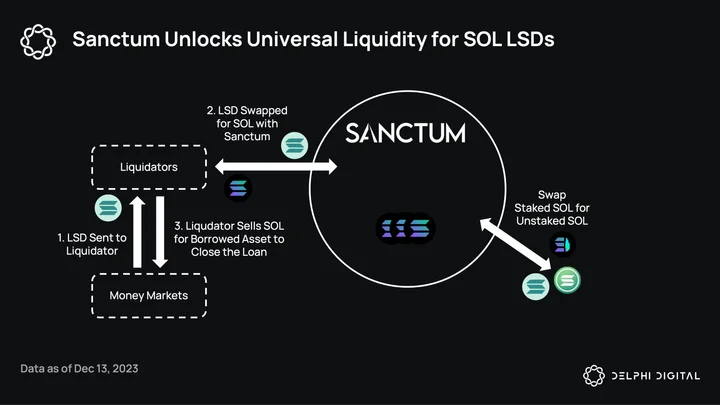 Sanctum, formerly known as unstake.it offers a novel solution for providing immediate liquidity to any liquid-staked SOL. This platform enables users to exit their staked positions at any time, without having to wait for the end of an epoch. The process involves users transferring their staked SOL to Sanctum, in return for unstaked SOL from the pool, incurring minimal swap fees. This approach offers instant pooled liquidity for all staked SOL, as opposed to the fragmented liquidity often seen across multiple SOL LSD stableswap pairs.
Sanctum’s system also plays a crucial role in facilitating a more liquid environment for handling liquidations related to SOL LSDs on money market protocols. With the current DEX liquidity, it is evident that there is insufficient liquidity to uptake larger swap amounts. Sanctum unlocks deep liquidity for such liquidations until all unstaked SOL in its pool is utilized. Subsequently, Sanctum will unstake the corresponding LSDs to replenish the SOL pool, ensuring a continuous and efficient liquidity cycle.
As mentioned in our Infrastructure Year Ahead report, “this has the potential to be a massive unlock for Solana DeFi as all LSTs could be added to DeFi protocols without a vigorous underwriting process. Most of the reason why LSTs are winner take most is because the moat they get from on-chain liquidity. With Sanctum, they are willing buyers of any LST, for a fee. This would also reduce contagion
Read the full report
This report is part of Delphi Pro.
- 800+ Pro reports across every major sector
- Talk directly with our analysts
- Private community of funds and builders
Already a Pro member? Log in



0 Comments