Chapter 1: What are Ordinals & BRC-20s?
1. Introduction
2023 went down as one of the most transformative years in Bitcoin’s history. Having a reputation of being a stagnant network, Bitcoin experienced an exciting technological revolution with the emergence of inscriptions.
Colloquially known as Ordinals, the development of this new technology led to an entirely new market. The market quickly adopted Ordinals with the sector reaching a market cap of over $1.8 billion through a vibrant ecosystem of digital artifacts, metaprotocols, and emerging token standards such as BRC-20.
The once ossified Bitcoin network is now a relic of the past as bitcoin incorporates exciting new functionality. But what exactly are inscriptions, and what is their value proposition? How do Ordinals and BRC-20s function? Most importantly, how can you immerse yourself and take part in this ecosystem?
2. Jargon Demystified
One of the most confusing parts of crypto is the jargon – truly a maze of unfamiliar slang. To cut through the confusion, all crypto-native terms are written in italics and either explained immediately or defined in the glossary.
Chapter 2: A Closer Look
1. Technology Overview
Satoshis
Before diving into Ordinals, we need to understand its basis: Satoshis.
Satoshis, often abbreviated to “Sats”, are the lowest denomination of Bitcoin. One Bitcoin is always equivalent to 100 million Sats and vice versa, 100 million Sats always make up one Bitcoin. The name is derived from the anonymous creator of Bitcoin, Satoshi Nakamoto.
The maximum supply of Bitcoin is hard-capped at 21 million, and therefore the maximum supply of Sats is hard-capped at 2.1 quadrillion Sats.
Why do Sats exist?
Sats are the native currency of the Bitcoin Network. As such, they are used to pay for transactions and due to its low denomination enable small payments.
Not all Sats are created equal!
There are several recurring events resulting from key mechanisms hard-coded into Bitcoin’s technology. These recurring events offer a simple way to categorize Satoshis by creating a system of rarity:
| Event | Frequency | Definition | Sat Type |
| New Block | Approx. every 10 mins | A new bitcoin block is mined and block rewards are paid out in bitcoin. Sats are created in the order of mining. | Common sat: Any sat in a block other than the first.
Uncommon Sat: First sat of each block. |
| Difficulty Adjustment | Approx. every 2 weeks / 2016 blocks | The Bitcoin network adjusts the difficulty target that accepted blocks must meet by changing the hashrate. | Rare Sat: First sat after each difficulty adjustment. |
| Halving (next in late April) | Approx. every 4 years / 210,000 blocks | The amount of Bitcoin mined with every block is halved. | Epic Sat: First sat after each halving. |
| Conjunction | Approx. every 24 years | Every 6 halvings the difficulty adjustment and halving event occur at the same time called a conjunction. The time between conjunctions is defined as one cycle. | Legendary Sat: First sat after a conjunction occurs / cycle starts. |
| Genesis Block | Once | The first Bitcoin block ever mined is called the Genesis block. | Mythic Sat: First sat of the Genesis block. |
Ordinal Theory: The Value Proposition.
How do we track rare Sats?
This is where Ordinal Theory, introduced by Casey Rodarmor, a former Bitcoin Core contributor, comes into play. On a higher level, Ordinal Theory is concerned with giving each Satoshi a unique identifier.
Simplified, the theory proposes a numbering scheme for Satoshis assigning each Sat a unique number based on the order it was mined. This allows for tracking, transfer, and collection of Sats opening up a whole new market for trading based on rarity.
Inscriptions: The Birth Of Ordinals.
In 2021, Bitcoin received a key upgrade called “Taproot” designed to help the network scale. Casey Rodarmor pioneered a unique way of using some of taproot’s capabilities to embed data on the bitcoin blockchain, specifically on satoshis. Inscriptions were born. An inscribed Sat is now commonly referred to as an Ordinal.
An easy way to conceptualize Ordinals is by imagining someone scraping artwork into a penny. The owner can still spend that penny if they’d like, but the artwork will forever be etched on its surface. Inscriptions work the same. Once someone has tied data to a single Sat, they can then spend that Sat transferring the associated data with it.
With the newfound ability of tracking and identifying Sats using Ordinal Theory, the craze to inscribe arbitrary data into Sats started and a completely new ecosystem was born.
Total inscriptions surpassed 60m in early February, showcasing the booming ecosystem.
The arbitrary data inscribed on Sats can include pictures, gifs, videos, and even HTML code. The only limit on the data is bitcoin’s block space limit of 4MB. It’s important to note that each inscription costs a fee, just like any other transaction made on the Bitcoin network. The transaction fee paid to inscribe Sats is typically more expensive the larger the file.
NFTs vs. Ordinals
Ordinals with inscribed pictures resemble NFTs on Ethereum. So, people started calling them Bitcoin NFTs. Although parallels between the two exist, Ordinals have 4 distinct differences from NFTs:
- Ordered: Ordinals are inscribed Sats and Sats are numbered in the order by which they were mined. Unlike NFTs, each Sat is therefore truly ordered.
- Limitations: As briefly mentioned, there is a significant bottleneck when it comes to inscribing Sats. Bitcoin blocks are capped at 4MB putting a cap on the amount of data that can be inscribed on all Sats per block. However, smart contract based NFTs are theoretically subject to no significant data limit.
- On-Chain: Ordinals are stored fully on-chain, meaning inscriptions on Sats exist on the ledger forever and are immutable. Unlike the metadata of NFTs which is often stored on a centralized server. If that server shuts down, the path of the NFT is lost and points to nothing.
- Concurrency: Sats can be inscribed with multiple files. Since inscriptions can be any arbitrary data, unique digital artifacts are created. For instance, a Sat could be inscribed with HTML code pointing to different files on the same Sat. This functionality of internal hyperlinks gives an inscribed Sat similar characteristics to a traditional webpage.
Mempool
Before interacting with applications supporting Ordinals it’s crucial to understand the ramifications of Bitcoin’s mempool.
Bitcoin transactions are not directly added to the Bitcoin blockchain. Instead, transactions enter a queue, called the mempool. All valid transactions sit in this waiting area before being verified and included in a block, a process that takes approximately 10 minutes. When the chain is busy, numerous transactions enter the mempool and miners struggle to add them quickly, which causes congestion and slower transaction times. The result: increased transaction fees.
Bitcoin miners receive transaction fees as a reward for verifying and adding transactions to the blockchain. Users have the option to select the transaction fee for each transaction. To encourage miners to prioritize their transactions, users can increase the transaction fee. The higher the fee offered to miners, the greater the incentive and, consequently, the higher the priority within the mempool.
Below is a screenshot of the mempool explorer.
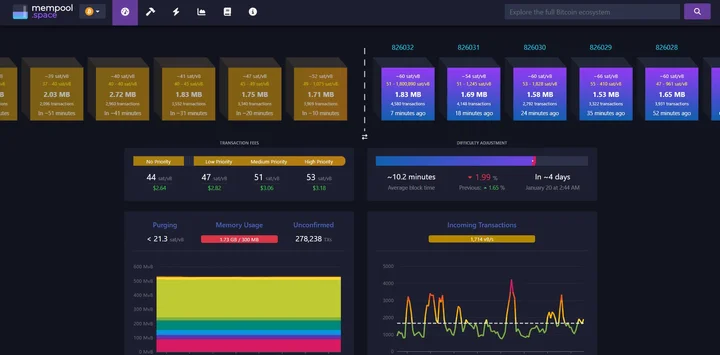
Here, you can check several metrics such as current gas fees, block height, and the average block time. The mempool block explorer also projects a visual of the bitcoin blockchain with pending blocks in orange and confirmed blocks in blue and purple. At the top right, you can paste any transaction ID or wallet address to gain additional insights, precisely where your transaction is sitting in the queue and what tokens a specific address holds. Overall, the mempool is a great crux to track transactions when interacting with apps.
2. BRC-20: A New Token Standard
Not long after Ordinals emerged, the X user redphone first conceptualized a new token standard. Domo executed on this idea and designed the novel token standard: BRC-20s. BRC-20 inscriptions quickly caught on and started to dominate the vast majority of transactions related to Ordinals.
BRC-20s are Ordinals inscribed with JSON data enabling the creation and transfer of tokens. Exactly three token functions exist: deploy, mint, and transfer. Ownership is proven by the latest receipt of token transfers. In practice, wallets and other Apps read these receipts and assign BRC-20 balances to the address owning the receipt.
The very first BRC-20 token contract created by Domo was $ORDI. Originally, batches of 1,000 ORDI were minted for an inscription fee of $5. Recently, the market capitalization of $ORDI surpassed $1.4 billion, and tokens currently trade at $67.72! This means if someone minted an original stack of 1,000 ORDI for $5, it is now worth over $67,000.
Interested in learning more about the intricacies of BRC-20 tokens? Check out these deep-dives from Delphi Digital:
Chapter 3: How to get Started
1. How to create a Bitcoin Wallet that supports Ordinals.
Wallet Installation
The first order of business is creating and funding a Bitcoin wallet. A Bitcoin wallet stores your Sats & Ordinals and enables interaction with various applications.
The most important aspect here: your wallet must integrate a separate address for Ordinals or have the ability to freeze inscribed Sats. As mentioned earlier, Sats are the native currency for the Bitcoin Network and used to pay for transactions. Ordinals are simply inscribed Sats. This poses the risk of accidentally using your precious Ordinal Sats to pay for transaction costs.
Therefore, a wallet supporting two addresses or with the ability to freeze sats is strongly recommended to avoid risking the loss of your inscribed sats.
The two leading wallets supporting this tech are Unisat and Xverse. Unisat offers better interoperability with more applications, while Xverse is more user-friendly. The choice is yours! For the following tutorials, we used the Xverse wallet.
Installing your Bitcoin wallet.
Visit the Xverse webpage. The Xverse wallet is available as a mobile app or browser extension. To efficiently interact with apps later, the browser extension is recommended. To install the browser extension, click on download and add the extension to Chrome.
Creating your Bitcoin wallet.
Once installed, click on the icon under browser extensions and on “Create Wallet”. Each new wallet generates a unique seed phrase, typically consisting of 12 words.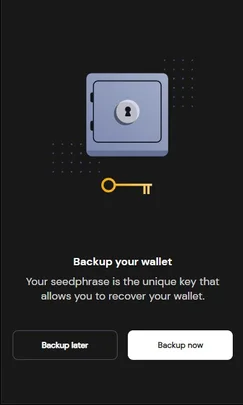
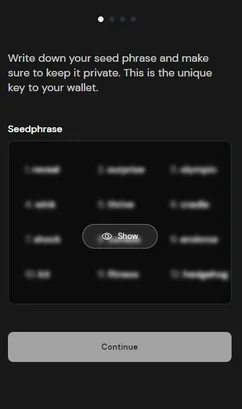
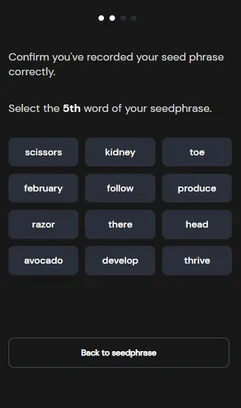 This is your wallet key. It allows you to recover your wallet. Keep it safe! Anyone who may have access to your seed phrase can gain complete access to your wallet and assets. Generally, it’s recommended to write the seed phrase down physically versus storing it electronically to avoid unauthorized access caused by compromised devices.
After backing up your seed phrase, confirm you have stored it by selecting the correct words.
Finally, create a safe password. This is used every time you want to access the wallet from the browser extension.
Navigating your Bitcoin wallet.
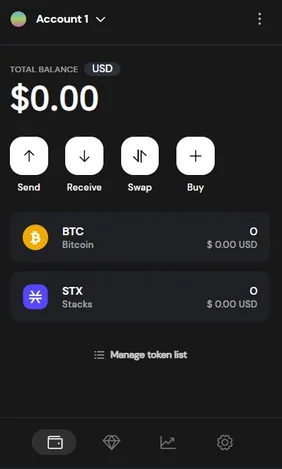
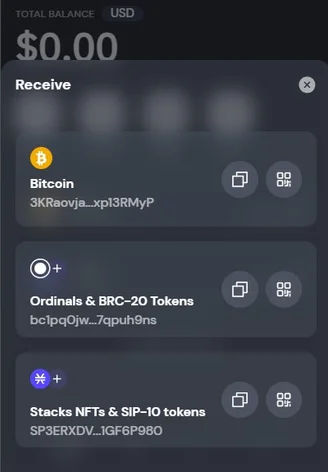
Your wallet displays your token balances and allows you to send, receive, swap, and buy tokens. In settings, you can access your seed phrase and change the display currency. For now, our token balances are all zero.
When clicking on “Send” or “Receive”, your wallet displays three different bitcoin addresses. Your addresses are similar to bank account numbers and must be provided when sending or receiving funds. Here, Xverse’s user friendliness comes in handy.
The first address is your bitcoin address and should always be used for funding your wallet. Your bitcoin is stored here and used to pay for transactions. Never use this address to manually receive Ordinals or BRC-20 tokens to avoid spending ordinal Sats on transaction costs.
Your second address is for Ordinals & BRC-20 tokens only. When deploying and minting inscriptions, Xverse automatically ensures that Ordinals and BRC-20 tokens are sent to this address. However, if you engage in peer-to-peer transactions make sure you provide this address to receive Ordinals and BRC-20s.
Your third address is for Stacks NFTs & SIP-10 tokens, which are beyond the scope of this guide.
Funding your wallet.
Your wallet can be funded in several different ways:
- Buying Bitcoin directly from your wallet: By clicking on the “Buy” symbol, you can purchase bitcoin directly via third parties like Moonpay or Transak. These on-ramps enable you to buy bitcoin using a debit or credit card. Please note that using third parties always introduces additional risks.
- Sending Bitcoin from a centralized exchange: If you use centralized exchanges such as Coinbase and Robinhood, funding your wallet directly from your account is your best bet. Even if you do not have an account yet, creating one may be beneficial to avoid additional risks introduced by using other funding options. When sending bitcoin, provide your bitcoin wallet address. Transactions typically take approx. ~10 mins to confirm.
- Bridging funds from a different network: If you are a crypto native and already have wallets on networks like Ethereum, you can bridge funds from one of your existing wallets. Please be aware that bridging funds introduces a plethora of security risks, counterparty risk and smart contract risk to name a few. Do your own research before using any of these applications!
If you want to interact with any of the apps listed below, we recommend only using small amounts until you are comfortable with the process.
Chapter 4: Guide to Ordinals & BRC-20s Ecosystem
Although the Ordinals ecosystem is still relatively young, there are several applications supporting trading for Ordinals and BRC-20 tokens. Here’s a list of a few applications worth checking out:
1. OKX, Unisat, and Magic Eden – Ordinals Marketplaces.
Ordinal marketplaces facilitate the purchase, sale, and exchange of Ordinals and BRC-20s. Through these platforms, you can effortlessly list your Ordinals and BRC-20s tokens for sale and explore diverse collections for purchase. Additionally, these marketplaces frequently allow users to deploy, mint, and transfer inscriptions.
The top 3 marketplaces by volume and transactions are OKX, Unisat, and Magic Eden. While OKX currently leads this race, it limits some functions to users with native OKX wallets only. On the other hand, Unisat and Magic Eden offer more user-friendly UXs.
Quick Recommendations.
Although you can trade Bitcoin NFTs on these marketplaces, Ordinals Market and Ord.io cover a wider range of NFT collections and are great tools to track trending collections of the past 24h, 30d, 90d, etc.
2. Ordinals Bot – Deploying, Minting, and Transferring Ordinals.
One of the easiest ways to create inscriptions and deploy any type of Ordinal is the OrdinalsBot app. With the integrated API users can generate inscription orders at scale, which is especially handy when creating entire collections. Payments for API services can be made with lightning or on-chain Bitcoin.
All types of inscriptions are supported and additional functionality includes inscribing onto specific satoshi types, such as inscribing on uncommon sats only.
3. Magisat – Rare Sats Marketplace.
Magisat is a marketplace specifically for trading rare Sats. You can trade, buy, and sell Satoshis covering any rare and exotic Sats such as pizza Satoshis. Pizza Satoshis are infamous amongst the bitcoin community related to a historic purchase of 2 pizzas in 2010 for 10,000 Bitcoin.
Additionally, Magisat lets you scan any Sats in your wallet for rarity.
4. Ordinalhub – Aggregator & Analytical Tool for Ordinals.
Ordinalhub is an aggregator, a tool that compiles Ordinals listings from different marketplaces, providing a clear overview of trends, recent sales, and floor prices. This streamlines trading by helping users find best prices, especially since tokens and collections can vary in value across different platforms.
5. Liquidium – Borrowing & Lending featuring Ordinals.
Liquidium is one of the first apps supporting decentralized finance, short DeFi, for Ordinals. The protocol enables peer-to-peer borrowing and lending for Bitcoin using Ordinal inscriptions as collateral.
Top loan markets currently include NodeMonkes, Bitcoin Frogs, and RSICs.
6. Alex Go – Advanced DeFi.
With over $800m in total transaction volume and $122m in TVL, AlexGo is one of the leading protocols for DeFi on Stacks, a Bitcoin L2. The application offers support for Ordinals with four apps:
Native decentralized exchange using automated market makers, AMMs, to facilitate swaps between various Bitcoin assets.
Native trading app supporting trading for BRC-20 tokens using an orderbook.
Launchpad for various projects including Ordinals and BRC-20s.
Application enabling bridging for Bitcoin, BRC-20s, and EVM-compatible networks.
Chapter 5: Development Highlights
1. Recursive Inscriptions
One of the first breakthrough developments in the realm of inscriptions was the introduction of recursion. Recursive inscriptions first gained traction in June 2023 and recently total recursive inscriptions surpassed 350,000.
On a higher level, recursive inscriptions allow new inscriptions to call and reference data from already existing inscriptions. This may sound boring but has far-reaching implications!
For one, recursion offers a practical way to circumvent the 4 MB limit imposed by Bitcoin blocks. By splitting up the data over several inscriptions in different blocks that reference each other, large files can now easily be uploaded to the Bitcoin Network. Two other main benefits of recursion are improved storage efficiency and reduced transaction costs.
Most importantly, recursion was the genesis for a plethora of developer tools. With recursion, code repositories were able to be built with inscriptions. As a result, Ordinals truly reached the next level of optimization. For example, high quality NFT collections on Bitcoin can now be created using recursion as it enables creators to leverage existing repositories on inscriptions. Creators can aggregate inscribed traits for collections streamlining the creation of thousands of unique NFTs. No need to inscribe a collection of thousands NFTs individually ever again.
2. Alternative Token Standards
With only three inherent functions (deploy, mint, and transfer), BRC-20 tokens are not only limited in capabilities but also static in development. Naturally, new experimental token standards aiming to be improved versions of BRC-20 have emerged. Here’s a quick spotlight of two current alternatives:
Named Cybord, the CRBC-20 token standard takes advantage of the fact that Inscription envelopes can now store arbitrary data directly. As a result, the cost for inscriptions is drastically reduced and the indexing process vastly simplified, making CRBC-20s a cheaper and faster alternative to BRC-20s. A Deep Dive can be found here.
Like CRBC-20, ORC-20 addresses the limitations of BRC-20 and is focused on enhancing security and flexibility. Unlike BRC-20, ORC-20 supports a wider array of data formats, allows transaction reversals, and has backward compatibility with BRC-20. Additionally, ORC-20 is significantly cheaper by running reusable inscriptions saving transaction fees. A comprehensive guide to ORC-20s can be found here.
Chapter 6: The Road Ahead
1. Key Takeaways
In early 2023, Bitcoin experienced significant developments centered around Bitcoin inscriptions creating immutable digital artifacts: Ordinals and BRC-20s tokens. Despite its immaturity, the emerging Ordinal sector is now valued at over $1.7 billion and undoubtedly revolutionized Bitcoin by enabling users to store diverse data on a Bitcoin Sat.
The ecosystem currently encompasses centralized and decentralized exchanges, marketplaces, a popular token standard, and protocols building upon its technology. Being in its early innings, speculation and enthusiasm are high amongst Ordinals proponents with new token standards emerging and even DeFi applications taking first stabs at the financialization of Ordinals.
Additionally, Spot Bitcoin ETFs have recently been approved marking a milestone in institutional adoption. Although long term consequences are disputed, the Ordinals & BRC-20 ecosystem is poised to benefit from widespread adoption and growing demand for Bitcoin.
2. Future Outlook
Albeit a booming ecosystem, skepticism persists, and select groups of Bitcoiners advocate for developers to eliminate Ordinal technology and its associated elements. Although being multi-faceted, this criticism stems from drawbacks of the technology itself and effects on the Bitcoin network seeing inscriptions as vulnerabilities.
Covering this discourse in detail is outside the scope of this guide. However, it’s important to acknowledge that Ordinals and BRC-20 transactions led to an explosion in Bitcoin blockspace demand which can have negative effects on Bitcoin’s network health. A congested mempool resulting in unreasonably high transaction fees and confirmation times is just one negative consequence. On the other hand, inscriptions are an important source of revenue for struggling miners securing the network. The upcoming Bitcoin halving, approximately taking place in late April 2024, will shake up this debate even further when block rewards for miners are cut in half.
Although the future of Ordinals and BRC-20s may be uncertain, developments around the ecosystem continue at feverish levels. Hopefully, this guide not only piqued your interest but encouraged you to explore the world of Bitcoin Ordinals further. To keep your curiosity alive and point you towards potential avenues for personal research, here are two noteworthy upcoming developments worth keeping an eye on:
Trac Network: Pioneer of Decentralized Indexers.
For Ordinals to work, Ordinal indexers are needed. Without digressing into technical intricacies, it’s useful to understand that Ordinal and BRC-20 transactions are ordered through off-chain indexing of onchain data. This enables identification, tracking, and sorting of Ordinals in the first place, meaning indexers are crucial infrastructure.
To exchange inscriptions between two parties, both entities must run the same indexer. Currently, the vast majority of projects is using the ord indexer to avoid compatibility issues which makes this vital piece of infrastructure very centralized. Reliance on a single indexer introduces severe technology risks, and several protocols are working on building viable competitors. One of them being Trac Network.
Trac Network’s core product is Trac Core. The value proposition: A decentralized and open-source indexer. The decentralized aspect is introduced with the governance token $TRAC. Meaning, $TRAC holders will be able to influence the direction and govern the development of Trac Core by voting on key developments.
$TRAC currently trades at a price of $4.65 with a market cap of $97m. That being said, the decentralized indexer has not been fully released yet.
For more information, check out this Alpha Feed post “Many Words On Trac Network”.
Rune: Fungible Token Protocol.
Casey Rodarmor, the creator of Ordinal Theory, is working on a fungible token protocol with an estimated release date for April. Called Rune, this new fungible Bitcoin token protocol is based on the Ordinals tech stack and aims to solve many issues inherent with the current BRC-20 token standard. For instance, tokens created with the Rune Protocol will not require off-chain infrastructure eliminating many points of contention with BRC-20.
Since it is being built by the same person that proposed the Ordinal Theory, speculation surrounding an official token release for Ordinals is prevalent. Such a token standard may have real potential to dethrone and replace BRC-20s.
Aaron summarized the latest podcast about Rune by Casey Rodarmor here, a goldmine of alpha.
Glossary
- Aggregator: Aggregators integrate with various marketplaces or exchanges to combine and display all offerings in one platform. By using an aggregator, users can efficiently identify best price rates.
- Automated Market Makers (short AMMs): AMM are algorithms facilitating decentralized trading of digital assets. On a higher level, AMMs automatically swaps assets by using liquidity pools, a smart contract containing two or more cryptocurrencies.
- Bitcoin Halving: The Bitcoin halving is a pivotal mechanism built into Bitcoin’s core design. Approx. every four years, the block reward is halved to control supply, scarcity, and inflation of Bitcoin. Miners, securing the network by solving complex math equations, are rewarded for verifying the state of Bitcoin with block rewards. After every halving, the reward for miners is cut in half.
- BRC-20: BRC-20 is a token standard designed for the generation and administration of fungible tokens within the Bitcoin blockchain. It leverages the Ordinals protocol for data inscription and is a type of Ordinal.
- Bridging & Bridges: Bridges in crypto are applications that allow users to swap assets between two different networks. Bridging therefore refers to transferring assets across networks.
- Decentralized Finance (short DeFi): Decentralized finance refers to applications leveraging blockchain technology to offer financial services without the need for an intermediary. DeFi allows you to trade assets, earn interest, borrow, lend, and much more without requiring a third party.
- EVM-compatible: EVM stands for Ethereum Virtual Machine, the computation engine for the Ethereum network. It controls the state of the network and enables smart contracts to function. EVM compatibility refers to the ability of networks or protocols to write and deploy code that is compatible with the Ethereum Virtual Machine
- Floor Price: The floor price refers to the lowest price at which an asset is listed and therefore the cheapest price it can be acquired.
- Governance Token: Governance token are cryptocurrencies with the distinct utility of granting holders the right to participate in the decision-making process of a project. This typically entails voting on governance proposals that influence the trajectory of development.
- L2: L2 is short for Layer 2 and refers to a network built on top of a Layer 1, such as the Bitcoin network. Generally, L2 networks exist to introduce enhancements and extend capabilities of the underlying blockchain such as lower transaction fees.
- Ordinals: Ordinals are specific sats inscribed with arbitrary data on Bitcoin. Data can include text, pictures, videos, gifs, audio, and even code.
- Satoshis (short sats): Satoshis, often abbreviated to Sats, are the lowest denomination of Bitcoin. One Bitcoin is equivalent to 100 million sats. The name is derived from the anonymous creator of Bitcoin, Satoshi Nakamoto. Used to pay for transactions, Sats enable small payments. The maximum supply of Bitcoin is hard-capped at 21 million, and hence the maximum supply of Sats is hard-capped at 2.1 quadrillion sats.
- TVL: TVL stands for Total Value Locked and is a common metric used in crypto to define the total value of digital assets locked in applications.
Special thanks to Redphone and Gutz for their valuable feedback and contributions to this report.
0 Comments