zkVerify Memo: Integration Flow, Potential Markets, and Token Economics
APR 11, 2025 • 22 Min Read

Report Summary
Summary of “zkVerify Memo”
The report explores zkVerify, a Layer-1 blockchain optimized for Zero-Knowledge Proof (ZKP) verification. It highlights zkVerify’s role in reducing verification costs, improving scalability, and enabling privacy-preserving applications, along with its integration flow, target markets, and token economics.
Key Takeaways
1. The Problem: High Costs & Complexity of ZKP Verification
-
ZKPs improve privacy, scalability, and interoperability, but verification on existing blockchains (e.g., Ethereum) is expensive and computationally intensive.
-
Developers must rewrite application logic, maintain verifier contracts, and deal with evolving proving systems.
-
STARK-based proofs, though scalable, are difficult to verify directly on-chain due to their size.
2. zkVerify’s Solution: An Optimized, Modular L1 for ZKP Verification
-
Forkless architecture enables seamless upgrades without hard forks.
-
Proof agnostic: Supports different proving systems (Groth16, PLONK, STARK).
-
Dedicated blockspace for verification ensures low latency and high efficiency.
-
Interoperable across multiple blockchains, allowing developers to focus on product logic rather than verification.
3. How zkVerify Works
-
Developers send proofs to zkVerify’s network instead of deploying on-chain verifiers.
-
zkVerify aggregates proofs using a Merkle tree, reducing costs and transaction loads.
-
Smart contracts only interact with zkVerify attestations, cutting down on-chain execution requirements.
-
For STARK proofs, zkVerify eliminates the need for STARK-to-SNARK conversion, making verification faster and cheaper.
4. Target Markets & Use Cases
Private DeFi
-
Institutions demand privacy-preserving financial tools to prevent front-running and strategy leaks.
-
zkVerify enables on-chain dark pools and private execution for DeFi, high-frequency trading (HFT), and asset tokenization.
-
Expected 10x growth in private DeFi trading volume in the next 5-10 years.
Scaling & Interoperability
-
Ethereum, Solana, and Bitcoin L2s already rely on ZKPs for scalability—zkVerify reduces verification bottlenecks.
-
zkVerify’s partnership with Arbitrum highlights the shift towards modular ZKP verification.
Proof of Humanity & Digital Identity
-
zkLogin: Enables Web2-style logins with ZK privacy protection, preventing data leaks.
-
zkTLS: Allows secure Web2-to-Web3 data bridging, bringing real-world data on-chain.
-
zkVerify could become the default verification layer for identity and AI-authenticated users.
5. Token Economics
-
zkVerify will launch a governance and utility token in 2025.
-
Primary uses:
-
Staking for network security (Nominated Proof-of-Stake).
-
Fee payments for verification services.
-
Governance participation via a decentralized autonomous organization (DAO).
-
Token Distribution
Category Allocation Unlock Schedule Community 35% 29% at TGE, remainder over 48 months Foundation 31.375% 47% at TGE, remainder over 24 months Core Contributors 19.625% Monthly vesting over 12 months (starting after 12 months) Investors 14% Monthly vesting over 12 months (starting after 12 months) -
Annual inflation rate starts at 3% to encourage staking and validator participation.
-
Governance will transition to a fully decentralized model within 3 years.
6. Future Outlook
-
zkVerify is positioned to be the standard for ZKP verification, benefiting from the growing institutional adoption of private DeFi, identity solutions, and ZK scaling.
-
If successful, it will reduce costs, increase efficiency, and make ZKPs a foundational layer for blockchain applications.
Conclusion
zkVerify solves the biggest bottleneck in ZKP adoption: high-cost verification. By offloading verification from smart contracts, it reduces transaction fees, improves efficiency, and enables new private DeFi applications. With institutional tailwinds and partnerships (e.g., Arbitrum), zkVerify could become the leading verification layer for scalable, privacy-enhanced blockchain applications.
-
Vitalik Buterin has consistently emphasized the transformative potential of zero-knowledge proofs (ZKPs). Their ability to provide validity at scale while ensuring anonymity is a significant unlock across technological paradigms, with use cases covering interoperability, privacy, and scalability. The implementation of the tech, however, presents challenges. Overhead costs and system complexity are two major bottlenecks that have hindered adoption over the past few years.
Given the maturing landscape of ZKPs, zkVerify aims to address developer inefficiencies and capture the growing opportunity for at-scale verification. As an optimized, modular L1 specialized in ZKP verification, zkVerify offers developers simplicity and better interoperability through its tailored design. This includes a forkless architecture for seamless integrations and upgrades, proof insensitivity for high-volume processing, and a modular design for better specialization.
This second installment of the accelerator series builds on the original report, providing a deeper assessment of zkVerify and addressing concerns regarding growth and product efficiency. We will discuss the high level operations of zkVerify, potential target markets, and dive into the protocol’s recent token economics release.
Operation Flow
As a standalone chain for pure ZKP verification, zkVerify offers flexibility and interoperability to its customers. zkVerify optimizes verification management, leading to significant time reduction throughout the ZKP verification process. Below you can view the high level integration workflow with zkVerify.
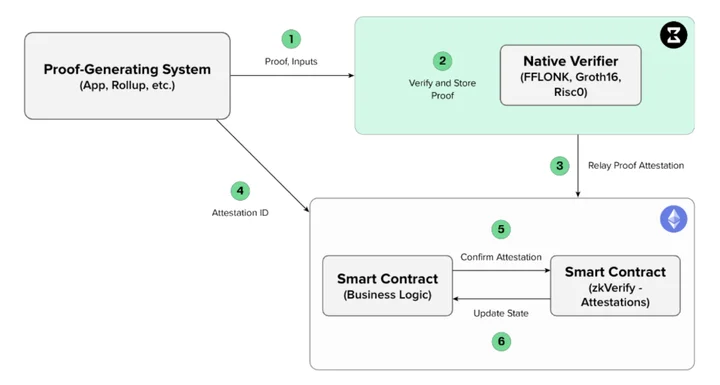
Without zkVerify, the standard procedure for integrating ZKPs into a product/backend system is as follows:
- Prover configuration: Developers rewrite their application logic using the DSL for their circuit generation. When using a zkVM, developers only need to rewrite their programs in a language like Rust or Solidity.
- Verifier configuration: Developers then deploy the verification logic, typically as a smart contract that is base-layer compatible. This logic contains the verification algorithm that fits the proving system and accepts inputs from the prover. The verifier contract interacts with the blockchain’s execution environment to validate proofs. The traditional framework of using ZKPs via DSL requires a compatible, customized verifier for each circuit. In the case of using a zkVM, the verifier is often a standardized contract that can verify proofs from any program compiled to that VM, simplifying the deployment process.
With zkVerify, while the prover configuration remains the same, the work done to the verifier changes. Instead of modifying the verifier, developers go through a straightforward, three-step process to integrate with zkVerify:
- Send proofs to zkVerify’s network: Developers can direct their generated proofs to zkVerify’s network via an API call, along with verification keys and public inputs. To improve efficiency, verification keys can be re-registered for subsequent submission, which results in lower transaction costs.
- Await proof verification: Developers monitor the network for verification confirmation. Valid proofs are included in a Merkle tree and assigned an attestation ID. The proof’s leaf digest is calculated using cryptographic hashing of the verification context, verification key, and public inputs. Once enough proofs have been accumulated or a specified time period is reached, an attestation is produced. This attestation is relayed to zkVerify’s smart contract on the designated settlement layer.
- Modify the verification path: Developers modify their dApp smart contracts to interact with zkVerify’s smart contract instead of implementing verification logic directly. This allows proof verification through a lightweight Merkle path rather than executing the full verification algorithm onchain.
Developers have significant advantages in utilizing zkVerify for verification work, especially when comparing maintenance workload. Traditional implementation requires developers to deploy custom verifier contracts for each ZKP circuit they develop. These verifiers must be maintained to remain compatible with both the proving systems (e.g., Groth16, PLONK, STARK) and the settlement layer’s evolving specifications.
For STARK-based proof systems specifically, zkVerify can be a real game-changer for the developer experience. STARK-proofs are often too large and too computationally intensive to be verified on the L1, like Ethereum. This has forced developers to opt for the STARK-to-SNARK conversion, which is more suitable for base layer verification. By bringing verification out-of-protocol, zkVerify has the ability to verify the native STARK proofs directly via its extrinsic pallets, reducing both cost and computation requirements. Its dedicated block spaces for pure verification also ensure that the end-to-end process happens in seconds, which opens up space for efficient ZKP implementations in application designs.
With blockchains’ ongoing improvements and technical changes, maintaining these verifiers is a challenging and time-consuming endeavor. zkVerify, as a forkless and standalone architecture, does not have these problems. The protocol can quickly integrate new pallets that adapt to proving systems and respond to the market as needed. By eliminating the need to implement and maintain circuit-specific verification logic across multiple execution environments, zkVerify helps developers save significant time and effort.
Using zkVerify also means better flexibility for cross-chain deployment of ZKP applications. While zkVMs simplify ZKP utilization by allowing for development in high-level languages (like Solidity and Rust), their business models eventually hinge on verticalization to build a moat. This restricts deployment to only settlement layers compatible with the specific VM architecture.
As an out-of-protocol verification, zkVerify is deliberately proof agnostic. Its validation is accessible via onchain attestations relayed to the base layer. This design helps standardize the verification across multiple blockchains and simplifies the integration process. With zkVerify, developers can focus on product development and execution functions. There is no longer any need to tailor to the right verification algorithm and validation mechanics of different base chains.
Potential Markets
Unlike other standalone chains, zkVerify does not have smart contract capabilities. Instead, it uses its forkless architecture for faster upgrades and focuses on providing low-cost verification. This allows zkVerify to benefit from high-volume use cases, where proofs from various sources can be verified natively without much modification.
In the previous report, we highlighted several potential market verticals where zkVerify can drive growth and improve development efficiency. In 2025, private DeFi, Proof of Humanity, and scalability remain the primary sectors with tailwinds for growth.
Private DeFi
DeFi is one of the major pillars of crypto, focused on creating a permissionless financial layer without intermediaries. The exponential growth and variety of DeFi protocols has gradually attracted a larger pool of participants with different user profiles, like retail participants, professional traders, and institutional funds. There is a case to be made that the transparent nature of blockchains coupled with the increasing institutional interest will likely result in growing demand for privacy-enabled tools and protocols.
Today, privacy is one of the core tenets of crypto. While it’s not a major category in crypto yet, the demand for privacy solutions has always existed. Tornado Cash’s utilization is a great example of this. Launched in December 2019, Tornado Cash is the OG decentralized protocol for private, anonymized transactions on EVM-compatible networks. Despite the volatility after being sanctioned by OFAC, Tornado Cash’s net flows have been slowly recovering over the past months.
Another example is Railgun, a protocol that provides universal EVM privacy. With Railgun, users can have uncompromising onchain privacy with secure encryption – and just as much DeFi functionality as any other wallet. With $68M in TVL, the protocol has been live on major EVM networks, including Ethereum, BSC, Polygon, and Arbitrum. From April 2024 onward, Railgun has processed a monthly average of around $170M in private flows. This significant uptick in onchain flows is indicative of a consistent and growing demand for Private DeFi.
Looking ahead, we see two key catalysts that can shape Private DeFi. The first is the increasing appetite for serious investors to interact with DeFi. This has been underscored by tokenization efforts from behemoths like Blackrock, the approval and success of multiple spot BTC ETFs, and the Trump administration’s positive regulatory approach to crypto. Below is the visualization of net flows for all 11 Bitcoin Spot ETFs since their inception in January, 2024. Recently, the total net inflows across all ETFs have surpassed $36B.
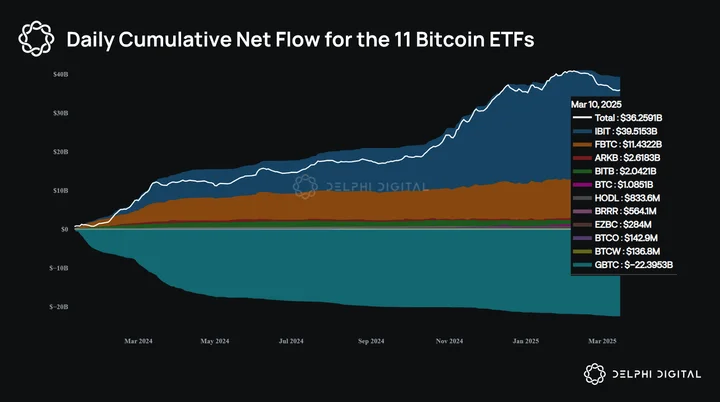
During the late 2024 runup when Bitcoin broke $100,000, IBIT – Blackrock’s iShares Bitcoin Trust – became the most successful ETF launch ever, hitting 50B in AUM within just 11 months. For comparison, the second-fastest ETF to reach this milestone was $IEFA taking 1,329 days. What Bitwise’s CIO Matt Hougan said back in August is spot on:
7/ Eye-catching, right? Bitcoin ETFs are by far the leaders in terms of institutional adoption. That’s true whether you measure by number of institutions or AUM.
— Matt Hougan (@Matt_Hougan) August 21, 2024
Jumping back to 2025, BTC has become a legitimate treasury asset to consider on the balance sheet. The reason for adoption might vary, be it diversification or hedging against the dollar debasement, but the overall trend paints a clear picture. Institutions, companies, and even countries have started acquiring Bitcoin as part of their portfolio construction. Per data from Bitcointreasuries.com, governments and institutions collectively own 7.454% of the total Bitcoin supply of 21M.
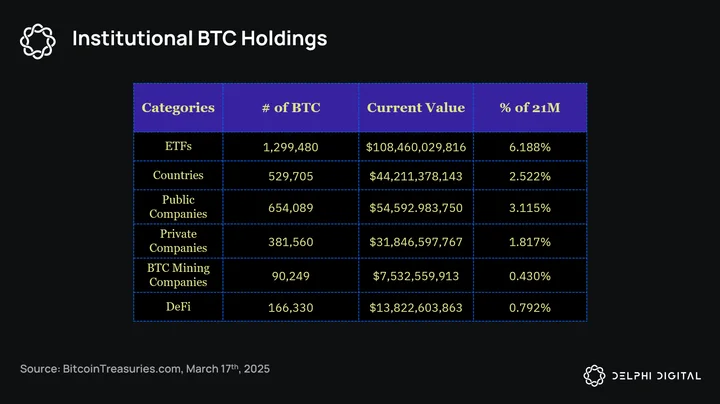
This marks a significant sentiment change on crypto from institutional investors and provides the necessary stepping stone for the next stage of adoption: DeFi and asset tokenization. Blockchains and crypto have the unique opportunity to provide a new backbone for the financial system, one that improves liquidity, enhances market efficiency, and lowers systemic risk. The trend of tokenizing real-world assets will likely go up and to the right both in regards to trading volume and tokenized value, taking advantage of fast, low-cost blockchain technology to streamline and automate manual and time-consuming processes. According to rwa.xyz, excluding stablecoin growth, the total RWA value onchain has 9x’d, from $1.89B in late Dec 2022 to $17.95B in March 2025.
This means that complex strategies can be executed at scale, addressing some of the institutional concerns. In its 2024 report, EY-Parthenon highlighted that connections to LPs (52%) and borrowing and lending against their crypto (37%) were among the top features institutions sought from their TradFi partners. TradFi adoption now goes beyond traditional crypto custody. And the DeFi space has evolved likewise. Protocols have become more modular leveraging robust tooling, often referred to as “money legos”. Combined with DeFi’s composable nature, this creates an attractive edge over TradFi infrastructure.
Secondly, following the current trend, retail flow will likely continue to grow and move onchain over the next few years. For example, the DEX to CEX spot volume ratio has grown to 20% this year, thanks to popular applications such as Hyperliquid and pump.fun.
The second-order effect of all of this? Accelerated growth of DeFi as measured by participation, volume, and asset issuance. But given the transparent nature of blockchains, institutions participating in onchain trading risk revealing their positioning and strategies. As such, the demand for privacy-focused solutions is poised to grow, unlocking private execution.
Monthly volume for DeFi peaked at $564B in late 2024, up roughly 29.68x from ~ $19B in 2020. The dominant applications in Private DeFi have boasted a combined $300M in monthly volume throughout 2024, or 0.04% of the total DEX volume. As we pointed out in the previous report, according to NASDAQ, nearly half of all trading activity occurs in dark pools and off-exchange venues. For some stocks like GameStop, dark pool volume exceeded 50% of total trading volume on certain days.
Given the nascency of DeFi and the growing trend of asset issuance onchain, we believe onchain dark pools will become table stakes for institutions. Over the next 5-10 years, we estimate the total DEX monthly volume could hit $5.4T, with privacy protocols facilitating around 0.5% – 1%, or in $27B to $54B, in monthly volume.
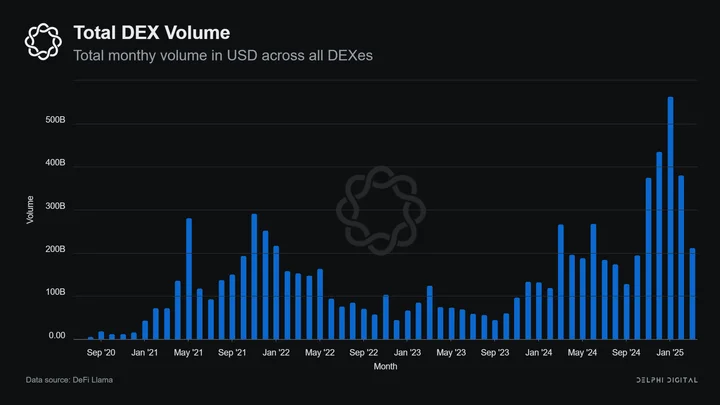
This represents a 10x from the current monthly volume numbers and a 10-20x for the take-rate of privacy-enabled protocols. While retail participation will likely remain high, institutions are expected to be the major driver of this volume expansion. Today, regulatory uncertainty, infrastructure sandboxing, and deployment speed remain the major headwinds left for true institutional participation. And we believe these headwinds will dissipate over time.
For privacy products, such a wave of institutional adoption could present the catalyst to accelerate volume take-rate to 0.5% – 1% from our current figure of 0.04%. In such a future, ZKPs will play a crucial role in providing privacy for trade execution, enabling confidentiality for trade size, asset type, and trading frequency. In a multichain world, ZKPs could also help with settlements across different blockchain environments.
With zkVerify, developers will gain greater flexibility when designing their dark pool/private execution strategy by offloading verification to a specialized, dedicated, and out-of-protocol party. Waiting for proof aggregation or converting ZKPs to submit them to the L1 is no longer necessary. Instead, trade execution and settlement could happen almost instantaneously, as zkVerify can directly verify proofs in a highly efficient manner.
The composability of zkVerify across different proof types and prover designs also gives institutions better control over their prover/execution environment, regardless of base layer configurations. This helps reduce third-party dependency risk within a permissionless environment, while also increasing surface coverage for tail-end assets. As client-side proving becomes more viable, we will likely see an exponential growth in proof generation for Private DeFi. And here, zkVerify could be the partner to handle large volumes with minimal fees.
What zkVerify enables
All in all, zkVerify is strategically positioned to capitalize on the growth of Private DeFi. Its infrastructure enables low-latency proof verification for onchain use cases, unlocking privacy and real-time edge for institutional trading. The support for native STARK verification also allows for high-frequency trading strategies and RWA settlement at scale without needing L1 execution logic. With institutions likely driving the next wave of adoption for Private DeFi, zkVerify stands to be a key beneficiary.
Scaling
There is some merit to the saying that “ZK is the endgame” when discussing scalability. With the broader institutional adoption of blockchains and the trend of retail moving onchain, infrastructure scalability will continue to play a pivotal role. Combined with the expansive whitespace for private application design, ZKPs offer a compelling solution as computation at scale that can be compressed and validated in a distributed manner. Provers can encrypt users’ actions into proofs to be verified by the designated base layers, with multiple provers providing parallelized proof creation and verifiers enabling collision resistance.
Why does this matter? Beyond scalability, ZKPs can be leveraged to enable interoperable layers that interact in a trust-minimized manner. Users no longer need to know what blockchains/ backends their application is currently using, which stands to improve UX.
And in general, the adoption of ZKPs as tools to improve scalability has gained traction across almost all major ecosystems. Ethereum’s roadmap embraces ZK rollups, Solana leverages ZK compression, and even Bitcoin L2s utilize ZKPs to scale and provide uncontested blockspace for applications.
Protocols that zero in on improving the ZKP verification flow, like zkVerify, are net beneficiaries. As such, the partnership with Arbitrum can be seen as a nod to this trend of ZKP acceleration. Arbitrum is a leading optimistic rollup on Ethereum, with over $2.5B in TVL and more than 500,000 daily active addresses.
This integration will enable apps on Arbitrum to leverage zkVerify’s dedicated proof verification infra. Besides unlocking fast and cost-effective proof verification, benefits include the ability to introduce privacy features, a reduction in computational overhead, and expanding the possibilities of new proving systems, such as native STARK-based proof deployment.
For Arbitrum, this partnership lets the team focus on its core strength of scaling Ethereum transactions, while zkVerify handles the specialized task of proof verification for native apps.
What zkVerify enables
With ZKPs, we are in the next paradigm of verifiable, arbitrary computation that ensures validity while expanding computational expressivity. zkVerify’s architecture helps extend the trust engine behind this vision, making verification cheap, fast, and adaptive to different base layers. Developers now have a more efficient toolkit for application designs and experimentations.
Proof of Humanity
As AI rapidly accelerates the development of new technologies, data privacy, and human authenticity are increasingly becoming major concerns. And at their most basic function, ZKPs can prove the validity of information without revealing the underlying content – guaranteeing user authenticity and preserving privacy.
Utilizing ZKPs with authenticated opt-ins, developers can better serve their end users not only by protecting their anonymity but also by maintaining a high degree of personalization. Two sectors that come to mind are login credentials and zkTLS.
zkLogin
Traditional logins store personal information across third party’ servers, running risks of security vulnerabilities. Data leaks revealing user passwords and usernames are all too common.
With ZKPs, developers can ensure privacy-preserving authentication with pre-existing credentials via identity tokens. This is the approach that zkLogin on Sui (developed by Mysten Labs) has taken. At the heart of this solution is a signature scheme. It allows the signers to sign using their existing accounts and nothing else. Meaning, ZKPs ensure the sensitive link between the user’s offchain and onchain identities remains hidden – even from the platform itself. This maintains user anonymity while also providing compatibility with the current user authentication of Web2 products.
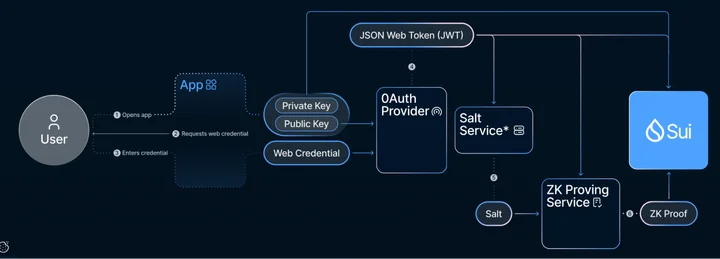
Sui is a Move-based monolithic L1, with over $1.1B in TVL and daily active addresses fluctuating between 500k -1.7M. Data provided by Mysten Labs shows that around 7.6 million zkLogin transactions have been generated since the feature went live in October 2023. Mysten Labs also launched Enoki, a SaaS product for business integrations in blockchain environments. Enoki enables businesses to seamlessly integrate Sui wallets into both existing and new services, leveraging zkLogin, sponsored transactions, and other Sui primitives. Since its launch in April 2024, Enoki has recorded north of 2 million zkLogin addresses, with over 1.5 million ZKPs generated by users.
Looking more broadly, implementing ZKPs in this manner could be duplicated across other ecosystems, which would help reduce user friction and meaningfully improve data privacy and security.
zkTLS
zkTLS is the second subcategory where ZKPs play a pivotal role. zkTLS, also referred to as TLS oracles or web proofs, allows private data to be extracted from Web2 walled gardens. While the focus of this memo is not on TLS, it’s good to understand the technology and its value proposition in the context of ZKPs. In our memo, The Inefficient Market Hypothesis, Delphi Research’s DeFi lead, Jordan, succinctly explains TLS:
“Transport Layer Security (TLS) is a protocol for encrypting traffic between a client and a server. TLS makes up the ‘S’ in HTTPS (HTTPS = HTTP + TLS), and has become standardized across the web, securing 95% of web traffic.
TLS is a trusted, centralized authority that issues session keys. When entering a website, the browser and the target server engage in a TLS handshake process that generates session keys in order to use symmetric encryption for data transmission. The data exchanged between the client and server is not signed, so its authenticity cannot be proven elsewhere.
TLS guarantees:
- Authenticity
- Security
- Privacy
- But NOT data portability”
However, zkTLS enables data portability by authenticating transcripts between the client and server during an HTTPS session, bringing arbitrary, privacy-preserving proofs onchain. The technology works by establishing a TLS handshake. After the ZKP protocol helps create a proof of the authenticated data, it can be transported and validated by the verifier. Importantly, the proof creation and routing process is undetectable by the server and cannot be firewalled. As a result, the entire repository of internet data becomes accessible and composable – creating building blocks for blockchain applications.
The implications of zkTLS are quite impressive. Developers are now equipped with fast opt-in access to new user graphs and selectively disclosed information. By querying, segmenting, and creating feedback loops around this data, developers can build new social primitives and accelerate the growth of new applications. In this system, ZKPs serve two purposes: they provide compacted, scalable data access while also preserving user privacy via self-selected disclosure mechanisms.
For growth hackers, zkTLS can be an interesting approach to initiate contact density and user discovery, given the new permission control to contacts in iOS 18. This upgrade means social graph access is granularly restricted, and developers will find it more challenging to accelerate the user growth loop, as Nikita Bier points out. zkTLS allows users’ social graphs from Web2 to be effortlessly portable, reducing onboarding friction. The additional benefit of validity with privacy is also a nice touch, especially in today’s climate of personal data sovereignty. zkTLS has the potential to be a commoditized infrastructure piece that will be available on every chain.
If you’re building a social app and less than 70% of your users are granting access to contacts, your app is dead on arrival until that’s fixed
Network effects will never form if you expect users—who have a 5 second attention span—to find their friends by typing in usernames.
— Nikita Bier (@nikitabier) June 11, 2021
In both product use cases that we described, the commonalities between zkTLS and zkLogin are high usage frequency and demand for user privacy. zkVerify, as a proof-agnostic verification protocol, is well aligned to serve both use cases described here. Its heterogeneous aggregation allows for multiple proof types, thus maintaining product flexibility. And its lack of smart contract features lets the system handle significant volumes at scale at a fraction of the cost.
What zkVerify enables
If the trend of “onchain is the new online” continues to unfold, zkVerify stands to benefit from the growth of ZKP adoption within this “Proof of Humanity” sector, as data portability enables new use cases and applications. In this scenario, zkVerify could be the new standard for ZKP deployment, handling proof types from any applications in real time while quoting low verification costs. The demand would be driven by the adoption of ZKP-powered logins and zkTLS, especially for consumer applications, and would likely lead to a tremendous growth in proof creation. Instead of dealing with the EVM’s inherent constraints, developers could switch to the solution provided by zkVerify: unconstrained, flexible, and native verification at scale.
Token Economics
zkVerify will launch its governance/utility token in 2025. As the cornerstone of the zkVerify protocol, the token will be essential for enabling efficient and decentralized proof verification across multiple blockchains. It will also be utilized to incentivize alignment across different parties and ensure secure and efficient operations.
The token will have three main functions: incentivizing validators, securing the network, and reducing verification costs. Through a combination of the staking mechanism, fee structure, and decentralized governance, the native token will aim to make the zkVerify network economically secure and viable.
Value will be captured through verification fees, as it scales alongside proof volumes. Fees will be paid in the native token. If usage grows across chains and applications, this demand loop will drive staking participation, economic security, and alignment among validators, users, and builders.
Token Economics Distribution
| Allocation Categories | Token Amount | Percent of Total | Unlock Schedule |
|---|---|---|---|
| Community | 350,000,000 | 35.0% | 29% at TGE, remainder unlocking monthly over 48 months beginning at 12 months. |
| Foundation | 313,750,000 | 31.375% | 47% at TGE, remainder unlocking monthly over 24 months beginning at TGE. |
| Core Contributors | 196,250,000 | 19.625% | 0% at TGE, monthly vesting over 12 months beginning at 12 months. |
| Investors | 140,000,000 | 14.0% | 0% at TGE, monthly vesting over 12 months beginning at 12 months. |
| Total | 1,000,000,000 | 100% |
Token Allocation Categories
Community (35%)
Tokens allocated to the community will be distributed as follows:
- Developers exploring and experimenting with zkVerify, such as hackathon rewards, grant programs, and ZK application incubator programs.
- Campaigns to distribute tokens as incentives to users.
- Any other activities designed to facilitate awareness and engagement.
Foundation (31.375%)
These tokens will fund the foundation’s operations. This includes:
- People working for the foundation directly to grow the project.
- Organizations providing services to the foundation.
- Exchange liquidity and market-making operations.
- Other operational expenses incurred by the foundation.
Core Contributors (19.625%)
These tokens will be payments to organizations building and improving the zkVerify technology. Such as:
- zkVerify technology development, testing, production.
- Security reviews.
- Ongoing improvements.
Investors (14%)
The tokens will be allocated to the investors in the Ellipsis Distributed System to be able to purchase tokens with the Token Warrants. And investors who funded the development and growth of zkVerify.
Validator Rewards and Inflation Model
A dynamic staking mechanism will secure the zkVerify network with a variable inflation rate designed to optimize participation and economic security.
- The Nominated Proof of Stake system will allow token holders to participate in network security by either running a validator node or nominating validators. Validators contributing to the network will receive the transaction fees for the blocks they produce plus the inflation component.
- Initial inflation rate: 3% annually, adjustments will be made based on staking levels to incentivize active participation.
Governance
zkVerify will be governed by a DAO domiciled in the Cayman Islands, ensuring that network decisions align with community interests. Governance will follow advanced Substrate OpenGov features, and the zkVerify Foundation will be responsible for protocol operations.
zkVerify will move from a partially centralized model to a fully decentralized governance structure on a 3-year timeline. In this DAO structure, holders and delegators will propose changes and updates to the protocol’s development. Their participation within the governance and the decision-making process will be critical in fostering a collaborative environment and engaging the community, given the vested interest in the protocol’s growth and successful outcome.
Looking Ahead
With institutions leading the next wave of crypto adoption, ZKPs are poised to benefit from the growing demand for expressive and privacy-enhancing functionalities. And zkVerify stands to be a key beneficiary.
By solving many of the development headaches rooted in the current thorny ZKP verification flow, zkVerify pushes the envelope for developers. Combined with the network’s ability to provide efficient ZKP verification at scale while keeping fees low, we can see a clear moat forming.
As ZKPs move beyond scaling networks into sectors like private DeFi, identity, and authentication, zkVerify is well positioned to become the connective tissue that enables efficient verification for a wide range of use cases. While its success will hinge on continued – and ideally growing – market interest in ZKPs, the legwork to fulfill the aforementioned role has been done.
0 Comments