Green Shoots — The State of NFT Markets
Last year, we opined that NFTs were in the trough of disillusionment. Twelve months down the line, it looks like we were right.
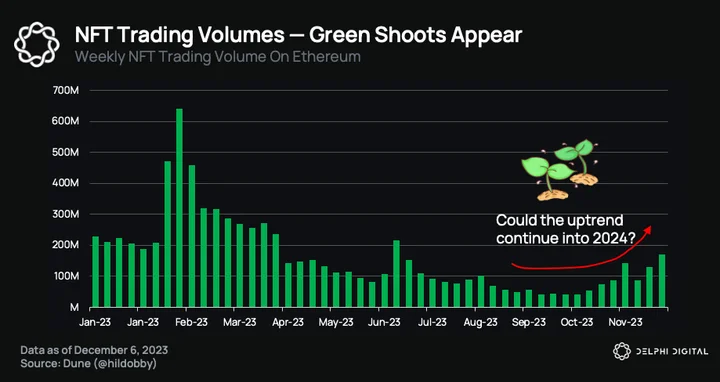
Throughout most of 2023, NFT trading volumes were on a downtrend and significantly lower on average compared to 2022. The peak in mid-February coincided with the launch of BLUR, which many thought would invigorate NFT markets. But it was short-lived.
The silver lining: while trading activity has been down for most of the year, we’re finally starting to see an uptick in volumes coming into the end of the year. Could this be the proverbial green shoots and foreshadow a good year ahead for NFT markets? Time will tell, but our intuition tells us yes.
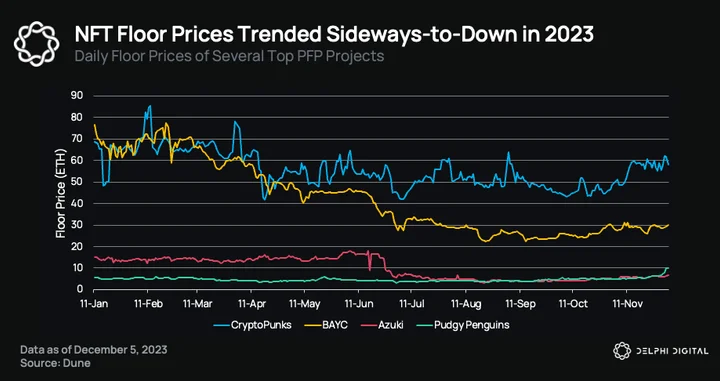
Throughout 2023, NFT floor prices have mostly gone sideways to downwards in ETH terms. This is in contrast to BTC (up 150% YTD) and select altcoins (ILV, a top Web3 gaming coin, is up 215% YTD). It’s been a mixed bag for some of the most prominent NFT projects:
- CryptoPunks have held steady at around 60 ETH, while BAYC fell 57% from 70 ETH to 30 ETH.
- Pudgy Penguins rose to an 11 ETH floor price, while Azuki floor prices have halved to 6 ETH.
For traders, 2023 was a year that required careful selection of NFT projects to achieve success. This trend of selective performance will likely continue into 2024, favoring ‘winners’ rather than a uniform rise across all NFTs.
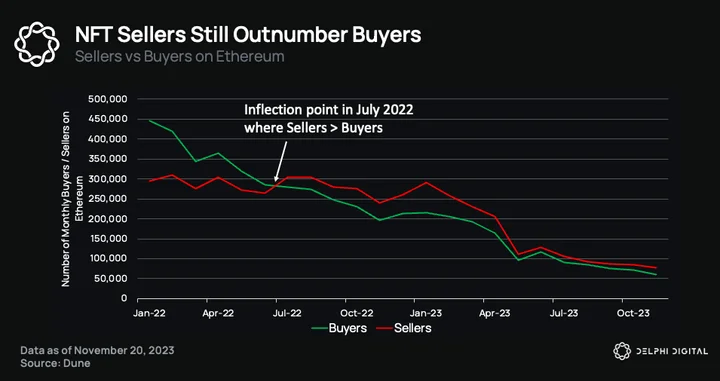
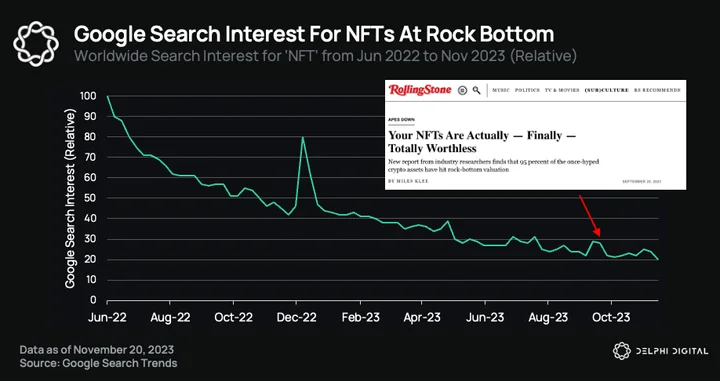
A big reason why NFT markets have stagnated is the general lack of new participants. Indicators like the decline in Google Search interest for ‘NFT,’ a proxy for mainstream attention, and the fact that NFT sellers have outnumbered buyers since July 2022 point to a subdued market. Rolling Stones magazine published an article in September calling NFTs pretty much “worthless”.
While these are likely lagging indicators, we would like to see the trend reverse meaningfully to give us confidence that we’re heading into another NFT bull market.
So, where do we stand today?
- NFT markets have been grounded with little exuberance this year, barring the last few weeks. Mainstream interest has not yet returned.
- NFT prices have been largely sideways or trending down for most of 2023. Intuitively, it feels like we’re in the bottom 1/3 of the market for top-quality collections, with sellers getting exhausted.
- Despite market conditions, builders continue to build. There is continued momentum behind the scenes from developers and creators.
These factors could set the stage for a potential resurgence in 2024. This optimism is partly contingent on a favorable year for the broader crypto market, including a Bitcoin spot ETF approval and the upcoming Bitcoin halving. As crypto wealth increases, spending on discretionary items like NFTs for “flexing”, identity, and entertainment is expected to rise.
Additionally, three potential drivers could fuel the next NFT bull market:
- NFT character brands & gaming go mainstream and draw in new participants.
- Large consumer brands enter Web3, bringing along their substantial customer bases, as seen with companies like Nike and Starbucks.
- The launch of innovative new consumer products utilizing NFTs.
While each factor progresses independently, their combined momentum could herald an explosive year for NFTs. That is, in essence, the bullish scenario we’re watching out for.
The Big NFT Themes For 2024
#1: A Few NFT Character Brands Explode; Most Falter
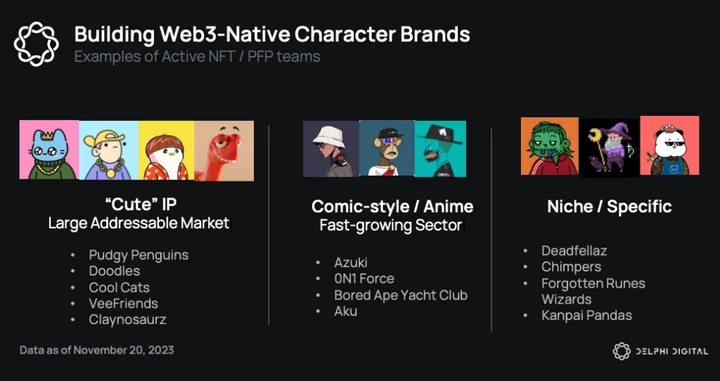 PFP (profile picture) NFT projects were born out of the speculative frenzy of the 2021-2022 bull market. Since then, several have shifted their ambitions towards building global character IP brands, such as Pudgy Penguins, Doodles, Cool Cats, and Azuki. They’re going for the gold — mainstream awareness. They have assembled their teams, established their vision, and are executing toward it. By 2024, they will have been building for 2+ years.
Ernest Hemingway once said, “Two ways. Gradually. Then all at once”.
It’s time for a few of them to shine. And some might even achieve evergreen ubiquity one day.
Character Brands & NFTs
The market for character IP brands is huge. The global licensed merchandise market was estimated to be worth $292B in 2019, while the global character IP market was estimated to be $180B in 2018. Hello Kitty has generated $80B in revenue over its 49 years of existence.
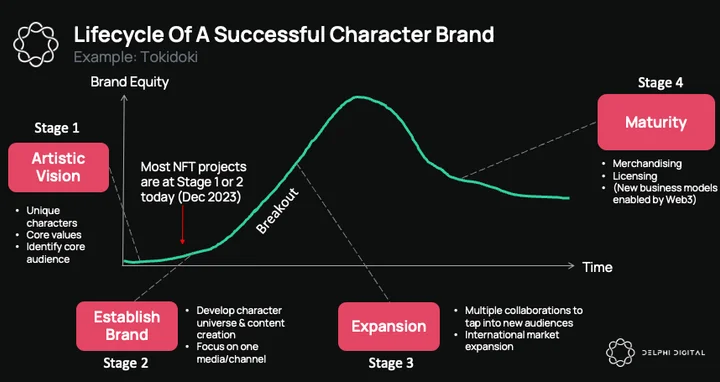
There are several stages in the lifecycle of a successful character brand:
- Artistic vision: identify core values and target audience
- Early Years: establish the brand; develop the universe, content, and foothold in at least one media sector.
- Expansion: grow via collaborations. Tap into new audiences and new geographical markets. Go transmedia.
- Maturity: focus on monetization with merchandising, licensing, and other channels
Let’s illustrate this with a brand example: TOKIDOKI
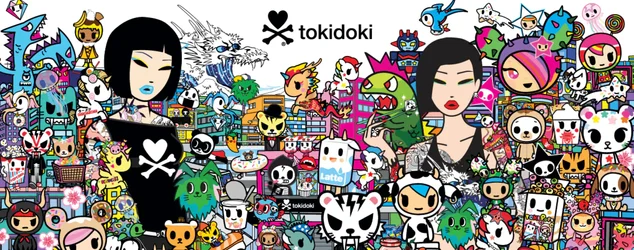
Tokidoki is an internationally celebrated lifestyle brand that merges Japanese-inspired aesthetics with Italian design flair, resulting in a distinctive line of products adorned with vibrant, whimsical characters.
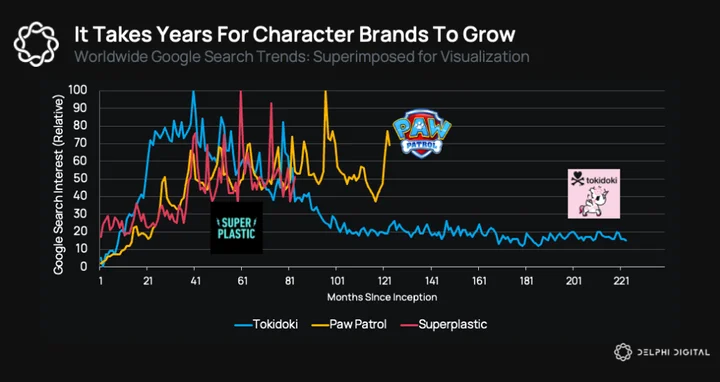
The brand’s success was propelled by strategic collaborations across various industries: fashion entities like LeSportsac, iconic characters such as Hello Kitty, and luxury brands including Karl Lagerfeld. In the tech and entertainment sectors, Tokidoki has collaborated with Marvel, Xbox, and Fujitsu, and in the realm of sports and leisure, with Major League Baseball (MLB) and New Era caps. After launching in 2005, it took Tokidoki ~2 years to build an early audience, followed by rapid expansion and hitting peak popularity in 2008.
 We caught a glimpse of the future with the Bored Apes in 2021. When you go mainstream:
- Celebrities talk about the brand on social media, changing their IG/Twitter profile pictures to match. Just like Eminem, Justin Bieber, and Gwyneth Paltrow did with their Bored Apes back then.
- Normie friends will be gushing about the brand on Instagram and TikTok and have no clue that they are NFT-related. We’re already seeing this with Pudgy Penguins.
- Media outlets will publish articles with headlines similar to this below
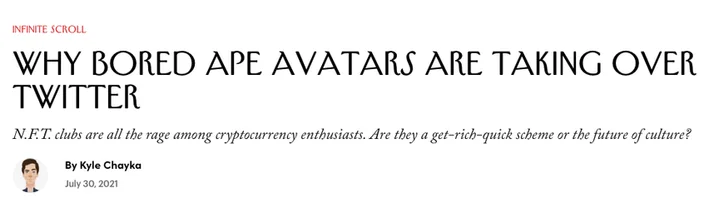
So, one or two NFT character brands could explode into mainstream consciousness in 2024. These teams understand the big picture: it’s not about bringing the masses into NFTs but instead bringing the brand to the masses. They will trailblaze and prove the thesis that NFT-native brands can shorten the time and increase the odds of success because:
1. Ownership: NFTs seed an early, passionate community of owners that are aligned with the project’s success. These early adopters provide quick feedback to support fast iterations and will be the brand’s most vocal proponents.
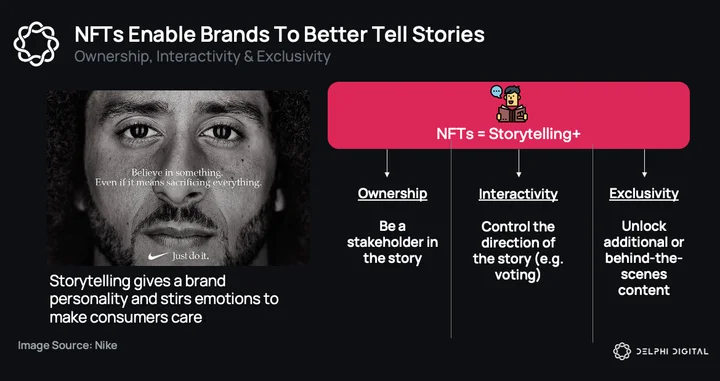
2. Storytelling+: NFTs enable brands to tell more interactive stories and build an emotional connection with their audiences. Holders can shape the direction of the story, co-create, interact with it directly, or unlock additional content. And consumers today love interactivity. In one recent TikTok trend, people pay live-streamers thousands of dollars to react and perform actions.
3. New business models: the traditional business model for character brands hinges on merchandising and licensing. NFT brands can monetize with new business models, shortening the time to profitability: sale of digital collectibles, “phygital” items, membership passes, royalties, etc.
A few NFT brands are probably on the cusp of moving into stage 3 (expansion). We can evaluate their progress based on several dimensions:
- Content creation
- Digital and physical touchpoints
- Collabs & licensing
- Community Building
Pudgy Penguins: The Frontrunner
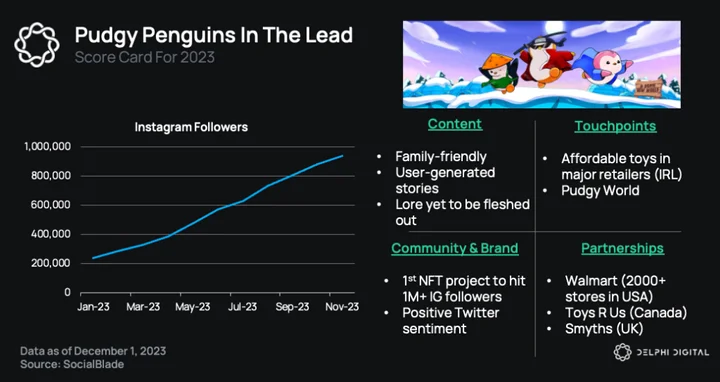
Content Creation: Pudgy Penguins emphasizes charming and family-friendly content. While the depth and details of the penguins’ story and lore are still being developed, individual community members have started to create stories around their penguins.
Digital & Physical Touchpoints: The Pudgy Penguin plush toys, priced accessibly between $20 and $40, are available across the US and Canada. But it is not just a toy. Each plush includes a QR code, which links to an NFT that can be utilized in Pudgy World, their interactive metaverse game that will debut in Q1 2024. This blend of physical and digital offerings creates more direct touchpoints between the brand and the end consumer.
Pudgy Penguins is the 1st NFT PFP project to reach 1M Instagram followers — a 4X increase since the start of the year. The brand’s endearing appeal extends to a wide audience, including non-crypto native people who are actively sharing their content on socials. Cuteness is the Trojan horse that will bring more consumers on-chain.
Collabs & Licensing: A landmark achievement for Pudgy Penguins was their partnership with Walmart, a major player in the U.S. toy retail market. This collaboration taps into a segment that represents about $2.3B of the $29.2B total U.S. retail toy sales. With Walmart attracting approximately 180M visitors daily and commanding about 20-25% of the U.S. retail toy market, this partnership significantly broadens the brand’s reach. Other key partnerships include Toys R Us in Canada and Smyths in the UK. Additionally, the brand plans to debut two arcade machines in 2024, further expanding its consumer base and anticipating significant expansion into the Asian market through similar collaborations.
Community Building: The Pudgy Penguins community stands out as one of the strongest in the domain, judging by social media sentiment and the adoption of Penguin PFPs by influencers like Pentoshi. This is driven by faith in Luca and the brand and a rising floor price. The brand also actively engages in real-life community events across various countries globally.
We expect Pudgy Penguin’s brand growth to accelerate into 2024.
Doodles, the Underdog
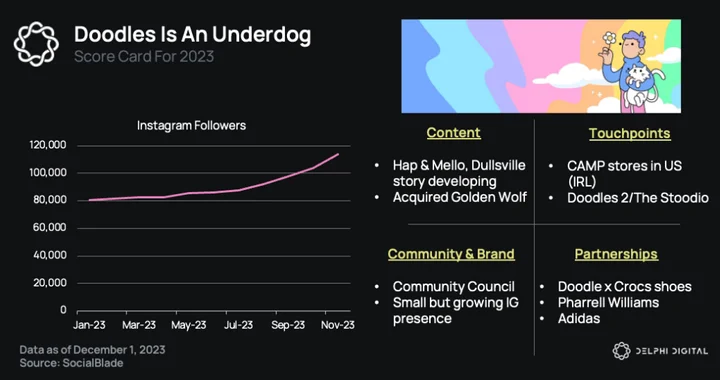
Another NFT team to watch out for in 2024 is Doodles. It’s a family-friendly, colorful character brand with fun vibes targeting young urban professionals with kids.
Content Creation: Doodles has been building towards its vision of a participatory, transmedia storytelling platform, leveraging digital collectibles to unlock new content and deeper engagement.
This year, they introduced their main characters, Hap & Mello, and have been using animation shorts to develop their story. This is powered by Golden Wolf, an animation studio that they acquired.
Digital & Physical Touchpoints: Doodles has established a physical presence with the CAMP store, offering an immersive IRL experience for kids and selling a range of merchandise. The CAMP store introduces Doodles’ IP and characters and provides valuable feedback for the character builder product. According to the team, metrics are surpassing expectations, with >13,000 paid visitors in total, 1,200 tickets sold each week, and a $98 average reservation value. CAMP is poised for expansion to other cities and internationally.
Collabs & Licensing: This year’s main one is the Doodles x Crocs partnership, where a limited-edition set of Crocs was sold out within 24 hours at $120 each. A Hap & Mello capsule collection with holiday-themed clothing has also been launched.
Community Building: Doodles established the Doodles Community Council, which initiated the Inkubator program. This program supports community events and commercial experiments by providing small grants. Doodles has also grown its Instagram following from 80K to 120K followers this year.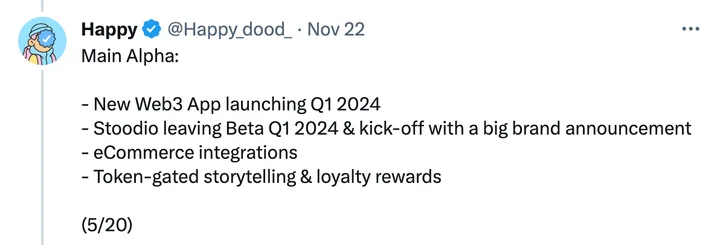 Doodles takes a different approach that focuses on storytelling content and unique physical experiences to grow the brand. With a robust pipeline of brand partnerships ahead, Doodles is laying the foundation for a potential redemption arc in 2024.
Claynosaurz, the “Pudgy Penguins” of Solana
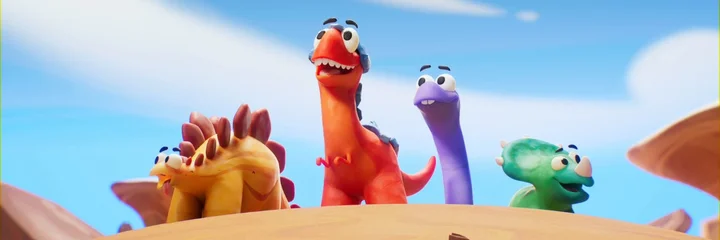
And finally, there’s one more contender we’d like to highlight. In April, we pointed out Claynosaurz as a leading NFT collection on Solana to watch for. Claynosaurz stands out for its strong NFT-native team dedicated to building a distinctive character brand. The collection is known for its intricately designed 3D animated dinosaurs, which have resonated with the NFT community on Solana. Claynosaurz has:
- Launched a line of plush toys, with the 1st run selling 1,607 units at 1 SOL each and with another large public run coming soon. This step towards tangible merchandise reflects their growing brand presence.
- Actively expanded their digital footprint on Instagram. Starting their focused IG campaign in November, they rapidly gained over 40,000 followers in just a month. This social media success is underscored by their latest short animation, which garnered an impressive 240,000 likes and 3.5M views, demonstrating the broad appeal of their characters.
- Achieved all of this with significantly less financial backing (no known private fundraise) compared to major players like Doodles and Pudgy Penguins, which have previously secured millions of funding dollars.
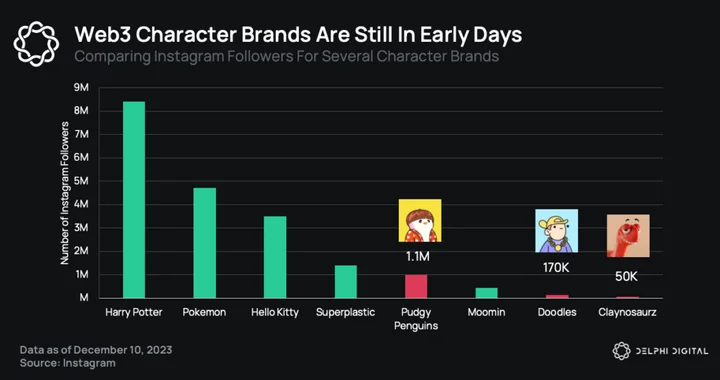
How would we measure success for character IP brands? We watch for an inflection point across several key areas indicating that a brand is heading into expansion and about to take off:
- Revenue.
- Most character brands are in the very early stages of monetization.
- Pudgy Penguins is on track to hit $10M in revenue for 2023, according to its CEO, largely from toy sales
- Doodles hasn’t disclosed any revenue numbers but generates income from CAMP tickets, merchandise sales, and Golden Wolf agency work.
- Brand awareness, with Instagram followers as a proxy. Most Web3 character brands are in their early days compared to their traditional peers.
- Community. Growing the community while keeping members engaged and happy is critical in Web3.
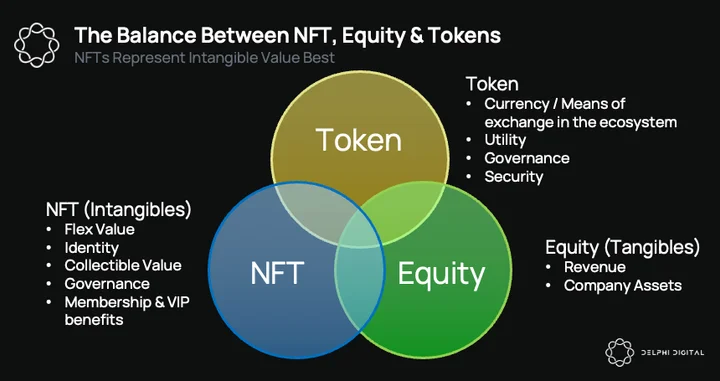
One big question remains: as these Web3-native brands grow, how does value accrue back to NFT holders? Theoretically, it is possible to find the right balance. Value accrual for NFTs will probably be more about intangibles rather than direct revenue sharing (equity):
- Identity Value: owning an NFT from a popular and growing brand becomes a statement of identity and belonging.
- Flex Value: scarcity enhances the ‘flex’ or bragging rights value for the NFT. As the brand influence and audience grows, there will be more demand to own a rare NFT from its early days
- Exclusive Access: much like a VIP club, holding these NFTs will grant access to holder-only benefits. These can range from special events and unique experiences to early access to new and limited-edition products.
Our Predictions for 2024
- A few NFT character brands surprise everyone by going viral and growing exponentially.
- The majority of NFT character brands struggle to break out of their niche communities. The battle for consumer attention is intense; only a few will successfully navigate this competitive landscape.
- We will see an influx of seasoned creatives from the traditional entertainment industry, such as veterans from Disney and Hollywood. They will launch new brands leveraging Web3 tools. The OG PFP teams of 2021-2022 were founded by crypto-natives without much brand-building experience. The projects of 2024-2025 will have a much stronger pedigree.
#2: Ethereum Loses its Dominance; Solana, the “Dark Horse,” Catches Up
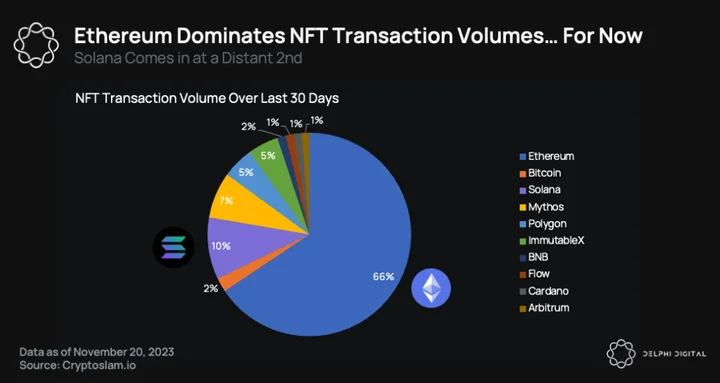
In today’s NFT landscape, Ethereum stands as the dominant force, accounting for ~66% of the total NFT transaction volume by value. It’s where the lion’s share of liquidity resides. The most valuable NFTs, like CryptoPunks and Fidenzas, call Ethereum home.
However, the tides are shifting. We could witness Ethereum’s NFT dominance fall below the 50% mark as early as next year. Here’s what is driving this change:
1. NFTs become more sophisticated
Most of the 1st generation of NFTs were designed to have little use except to adorn our digital wallets.
This limited utility is a reflection of how early NFTs are as a technology. The NFTs of tomorrow are set to take on roles in interactive experiences (gaming & entertainment), voting (DAOs), and being transacted (real-world assets). Many innovative applications are yet to be fully conceived.
2. Ethereum’s Achilles Heel — Gas fees
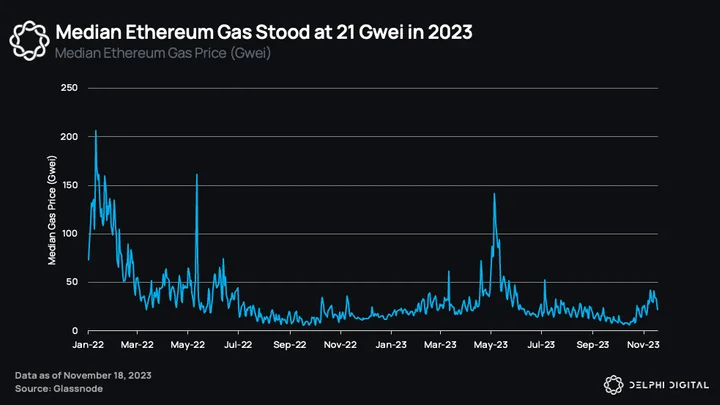
This evolution comes with a caveat — more transactions are needed. And every line of code executed on the Ethereum blockchain has a real dollar cost.
The median gas price on ETH in 2023 was 21 gwei. Transferring an NFT incurs a gas cost of about 55,000 units, equivalent to a transaction fee of ~$2.50 at an ETH price of $2,200. Gas prices will likely rise over time as Ethereum experiences increased usage and ETH price increases.
While crypto enthusiasts may not be deterred by these fees, the future NFT consumer demographic is unlikely to embrace such costs. Even $1 transaction costs are far too high for mainstream adoption. Optimizing for micropayments often becomes very important to the user experience.
3. Other NFT ecosystems gain momentum
While Ethereum’s NFT ecosystem will likely remain robust, other L1s & L2s could outpace Ethereum’s rate of growth, gradually chipping away at its market leadership. Solana is the prime contender to narrow the gap with Ethereum and could make significant strides in the NFT space in 2024.
Enter Solana, the “Dark Horse”
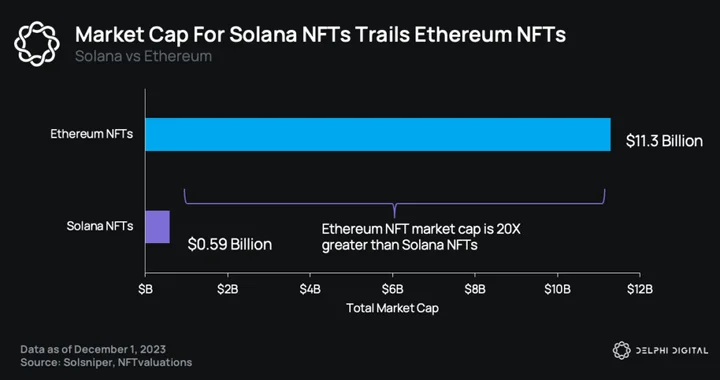
Solana has a flourishing native NFT community that provides a ready audience base for new projects. The market cap for Solana NFTs is a modest 5% of Ethereum NFTs today, while its trading volume is ~15% of Ethereum’s. This might seem small, but it implies significant room for growth. This led us to highlight Solana’s NFT marketplaces, NFT finance protocols, and interesting NFT projects in our reports earlier this year.
With its fast transaction speeds and nearly negligible fees, there are products you can build on Solana that aren’t possible anywhere else.
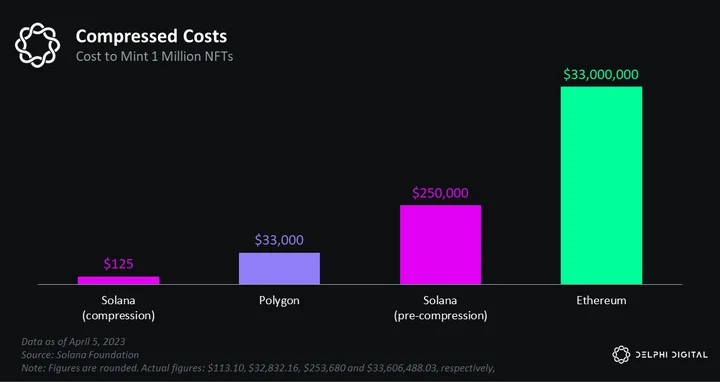
This is because there are several things unique to Solana NFTs:
1. Compressed NFTs. By utilizing state compression, it becomes possible to mint one million NFTs for just $125 (equivalent to $0.000125 per NFT). This opens up new possibilities for NFT use cases, such as offering free mints as a user acquisition strategy or enabling brands with millions of existing customers to experiment with NFTs. One example is DRiP, a platform for artists to send (or “drip”) weekly free art to collectors. This unlocks wider distribution for artists and creators at a price point everyone loves: free.
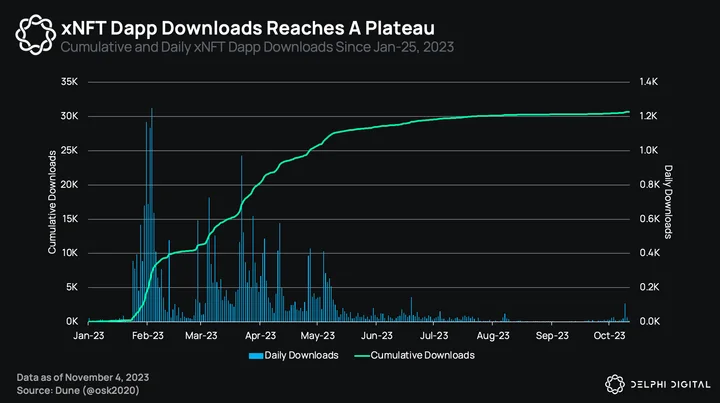
2. Executable NFTs (xNFTs). An xNFT can encompass a game, an NFT gallery, or even a cryptocurrency price tracker – essentially, anything that can be executed with code. Backpack xNFTs run on Backpack, a multi-chain open-source crypto wallet. Importantly, xNFTs can operate within the wallet itself, eliminating the need for users to download additional apps and reducing friction points. While the number of xNFTs has reached a plateau, it only takes a single compelling app to truly take off.
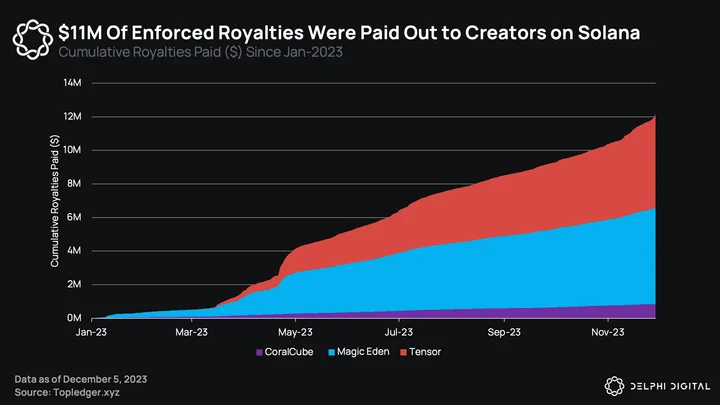
3. Enforced Royalties by Default. The vast majority of Solana’s NFT ecosystem uses or supports Metaplex’s programmable NFT standard. This enables creators to protect royalties on-chain and ban marketplaces that do not enforce them. This is in contrast to Ethereum, which has largely shifted towards optional royalties. This difference could attract creators who appreciate royalties. In 2023, $11M of royalties were paid out to creators on Solana.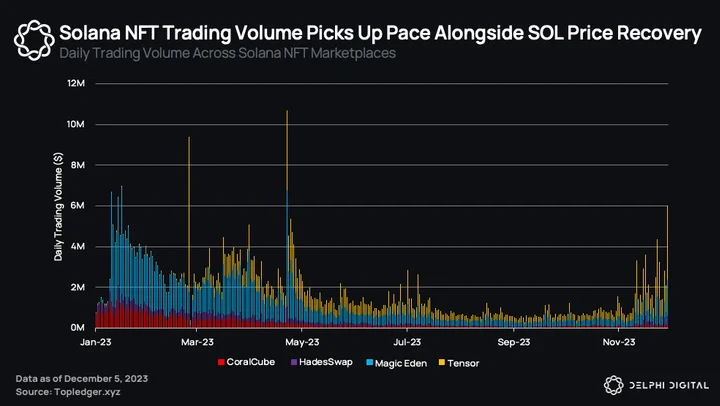
Daily NFT trading volume for Solana has picked up significantly in recent weeks, hitting >$6M. The recent surge in SOL’s price over the past few weeks serves as a strong tailwind, bolstering Solana’s prominence and attracting entrepreneurs, developers, and users into its expanding ecosystem.
While many existing Solana NFT projects today may not be particularly innovative (typically PFPs or simple games), we anticipate a wave of more intriguing projects launching in 2024. There’s typically a lag time between new entrants joining the ecosystem and the launch of new projects.
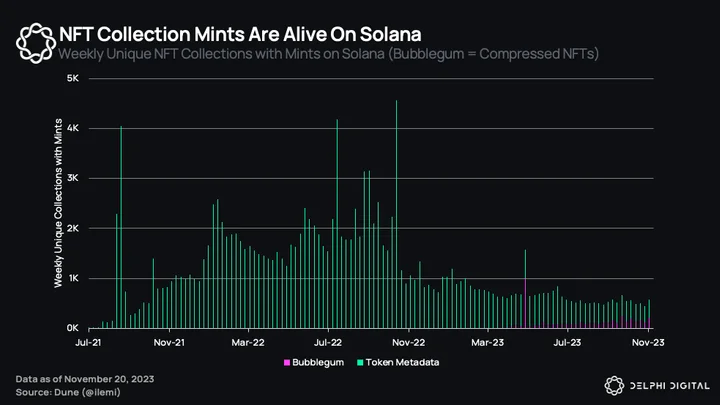
Although NFT trading volumes are still well below their 2022 pre-FTX highs, a steady stream of NFT collections is being minted on Solana, with around 400 to 500 new collections emerging weekly. In our conversations with builders in the space, they are seeing more non-speculative, hobby-type NFT launches by solo developers.
In its earliest days, the Solana NFT ecosystem primarily attracted individuals who had missed out on Ethereum and were seeking cheaper options for speculation and trading. Hence, a large number of earlier projects were PFP-type communities. However, it has evolved significantly since then, and the community has proved its mettle by successfully navigating challenges such as the FTX collapse and thriving in the face of adversity.
- MadLads has emerged as the top NFT community on Solana, with a comprehensive ecosystem supporting it. The team is actively developing a cryptocurrency exchange aiming to become FTX 2.0, featuring verifiable proof of reserves. They also pioneered Backpack and xNFTs. It is possible that MadLads will be viewed as the CryptoPunks of Solana in the future.
- Tensorians are the PFP collection for Tensor, the upstart NFT marketplace that overtook Magic Eden this year despite having a much smaller team. Think of Tensor as the Blur of Solana. They have been executing tremendously well. There is a points reward program in progress, and it’s likely that Tensor will launch a token at some point.
Besides Solana, several other chains are coming for Ethereum’s NFT lunch:
- Polygon needs no introduction. It has already onboarded Starbucks, Nike, and Reddit. Riding on Polygon’s business development muscle and lower transaction costs, more brands will likely build on Polygon in the coming year.
- ImmutableX and Ronin are gaining traction as gaming chains, with many games launching in 2024. We cover them in our Year Ahead for Gaming 2024 report.
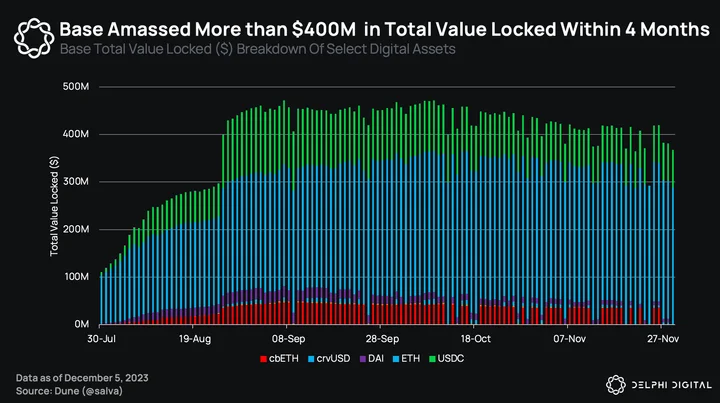
- Base has seen an impressive $400M in total value locked after launching just 4 months ago. Some of this capital could migrate into NFTs as its ecosystem grows and matures. Consumer apps (such as FriendTech) have been building on Base, and its direct association with Coinbase could make onboarding easier.
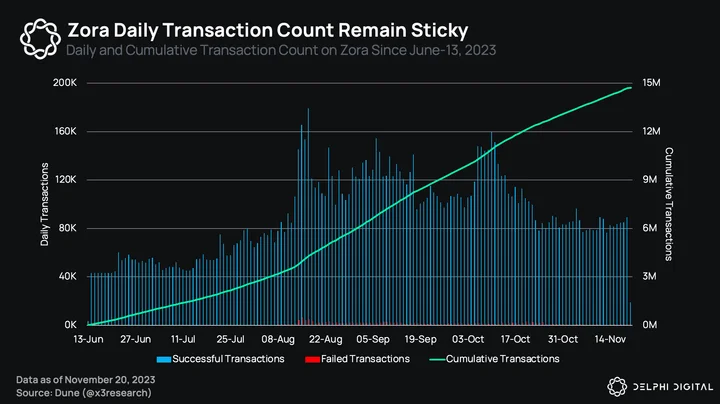
- Zora network is an NFT-focused Layer 2 built using the Optimism stack to help bring media on-chain. Activity on the network has been steady in recent months, and it could gain some traction amongst the art and creator community. One app on Zora is Mintdotfun, a rewards program for minting to make minting fun.
- Frame is another new NFT-focused rollup built using the Arbtirum Nitro stack to enable lower fees and faster block times. It has enforced creator royalties by default and is currently on testnet.
- And let’s not forget Bitcoin Ordinals, which truly blossomed in 2023, much to the surprise of many.
With over 40M inscriptions to date, this translates to an astonishing rate of more than 100,000 new ‘NFTs’ created daily on the Bitcoin blockchain. Despite a significant portion of these inscriptions being BRC-20s, (more akin to fungible tokens), the volume is nonetheless remarkable. ORDI, the first BRC-20 which we talked about in our BRC-20 report, hit a $1B market cap this month. It shows how the animal spirits are well and alive on Ordinals.
In our view, as detailed in our Ordinals report, Ordinals is poised to emerge as a pivotal protocol layer for generating fully on-chain, immutable, and censorship-resistant digital artifacts. This platform aligns perfectly with the ethos of Bitcoin, especially for store-of-value assets like high-value digital art.
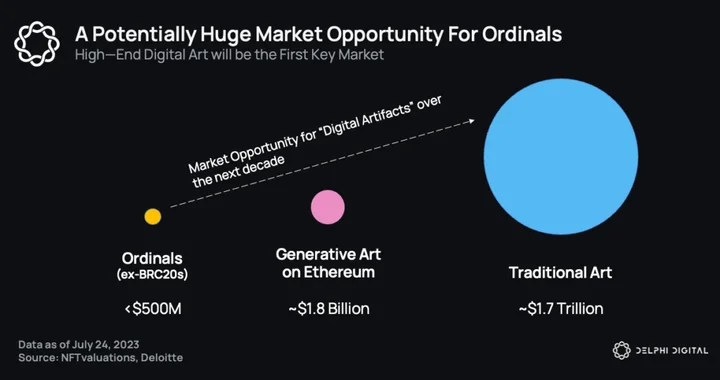
However, challenges persist due to the inherent infrastructure and limitations of the Bitcoin blockchain. With block times averaging 12 minutes and occasional hours-long gaps without a mined block, creating seamless user experiences remains a hurdle.
Within the Ordinals ecosystem, we are keeping an eye out for items with historical & cultural significance that can generate attention. Some examples include:
- The emergence of Rare sats as unique, collectible Satoshis.
- Digital artifacts like OCM Dimensions, which pioneered the use of recursions.
- Cultural movements like Ordinal Maxi Biz & Taproot Wizards.
- Early # inscriptions, such as Bitcoin Shrooms which will be auctioned at Sotheby’s in December.
Our Predictions for 2024
- An NFT collection on Solana will rival the Bored Ape Yacht Club in floor price.
- Ethereum NFT dominance will drop below 50%, even though high-value NFTs will continue to reside there.
- Ordinals will flourish as we head into the halving and renewed interest in Bitcoin.
- The best and most innovative NFT teams will launch their projects outside of Ethereum L1.
#3: Physical Collectibles Will Come On-Chain Quickly
Real-world assets (RWAs) have been the buzzword in crypto lately. Many agree that RWAs will be huge but have differing views on the timeframes and pathways to get there.
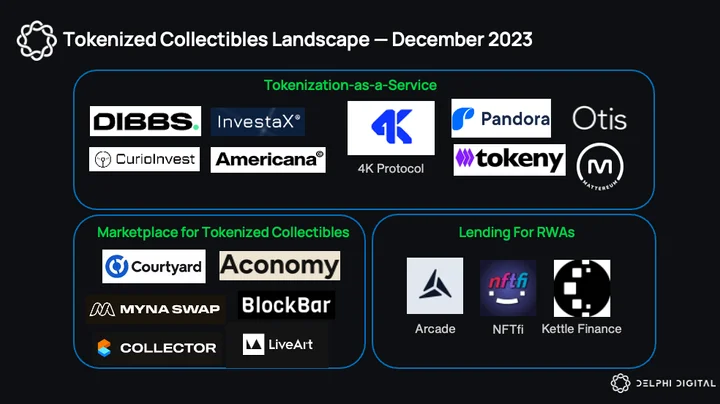
One particular RWA category could gain good traction in the coming year — tokenized physical collectibles as NFTs.
Why Collectibles?
Collectibles are objects of value to collectors and can be worth far more than the prices they were initially sold for because of their rarity, historical significance, or cultural value. Examples include trading cards, sneakers, luxury watches, wine & spirits, antiques, and traditional physical art.
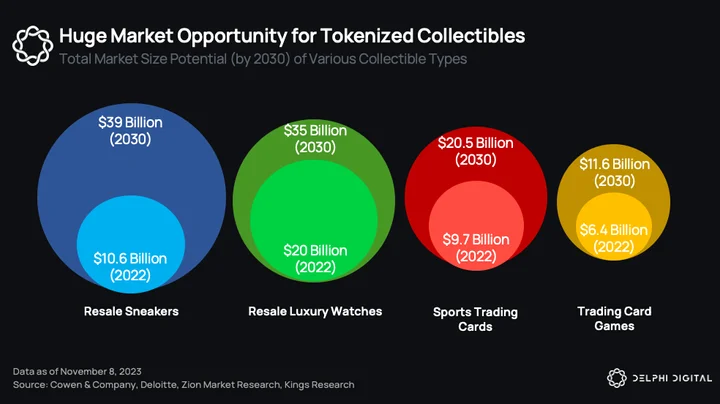 The market size for collectibles is larger than most people imagine.
Just sneakers, resale luxury watches, and trading cards in combination are a $40B+ market today that is expected to grow to $100B+ by 2030. If we conservatively assume that 10% of these collectibles will undergo tokenization, that’s a $10B+ opportunity with no market leader. StockX is one of the largest off-chain collectible marketplaces today, valued at $3B+.
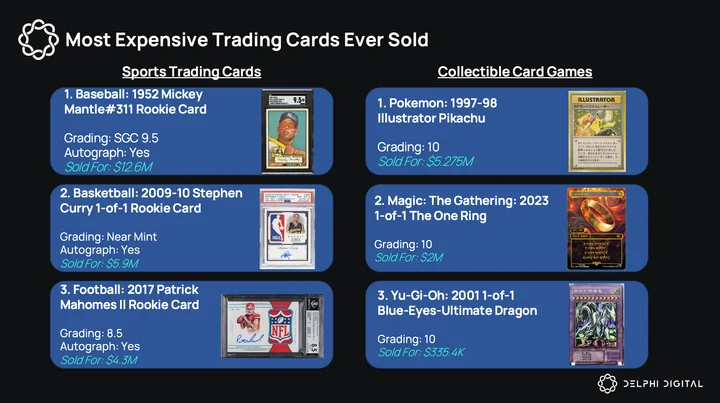 There is a real demand for collectibles, as evidenced by nose-bleed prices for some of the world’s rarest collectibles. For example, last August, an ultra-scarce, limited edition Grade 9.5 1952 Mickey Mantle #311 rookie card was the first trading card to sell for eight figures at Heritage Auctions.
Our thesis behind why tokenized illiquid & niche collectibles could take off is built around three major ideas:
- Lack of traditional financial infrastructure; “On-chain” solves this
If you go to your local bank looking to take out a loan using your $100,000 Pokemon rare card collection, you’ll likely be shown to the door.
There are reasons why TradFi doesn’t have the capabilities or interest to deal with collectibles:
- Valuation is subjective
- Highly illiquid
- Counterfeiting and authenticity risk
- Storage and security
While specialty lenders and pawn shops do deal with these alternative asset classes, they often charge exorbitant fees. Taking 20%+ of sale proceeds is common.
With this backdrop of limited infrastructure and high take rates, the financialization of collectibles could leapfrog traditional financial rails and rapidly come on-chain instead. Especially once the benefits of tokenization become more apparent and friction points are reduced. We’ve already seen a $1.1M on-chain loan taken out against a collection of Supreme T-shirts on Arcade, an NFT lending protocol.
Tokenizing collectibles also enables:
- 24/7, borderless access to liquidity
- Collectors worldwide can participate without the constraints of geographical boundaries or time zones, increasing the pool of potential buyers
- Better capital efficiency
- Tokenization enables fractional ownership, allowing smaller investors to capture the upside of high-value collectibles. Permissionless DeFi protocols can also create lending primitives to enhance the capital efficiency of these RWA collectibles.
- Reduced intermediary costs
- Tokenization reduces the need for numerous intermediaries in the asset transfer process, such as brokers and clearing houses, to opt to settle automatically via self-executing smart contracts.
2. Growing investor demand for collectibles
There is a growing demand to invest or speculate on these collectibles as awareness of their role as alternative investments grows. Web2 competitors like Collectable, Goldin, Rally, and Alt have ~$565M in combined collectible assets under custody.
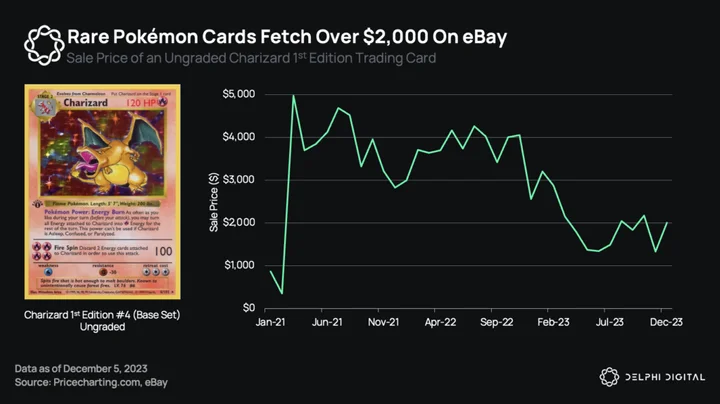
Amidst the COVID-19 pandemic, Pokémon cards enjoyed a notable resurgence on secondary markets. Collectors spent an estimated $224M on Pokémon cards at auctions and private sales in 2021 alone. An ungraded Base Set 1st Edition Charizard Pokemon card can fetch around $2,000 in the secondary market.
In order to speculate on these cards, a trader would typically need to buy on eBay (or a similar marketplace), take hold of the physical item, and handle storage and shipping. On the other hand, tokenized cards can be traded easily and multiple times on a global market without any friction of dealing with the physical card. Making it easier to trade unlocks the market for more traders to enter.
3. Creation of new consumer experiences & utility
Once collectibles are on-chain, gamification can make the collection experience much more interesting:
- Companies can target specific types of collectors (measured by their on-chain holdings) to create unique experiences and benefits for various cohorts of collectors. For example, Nike could target holders of a tokenized sneaker set with early access to their latest physical sneaker drop.
- Courtyard.io allows the person who tokenized the collectible to earn 1% fees on all secondary sales of the NFT
- Collectors can build virtual showrooms using no-code tools like OnCyber or Gallery since they all speak the same language: NFTs
We want to highlight two projects that are creating new consumer experiences: Courtyard & Myna Swap.
Courtyard.io — A Marketplace for Tokenised Trading Cards
Courtyard has been making waves in recent months due to their Pokémon card drops on Polygon. Operating as both a tokenization service provider and a marketplace for RWA NFTs, Courtyard allows collectors to vault and tokenize their graded trading cards and trade them. All cards on the platforms are authenticated and custodied in an insured vault at Brink’s to ensure integrity and redeemability.
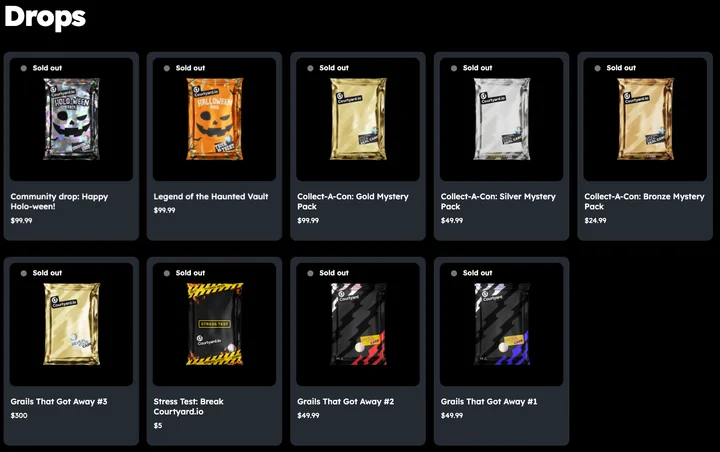
Pack drops can be as low as $5 each and often mint out in minutes. Within each pack is one graded Pokémon card vaulted at Brink’s, with different price points and probabilities of pulling a “grail” card. One lucky pack buyer managed to walk away with a mint-condition “Mario Pikachu” card worth $6,000. All pack openings are recorded on-chain to prove 100% fairness and randomness in distribution.
Courtyard’s daily transactions are small but have been on an uptrend in October, with the average daily transaction count increasing to 132 from 46 in September. The daily average number of buyers doubled to 60 from 30 in September. The number of unique wallets holding a Courtyard trading card NFT has increased to 1,000+, from just 385 in August.
Myna Swap — A Marketplace For Tokenised Sneakers
Myna Swap is a trading and vaulting platform built on Avalanche specifically for sneakers. Myna is backed by Coolkicks, a popular footwear company that sells stylish sneakers and clothing primarily aimed at millennials and Gen Z consumers. Coolkicks has a strong social media presence, with >1.8M subscribers on YouTube and often featuring celebrities like Gary Vee or NBA player Ja Morant.
Myna utilizes blockchain technology to facilitate ownership, proof of authenticity, and deeper liquidity on-chain. Tokenizing sneakers as NFTs tackles several problems faced in the sneaker resale markets, namely:
- Counterfeit products & lack of buyer protection make the trading experience risky
- Fragmented liquidity with a lack of good pricing information
Collectors can convert their physical sneakers into digital twins and buy, sell, and trade these vaulted items on the Myna platform. Tokenization and authenticity verification are done by Myna. All physical goods are vaulted in a high-security, temperature-controlled facility, and collectors can redeem the digital collectible for its physical match at any time. Myna is not live to the public yet and currently has an early access waitlist.
We could see Coolkicks kickstart the on-chain collectible market by bringing their large inventory on-chain. Since there is real demand already, customers will follow where the inventory goes. Putting these items on-chain enables interesting gamification mechanics: mystery boxes, token-gated VIP access to benefits/content, and token-driven incentive mechanisms.
If NFT speculators decide to join the game, we could see a speculative frenzy for rare collectible items. After all, they arguably have more real-world value than a Bored Ape PFP.
A Few Caveats
Tokenization of collectibles introduces a few new risks. There is a trust assumption — reliance on a centralized tokenization provider to ensure the authenticity and condition of the physical item. This can create some hesitation among existing owners. There are also long-tail smart contract risks.
Our Predictions For 2024
- Speculative trading on tokenized collectibles becomes a new narrative: e.g., rare Pokémon card NFTs could reach wild prices when on-chain speculators pile in.
- An eye-popping 7 or 8-figure sale of a tokenized collectible happens on-chain, generating lots of media attention.
- Large dealers tokenize their extensive collection of collectibles and bring them on-chain.
- Collaborative bidding for rare, high-value collectibles become more popular via DAOs or on-chain collectives. Consider how Constitution DAO was spun up to purchase an original copy of the US Constitution for $40M+. Group bidding has become extremely popular in China’s e-commerce market and could also happen with collectibles.
#4: New Token Standards Give NFTs Superpowers
The existing crop of NFTs can seem pretty basic to an outsider. They are static with limited interactive capabilities. But two new NFT standards are changing that.
ERC-6551 — Token Bound Accounts (TBA)
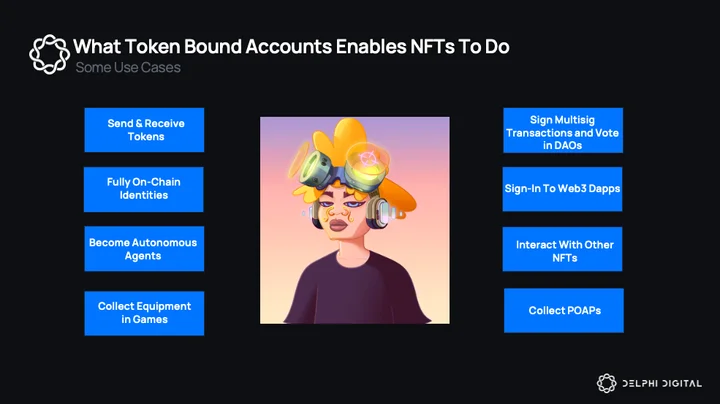
ERC-6551 was launched in May 2023 by Future Primitive. Every 6551-enabled NFT possesses its own personal wallet and a dedicated smart contract exclusive to that specific NFT, ensuring that only the owner of the NFT has access to the associated wallet.
NFTs can now do anything on-chain — take ownership of assets, execute on-chain actions, and interact with other apps. They have the entire Ethereum ecosystem at their disposal. The possibilities are limitless. Finally, NFTs are ready to transcend beyond “useless JPEGs”.
We’ve been waiting for this moment.
Potential Use Cases of Token Bound Accounts
6551 enables NFTs to have a dynamic state and be customizable on-chain. TBAs can work with any NFT, even if they were minted prior to May 2023. The Tokenbound website explains how this can be done.
TBAs are still quite new, and we’re only beginning to scratch the surface of what we can do. We expect that these use cases will expand in the coming year:
- PFPs can change their appearance by equipping other NFTs. They can develop their own reputation and personalities based on their on-chain activity. Stapleverse is one project doing this.
- Membership NFTs where reputation and rewards accrue directly in their wallets. This eliminates the need to take snapshots for airdrops or POAPs, which can lead to community unhappiness if executed poorly. Reputation can also transfer together with the NFT so it doesn’t get lost.
- Social networks enabled by dynamic, stateful identities. For example, an Otherdeed could own a Lens profile (which was recently upgraded to support ERC-6551). From there, it has the ability to access mailboxes, receive in-game messages, and engage in communication with other Otherdeeds.
- Web3 game avatars can directly hold equipment NFTs and earn in-game assets.
- Autonomous AI agents that can execute transactions and actions without human intervention. This is somewhat futuristic but almost inevitable. One implementation is in-game NPCs — Parallel Colony is trying to achieve this. Another would be the rise of virtual influencers (similar to vTubers) who can create entertaining content autonomously and be represented as TBAs.
In just six months, projects such as Lens Protocol, Collab Land, Polygon, Zora, and more than 20+ major teams are using or actively exploring this new implementation. There are more than 54K activated TBAs across all EVM chains, and more than 16.6K NFTs are held by these TBAs.
Source: Tokenbound.org
Polygon has the most number of NFTs with TBA activated (36.3K NFTs), mainly from 2 collections, including Dippi and Lens Protocol Profiles. Ethereum mainnet currently has 4.8K NFTs with TBA enabled, mostly across 4 main collections, including Cre8ors, Atticc, Sapienz, and the Managers.Are people utilizing these TBAs to conduct transactions? Ethereum TBAs account for 68% of the TBA transactions, while Polygon TBAs account for 32%, despite Polygon having 7 times more TBA NFTs.
A few reasons why we think TBAs will take off in 2024:
- There is usually a lag time between the launch of a new primitive and substantial usage due to the time needed for education, development, and good tooling to be built.
- The costs of deploying TBAs are quite reasonable. Deploying Token Bound Accounts in a single multicall costs 133,000 gas units (~$5.30 at 20 gwei/$2,000 ETH)
- The latest v3 version of TBA comes with multi-chain support, allowing NFTs to interact on chains beyond where they reside. This means your Ethereum NFT can perform transactions on Arbitrum and interact with other NFTs there.
ERC-7160 — “Doppelganger”
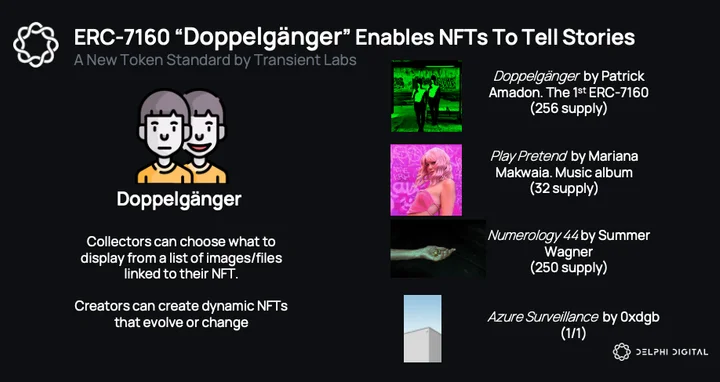
ERC-7160 by Transient Labs enables NFT collectors to choose what to display from a list of images/files linked to their NFT using an array function. These files could be GIFs, JPGs, MP4s, etc. This is unlike vanilla ERC-721 NFTs, which can be linked only to a single file via its metadata.
This creates a new form of customization and dynamic ownership experience for collectors. This is especially interesting for art and creative works.
- Patrick Amadon is the first to use this with his collection “Doppelganger”.
- 0xdgb released “Azure Surveillance”, offering five different aspect ratios of the same artwork in a single NFT
- Mariana Makwaia’s “Play Pretend” is an evolving music album that encapsulates multiple songs directly within the NFT, but only one is on display at any time.
Our Predictions For 2024:
- Existing NFT projects (including big-name ones), and new projects, will activate TBA for holders and do interesting things with them. TBAs are a big unlock for the creative use of NFTs.
- NFTs existing as static images become a thing of the past. More new standards that enable NFTs to be dynamic will emerge.
- TBAs become a standard implementation for Web3 games building on EVM chains.
Other NFT Themes to Pay Attention to
Blur Set To Blast Off in 2024
Blur, the leading NFT marketplace on Ethereum, is going big. Pacman, the founder of Blur, unveiled his plans for Blast in November — a Layer-2 blockchain built on the Optimism stack and promising native yield. This strategic move is motivated by the need for robust infrastructure to support Blur’s future endeavors, such as the development of NFT perpetual products.
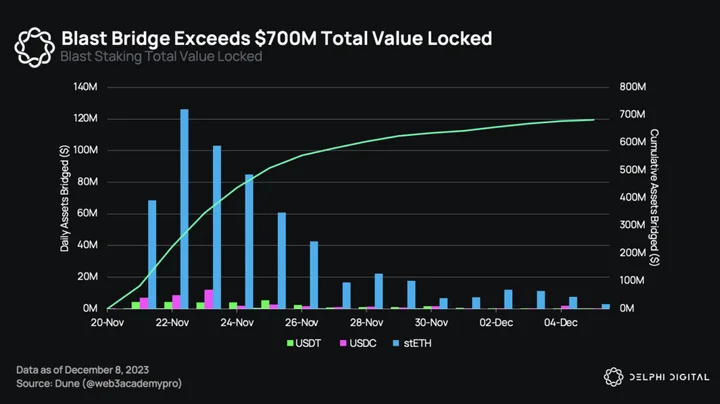
Despite some controversy that Blast only exists as a multisig wallet today, the community has shown substantial confidence. More than $760M in funds are already locked on Blast, and withdrawals will only be enabled in February 2024. The BLAST airdrop will happen in May 2024.
These will be two major events to watch for next year. Where will money flow after withdrawals are enabled and the airdrop happens? Could some of it directly flow into NFTs, giving the market strength?
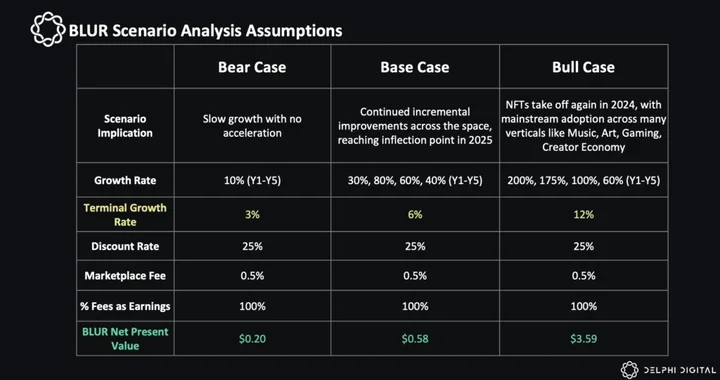
Our fundamental analysis of Blur in August highlighted BLUR as a prime opportunity to benefit from the potential recovery and expansion of the NFT market. It has a strong narrative. We opined:
“Blur is poised to be a frontrunner in this resurgence. The platform is primed and ready, with several positive catalysts on the horizon, to capitalize on the growing enthusiasm and investment in the NFT space.”
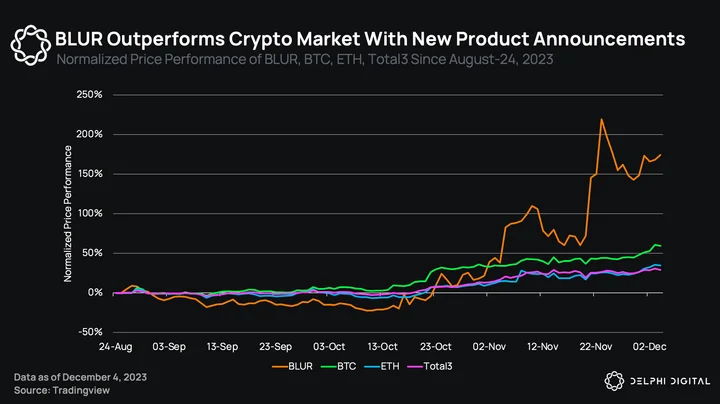
Since the release of our report, the price of BLUR has doubled, outperforming most of the crypto market within the same time period. At a $1.4B FDV (11 December), BLUR is at a similar valuation to OpenSea’s bear market valuation but is doing significantly more volume, making it a compelling opportunity if you believe NFT markets will rebound.
Looking ahead to 2024, we anticipate a growth period for Blur, marked by new product launches (such as NFT perps), the activation of Blast, and a possible NFT market boom.
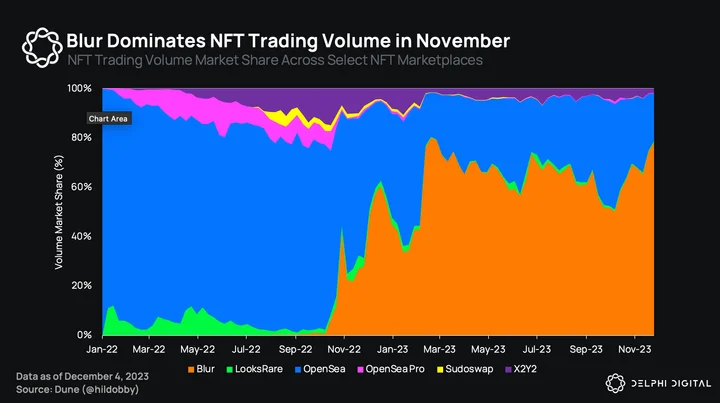
Blur remains the dominant NFT marketplace on Ethereum, with a 60%+ share of total volumes. OpenSea comes in at a distant 2nd place (32%). Overall, it has been a tough year for NFT marketplaces because the steep drop in trading volumes has significantly impacted their revenue.
This year, OpenSea had to lay off 50% of its staff, and one investor marked down the valuation of their OpenSea equity stake by 90% (from a $13B valuation to $1.4B now). We would not write off OpenSea yet: it still has strong brand awareness, and its CEO has talked about revitalization with ‘OpenSea 2.0’. Despite the mishaps and confused strategy that led OpenSea to lose its dominance, it has a small window of opportunity to turn things around. And maybe, just maybe, it might finally launch a token.
Major Consumer Brands FOMO into NFTs
Remember the good ‘ol days? Billion-dollar consumer brands were FOMO-ing into NFTs in 2021.
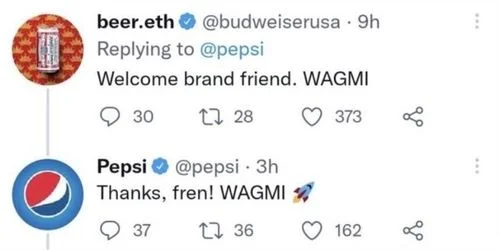
History is going to repeat itself soon.
A few brands were early to recognize the Web3 opportunity — Adidas, Nike, TIME, Gucci. They entered during the hype phase of the NFT bull market in 2021 – 2022. Nike (via its acquisition of RTFKT) sold $93M of NFTs and made another $92M from royalties. Dolce & Gabbana sold $23M of NFTs.
Yet, in retrospect, most of their early “success” was from being at the right place at the right time — riding on the NFT bull market and speculative fervor. Today, many of these 2021-early 2022 vintage projects appear dead: no secondary trading volume (a proxy for demand) and a discord server akin to a ghost town.
Brands should not worry about having missed the boat.
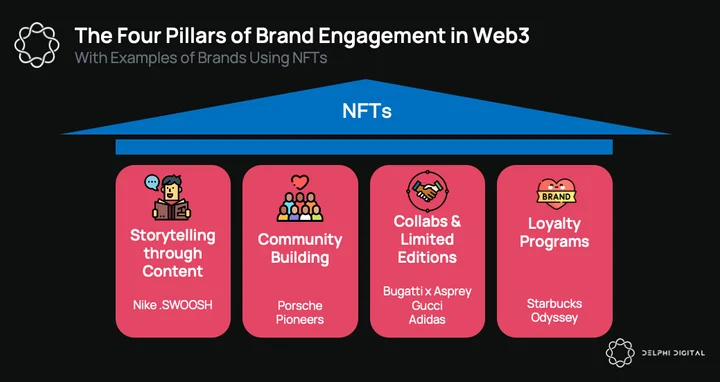
In fact, the next generation of brands embracing NFTs will have a greater chance of achieving long-term success. They can draw valuable insights from previous brand experiments, learning from their successes while avoiding their mistakes. In 2023 alone, we saw Starbucks, Nike (.swoosh), Porsche, Bugatti, Mercedes-Benz, and several other top consumer brands experiment with NFTs.
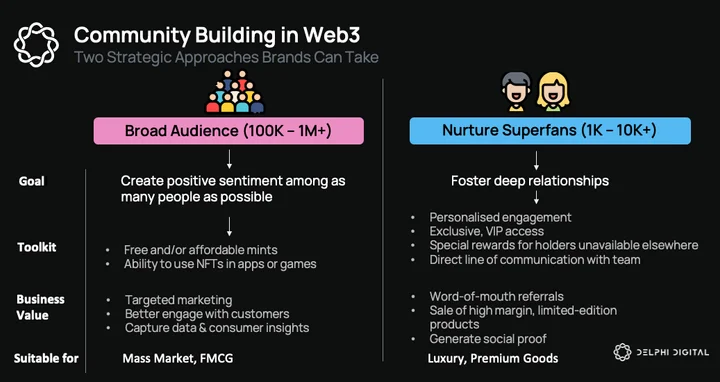
The holy grail of Web3 and NFTs is giving brands the power to connect with their customers more closely and co-create with them. Building a sense of community can foster brand loyalty and provide an authentic platform to engage in real-time dialogues with customers. NFTs create a sense of psychological ownership, which supercharges tribes and drives greater cooperation.
Brands have two primary paths for community-building: targeting broad audiences or focusing on a core group of superfans. While these approaches aren’t mutually exclusive, they do demand different strategies.
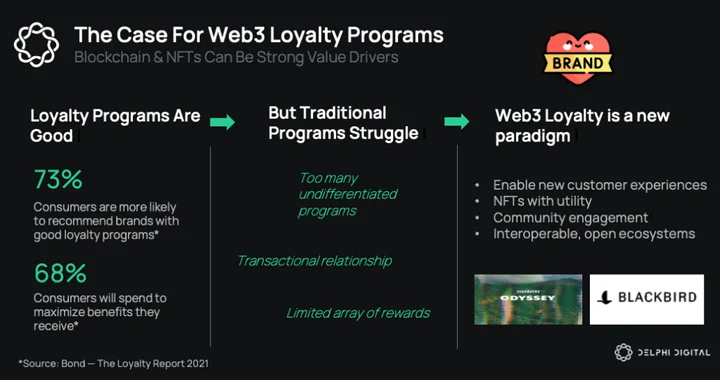
And let’s not forget about loyalty programs. NFTs have the potential to reinvigorate existing loyalty programs with new experiences and utility. These include special offers, early access to products, discounts, and priority access to stores or events.
On-chain activity will be a treasure trove for understanding customer behaviors deeply. Brands can observe actual user behaviors on-chain, beyond just their brand, and offer consumers highly personalized experiences that were not possible before. NFT metadata can be used to track loyalty progress and achievements with the brand as well as with its partners. Starbucks is one major brand that is trailblazing the path forward.
We expect many more top brands to enter in 2024, onboarding their millions of customers. For a deep dive into lessons and strategies for brands, refer to our 45-page report on Brands & NFTs: How Web3 Is A Game Changer For Brand Growth
NFT Finance Expands
Outside of marketplaces, we are watching two verticals in NFT finance closely because they have the greatest potential for growth in the coming year. These are:
- NFT Lending (credit markets)
- Derivatives (perps & options)
Let’s face it: NFTs are illiquid assets. While they can hold significant value, converting that value into liquidity can be a slow and cumbersome process. NFT lending disrupts the status quo. Owners can unlock liquidity quickly and efficiently by collateralizing their NFTs.
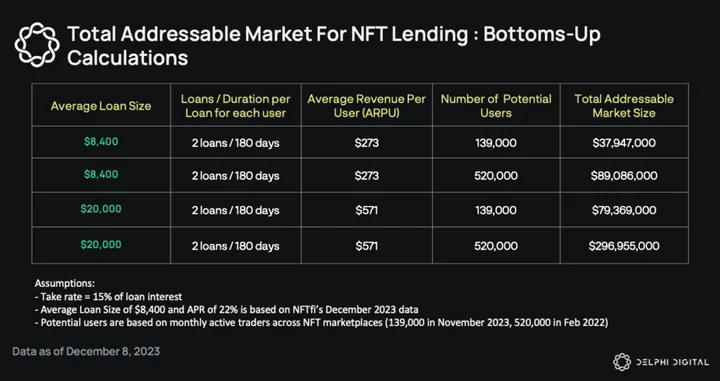
In our September deep dive report examining the state of NFT lending, we noted that while the total addressable market for NFT lending is presently small, there are a few scenarios that can lead to major expansion in the near future:
- Real-World Assets gain adoption. BCG predicts that the market for on-chain RWAs will be a $16 trillion business by 2030. The burgeoning RWA ecosystem also presents significant opportunities for the NFT lending sector.
- NFTs go on a bull run. Given the vast potential use cases of NFTs, it’s easy to envision a future where NFTs reach 5-10% of crypto’s market cap. An NFT bull run would lead to an exponential rise in the TAM for NFT lending because it increases the average loan size (due to rising asset prices) as well as the total number of NFT users/traders.
- Interest rate opportunity and arbitrage. One of the most compelling arguments for the growth of the NFT lending market is its attractive yield — particularly compared to the rest of DeFi. This has led to a surge in interest, with an expanding group of lenders keen to capitalize on these lucrative returns.
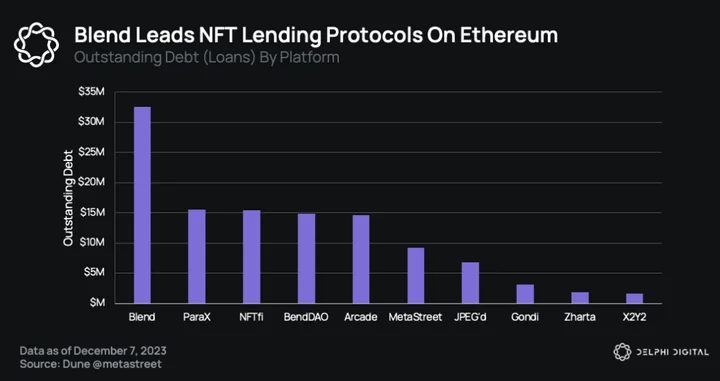
Blend, NFTfi, and Arcade are the 3 top peer-to-peer NFT lending protocols on Ethereum.
Arcade and NFTfi are running incentive programs and will likely launch tokens in the coming year. NFTfi has already announced that its Season 2 rewards will end on 26 March 2024, implying that an airdrop could happen after that based on points earned. Arcade also has a points program based on loan volume and activity.
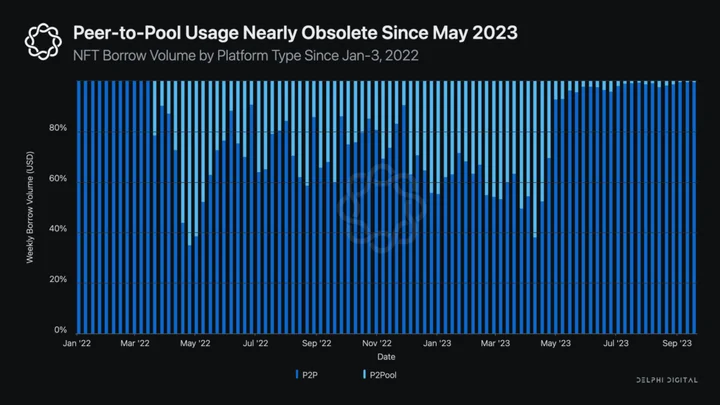 Looking ahead for NFT finance, we anticipate that:
- NFT finance will expand in tandem with the growth of the NFT market.
- Peer-to-Peer lending is expected to maintain its dominance over Peer-to-Pool lending because of fewer protocol risks, liquidation risks, and oracle dependencies. Established protocols like NFTfi & Arcade and newer lending protocols like Gondi will continue to enhance the user experience.
- Larger lending entities will emerge. Smaller retail lenders may pool their capital into DAOs or aggregator-type platforms (like Spice Finance or Metastreet) to optimize efficiency.
Conclusion
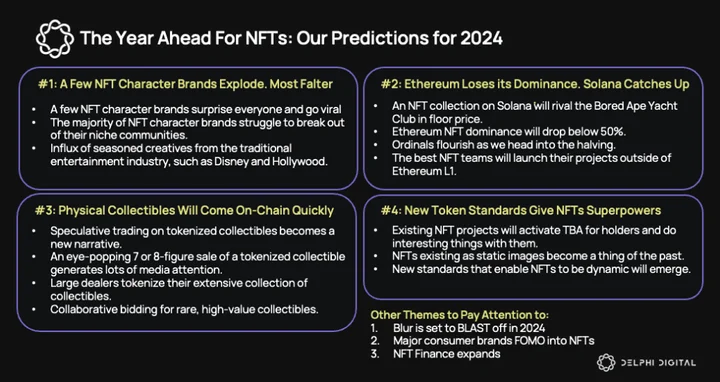
In summary, the year ahead looks incredibly promising for NFTs.
As we mentioned in last year’s report and still strongly believe today, NFTs are crypto’s first major mainstream opportunity. The fact that the NFT market is still relatively small compared to the broader crypto market suggests that we’re in the early stages of this journey.
New technology is opening up fresh opportunities. Mark our words: a creative and cultural renaissance is upon us.


0 Comments