Report Summary
Crypto is entering the aggregation era: Value is shifting to platforms that own the user interface as distribution costs collapse.
Crypto superapps are aggregation layers: They unify best-in-class protocols into one interface with one identity, one balance, and one activity feed.
Aggregation consistently wins: Across e-commerce, social, and fintech, users pay a premium for convenience, fewer apps, and reduced friction—crypto follows the same pattern.
Crypto superapps scale faster than TradFi: Features can be added via protocol integration rather than costly builds or acquisitions, enabled by 24/7 markets and composability.
Why now: UX maturity, regulatory clarity (US, EU, Asia), and real-world financial utility have removed prior adoption bottlenecks.
The core battle is the daily surface: Winning platforms secure a high-retention wedge product, then expand vertically once user attention is locked in.
Coinbase’s strategy: Evolving from a cyclical exchange into an “Everything Exchange” via Base (OS), Base App (interface), stablecoins, subscriptions, and derivatives.
Endgame: The durable moat is distribution and attention—platforms that seamlessly blend centralized trust with decentralized rails become financial infrastructure.
The Quest for Crypto Superapps
The aggregation era follows a familiar rule of digital markets: when distribution gets cheap, value shifts to whoever owns the user. In crypto, this idea showed up as the Fat Wallet thesis earlier. What’s different now is that the stack is finally mature enough for true crypto superapps (aggregated giants) to exist without being limited to the wallet form factor.
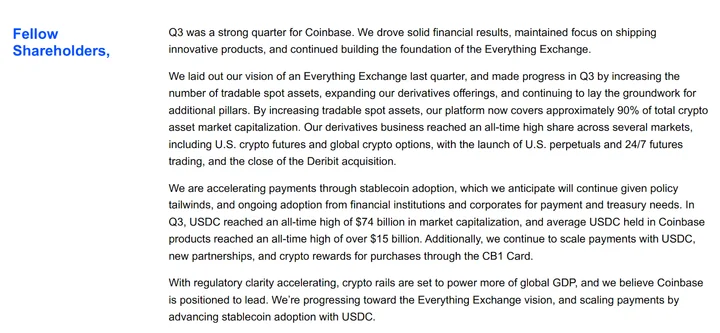
Coinbase’s Q3 shareholder letter reads like a claim to become the first Everything Exchange: spot, derivatives (Coinbase Advanced, Deribit), payments (USDC, Coinbase Commerce, x402), launchpad (Echo), and a pipeline of new products distributed through Base. It’s one of the clearest signals that the market is moving toward consolidation at the application layer.
What is a Crypto Superapp?
For the purpose of this report, a crypto superapp isn’t a monolithic do-everything product built end-to-end by one company. It’s an aggregation layer: a unified interface that curates and integrates best-in-class protocols already available in open markets.
Their job is to compress most of a user’s onchain and financial life onto one surface, built around:
- One identity (wallets/accounts)
- One balance (majors, stablecoins, tokenized assets)
- One feed (a single interface for onchain actions)
Why Aggregation Wins
Aggregation has been the internet’s most valuable business model: companies that don’t own supply, but win by owning discovery, workflow, and distribution. The pattern shows up repeatedly:
- Internet aggregators: Amazon (marketplace aggregation), Meta (social/content aggregation).
- Mobile superapps: WeChat’s mini-program ecosystem; Grab’s expansion from ride-hailing into a multi-product platform.
- Fintech: Nubank, Revolut, Cash App – each bundling services to outcompete legacy banks by reducing friction.
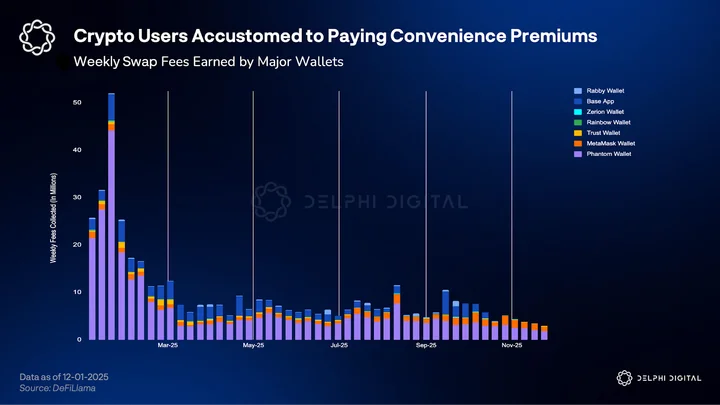 Different sectors, same outcome: users pay a steep convenience premium for fewer apps, fewer logins, fewer handoffs. Wallets and trading terminals raking in millions of dollars in fees proves that crypto users too aren’t opposed to paying additional fees for such convenience.
Integrate vs. Acquire
Fintech aggregation works, but it’s constrained by the cost of expanding on legacy infrastructure. Adding a new line of business usually means one of three slow, expensive paths:
- Build (years of licensing + R&D across jurisdictions)
- Acquire (e.g., Block buying Afterpay to gain BNPL capabilities)
- License-hunt (buying entities primarily for regulatory permissions)
Crypto overhauls the expansion economics: a superapp can add functionality by integrating a protocol, not buying a company. Basic integration advantages compared to fintech start compounding:
- Global, 24/7 liquidity by default. No market hours or T+1/T+2 settlement constraints.
There was a time when you couldn’t trade stocks on your phone. Imagine explaining to someone in 2035 that back in 2025, markets closed on weekends and holidays.
Tokenization will unlock 24/7 markets, and once people experience it, they’ll never go back.
It’s the same story…
— Vlad Tenev (@vladtenev) November 11, 2025
- Composability: Protocols share a global backend. Users can chain actions that would require legal contracts and long drawn partnerships in fintech e.g., borrow against tokenized T-bills, receive USDC, and deploy it into perps.
- Mini-app distribution: Crypto superapps can become the distribution layer, allowing 3rd party developers to build and share mini-apps within their ecosystems. Think Tencent’s Wechat strategy applied to financial services.
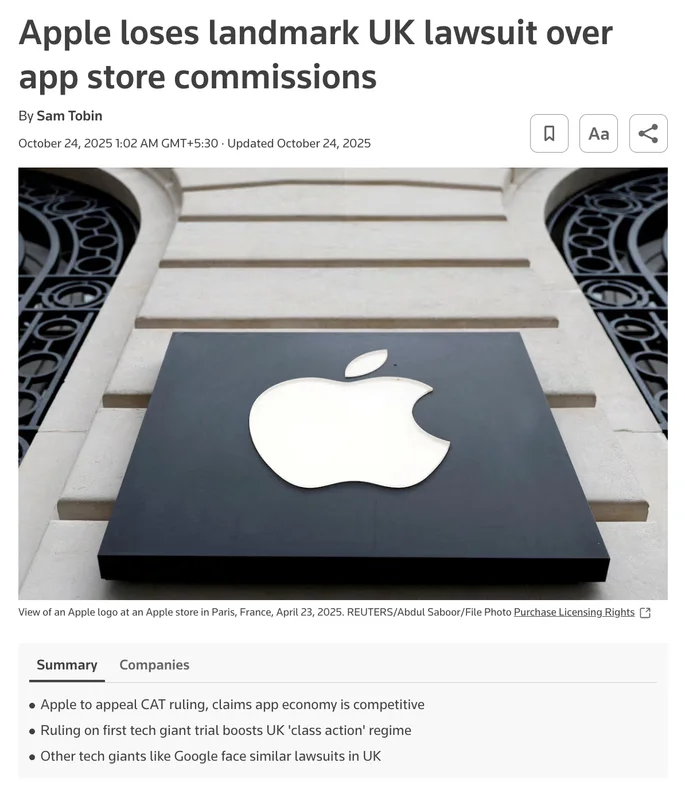
This is in line with a larger shift: as app-store gatekeeping weakens globally, distribution will expand beyond Apple/Google’s playstores and their high taxation of third party developers will clear the way for new app distribution channels. In that environment, embedding inside dominant surfaces (superapps) becomes a rational strategy for smaller apps.
Why now?
- Tech Maturity: Smart accounts, secure bridging and cheap L1, L2 blockspace have finally solved the UX and cost friction that stalled previous cycles.
- Regulatory Clarity: The shift from enforcement to clear frameworks [US (FIT21, GENIUS), EU (MiCA) and Asia (AGDM)] has de-risked the sector and invited institutional capital.
- Expanded Utility: The ecosystem has moved beyond pure speculation to offering a complete menu of actions from RWAs, yields, consumer credit to prediction markets.
The Superapp Stack
The most bullish aspect of the crypto superapp thesis is that no single team has to build it all. The supply of these services is already permissionlessly available. The task now is to aggregate these modules into a single seamless interface.
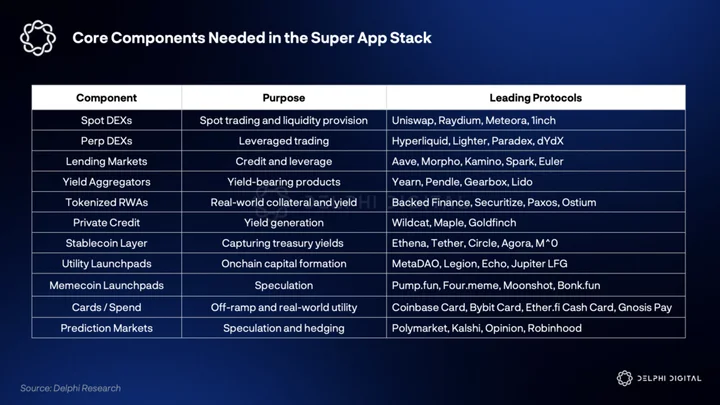
Improvements at the individual component level are going to happen in a staggered manner with step function improvements coming infrequently. Some developments that we are looking forward in 2026 includes:
- Broader proliferation of Prop AMMs e.g. HumidFi, Tessera V, SolFi
- Liquidity Infrastructure like 1inch Aqua, Barter Superposition
- Orderbook based lending e.g. Avon
- Under collateralized lending and consumer credit e.g. 3Jane
- Growth of non-USD denominated stablecoin bring FX volumes onchain
- Non-custodial crypto cards embedded with DeFi yield for idle assets
- Launchpad auction mechanisms maturing for fairer launches e.g. Uniswap’s Continuous Clearing Auction, Doppler Multicurve
The GTM Battleground
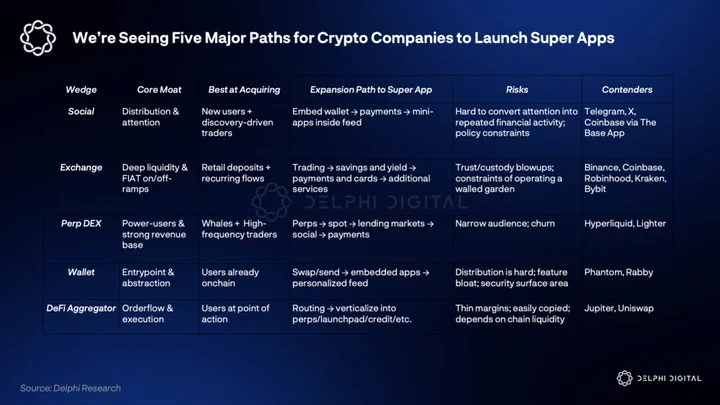
Building a Superapp is not a one time event; no one can build everything at once. Success in the web2 world has proven time and again that it requires a team to identify a specific, high-retention wedge – a singular value prop that hooks a user base and then verticalizes aggressively from there.
We will dive into the forerunners and counter-positioned teams in the market to understand the path they are taking to realize this vision.
Coinbase
Coinbase is running multiple plays at once. On one flank it’s cementing itself as the institutional partner and custodian that Wall Street can work with. On the other it’s pushing hard into the onchain economy through Base, and building the crypto native social layer via The Base App.
This duality explains the urgency of Coinbase’s 2024–2025 pivot. For most of its life, Coinbase’s P&L behaved like a leveraged instrument on Bitcoin: bull markets meant retail frenzy and transaction revenue; bear markets meant volumes evaporated. The last few years have been an explicit attempt to de-risk the business model. They’re doing this by turning Coinbase into a platform that earns when users trade, hold, stake, spend, and build.
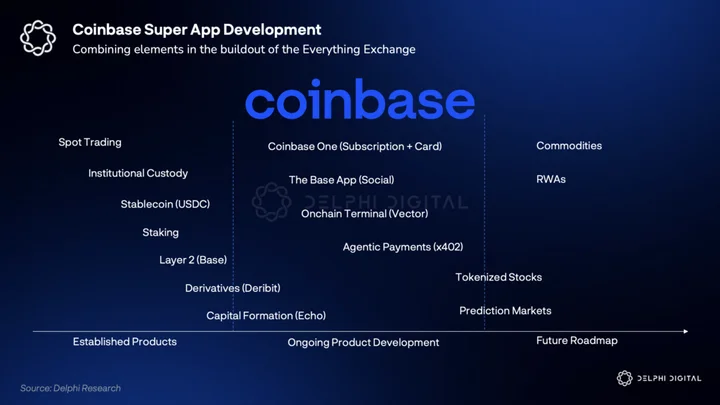
Financial Diversification
The clearest proof is the revenue mix shift. In 2020, transaction revenue made up 96% of the top line. By late 2025, the profile looks meaningfully different and transaction revenues are projected at 60%, with Subscription & Services expanding to 40%.
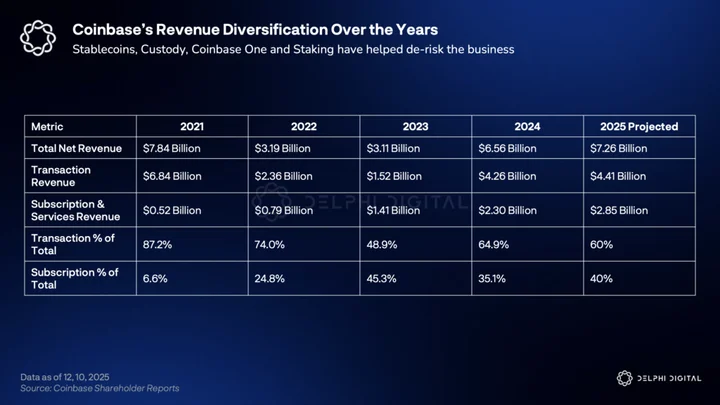
This is how revenue diversification should happen. Coinbase has been productizing based on its balance sheet and monetizing all the plumbing: custody, yield, payments, stablecoins and infrastructure.
The Subscription and Services Business
USDC
The most important non-exchange lever is stablecoin revenue, driven by Coinbase’s economics with Circle around USDC reserve yield. As USDC grows on Coinbase and spreads across DeFi via Base, Coinbase’s take expands with it.
In Q3 2025, stablecoin revenue hit $354.7M (+44% YoY) changing the shape of Coinbase’s previous cyclicality. Trading volumes can collapse in a bear market, but stablecoin balances tend to be stickier because many users park risk-off capital in stables on the exchange. Coinbase gets paid in both moods: risk-on speculation and risk-off cash management.
And if USDC keeps growing to become the default settlement currency across Coinbase, Base, and payment rails (like Tempo by Stripe), they get something crypto products rarely enjoy: an earnings floor that doesn’t require market euphoria.
Staking Rewards
The transition of Ethereum to Proof-of-Stake provided Coinbase with an opportunity to monetize its assets under custody (AUC). By offering Staking as a Service, holders of ETH, SOL, and other PoS assets can earn yield without managing complex validator infrastructure.
Whilst being a relatively smaller revenue driver, this is a valuable business line as it improves customer retention and allows Coinbase to monetise on top of user holdings. The growth in this segment is driven by institutions, who have become comfortable with holding crypto via Prime and are now seeking yield on idle assets. Coinbase’s ability to offer regulated, secured staking is a significant competitive advantage over decentralized protocols or offshore competitors.
Coinbase One
This is where Coinbase is trying to convert their problems (customer dissatisfaction and high trading fees) into a relationship product.
For a tiered monthly fee, users get fee relief on capped volume, boosted rewards, and priority support. They are reshaping user behavior by introducing the subscription plan. A subscription creates a sunk-cost effect: once users pay, they’re incentivized to consolidate activity and asset holdings on Coinbase to maximize value, starving competitors of volume.
This again dampens the most painful part of exchange economics: the lumpy dependence on retail trading spikes. Coinbase doesn’t need users to overtrade; it just needs them to stay subscribed now.
International Exchange and Derivatives
The final piece of the business diversification is the expansion into derivatives, with the launch of the Coinbase International Exchange and the Deribit acquisition. In the global crypto market, spot trading represents a small fraction of volume and derivatives account for up to 80% of volume. Historically, Coinbase gave way to other players like Binance, Bybit, OKX, Deribit to capitalize on this opportunity.
With the Deribit acquisition they’ve shown intention to grow this business line. With Deribit the orderflow is unique and perennial. Institutional hedging occurs throughout the market cycle, ensuring transaction revenue persists even when prices are falling.
The Superapp Buildout: Base L2 (OS) + The Base App (Interface)
With the financial diversification in place, Coinbase has started the next leg of their everything exchange vision. Superapps learn that having every feature matters less than being where users show up every day. If they own the daily interaction surface for users, they can route them to anything: CEX, DEX, loans, payments, yield, mini-apps without losing the relationship.
The Base App
The Base App has been designed to become this daily surface. It caters to a wider audience by becoming a social feed rather than a financial tool. And they’ve made the UX visibly simpler for a new user –
- Passkeys over seed phrases (biometric recovery)
- Sponsored transactions (paymasters) so users aren’t forced into buying ETH for gas
- Magic Spend for users to complete onchain actions with their Coinbase Exchange balances
The goal here is clearly to push the larger user funnel of the centralized exchange to come onchain to Base. And on Base, third party developers are building additional apps and experiences for users to get further immersed in the coinbase ecosystem.
Base L2
If Base App is the interface, Base L2 is the operating system. The strategic choice to build an Ethereum-aligned rollup instead of a closed, proprietary chain has worked well. Coinbase gets to reap the benefits of the developer tooling and community while still capturing the economic benefits that come with being the dominant distribution surface.
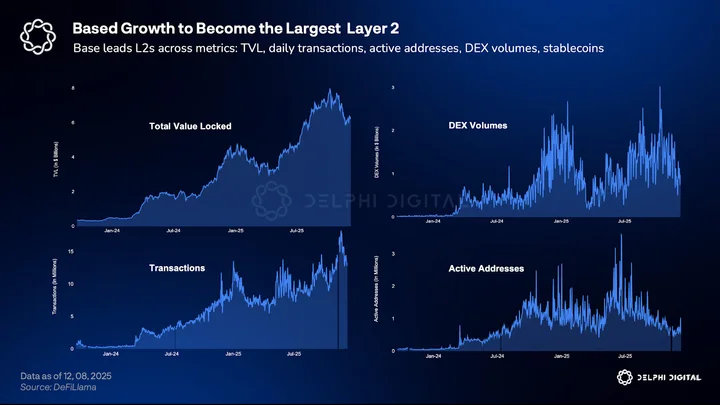
Coinbase’s distribution power is visible in the growth of their Morpho loans product. Offering BTC backed loans for their users directly from the Coinbase App has grown Morpho markets on Base to issue over $905M in active loans. The flywheel on display is amazing: builders use coinbase’s strengths to grow products on Base and Coinbase will utilize this growing DeFi ecosystem to introduce new financial products and services in their superapp.
Base has been among the most vocal ecosystems to explore and support apps beyond DeFi, particularly emphasising on consumer crypto and payments. Crypto has had a tendency to alienate users with hyper-financialization. This is an attempt by Base to utilize the core competencies of crypto but while still catering to previously alienated users.
Coinbase should expect fierce competition from Stripe in the crypto payments category with the upcoming Tempo launch. To match with Stripe’s dominance of the payments category: Coinbase has been gearing up to provide agentic payment rails with x402.
Mergers & Acquisitions: Buying Missing Primitives
Every crypto superapp will take pages out of the Amazon playbook. Proven product categories will be either built inhouse or will be quickly acquired to maximize the revenue capture (The Amazon Basics model). Coinbase has completed a few strategic acquisitions recently:
- Deribit (May 2025 – For $2.9B): Brings in deep derivatives liquidity and institutional options dominance. Deribit also plugs into the International Exchange whilst capturing ~90% of the Bitcoin options open interest
- Echo (Oct 2025 – For $375M): Brings fundraising and asset issuance closer to Coinbase. An exchange’s lifeblood is new assets, and Echo moves Coinbase earlier in that lifecycle. Post acquisition, Coinbase hosted the biggest ICO of 2025 (Monad raising $187.5M)
Tying it Together
Coinbase over the last decade has cemented its position as the most trusted crypto exchange visible in their monopoly as the ETF asset custodian. They’ve focused on strengthening their global regulatory positioning by securing licenses in key jurisdictions: EU approvals through MiCA license, Singapore and Bermuda (for the International Exchange).
There’s still room for improvements in their current offerings: reduced fees, prompt customer support and a competitive listing strategy. And they have been addressing these problems slowly so that they can then focus on the future – The Everything Exchange
Coinbase has placed its bet – that the future winner won’t be the most decentralized system or the most centralized one. It’ll be the company that blends both without the seams showing.
- a WeChat-like surface in Base App,
- an open OS in Base,
- an NYSE-grade liquidity hub in Exchange + Deribit,
- a Institutional vault in Prime,
- a Membership program in Coinbase One that keeps users from wandering.
If it works, Coinbase graduates from exchange to financial infrastructure. Not because it wins a category, but because it wins the right to sit between everyone: traders and builders, stablecoins and RWAs, humans and agents. The moat Coinbase has started digging is a distribution-and-attention moat. And those are the ones that last.
Robinhood
Robinhood is a beneficiary of a macro swing most fintechs only talk about: after a decade of unbundling (separate apps for trading, banking, crypto), the next era will be defined by rebundling as everyone realizes fragmentation strands capital. When funds are trapped behind settlement windows and app boundaries, users keep more money idle than they should.
Robinhood’s play is to centralize liquidity and maximize velocity of the money flowing in their system. Sell a stock, redeploy instantly, spend through a card, sweep cash into yield, or rotate into crypto without leaving the Robinhood app. It’s the superapp thesis in its simplest form: own the balance, own the behavior.
There’s also another tailwind no platform can ignore: the great wealth transfer. As assets move from baby boomers to a digital-native generation over the next two decades, Robinhood wants to be the on-ramp where that cohort manages their wealth. The signal is already visible in Robinhood’s balance sheet: Retirement AUC hit $24.2B in mid-2025, doubling YoY, proving the platform is graduating from a trading app to a wealth manager.
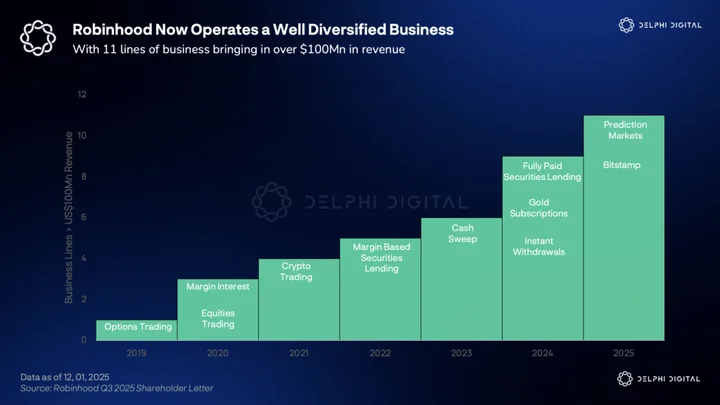
Robinhood already is a financial superapp by all accounts. Within less than half a decade they have moved away from a reliance on volatile retail trading revenue (PFOF).
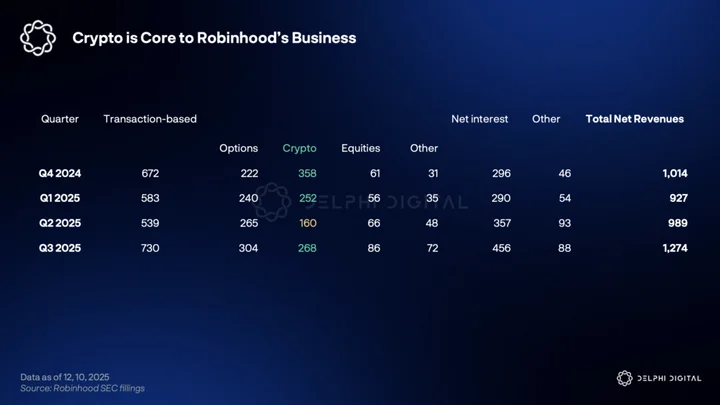
Crypto has become comparable to their options transaction revenue and shows how crypto is no longer a side note but a major business line. And Robinhood’s crypto ambitions are going to be critical in their attempt to build the financial superapp.
Robinhood Gold
If Coinbase’s flywheel starts with USDC yield, Robinhood’s starts with Gold. Robinhood Gold has evolved from a simple premium tier into an inescapable flywheel of value and lock in.
The 77% YoY growth in Gold subscribers is arguably one of the most critical metrics in their Q3 report. It proves their transition to a relationship bank is working. As part of the Gold flywheel, Robinhood uses Gold ($5/month or $60/year) as a loss leader to incentivize asset consolidation. The logic is simple:
- Create The Hook: Offer market-leading rates (3% Cash Back Card, 3% IRA Match, 3.5% interest on cash) that are mathematically irrational for a user not to take if they have significant assets.
- Lock-in Users: To keep these benefits, users must remain subscribed and keep assets on the platform (e.g., the 3% IRA match requires a 5-year hold).
The Gold Card also closes the loop on spending data. Robinhood now sees a user’s paycheck (Direct Deposit), their savings (Cash Sweep), their investments (Brokerage), and their daily spend (Credit Card). This in time will allow for superior credit underwriting compared to other banks.
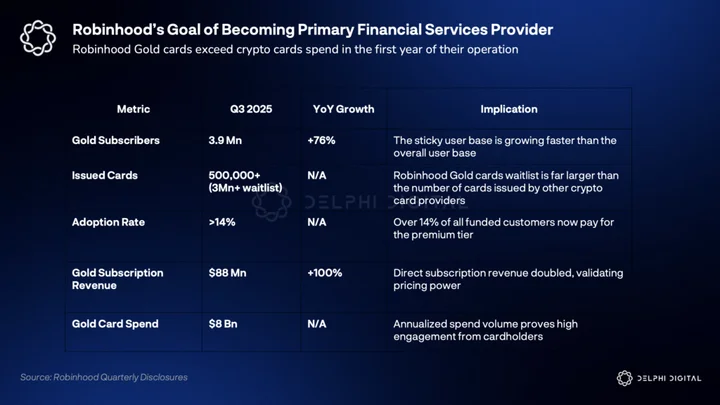
The 3% IRA Match, 3% Cashback and 3.5% interest on cash deposits are risky and expensive customer acquisition costs (CAC). If the Fed cuts rates significantly in 2026, Robinhood’s Net Interest Income (NII) drops, but they could be locked into these high payouts.
Capturing the Prosumer
Given that Robinhood is currently in the lead to build the financial superapp, one major risk for them has been to reduce churn or graduation of most profitable users to other platforms like Charles Schwab or Coinbase Advanced. Robinhood’s solution to this is to build a trading venue for the Active Traders.
Robinhood Legend: Closing the Tooling Gap
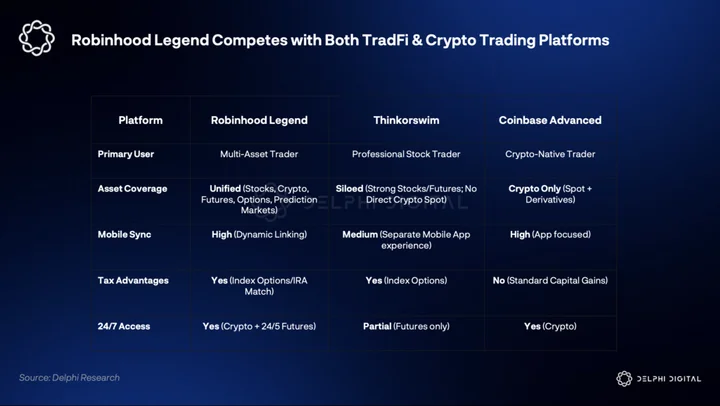
Legend is a defensive moat: it gives serious users pro-grade workflows without forcing them into a different ecosystem. The most important feature is the platform continuity. Dynamic linking keeps mobile and desktop as one session, which matters when the app is trying to be the one surface for all user interactions.
Futures: Gateway to 24/7 Markets
The introduction of Futures (S&P 500, Oil, Gold) is a neat behavior modification tool. Futures trade 24 hours a day, 5 days a week. This product bridges the gap between the rigid NYSE schedule and the 24/7 crypto market, keeping users engaged with the app around the clock. Add the 60/40 tax treatment for products like Index options and they’re explicitly targeting higher-net-worth, higher-velocity traders.
Tokenization Play: Export Robinhood to the World
If Gold is the retention mechanism, tokenization is their expansion mechanism. Robinhood’s tokenized equities push (starting in Europe) is basically a play to bypass the friction of cross-border investing and compete with local incumbents (like Revolut) on access and simplicity. A fundamental rethinking of the product led them to issue assets as tokens which simultaneously appeals to the crypto-native audience too.
Market Breadth & Depth: They already offer over 400 US-listed companies and ETFs (e.g., Nvidia, Apple, Vanguard S&P 500) to EU customers. In a controversial move to drive adoption and hype, Robinhood offered tokenized shares of private companies like OpenAI and SpaceX, signaling a future where retail investors could access pre-IPO equity via tokens.
In Beta Phase
It is important to understand that the current iteration is akin to them testing the waters and building investor appetite. In its current form, users are trading derivatives that track the price, not the actual underlying stock.
Robinhood (via a SPV) holds the actual share of Apple or Tesla as a US custodian. They then mint a shadow token onchain that tracks the price 1:1. This model has its limitations:
- No Self-Custody: Users cannot withdraw these tokens to a non-custodial wallet yet.
- Trading Hours: Currently limited to 24/5 (closed on weekends), unlike true crypto markets.
- Counterparty Risk: Users currently hold IOU. If the entity becomes insolvent, the claim on the derivative can fail.
Robinhood’s stated endgame is to migrate these assets from a private database into a public L2 built on Arbitrum Orbit. This unlocks:
- True Instant Settlement: Moving to L2 enables Atomic Swaps. Trade settlement happens in the time it takes to produce a block, freeing up capital stuck in the T+1 settlement cycle.
- 24/7 Markets: A decoupling from the NYSE’s schedule allows trading to reflect real-world events (e.g., an earnings report or geopolitical event) instantly, regardless of time zone.
Scaling Distribution: Bitstamp
To go global quickly, Robinhood needed licenses and institutional-grade crypto infrastructure. The $200M Bitstamp acquisition (June 2025) is best understood as a regulatory shortcut to gain a footprint that would have taken years to assemble organically.
It also creates another line of business that most people will underweight: Bitstamp-as-a-Service, a white-label stack for banks and fintechs that want to offer crypto exposure without building it themselves.
Entering into more Crypto Profit centers
Stablecoin Issuance
Robinhood has taken note of the economics behind stablecoin issuance and Coinbase’s USDC revenue. USDG (Global Dollar Network) is Robinhood’s entry into this category. By co-creating this network with partners like Kraken, Galaxy, and Anchorage, Robinhood moves from a mere distributor to a co-issuer.
Instead of earning a small transaction fee on crypto purchases, Robinhood will now share in the Net Interest Income (NII) generated by the US Treasury reserves backing the USDG held by its users.
Prediction Markets
Robinhood was the earliest mainstream broker to treat prediction markets as an important product category. They started by routing event contracts through Kalshi, while Robinhood supplied what matters most: distribution. Estimates range from ~25–35% of Kalshi’s daily volume coming from Robinhood with an even higher share of volume in recent months.
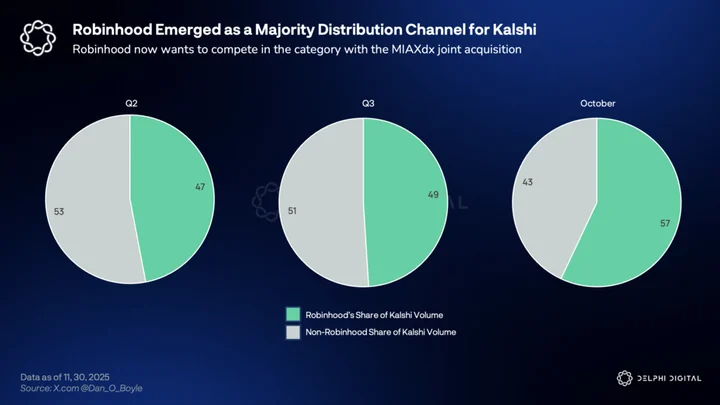
Robinhood signaled back in October that they were looking for acquisition opportunities to vertically integrate and keep a larger share of the revenue. In November, they announced a joint venture with Susquehanna International Group (SIG) to acquire MIAXdx (a CFTC-licensed derivatives venue) to offer prediction markets natively.
Strategically, prediction markets fit Robinhood’s playbook perfectly: they’re high-frequency, culturally-driven, and complementary to both crypto’s 24/7 mindset and Robinhood’s push into derivatives.
Web3 Access: Connect, Wallet & The Embedded Future
Robinhood already has the building blocks to bring onchain access to their users:
- Connect is the on-ramp that lets users fund external wallets from their Robinhood balance. This allows them to monetize even when users leave the platform.
- Robinhood Wallet is the long-tail DEX interface (Using 0x, LI.FI integrations) for users who want assets beyond the limited listings.
The missing step is obvious: bring these into the main app with embedded self-custody. If Robinhood can make onchain feel like a normal tab within the app rather than a separate product, its superapp surface extends across TradFi and DeFi.
Robinhood Social
History shows that some of the most successful superapps achieved scale by adding financial interactions on top of a social layer. At the Hood Summit 2025, they announced Robinhood Social, a verified social feed for traders to be launched in 2026. Robinhood Social will have traders posting alongside verified trades and P&L cards to build a trader/investor centric social media.
We believe it will be monumentally harder for Robinhood to build a social feature with meaningful activity and retention. Layering finance on top of a social layer is very different from adding social layers on a predominantly consumer finance application.
But all in all, Robinhood sits in the Goldilocks zone: Regulated enough to be trusted by Boomers and crypto skeptics, but agile enough to offer crypto to the new investor cohort. Robinhood has effectively blurred the lines between a neobank, a brokerage, and a crypto exchange. The strategy is defined by the convergence of three powerful engines: Gold (the data-rich spending layer), Legend (the active trader retention moat), and the Arbitrum Layer 2 for tokenization.
Binance
Binance didn’t wake up one day and decide to build a superapp. It became one the same way Amazon, Wechat did: by owning the highest-frequency behavior first (trading) and then quietly swallowing adjacent loops: payments, savings, discovery, onchain access, and institutional plumbing. Binance stopped being an exchange and started being many a user’s default crypto home screen.
If Coinbase’s superapp story is convergence (CEX + onchain OS) and Robinhood’s is rebundling (one balance + product velocity), Binance’s story is that of scale with over 270M registered users. Binance has consistently been the volume leader of the crypto industry.
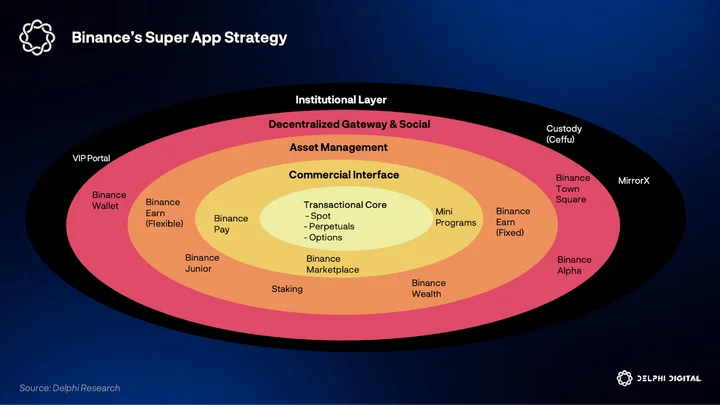
Their super app offering can broadly be broken into 5 parts:
- The Transactional Core: The centralized exchange (CEX) infrastructure.
- The Commercial Interface: Payments, the Marketplace, and Mini Programs.
- The Asset Management Suite: Wealth, Earn, and Staking.
- The Decentralized Gateway: The Web3 Wallet and Alpha platform.
- The Institutional Layer: Custody, Settlement, and VIP services.
The Transactional Core
Binance’s superapp starts where the money starts: the exchange. Their scale advantage is the moat: liquidity attracts traders, traders attract liquidity, and the flywheel continues. The core exchange remains Binance’s primary revenue source, facilitating $7.3 trillion of volume in 2024.
Spot
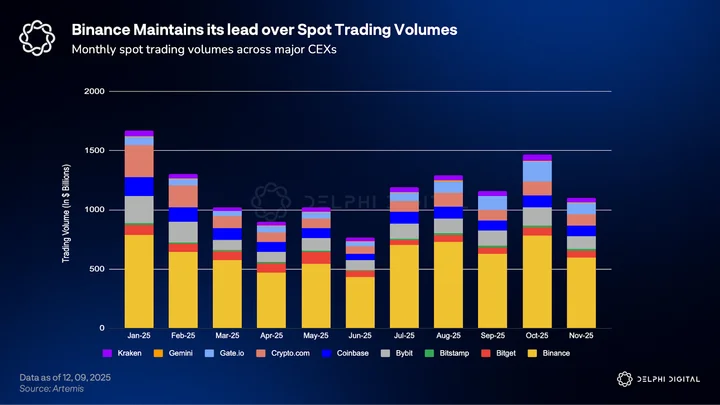
Spot is the mainstream on-ramp and still the largest first action for most users (~26% of users utilize spot trading). After leading USD-denominated liquidity, Binance is now pushing into local fiat pairs (BRL/TRY/EUR) to deepen its global dominance.
Under the hood, Binance is also segmenting UX and building features to retain trading volumes for different user personas:
- Convert (RFQ-style) for users who want just complete a trade
- Order-splitting tools for size without slippage
- Bots + Copy trading as the SocialFi layer attached to the Binance markets
Derivatives
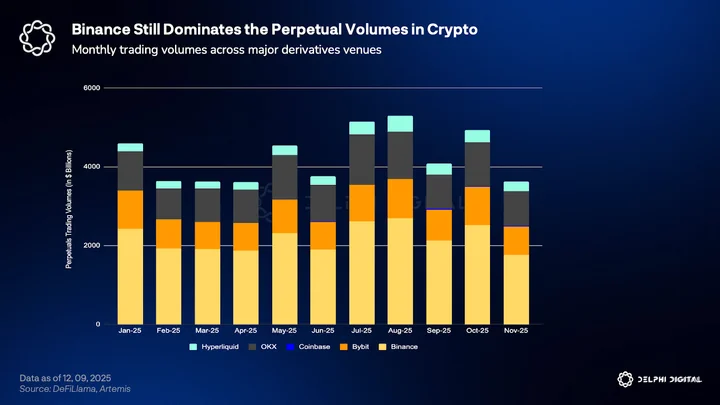
Perps and options are where Binance becomes sticky for power users and where volumes can exist outside of a bull market too as institutions need to hedge their exposures. While their options footprint is small, Binance dominates the perpetual futures category accounting for over 33% of open interest for both Bitcoin and Ethereum.
P2P: Shadow Banking infrastructure
This is the part most people underestimate. In markets where card rails are weak, bank access is uneven, or capital controls are real, Binance P2P has become essential infrastructure.
- Escrow-based matching across hundreds of local payment methods
- A professional merchant tier (P2Pro) that effectively behaves like a distributed FX desk
This is the first place Binance starts acting like a bank without calling itself one.
The Commercial Interface
If the exchange is the engine, Pay is the daily habit builder. Trading is episodic, but payments are a daily necessity. With this offering, Binance is trying to move from a speculation venue to spending. Their numbers tell an impressive story:
- $250B+ Pay volume within 5 years
- 45M+ active Pay users
- 20M+ merchants after a massive merchant network push
- Digital dollar wallet: 98% of B2C payments occur in stablecoins
The most strategic part is the integration with national rails [Pix (Brasil), Bhutan’s tourism platform]. That’s how Pay stops being a crypto feature and becomes part of users’ normal day to day life.
Marketplace and Mini Programs
Binance’s Asian roots are visible in how they’ve borrowed elements from Wechat’s mini-apps into Binance Marketplace. Marketplace is an early sketch of an app-store model: travel, rides, top-ups, gift cards. Users already hold stablecoin on Binance, this gives them places to spend it inside the app.
The success story within their mini-app experiment has been the Travala integration. 8.5% of all Travala transactions (gross volume: $103M) were initiated by Binance app users in 2024. The discovery and variety in Marketplace is lacking and thus the ecosystem feels secondary to the Pay push with most mini-apps offering just gift vouchers.
This is where the Binance Card comes into the picture. It’s the bridge to offline spending while the mini-program layer matures. Binance offers capped 2% cashback on transactions via their card. Although, the card is only available in Brasil, Peru and Colombia for now with spending data sparsely available.
The Asset Management Suite
To capture the revenue potential of a user’s idle balances, Binance has built a series of asset management tools. This pillar is designed to retain Assets Under Management (AUM) by offering yield. The data available for the usage of these features has been limited, but it helps us understand the breadth of financial services that Binance is able to offer within a single app.
Binance Earn
Binance Earn is the savings account of the ecosystem and the second most popular product after Spot trading (25.34% of users). TVL in Binance Earn grew by 144% in 2024.
Staking
Binance has moved aggressively into onchain staking services.
- ETH Staking: A managed service for Ethereum validator staking that has attracted deposits worth $11.1B (3.2M ETH staked).
- SOL Staking: In 2024, Binance introduced liquid staked BNSOL. While far smaller than the TVL in ETH staking, Solana staking has also been able to bring in over $1.1B in deposits.
Binance Wealth
Binance Wealth is Binance recognizing that its top users are aging into HNWIs. Binance is building private banking UX for crypto-native wealth: with portfolio management, onboarding/KYC workflows, and tools designed for capital allocators.
This move signals Binance’s intent to compete with traditional private banks (like JP Morgan) and Robinhood for the asset management category. It provides the infrastructure for traditional wealth managers to offer crypto exposure to their clients without losing custody of the relationship.
Loans and Credit
Overcollateralized borrowing is the logical extension: if users already hold assets and want liquidity without selling, Binance became the easiest place to do that. They started offering fixed-rate loans for borrowers, addressing a major pain point of DeFi borrowing.
The Decentralized Gateway
Binance was early to realize that onchain activity is where new attention centers are formed. Instead of fighting it, it’s trying to own that gateway too. The Web3 wallet integration matters because it collapses the jump from: from Binance → to external wallet → to DeFi
The Binance wallet product is further pushed via campaigns like Binance Alpha. They used the fastest way to acquire users – by routing them toward free money (airdrops, anticipated TGEs, early access). If users believe Alpha is where the first look for new opportunities happens, they will move parts of their onchain life into Binance’s wallet.
- 18 Alpha tokens later listed on Binance Spot
- Users got access to TGEs at better entry prices compared to day-1 spot closing price
- Binance wallet users have received up to 8 airdrops
Wallet adoption becomes cheaper than paid marketing. This is Binance’s distribution edge expressed in the most Binance way possible.
Institutional Layer
Binance doesn’t want to be the superapp that only serves retail. The whales and institutional market brings liquidity, tighter spreads, and volume. Post-FTX, custody trust became the core constraint and Binance built around it.
- Ceffu as the secure custody solution
- MirrorX allows Ceffu assets to be mirrored onto Binance Exchange for trading
Reducing the exchange’s counterparty risk perception helps them draw in higher institutional participation. And just like Robinhood and Bitstamp, Binance is also pushing Crypto-as-a-Service: selling liquidity and infrastructure to tradfi institutions that want crypto exposure without building the rails.
Binance’s flywheel is simple and brutally efficient
Liquidity pulls users in → Derivatives + Earn keep assets parked → Pay + Card to create daily utility → Wallet + Alpha capture onchain activity → the resulting flow feeds back into exchange volume, listings, and liquidity.
Binance doesn’t need to convince users to adopt a superapp. It needs to keep behaving like the place where every onchain action is the easiest to execute. The risks associated with such scale are significant. Regulatory compliance, reputational overhang, limited market adoption in the west and the complexity of shipping five apps worth of features inside one container. But on pure product mechanics, Binance is one of the only players that can credibly claim it’s already running a crypto superapp in production and at global scale.
Kraken
Kraken’s answer to building the super app is unique as they’re not building a single cluttered everything-app. Their plan is to unbundle the interface while rebundling the infrastructure. Kraken is aiming to counterposition in each category they operate in: starting with their aggressive listing strategy.
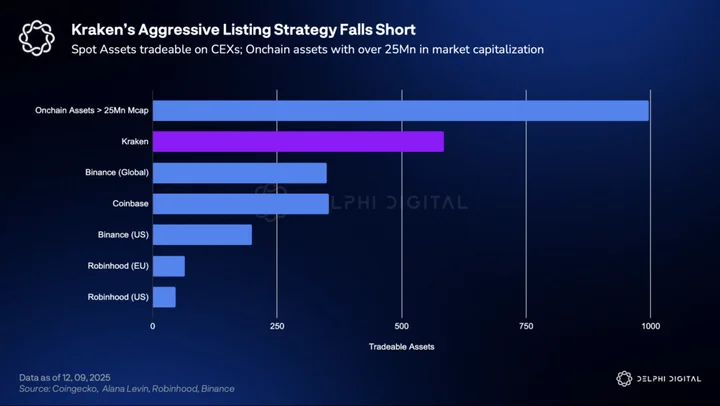
Instead of forcing every user into one UI, Kraken is building a constellation of apps. Kraken Pro, Wallet, Inky, and Krak are all tied together by the same identity, liquidity, custody, and (soon) a platform layer in Ink. It’s a new superapp strategy: specialized surfaces, shared rails.
In recent times, the centralized exchange (CEX) model has been under significant pressure to adapt. The traditional fee-based revenue model, slow listing strategy and reliance on cyclical retail trading volumes, is becoming increasingly difficult to operate under.
Closing the Growth Gap
Kraken is large and profitable, but a comparison with Coinbase reveals the problem: it’s not yet the default surface at Coinbase scale. In 2024, Kraken did $1.5B net revenue on $665B volume, with $424M adj. EBITDA. A strong business, but still a fraction of the size compared to the other CEXs.
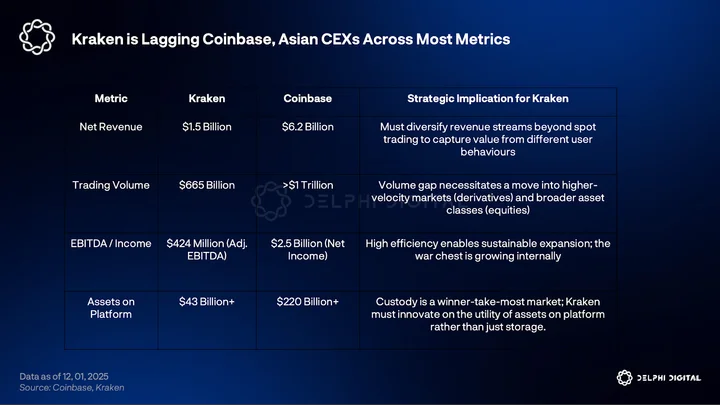
Kraken has a self-funded war chest that lets them buy and build capabilities without needing to chase fee wars. But the implication is simple: Kraken can’t bridge the gap to other CEXs without expanding into higher-velocity markets or growing new product categories.
To fuel this growth and expansion, Kraken recently raised $800 million at a $20 billion valuation before its planned IPO in 2026. This raise represents a vote of confidence in Kraken’s upcoming plans from institutions like Citadel Securities, which contributed a $200 million strategic investment.
The Unbundled Superapp
Kraken’s unique insight is that the attempts to replicate superapps in Western markets has often resulted in cluttered applications that try to do too much and serve no one effectively. Rather than forcing a high-frequency trader, a memecoin speculator, and a remittance user into a single interface, Kraken is unbundling its services into distinct apps while rebundling them at the infrastructure layer.
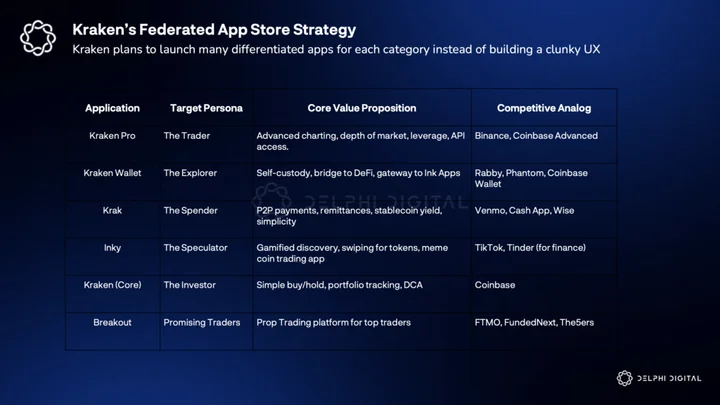
The Constellation of Apps
Kraken’s ecosystem is now segmented into use-case specific containers. Each app targets a distinct user profile and behavioral loop.
Inky
Inky’s swipe UX isn’t a gimmick, it’s a funnel redesign. It moves the user’s job from analysis to discovery, abstracts away chain complexity, and turns the memecoin game into a simple low stakes acquisition. If one believes the next retail trading wave looks more like TikTok than Bloomberg, Inky is Kraken’s attempt to grab a slice of that future.
It acknowledges that for a new generation of users, finance is entertainment.
Krak
Krak is the functional opposite of Inky: it targets the payments category. The pitch combines remittances and global transfers with a stablecoin balance that behaves like a high-yield checking account. The integration of USDG and an advertised 4.1% APY is key because it creates a reason to keep balances parked, not just pass through.
Crucially, Krak closes the loop on real-world utility with a Mastercard debit card, allowing users to spend their yield or crypto balances instantly with 0% foreign exchange fees and up to 1% cashback. By bridging high-yield savings with instant spending, the app aims to capture a significant share of the $800 billion global remittance market across 160+ countries. For a user looking at crypto purely as a payments layer, this offers a far simpler alternative to a complex super app.
Ink
If the mobile apps are the specialized interfaces, Ink is the operating system (OS) that underpins the entire App Store vision. Ink is Kraken’s layer 2 built on the OP Stack underpinning the shift from being a “store” (selling crypto) to a “platform” (hosting crypto businesses).
The team envisions Ink as an environment where third-party developers build the applications that Kraken chooses not to build itself. Kraken can effectively act as the trusted gatekeeper: like Apple curating the app store.
Developers building on Ink gain access to Kraken’s distribution to over 10M+ verified users. Kraken can feature trusted dApps within its Wallet or Main App, effectively funneling massive liquidity to partner protocols. They want Ink to become a top venue for the trading of tokenized stocks and the next acquisition gives them a headstart in the category.
xStocks
Kraken very recently acquired Backed Finance, the issuer behind xStocks. It is among the most used tokenized equity frameworks and positions the company to accelerate issuance, trading, and settlement across global markets. We believe this acquisition positions Kraken much further than most of their competitors in the tokenization space.
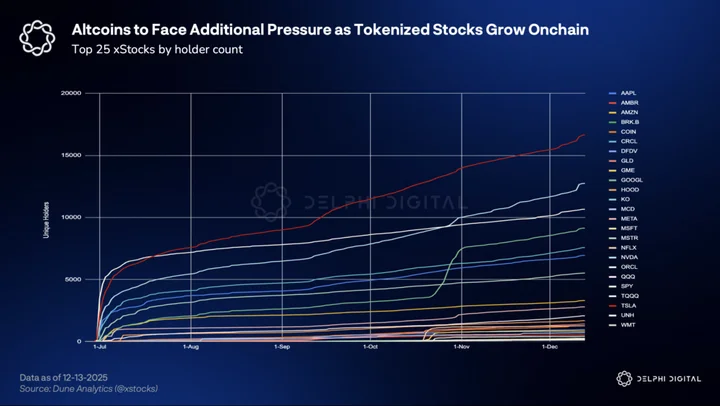
xStocks are structurally better than many other tokenized stock offerings as:
- Backed 1:1 by underlying shares held in regulated custody
- Withdrawable to self-custody: this is the unlock Robinhood’s early structure doesn’t offer. Once equity tokens can leave the venue, they can become collateral, liquidity, and building blocks
Over $180M of tokenized stocks have been issued via the platform across Ethereum and Solana with $400M in DEX trading volume. Early behavior suggests that people are utilising these as investment instruments rather than a trading instrument.
NinjaTrader Acquisition and Entry into TradFi
Kraken’s acquisition of NinjaTrader for $1.5B shows that Kraken thinks a financial super app needs to expand beyond crypto. NinjaTrader is a retail futures brokerage in the US, holding a Futures Commission Merchant (FCM) license with the CFTC. Acquiring an FCM allows Kraken to offer regulated futures products in the US.
This acquisition instantly diversifies Kraken’s revenue. Even if a crypto bear market freezes volumes, NinjaTrader provides steady income from traditional futures markets (oil, gold, indices), smoothing out Kraken’s earnings volatility.
Breakout (Prop Trading)
Even after achieving product and feature parity, Kraken is in a competitively difficult position compared to other CEXs. Thus they need to be operating in categories where other exchanges are not present.
They recently acquired Breakout: a crypto prop trading platform. Unlike a standard exchange where users trade their own money, a prop trading platform allows qualified traders to trade the firm’s capital. Breakout uses an evaluation-based model where traders pay a fee to take a test to prove they are skilled and disciplined. On passing the evaluation, traders get a funded account with $200k (using Kraken’s capital) and can keep up to 90% of the profits they generate.
Kraken plans to integrate Breakout’s features directly into Kraken Pro, creating a seamless experience where one can eventually access funded trading directly from the main Kraken interface. This is a part of the push to bring up & coming traders to choose Kraken as their go to trading platform.
Kraken’s Contrarian Bet
Most of Kraken’s recent moves show how they are trying to counter position in each product category with Inky (memes), Krak (payments) and Breakout (prop-trading). For categories where Kraken isn’t present, they are partnering with best-in-class providers rather than building from scratch.
The Legion partnership (Kraken Launch) is the proof of this playbook: rather than building another launchpad, Kraken is acting as the distribution layer for Legion’s onchain reputation engine. This effectively federates the ICO vertical to a partner capable of filtering for merit-based users (checking GitHub commits, onchain history and social clout) while Kraken keeps the user experience compliant and seamless.
Their superapp bet is to launch:
- Many surfaces that appeal to different personas (Trader, Explorer, Spender, Speculator)
- With One spine (identity, liquidity, custody) that keeps users inside the ecosystem even as they move between behaviors
- One platform layer (Ink) that lets Kraken scale to new products via external builders
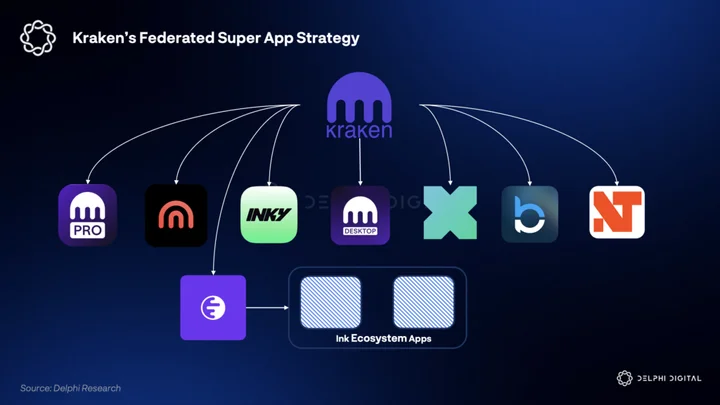
If Coinbase is building a converged mega-surface and Binance is already a large applications container, Kraken is trying to win with federation: a cleaner UX that has worked better in the US combined with an app-store style platform strategy.
X (Formerly Twitter)
Putting X in the superapp conversation is not a longshot as Elon has been vocal about building it up to become the Everything App. Unlike Coinbase, Binance, or Robinhood that have deep financial stacks, X is still at the “should they? can they?” stage.
𝕏 just rolled out an entire new communications stack with encrypted messages, audio/video calls and file transfer.
𝕏 Money comes out soon.
Join us if you want to build cool products.
𝕏 will be the everything app. https://t.co/7DyLNEgNnw
— Elon Musk (@elonmusk) November 13, 2025
But the potential is undeniable: crypto culture lives on X. The most valuable distribution surface for crypto ideas, narratives, and coordination is already there. If X ever turns that attention towards native financial rails, it doesn’t need to build everything. It just needs to make moving and deploying money as native as posting.
The WeChat of the West dream has been floating around tech circles for a decade. What’s changed is that for X, the pivot starts to look less like ambition and more like business necessity.
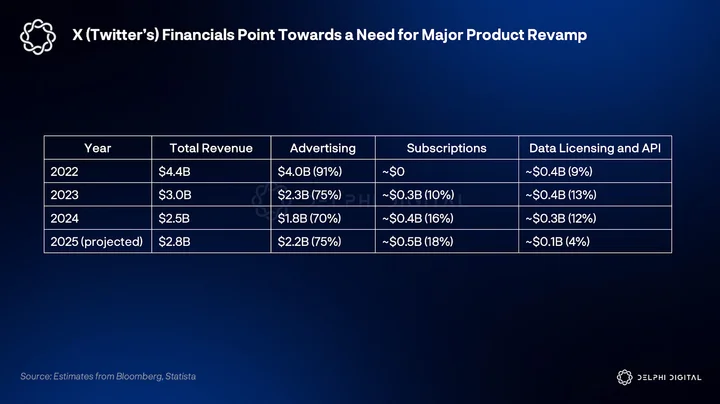
Post-acquisition, the revenue mix took a hit as ad revenue declined sharply from prior highs. Subscription revenue is growing but not enough to fill the gap yet. Layer in the cost of building and running frontier AI (xAI) and we get the real motivation: X needs high-margin, low-lift revenue streams that scales with usage. Financial services fit that pattern better than most categories.
If X converts attention into transactions, it will be able to carve out new revenue streams that it needs.
Trojan Horse Rollout: Payments First, Crypto Second
Phase 1
The credible path for X is to ship a boring Fiat wallet and then quietly expand what that wallet can do. The X Money route is the sensible trojan horse as X has already acquired money transmitter licenses across 38 states in the US. They can start with P2P fiat transfers and add Venmo-like utility within X as soon as they acquire the remainder of these licenses.
X is already working with Visa to make this a reality with instant funding to X Wallet via Visa Direct. Users will be able to connect to Visa debit cards for P2P payments. Once the wallet infrastructure is live, X can activate its latent advantage in phase two by combining payments and social media.
Phase 2
Once money starts moving natively on the timeline, the floodgates open. They can enable and create SocialFi behaviors that feel clunky on other platforms.
Imagine a seamless version of Solana Blinks, where swapping into a trending coin, or betting on a prediction market happens directly as a response to a tweet – no popup windows, no wallet connection. Creators could move beyond receiving tips and subscription payments to new Proof of Engagement models, where followers earn micro-rewards for amplifying quality content.
X could even offer low-risk DeFi yields on idle cash balances. Instead of money sitting dead in a wallet, it could auto-route to treasuries or stablecoin yield protocols, effectively becoming a high-yield savings account that you can tweet from.
Conclusion
X is nowhere close to the depth of the other players we’ve discussed in this report. But as everyone knows, Elon and team are exceptional operators capable of building and executing at breakneck speeds once the decision to pursue a new vision has been made.
Adding limited crypto functionality to boost social features is the logical starting point. YouTube is already dipping its toes in the water alongside PayPal, but X’s entry will be far more impactful because the crypto community already lives here.
X is the wildcard. If they do pull the trigger, we can’t wait to see what happens in 2026. While the forerunners covered above have secured a headstart, the landscape is far from settled. A diverse cohort ranging from native DeFi teams to ambitious new networks like Worldcoin are actively converging on this thesis. We believe the race to build “The ONE Interface” will be one of the defining narratives of 2026.
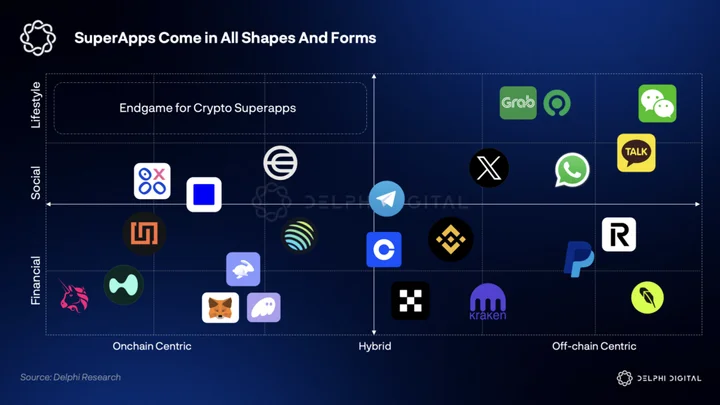
SocialFi Is the New Frontier
There are two secular trends emerging in 2025: trading is being socialized while social media is being financialized. These trends loosely coalesce under the SocialFi umbrella.
The social trading trend was jumpstarted by Roaring Kitty’s Gamestop call in 2021. Internet creator culture has continued to grow and naturally extends to finance. Two of the bigger financial memes over the past few years- Pelosi Tracker and Inverse Cramer, now have copytrader indexes via Autopilot.
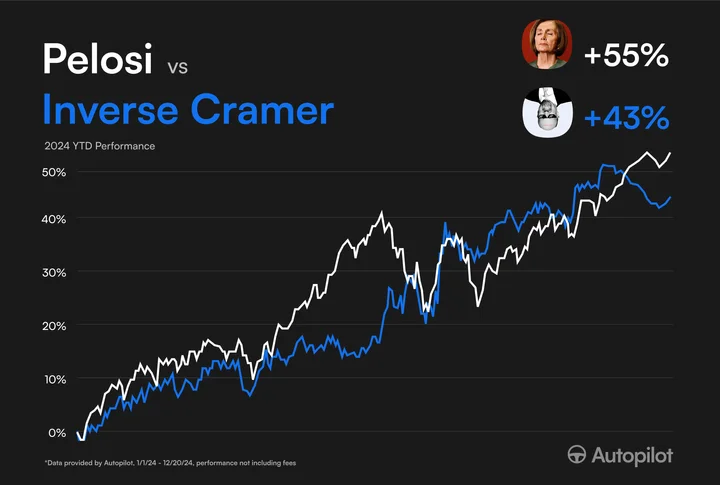
This behavior has manifested in crypto through copy-trader products and social trading apps like Fomo. The other side is the financialization of social media.
The creator economy is a massive ~$320B industry. The internet is usurping television as the premier information arena, in the same way television took over radio and newspaper. The COVID lockdowns accelerated the prominence of influencers. Entirely new forms of content have established markets now. Watching influencers react to content replaces watching with friends. There are async reality shows filmed by creator groups, etc. Internet-native influencers often emerge out of nowhere, wielding massive power. Boomers are late and they are scrambling. They haven’t achieved a sustainable model and time is running out.

Social media largely runs on ads. Even still, the Twitter model and streaming model are treading water.
Twitter was struggling before and after Elon took over. xAI now buoys its valuation. Bluesky is subsidized by VC money and has no model. Twitch is owned by Amazon, and while not individually profitable, it is hard to quantify the broader enterprise value it brings. Kick does not run ads and is subsidized by Stake. Vine infamously shut down due to its inability to monetize.
YouTube, TikTok, Instagram, and Facebook ‘work’ in the sense that they are profitable businesses with network effects, but they fail in achieving alignment with creators.
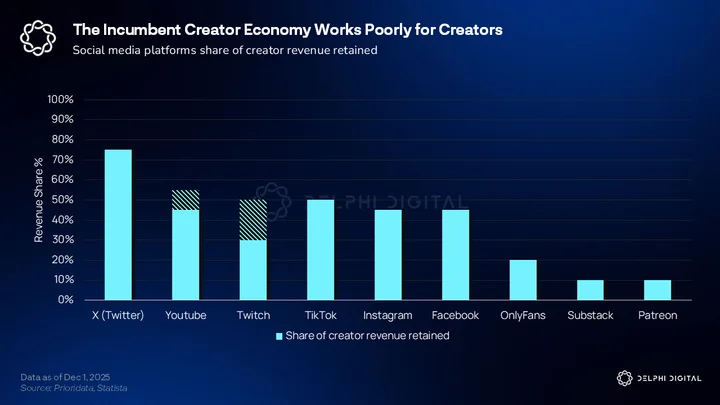
Many creators shift to running their own ads through sponsored content, bypassing the web2 ad infra, gaining control over the ads and earning more. This is in some ways a worse experience for users, who are less immersed in the content and cannot pay to remove this.
The alignment problem has prompted a shift in attitude from incumbents and an opportunity for crypto to infiltrate.
Base has been pushing the idea of the creator economy so hard that they seem to won it, but this is a real phenomenon that the major players are positioning for. Instagram has an entire web page dedicated to helping creators monetize their audiences, using a lot of the same buzzwords. Legacy powers know they must adapt and work with creators or they will lose their position. There is a fundamental incentive alignment issue with Web2, preventing them from executing on this effectively. Crypto is very well-positioned here.
fomo
fomo represents another attempt to modernize onchain trading, but with a clear emphasis on delivering a Robinhood-level mobile experience rather than relying on crypto-native workflows. fomo abstracts away nearly all of the traditional friction that makes onchain trading with any real edge difficult.
Where Pump’s core business remains anchored to prebonded memecoin trading on Solana, with its expansion efforts tied to the Padre acquisition and its broader streaming vision, fomo has intentionally moved toward a more general purpose, chain-agnostic trading experience. If the team succeeds, fomo could meaningfully expand the pie by bringing a much wider retail audience into onchain speculation in the same way Robinhood pulled a new generation into equities.
Thrilled to announce our Series A investment in fomo. This remarkable team led by @PaulErlanger and @pseudosey have a clear vision to make digital assets accessible to consumers by abstracting away all the technical complexity. And their growth on all metrics is exceptional. https://t.co/DyUWchDwwW
— Chetan Puttagunta (@chetanp) November 6, 2025
fomo’s team are ex dYdX and ex Uniswap, and recently raised a seventeen million dollar round led by Benchmark. Benchmark is not a crypto-native investor, which makes the conviction here particularly high signal given their track record in traditional tech venture.
The product reflects that pedigree. The app is aggressively mobile first and is, in my opinion, the most polished trading experience in the category. It feels fluid, intuitive, and genuinely consumer friendly in a way that is rare in crypto.
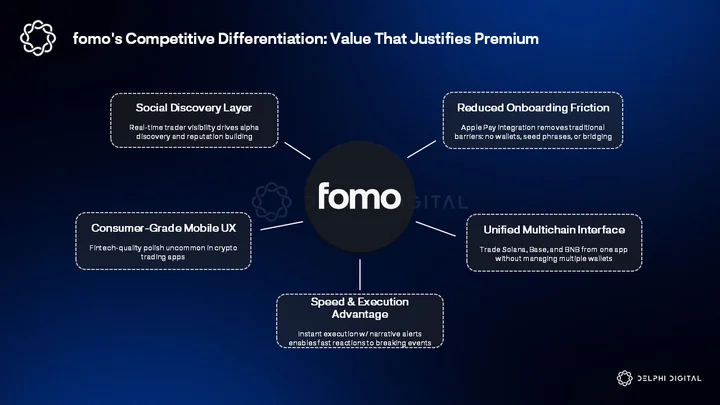
The company launched in May, and what stands out is that its earliest users have been crypto natives. These are traders who do not need abstraction and would normally avoid paying higher fees than what is possible with onchain execution. Yet, they still choose fomo because the mobile UX, discovery tools, and social element combine into a meaningful perceived edge, or enjoyable experience, even for traders who naturally optimize for the lowest-fee, fastest onchain paths.
That dynamic makes the early traction especially meaningful given the product has not yet reached the broader retail audience it is designed to cater towards
For a long time if you traded onchain, you had 100 wallets or trading bot terminals with money on every chain and managed them manually
fomo has completely solved this wallet logistics nightmare for the average retard. You can buy and sell instantly on any chain
Hyperliquid
— Sisyphus (@0xSisyphus) November 11, 2025
The social context is a major part of fomo’s appeal. Users can see friends’ PnLs, receive alerts when people they follow buy or sell, read or share trade theses, and compete for top spots on leaderboards. The result is an experience that is fun, addictive, and socially reinforcing.

There is also a practical advantage. Having capital on fomo is often +EV even with the 0.5% fee, because the combination of alerts, discovery, and instantaneous execution meaningfully improves reaction speed. And compared to other retail-friendly surfaces, fomo is actually cheaper. Most onchain terminals and Telegram bots charge 0.85–1%, Phantom’s in-app swap is 0.85%, and Moonshot ranges from 1–2.5%. On top of that, trading through fomo on Base, BNB, and Monad has been completely free for users so far.
The edge is most obvious during real time market events where convenience and speed matter more than marginal fees. Users do not need to bridge, manage slippage, juggle idle balances on multiple chains, or sit at a computer to react to headlines. Everything happens through a mobile interface that lets them trade instantly when a narrative breaks.
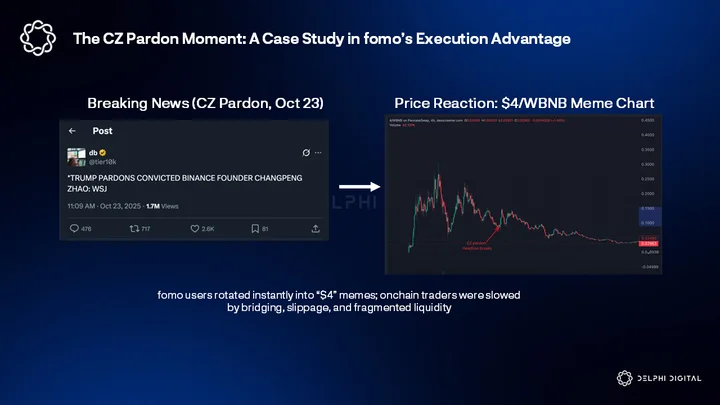
For example, during fast moving headline driven moments like the recent CZ pardon news, a fomo user could immediately rotate into the leading CZ related memes (like “$4”) on BNB with almost no friction. They do not need to have funds already sitting on BNB, they do not need to bridge, and they do not need to be at a computer to manage slippage or swap through multiple steps.
A trader relying on traditional onchain routes has a much higher bar, and those extra minutes can easily cost them during a moment when the market is still digesting the news. On fomo, users also see in real time what top traders in their network are buying through alerts and wallet tracking. Moments like this highlight why fomo can win not only with retail, but also why its beginning to attract experienced crypto natives.
Moonshot is another useful comparison point. It sits in a similar mobile forward niche and was eventually acquired by Jupiter, but its trajectory has diverged meaningfully from fomo’s.
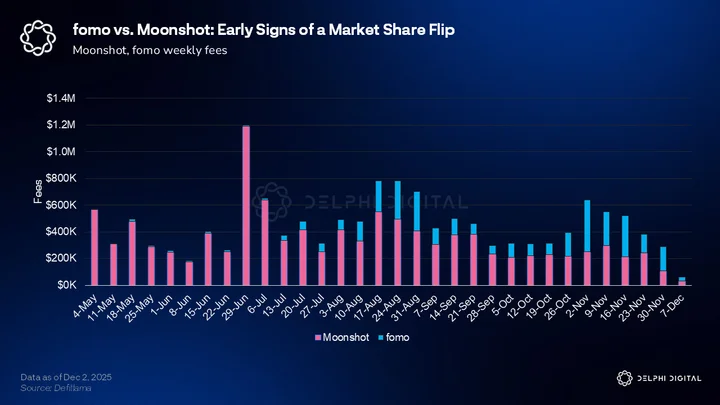
Moonshot reached a much higher peak during the Trump memecoin spike, generating nearly thirty five million dollars in fees in January 2025, but that performance was heavily timing driven. It benefited from a hyper concentrated retail moment and a market structure that no longer exists. Since then, revenue has declined steadily throughout the year, falling to roughly one million dollars in November.
Moonshot also continues to lag in listing newly launched tokens. Both platforms require vetting before pairs go live, but Moonshot’s slower approval and listing cadence makes it far less useful during fast moving meme cycles where early flow and speed matter most. The difference now shows up directly in the numbers. Moonshot still holds the higher historical peak, but its revenue has trended downward since while fomo’s has consistently risen. In November, for the first time, fomo generated more monthly fees than Moonshot, despite being a much younger product and charging far lower fees.
On Solana alone, fomo’s volume now runs roughly five times higher than Moonshot’s; across Base and BNB that gap expands closer to 10x. Moonshot also lacks the social layer that has made fomo so sticky for crypto natives, which further limits its ability to recapture momentum.
fomo’s execution and product quality look materially stronger. It simply feels like the better product. The ceiling is also likely higher: if fomo succeeds in capturing non crypto users it could meaningfully surpass the outcome Moonshot achieved before its acquisition.
Looking ahead to 2026, fomo’s model could extend well beyond memecoins. The core strengths of the product, including mobile native execution, social discovery, and a simplified UX, translate naturally into new verticals. RWAs, synthetic assets, leverage products, and even tokenized equities fit cleanly into the existing interface. Given the team’s background at dYdX and Uniswap, it would not be surprising to see fomo introduce a light perps product or other forms of leverage. The combination of mobile convenience and social signals could make these categories far more accessible to casual users than anything currently available.
fomo may look like a crypto trading app but that’s shortsighted
fomo is the the fist future proof trading application because it’s built on crypto rails
as everything moves on chain, everything will be available on fomo. watch closely as the incumbents try to catchup
— Paul (@PaulErlanger) October 23, 2025
More broadly, the universe of onchain assets is set to expand meaningfully over the next few years. As more assets become tradable onchain the surface area for mobile-first trading will grow alongside it. In that environment, fomo is structurally well positioned. The team can ship faster, iterate more aggressively, and respond to new narratives at a pace that large, regulated brokerages simply cannot match.
The most credible long term competitive threat is arguably Robinhood, given its distribution and the likelihood that it eventually moves deeper into onchain markets. But even in that scenario, fomo is well suited to compete. The product already fits the “onchain Robinhood” slot more naturally, and its social loop and mobile-native UX are difficult for incumbents to replicate within a heavier regulatory and product framework. It is also not hard to imagine Robinhood viewing fomo as an attractive acquisition target if onchain activity continues to accelerate. Earlier in the year, it was reasonable to think Pump might pursue something similar given its sizable war chest, but that now feels less likely.
It is worth addressing what I see as the primary risk, which is tied directly to one of fomo’s greatest strengths. The social visibility model effectively forces users to trade in public. Positions, sizing, timing, and PnLs are surfaced to followers in real time and, for many users, are tied directly to their Twitter identity.
That creates clear opsec concerns: traders cannot scale in quietly, manage size discreetly, or hide taxable events or mistakes. On top of that, the visibility itself introduces incentive issues. A user can accumulate supply through external wallets, corner meaningful float off-platform, and then trade from their linked fomo wallet in ways that influence follower behavior. That dynamic can be used to generate artificial social proof or exit liquidity if the product does not build guardrails. One obvious mitigation would be to surface wallet transfers the same way buys and sells are broadcasted, making in- and out-flows visible to all users.
Long term defensibility will depend on whether the team can introduce privacy controls, reputation systems, or visibility layers that preserve the social loop without requiring users to trade fully exposed or opening the door to these misaligned incentives.
Taken together, fomo is positioned to remain one of the leading venues for onchain trading heading into 2026. The combination of instant execution, multichain coverage, social context, and real time narrative awareness creates a trading environment that web based interfaces cannot replicate. If retail flows increase at any point, fomo is the app most normies are likely to use.
It is also the product I would recommend to a non crypto friend over Moonshot or any web based interface.
Pump can improve its mobile experience and narrow the gap, but for now the product and UX differentiation give fomo a meaningful advantage. If the team continues executing at this pace, and expands into perps, RWAs, or tokenized equities, the potential outcome is significantly larger than the Moonshot acquisition and represents one of the more compelling consumer facing opportunities for the coming year.
Pump
Since our initial, pre fundraise Pump report, a lot has happened. Many of the dynamics we predicted have played out, while several areas have fallen short, frustrating both users and investors. The core challenge, though, remains unchanged. For Pump’s broader vision to materialize, the team will need to manage the tension between crypto’s relentless short-termism and their longer-term ambitions for the platform. To that note, once a project launches a token, the operating environment shifts; the token becomes a product of its own, inherently reflexive, and constantly shaping user expectations. Pump has been no exception here.
The Pump team has continued to invest in crypto-native streaming since their fundraise but this has not unfolded the way we had hoped it might. At least not yet.
Pump hasn’t onboarded meaningful creators from outside the crypto ecosystem, and the CCM meta that emerged on Pump was short-lived. The standout moment came from the “Bagwork” run which highlighted both the potential of creator-driven tokens and the structural issues that still hold the model back.
bagwork guys just ran on the court in the middle of the nuggets vs clippers game 💀
— Jack (@Jackkk) November 13, 2025
This breakout was led by a group of teenagers, supported in part by Pump, who pulled off a series of viral stunts: stealing Bradley Martyn’s hat, running onto the field at a Dodgers game, storming the Knicks court, and even getting Pumpfun and Bagwork tattoos.
Bagwork’s emergence aligned almost perfectly with Pump.fun’s blowoff top in mid-September, when $PUMP reached an FDV of roughly $8.5 billion while Bagwork briefly traded above a $50 million market cap.
No creator coin since has come close to replicating that level of organic momentum or peak valuation. The Knicks stunt occurred more recently, well past the initial hype cycle, with Bagwork trading at a market cap of just over $2 million today.
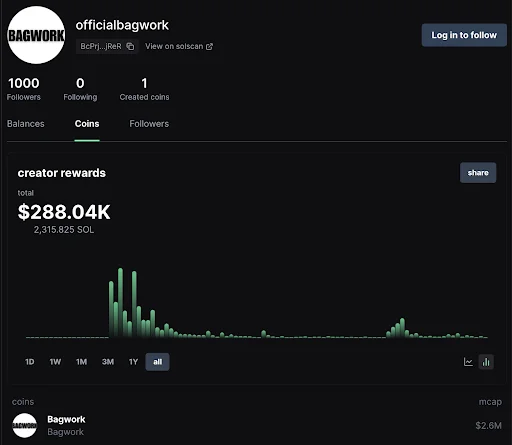
Bagwork was one of the only cases where Pump’s streaming experiment actually worked as intended. The Bagwork team made more than 2,300 SOL in creator earnings from $BAGWORK trading fees (roughly three hundred thousand dollars at current prices). Mind you, this was all generated without the team needing to sell any of their holdings. The viral stunts translated directly into attention, volume, and fees, creating the closest thing to a real creator-token flywheel that Pump has seen so far.
Outside of Bagwork, however, Pump has struggled to deliver on its streaming ambitions. Creator coins have consistently failed to hold value. This goes back to the structural point that tokens are part of the product itself.
The economic reason to own or support a streamer coin is still unclear. The early success of Bagwork faded quickly, and every major streamer coin since has failed to gain similar traction and has ultimately trended toward zero.
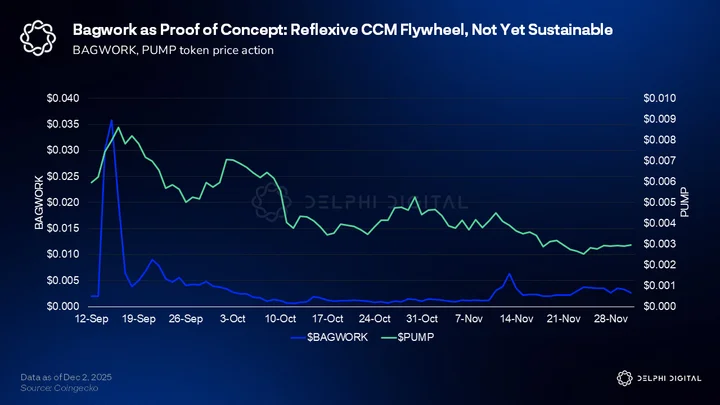
Creators can make short-term revenue through the CCM fee structure, but the reputational cost of being associated with a collapsing coin makes it unattractive for larger, more established creators who could help onboard wider audiences. From the trader’s perspective, these coins remain zero-sum environments rather than genuine communities.
This is the single most important problem Pump needs to solve going into 2026. The team has not yet meaningfully experimented with deeper creator incentives, and the airdrop allocation remains untouched. Outside of the informal support given to Bagwork during its run, there has been no coordinated attempt at things like targeted airdrops, creator rewards, or other incentive mechanisms that could be used to bootstrap early activity, create more PvE style incentives, and give creators room to experiment without immediately blowing up their communities.
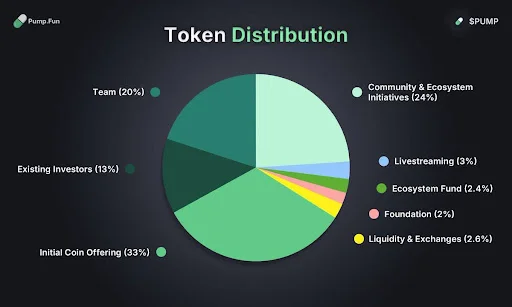
The good news is that this gives Pump significant optionality. The unspent “Community & Ecosystem Initiatives” pool are still major levers the team can pull when the model is ready. If Pump can design a sustainable incentive structure for creator tokens, it would unlock an entirely new economic category for creators who want to use crypto mechanics to monetize and scale their audiences. The upside is real but until then streaming will continue to function as a series of short lived hype cycles rather than a durable, recurring vertical.
On the token side, the main catalyst for $PUMP’s rally from roughly 0.025 to 0.085 was the decision to commit one hundred percent of net revenue to buybacks.
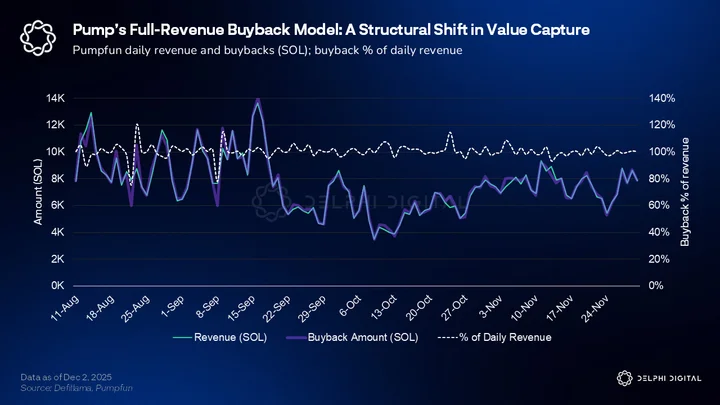
Pump shifted from an initial plan of allocating only about a quarter of revenue to buybacks to essentially adopting the full Hyperliquid-style model after the market made it clear that a partial approach would not be rewarded. The shift helped ignite one of the strongest large cap rallies of the year in an otherwise illiquid and unforgiving altcoin environment.
On a buyback-to-market-cap basis, no major token currently trades at cheaper multiples.
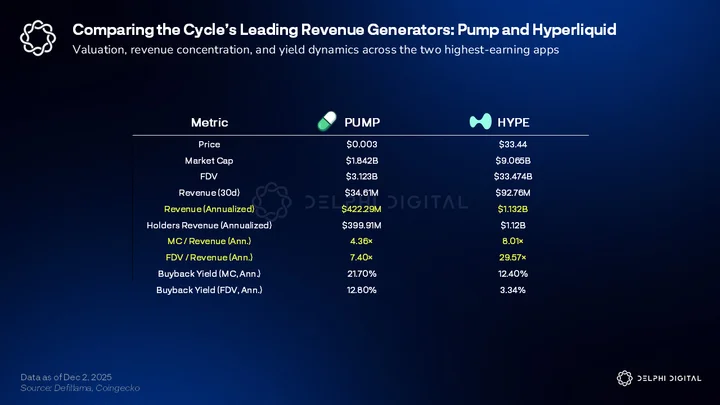
At today’s numbers, Pump generates $422M in annualized revenue against a $1.84B market cap, implying a 4.36× MC/Rev multiple and a ~12.8% annualized buyback yield, levels that are materially below every other large-cap token, including Hyperliquid’s ~8.01× MC/Rev and ~3.34% yield.
Even so, the market remains skeptical of Pump’s long-term business trajectory. Concerns likely include whether the team can continue shipping meaningful product, the impact of future unlocks given that ~40% of supply is still locked, and uncertainty around how the airdrop and creator incentive allocations will ultimately be distributed. This is compounded by the broader contraction in memecoin and terminal activity and lingering questions about the durability of Pump’s revenue base.
Despite these concerns, Pump continues to dominate the memecoin launchpad sector and is still earning (and buying back) roughly one million dollars per day even in what has been an extremely rough market.
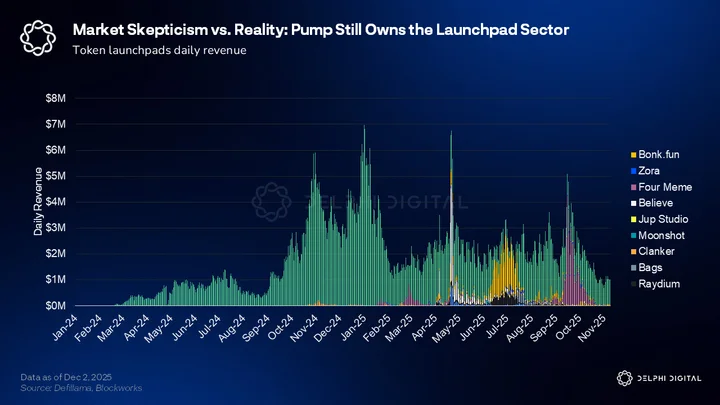
Daily launchpad revenue is down nearly 85% from the early-year peak of almost $14M/day to closer to ~$2M/day today, yet competitors have not meaningfully challenged Pump’s position for more than brief periods. This is consistent with our expectation from the original report during the short-lived Bonk and Raydium challenger phase: even with cyclical volume compression, Pump has retained a structurally advantaged share of sector activity.
The acquisition of Padre supports the idea that Pump intends to expand beyond Solana and reach a multichain audience, with support for BNB ecosystem assets already live via the Padre frontend. This also fits with our earlier prediction that Pump would eventually acquire a terminal or terminal-adjacent property to strengthen the top of funnel and consolidate more of the user journey. Outside of these moves, however, the team has kept a low profile. An investor call is scheduled, although it has not occurred at the time of writing, so additional clarity may be forthcoming.
internet capital markets on pump dot fun.
— alon (@a1lon9) October 28, 2025
Leadership has also indicated interest in the broader ICM category, although this is not an area we view as core to Pump’s current identity or product strengths. The original attempt at this model was Believe, which failed to gain real traction, and MetaDAO has since become the dominant player in the “high quality founder + community” fundraising space. ICM also feels culturally and structurally misaligned with Pump’s brand, which is built around speculation, speed, and creator memetics rather than long-form governance or futarchy-style systems.
For Pump to succeed in ICM, they would need to lean into governance-heavy structures and attract non-crypto teams that want to operate onchain, which is not where most of Pump’s current users or creators sit. While there is theoretical upside if the team committed meaningfully, I view this as a secondary or optional direction rather than a natural extension of Pump’s existing flywheel going into 2026.
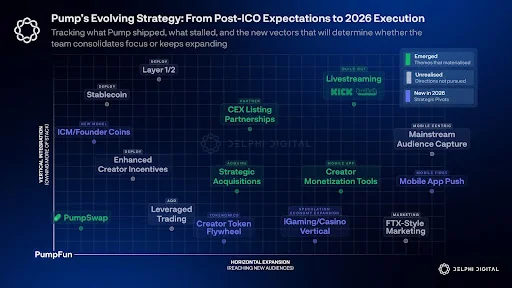
Looking ahead, the main questions for 2026 revolve around whether Pump can finally create an incentive aligned model for creator tokens, whether it meaningfully expands into multichain markets through Padre, how it manages unlocks and declining revenue visibility, and which product vertical it chooses to lean into most aggressively. Right now the strategy feels spread across several surfaces, from streaming to ICM to mobile.
At some point the team likely needs to commit to a primary wedge, and for most of 2025 that wedge appeared to be streaming. Today that is much less clear.
The bigger question is whether Pump can still attract larger non-crypto creators. That likely requires reworking the creator-token flywheel with stronger, longer-term incentives that can sustain virality outside the crypto-native cohort. The raw ingredients exist. In 2025, the Bagwork run showed a glimpse of what it could look like when the model hits, Pump looked close to crossing the chasm.
$SHFL is already a top-10 project in crypto on a revenue basis.
In the past 30d it generated ~$17M net revenue (~$200M annualized), yet it isn’t tracked on DeFiLlama and mostly flies under the radar.
Unlike $HYPE and $PUMP, both priced at their theoretical max with ~100% of… pic.twitter.com/NTOLNVtWuP
— Simon (@simononchain) September 21, 2025
Pump also retains meaningful surface area to expand its product suite. One strategic vector the team should be seriously evaluating is a move into iGaming or casino-adjacent verticals; a Kick/Stake-style model that fits naturally with Pump’s speculation-driven user base. It would be deeply synergistic with its memecoin and streaming ambitions, and the earnings potential in this category is already proven. Shuffle’s net gaming revenue and weekly lottery distributions show how large this opportunity can be when executed well.
Pump’s mobile app is another underutilized advantage. A deeper push into mobile could broaden the top of funnel, make the product more accessible to mainstream users, and give creators more surface area to monetize. Combined with iGaming, it would meaningfully expand Pump’s addressable audience while reinforcing the parts of the platform that already work.
Despite the uncertainty, Pump continues to operate as one of the cycle’s most resilient consumer apps, maintaining dominance even as the broader landscape has shifted. Material progress on any single vector could catalyze a meaningful sentiment reset and position Pump for a broader breakout beyond the crypto native cohort.
Zora & The Base App
Zora is the tokenization infrastructure behind tokenized content on Base. Its creator coins and content coins are piloted by the flagship Zora app, a crypto Instagram and Twitch. We recently covered Zora in Can’t Stop Coining.
Zora has become synonymous with Base’s vision, offering a concentrated bet on the Web3 creator economy. By tokenizing the individual content, Zora creates a spot market to work around that is agnostic of the app itself. This future-proof design can take the creator economy thesis farther than Pumpfun. It also offers numerous paths to success: through its native social media app, as a backend for the Base app and Base ecosystem, or through a rumored connection to Robinhood Social app.
So far, creator coins dominate speculation. No one cares about content coins, despite intense efforts by Zora to boost demand through trading competitions and subsidies.
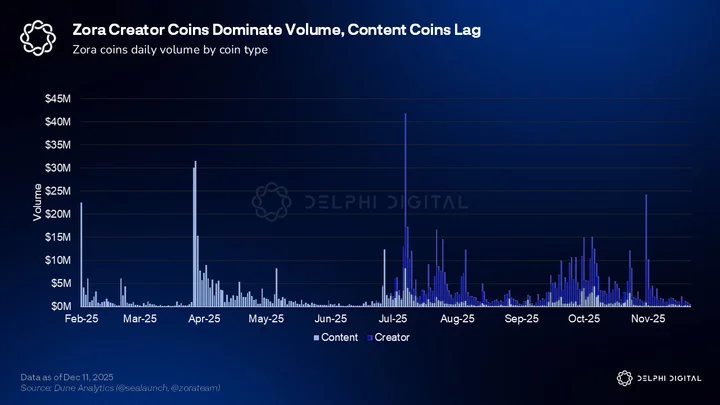
Content coins have been heavily criticized, likened to memes with better branding. The big issue at the moment is that there is no reason people care about content coins. Coinbase has been vague about discussing economic value drivers of content coins. Content coins will not work without economic drivers.
Content coin economics
The Web2 model, in a nutshell, charges advertisers for the attention of their target users. It is easy to see how a viable model could emerge by working backwards from Web2.
The price of an ad is a function of engagement, among other things like targeting and attribution. Social media apps are really just peer to peer marketplaces like Uber & Doordash, where consumers are selling attention to creators who earn it. Advertisers pay to insert themselves within this attention matchmaking process. The value of the attention scales with the network effects of the user base and the data it produces. From the platform’s perspective, creators are producers, advertisers are consumers. From the advertiser’s perspective, users are the producer. This is why the saying holds: if it is free, you’re the product.
An ad that Jeff Bezos sees on his phone is worth, say, $2K. If Bezos scrolls for 5 minutes and sees 100 pieces of content, each post generated roughly $20 in value. Each piece of content on twitter has an implied value based on its share of attention, and its proximity to the attention monetization vehicle, which is ads. Content coins aren’t memes any more than their web2 counterparts are, they just lack a fee switch.
The entire Web2 social media industry is built on the lie that the platform generated that value. That Jeff Bezos is there for the platform. We all know that isn’t true, and it is becoming harder to deny as creators become more liquid and demonstrate leverage by moving their audiences.
Coinbase is dedicating substantial resources to its creator economy initiative on Base. In Jan-25, Coinbase acquired Spindl, a Web3 user attribution platform, and is currently scaling up an advertising business.
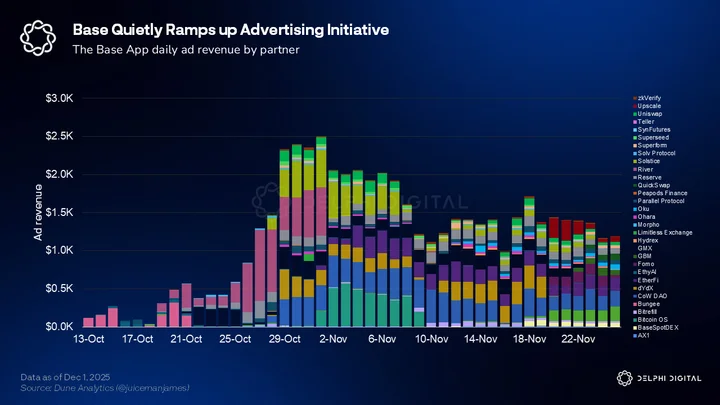
With Spindl, builders can define what “return” means (Users minting, staking, swapping, etc); reach users based on onchain behavior, traits, or custom lists; and only pay when users take the action. Ads are slowly ramping up since late October, reaching $57K in revenue across 30+ advertising partners. We’re starting to see more of a push to talk about Base ads by ecosystem leaders. Base ad revenue will be important to monitor as the Base App is fully released to the public. This could be as early as Dec-17, Coinbase’s highly anticipated system update.
1/ Spindl was built to bring modern growth marketing onchain and enable you to see real return on ad spend.
Spindl-powered ads are now running natively in @baseapp, letting builders launch wallet-targeted campaigns that drive real value.
You built it. Now find your people. pic.twitter.com/AMmKHTDUar
— spindl (@spindl_xyz) July 29, 2025
It is clear Coinbase has a plan for monetization, but unclear why they are being discreet about it. Perhaps to protect their lead against competitors, or maybe to avoid scrutiny around unregistered securities before legislation is passed. Regardless, it is encouraging to see that there is clearly an intention to build rails for real value accrual with content coins.
The lack of open dialogue about the roadmap for content coins allows the memecoin accusations to go unrefuted. It appears Coinbase wants to take a hands off approach to the monetization aspect, laying the groundwork and allowing others to come in and experiment.
an open stack for the global economy https://t.co/AcaDJDQEk8
— jesse.base.eth (@jessepollak) November 5, 2025
There is a lot of execution risk with Base, but the mission is far more ambitious than consensus is willing to acknowledge. The market has a clear negative bias towards Base’s creator economy, which could offer major opportunities for those that cut through the noise. Content coin trading volume will be the ultimate indicator of a healthy creator economy.
Zora as a social media app
Zora’s overall vibe and implementation of social media has been polarizing as well. Zora leans hard into the hyperfinancialization theme, completely removing traditional functionality of likes and replacing them with buys and sells. Market cap and creator coin holders even replace the traditional followers benchmark.
Zora faces some valid criticism for its uncompromising commitment to a fully financialized social media platform. Critics claim these behaviors do not exist but there are clear parallels with existing models. Streaming is a great example.
- Twitch : Zora
- Subs : token gated chats
- Hype trains : ATH meter
- Tips, donations, bits : Content coin buys
- Announcement chime feedback : Word art feedback
- Hosting : ZoraTV?
Zora isn’t completely reinventing the wheel, it is repackaging existing behaviors into a radical new form factor.
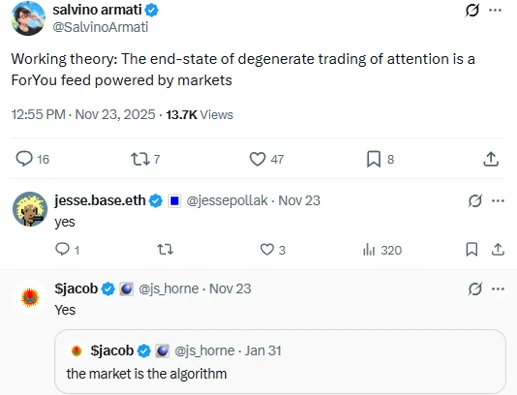
Once economic levers are activated, you have a familiar product suite with the potential for radical new experimentation. Users see the value their community enclave is producing. Their content and graph is portable across other social media apps/clients building on the stack. The algorithm, which is really the main proprietary feature of legacy social media platforms, becomes democratized and composable. The possibilities thereafter are endless:
- Ad revenue to creator coin
- Watermarking content and earning royalties
- Pay over x402 to be hosted by ZoraTV
- Continuous dutch auctions for algo boost
- Paying to reach anyone. shoot your shot with Elon
- Invest in a tweet (routinely referenced, seems to be Base’s north star)
- Hands-on brand engagement
Ideally, Zora will differentiate itself with the product rather than through speculation and economics alone. Demonstrate the value of Web3 Social from the product perspective, break out of the crypto schema. VSCOcam established itself in the 2012-2016 era with a distinct artsy hipster aesthetic.
Dead internet theory, bots, and rapid progress in AI imaging are pushing social media towards an inflection point. Google’s Nano Banana Pro has made striking progress, separating itself from the easily detectable blurred background template common across other services.
Nano Banana vs Nano Banana Pro
We’re cooked. 💀 pic.twitter.com/LRoJhALaZD
— sid (@immasiddx) November 24, 2025
One potential avenue for Zora to establish its own aesthetic and lead with the product could be supporting blockchain-based attestations and provenance for content. The Leica camera and Numbers protocol are examples of products exploring this through the C2PA (Coalition for Content Provenance and Authenticity) standard. Take a photo with the Zora app or with the Leica camera and it earns an algo boost and is marked as verified original content. Zora could support C2PA by including a checkmark on posts for Zora original photos. Could have a filter for Zora original content and better economics for this content as well.
Zora would seize an early lead on an emerging problem in social media, and have a draw beyond the economics. Who cares if it isn’t really used or doesn’t get traction, the idea is that it expands the social media skill tree and signals intent to build beyond speculation. Worldcoin has a massive valuation and mindshare, partly due to its ambition.
Abstract
Abstract is a ZK-rollup on Ethereum built by Igloo, Inc., the parent company behind Pudgy Penguins. Abstract is a consumer app-focused L2 with a different approach to both Zora and Pump. Abstract is less in-your-face with its crypto elements, aiming to present itself as a polished Web2 experience with a veiled crypto backend.
This approach has historically been celebrated by the crypto community. Our north star has always been to create apps that the user does not realize they are interacting with a blockchain. This was a major success factor for Polymarket, which is likely crypto’s most polished consumer app so far. Relative to its competitors in the creator economy, Abstract is best positioned to deliver here.
Abstract lacks some of the mindshare and distribution of Zora and Pump, but Luca and Pudgy Penguins have a strong track record of infiltrating legacy circles. Pudgy Penguins toys achieved $13M+ in retail sales at Walmart and has expanded to Target. If normies are indeed not ready for the futuristic shift in consumer behavior that Pump and Zora require, Abstract is in a good position. Has the TGE up its sleeve as well.
Abstract chain usage has seen a slow bleed throughout 2025, but it is well dispersed across a variety of apps, and fares much better than other alt-L2 ecosystems. There is a distinct character and brand with Abstract, and its usage comes without a liquid token.
We’re thrilled to announce that Pudgy Party, our mobile game, is now live on the @Apple App Store and @Google Play Store, globally.
Download it here: https://t.co/1y9AxbEt00
More information below. pic.twitter.com/Xy6V5GY4es
— Pudgy Penguins (@pudgypenguins) August 29, 2025
Pudgy Party is an example of the type of apps to expect from the ecosystem. Read more about Pudgy Party on our Alpha Feed. It is a take on the popular multiplayer game Fall Guys, built for mobile gameplay and utilizing Pengu characters.
The creator economy is a barbell play on the only thing that has worked in crypto so far (casino) and what crypto is desperately striving for (consumer app). Pump has been most successful at capturing an emerging behavior, while Zora and Base are well-positioned to shake things up in the near term. Catalysts for Abstract are unclear, but its blockchain augmented social-first approach is safer than its peers.
Speculation Engines
Perp DEXs Will Eat All of Finance
Silicon Valley investors have long championed the idea that software is displacing legacy industries at an inexorable pace. Or more famously said by Marc Andreessen, “software is eating the world.”
This conviction was widely shared among top venture capitalists and those that leaned into this bet did very well. Because software reduced overhead, made systems more efficient, and absolutely obliterated the cost structure of the incumbents leading to huge margin expansion.
The pattern has repeated across generations:
- Calculators automated tasks
- Computers automated functions
- The internet digitized and housed businesses
And now smart contracts are moving the economy onchain because they give businesses a common language + infrastructure to talk to and coordinate with each other.
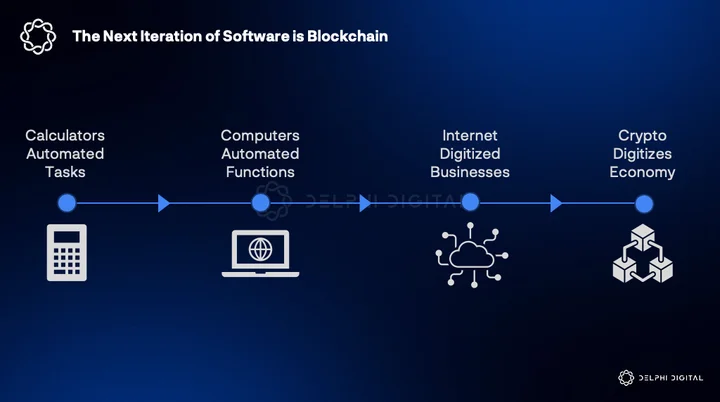
At its core, software eats industries by decoupling value creation from physical constraints. Blockbuster went bust because they could not keep up with the internet and incumbent financial corporations will go bust because they will not be able to keep up with the blockchain.
Now if you believe smart contracts are the next iteration of software, and the economy is moving onchain, then the next logical question becomes: what will serve as the hub of this new economy?
A place for commerce, or as I like to say, a DeFi Supercenter.
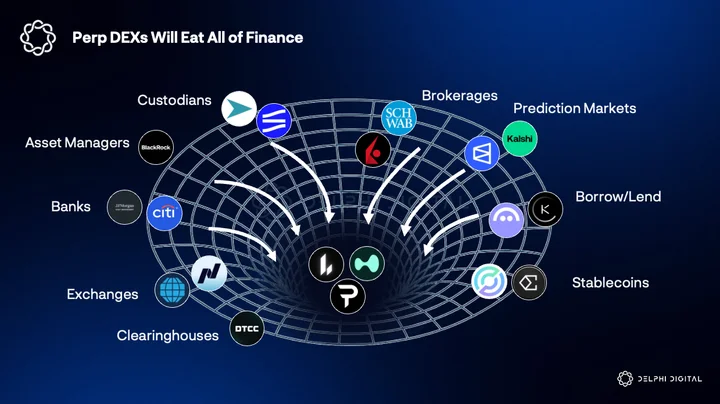
Every economy needs a hub for commerce. Wall Street was the hub for the industrial age and the internet/tech stocks was the hub for the information age.
Perp DEXs will be the hub for the “value” age.
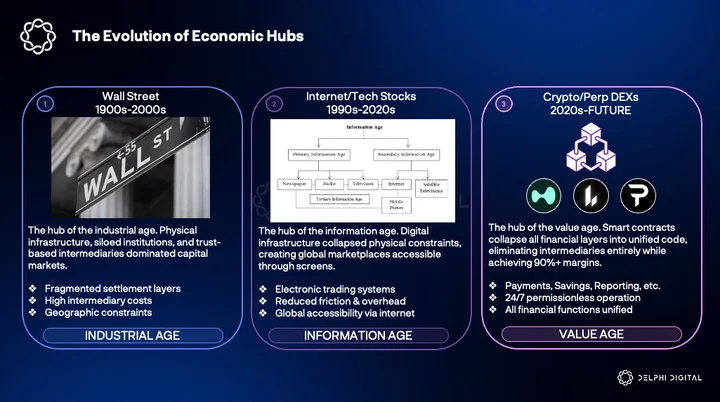
Perp DEXs: Blockchain’s Assault on Finance Costs
This is well known but I will reiterate, traditional finance is expensive because it’s fragmented:
- Trading happens on exchanges
- Settlement happens through clearinghouses
- Custody happens through banks
- Each layer takes a cut
Blockchain collapses all of this into one smart contract.
After years of experimentation, we finally have the infrastructure to deliver:
- Sub-second execution
- Sub-cent fees
- 24/7 operation
- No intermediaries
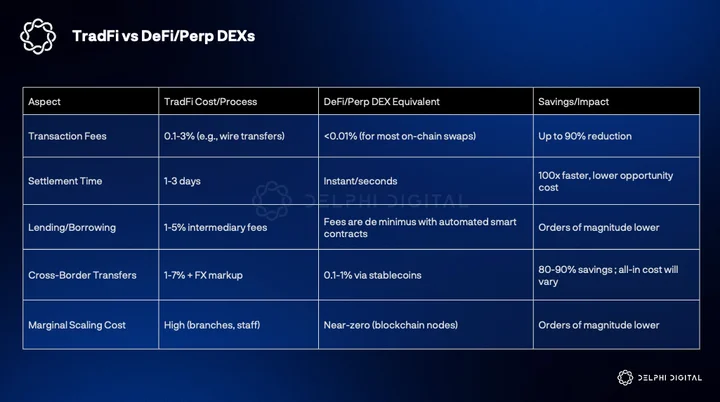
Layer 2 solutions (like Paradex’s zk-rollups and Lighter’s zk-circuits) and app-specific chains (like Hyperliquid’s L1) have solved the latency and cost problems that plagued early DeFi which is why now is the time for this new iteration of software, perp DEXs, to disrupt the traditional incumbents.
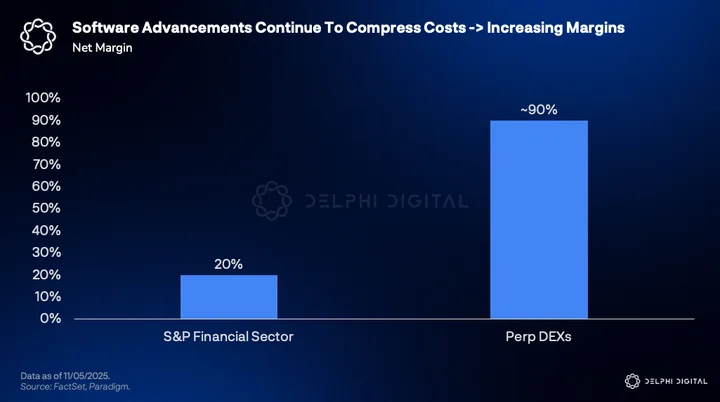
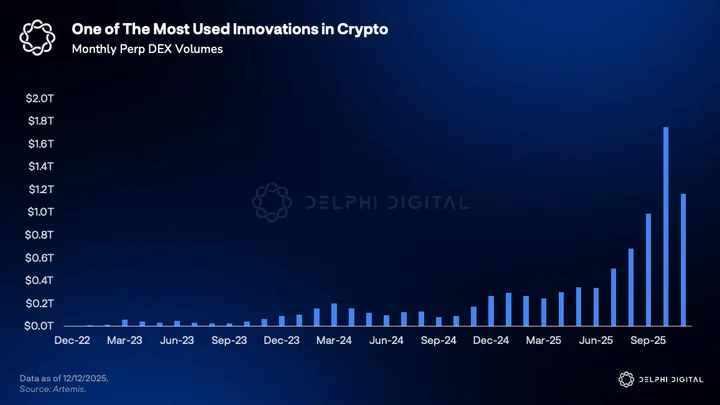
Perp DEXs: The DeFi Supercenters That Will Eat All of Finance
The internet didn’t just digitize existing businesses and give them a dotcom address, it created entirely new economic hubs. Amazon became the world’s mall. Google became the world’s library. Facebook became the world’s social square.
Blockchain will do the same for finance. And perp DEXs will become the new Wall Street.
Financial supercenters already exist in the physical world: Wall Street’s stock exchanges, the City in London, and Hong Kong’s finance district. These places attract massive capital and talent by concentrating liquidity, information, and access in one hub.
Now picture the onchain equivalent. A perp DEX can serve as a one-stop hub for the global digital economy, much like Wall Street does for the U.S. economy. Each leading perp DEX is poised to become a supercluster of liquidity, an onchain financial megacity where anyone in the world with a wallet can issue, trade, invest, lend, borrow, and hedge in a permissionless market that’s open 24/7.
What does this mean in practice? It means that down the line, every onchain business or community, whether it’s a DeFi app, a gaming platform, an appchain, or a streaming platform, will access these DeFi Supercenters to do things that previously only big banks or exchanges could do:
- Raise Capital / Issue Assets
- Invest Treasury Cash
- Borrow & Lend
- Hedge Risk
- Trade Everything Seamlessly
I teased out this thesis in my Paradex report, Reimagining On-Chain Markets from First Principles, which will apply to all the leading perp DEXs.
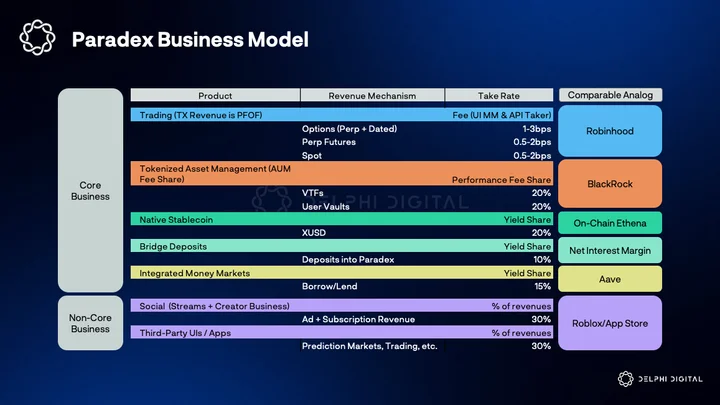
This has become increasingly more obvious to me. Just look at the recent leak by Hyperliquid, showing that they are building out their own native borrow/lend protocol. When you zoom out, what’s happening is that all the core functions of the traditional financial stack are being collapsed into a single onchain venue.
- A brokerage (like Interactive Brokers, Schwab, or Binance itself) lets you trade assets.
- An exchange (like NYSE, Nasdaq, CME) provides the marketplace and matching engine for those trades.
- A custodian (BNY Mellon, State Street) safeguards assets on behalf of institutions, holding securities and cash, reconciling balances, and ensuring funds are delivered correctly during settlement.
- A bank (JPMorgan, Citi) safeguards assets, lends money, offers yield on deposits, and facilitates payments.
- An asset manager or hedge fund (BlackRock, Bridgewater) creates investment products, manages portfolios, and allocates capital.
- A clearinghouse and settlement system (DTCC, SWIFT, etc.) handles post-trade processing, ensuring money and assets actually move to the right places securely.
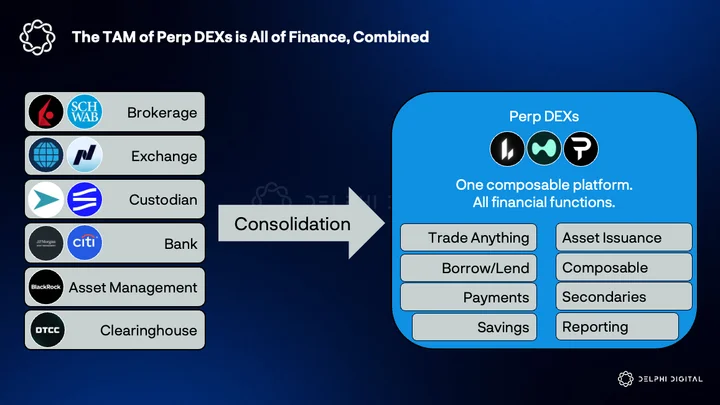
In traditional finance, these roles are siloed. They interoperate, but each is a distinct entity with its own ledgers and contracts. An onchain supercenter combines all of the above into one seamless digital venue with an order of magnitude higher margins than the tradfi incumbents.
Perp DEXs are at the core of this because perpetual swaps are such a versatile primitive, they can provide leveraged trading and hedging on any asset with a price feed. But the vision doesn’t stop at perps. The leading DEXs are quickly adding spot trading, options, structured products, lending, vaults, native stablecoins and payment rails, and many are talking about chat/streaming features natively integrated into the front end.
Now imagine a single decentralized platform that captures even a fraction of each of these verticals by offering a superior onchain alternative.

The winners in this race aren’t looking to build the next Binance, even though that is the first step, they’re building the next Wall Street + Silicon Valley + global banking network, rolled into one and open to all.
Every FTX implosion, every frozen account (White Whale and MEXC), every opaque liquidation accelerates the migration from CEXs to DEXs.
How DeFi Supercenters Will Compete For Liquidity
Not all supercenters will succeed. In fact, we’re likely to see a few big winners (3-5). What will determine who wins? It comes down to the cost and quality of liquidity. “Liquidity” here means more than just how tight the bid-ask spread is; it encompasses everything that affects a user’s ability to transact in size, quickly, at fair prices, or more simply said, “the users effective cost of trade.” Think of it like the “cost of access” to a financial hub. Key factors include:
- Price efficiency (tightness of the bid-ask spread, relative to fair value)
- Size capacity (maximum executable notional without slippage beyond a negligible threshold)
- Immediacy (probability of full fill within time t, for size s)
- Risk of information leakage or alpha decay (expected slippage from information decay or alpha leakage)
- Simplicity/complexity of execution (available complexity of execution, e.g., RFQ, TWAP, spreads, options)
Again, I teased this thesis out in my Paradex report.
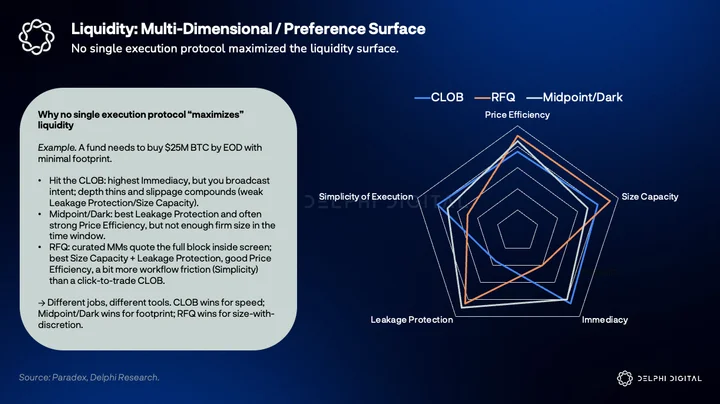
I have been thinking about this for quite some time, and I strongly believe that the leading perp DEXs will have multiple execution environments. Execution will be automatically optimized by AI agents, routing each order to the mechanism that best serves that user’s need (privacy, speed, size, etc). An exchange does not equal a single execution protocol. The leading Perp DEXs will not just be a CLOB. They will not just be RFQ. They will be a multifaceted execution environment.
The perp DEXs that excel on these fronts will become the dominant liquidity hubs and those that attract the best talent.
This is why you are seeing Solana scramble to kingmake a perp DEX and even give a hat tip to teams building sovereign L2s on Solana.
Once traders know they can get the best price and execution on platform “x”, that’s where they’ll go to transact, which in turn attracts more market makers and strategies, which further improves liquidity, and so on. In crypto, we’ve seen this reflexivity before, think about how all the trading of a given token often centralizes on one exchange or one DEX AMM pool because that’s where liquidity already is. For perp DEXs, this effect will likely be even stronger given how multifaceted these platforms are. They won’t just be competing on one asset or one feature, they’ll be competing as entire ecosystems, and the winners will attract the best builders, traders, and market makers, creating self-reinforcing flywheels that compound their advantages.
Conclusion: The Next Wall Street Will Be On-Chain
The future of finance won’t be a thousand scattered protocols or a handful of too-big-to-fail exchanges. We’re already seeing Lindy Effects favor the platforms that survived October 10th’s market-wide liquidation cascade. There’ll be a few onchain supercenters, transparent, global, 24/7 institutions that absorb every core function of traditional finance and run it on code instead of trust while running at 90%+ margins.
Perp DEXs started with leveraged trading, but they’re already expanding into lending, payments, issuance, and savings, all within one composable capital layer. Each iteration pulls more financial activities onchain, until the center of finance no longer lives in lower Manhattan, but inside cryptographic systems anyone can access.
Predictions About Prediction Markets
Distribution Wars
The Big Two have left limited room for small startups in binary markets. Kalshi is on track for over $600M in revenue in 2025, and Robinhood’s (via Kalshi) prediction markets (PM) business line already generates over $100M.
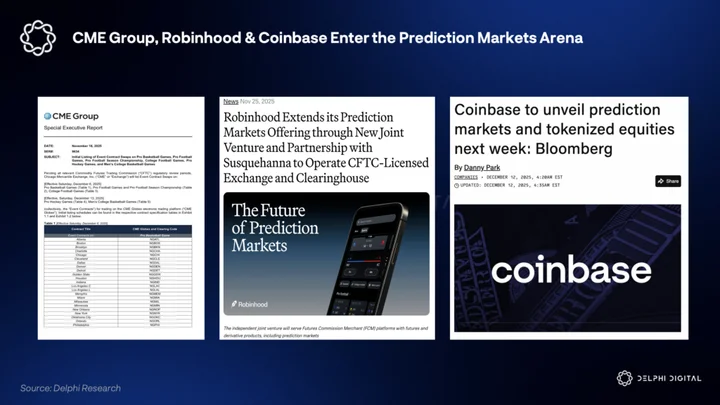
The category has matured past incubation into a race for distribution. Major players are entering: CME Group plans to list sports markets, Coinbase is launching prediction markets and Robinhood acquired MIAXdx to offer internal markets reducing reliance on Kalshi. Polymarket and Kalshi are now aggressively vying for each other’s turf.
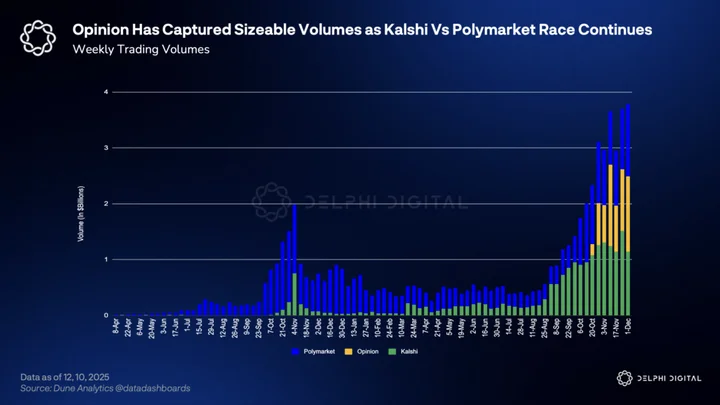
Polymarket’s Strategy: Wrap a crypto-native base with CFTC legitimacy to build maximum liquidity.
-
- US Relaunch: Launch via acquired CFTC-licensed exchange (QCX) is imminent.
- Web2 Expansion: Tapping into a new audience via deals with UFC, NFL, and Yahoo Finance.
- Onchain Moat: Cementing dominance via potential airdrop and wallet integrations (Rabby, Metamask) to drive retention.
Kalshi’s Strategy: Leverage regulatory moats and orderbook liquidity to attack global and onchain markets.
- Global Expansion: Armed with a $300M raise, Kalshi is expanding to 140 countries to challenge Polymarket’s international advantage.
- Onchain Integration: Rather than competing with DeFi, Kalshi is powering liquidity for Jupiter, Phantom acquiring additional volume via high-traffic onchain hubs.
The Ecosystem Response & Kingmaker Effect
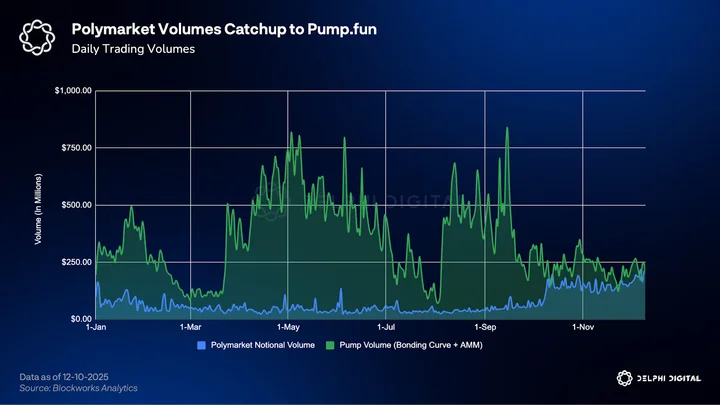
The financial stakes for having prediction markets are now undeniable for L1s and L2s. L1s and L2s (Base, BNB, Monad, MegaETH) will no longer passively support PMs; they will become kingmakers.
- Grants will flow: Chains will use grants to secure competitive PM products and their transaction flows.
- Niche is the frontier: General-purpose PMs will fail against the liquidity moats of incumbents. Success lies in specialized markets (e.g. sports, opinion markets) serving a specific subset of users.
Prediction 1: The Perpification of Options
The onchain options comeback won’t necessarily be TradFi replication; it will require radical simplification. Just as Perpetual Futures abstracted away expirations to drive adoption, Prediction Markets can do the same for options.
crypto has been waiting for options to take off for the longest time but never found PMF.
actually, options are already here.
Prediction markets are just options in disguise. except they’re 10x more legible for retail and simpler to trade pic.twitter.com/2H45qxOEzF
— John Wang (@j0hnwang) August 24, 2025
A PM asking “Will BTC be > $100k on Dec 31?” is effectively a cash-settled binary option. It removes the Greeks, fragmented strike chains and complex pricing models, offering an intuitive 0-100 cent probability. We expect new demand for onchain options to be generated via PMs that repackage volatility into these accessible products.
Options are too hard for normies
Euphoria makes them easier with tap trading
MegaETH pic.twitter.com/rjjCJlYANU
— munch (@munchPRMR) November 12, 2025
Gamification: Beyond prediction markets, newer protocols like Euphoria are wrapping this architecture in a “Tap Trading” interface, betting that the next surge of retail trading will look like a mobile game, not a terminal.
Prediction 2: Onchain-Native Risk Markets
PMs could graduate from speculation tools to core DeFi infrastructure by addressing the need for native insurance. Following the $120M+ Balancer exploit and xUSD depeg, the market needs instruments to hedge their DeFi exposure. If DeFi is to scale and attract liquidity from the broader public and more importantly the institutions, it must provide a native, trustless way for users to insure against these exact risks.
- PMs as Crypto-Native CDS: Short-dated (15/30-day recurring) markets (e.g., Will EigenLayer experience a slashing by Dec 31?, Will USDe depeg below $0.97 for more than 1 hour in December?) allow users to surgically hedge specific risks.
- Non-USD Denominated Risk: DAOs are some of the biggest LPs in DeFi and hold part of their treasuries in assets like ETH, BTC. They would prefer hedges denominated in these assets over utilizing their operational stablecoin balances. A protocol staking $50M stETH needs to pay premiums in ETH to protect their stack, creating a seamless B2B risk management loop.
Securing counterparties and market makers for such markets will always be very challenging as the liquidity providers are picking up pennies and can get steamrolled at any point. But the prediction market platform that is able to unlock this vertical will find immediate demand from DAOs and whales with capital locked up in DeFi.
Prediction 3: Unbundling
The next +EV opportunity is not in building a better Polymarket. That opportunity is in the Unbundling of the stack targeting specific users.
1. Pro Users
They require tools that allow them to improve their edge and spot additional opportunities in the growing vertical and breadth of prediction markets.
- Aggregators: Single interfaces for cross-market trading
- Advanced Analytics: Tools for risk management, alternative data and wallet monitoring.
- Examples: Hashdive, Polysights.
2. New Users
If the Pro user will need a terminal, the new users want entertainment and games. The TAM for financial speculation is massive, but it is dwarfed by the TAM for social entertainment.
The core insight is that people are inherently social, and betting with friends is a familiar activity for most people. The current PM interfaces are isolating (user vs the market) and are narrowly targeting the trader archetype. An interface that widens the funnel for user acquisition should shift the goal from just making money; to social signaling and being right among friends and larger groups.
- Example: Social Trading apps like Polyswipe.
3. Agentic Predictions
Anyone building AI agents for market making long-tail prediction markets?
It doesn’t make sense for HFTs to allocate their quants on these markets…
But an agent could make a $1 market for $0.10 of inference?
Reach out to @0xalpo if this resonates.. https://t.co/QQvj0SzxvW
— Georgios Konstantopoulos (@gakonst) November 11, 2025
The power users to leverage Pro tooling at scale won’t necessarily be human. We’ll see experiments of AI-Agent managed funds that use the tooling available to:
- Scrape real-time news and social data.
- Identify pricing inefficiencies across hundreds of markets.
- Execute arbitrage strategies at superhuman speed.
This will fundamentally change the market structure, introducing a new class of high-frequency, non-human participants. We expect the entry of such non-human participants to erode the easy bets in binary prediction markets.
4. Prediction-Adjacent Markets
As vanilla PM edges are arbitraged away, capital and users will flow to new mechanics:
- Impact Markets: Trading event impact isolated from probability. (e.g. Lightcone)
- Opinion Markets: Betting on crowd consensus rather than objective facts (e.g., Melee Markets).
- Fantasy Sports: Crypto-native versions (Football.fun) make player cards tradable assets adding another meta game to fantasy sports.
- Futarchy: DAOs using markets (MetaDAO) to make governance decisions based on predicted metric success.
- Coordination Markets: Protocol sets a goal and participants buy tokens and take action. If the goal is achieved, participants profit: bet pays out, protocol token appreciates. (e.g. Hyperstitions)
DeFi Innovation
Shifting Stablecoin Yield Power Dynamic
This section builds on our earlier thesis on stablecoin yield realignment and the rise of ecosystem-aligned dollars. For the full framework, see our original analysis
Stablecoins have become one of the clearest validated macro trends within crypto, but almost none of that upside has been accessible to liquid market participants. Despite a 10x increase in aggregate supply since early 2021, most of the economics have flowed to issuers and distribution partners rather than the chains and applications actually powering the demand.
Up until recently, this mismatch didn’t matter, and there was little reason to think it ever would. Stablecoins were viewed as public-good infrastructure. The assumption was that yield belonged to issuers, not ecosystems. Users wanted to make money with them, but chains and apps never expected to capture any of that value themselves. Lindy dynamics reinforced that view given that Circle and Tether had survived what dozens of others hadn’t: regulatory pressure, credit shocks, bank failures, depegs, chain migrations, and the blow-ups of every major “challenger” stablecoin. In a category defined by fragility, the incumbent duopoly has felt uniquely durable.
We expect that this worldview will break down in 2026, at least within DeFi. Regulatory clarity is improving, white-label issuance has commoditized the stack, and the leverage has shifted decisively toward the ecosystems that control distribution rather than the issuers sitting on top of the reserves. For the first time, incumbency alone isn’t enough, and the market is treating stablecoins as an economic layer, not untouchable plumbing.
Furthermore, with L1 and L2 valuation multiples deflating across the board, investor expectations have changed. Chains are under more pressure than ever to demonstrate real, recurring revenue. Stablecoin yield isn’t just attractive, it’s one of the only credible levers they have left to justify their valuations.
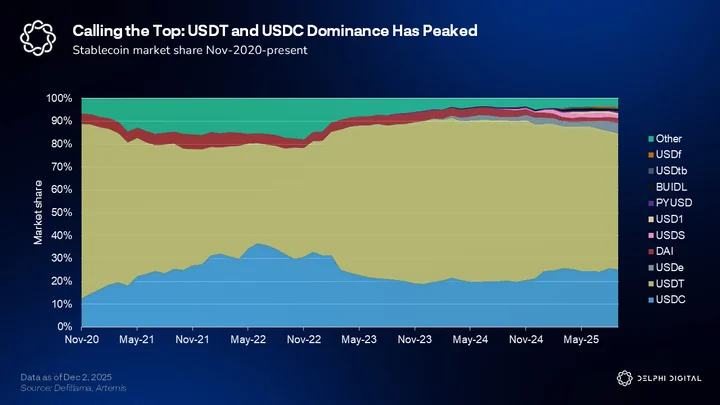
While Circle and Tether still dominate absolute supply, we believe that their relative dominance has likely peaked. Even if (when) aggregate stablecoin capitalization eventually crosses $1T, the incremental growth is more likely to accrue to ecosystem-aligned stables rather than incumbents.
The Circle–Coinbase revenue share shows how this underlying dynamic is unavoidable.
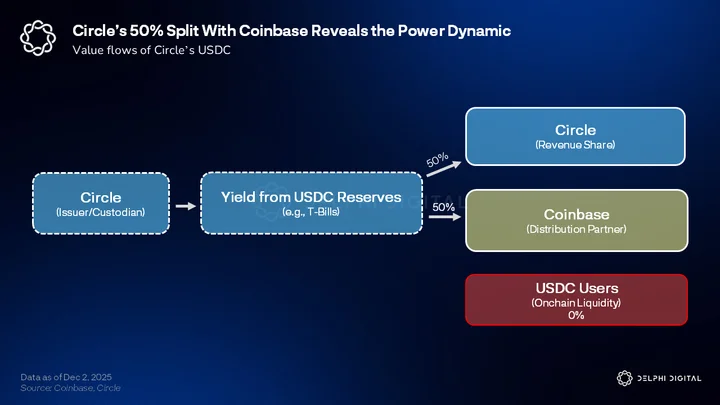
Coinbase captured more than $900M of USDC reserve income last year, more than half of the total, simply by controlling the end-user distribution. They didn’t out-innovate anyone. They just sat in front of the flow. It’s been the most clear confirmation that distribution, not issuance or lindy-ness, is the real moat.
Once you extend that logic to chains, the imbalance becomes increasingly clear. Solana, BSC, Arbitrum, Avalanche, and Aptos, for example, collectively earn roughly ~$800M a year in fees. Meanwhile, more than $30B of USDC and USDT sits across these chains, generating roughly $1.1B annually for Circle and Tether.
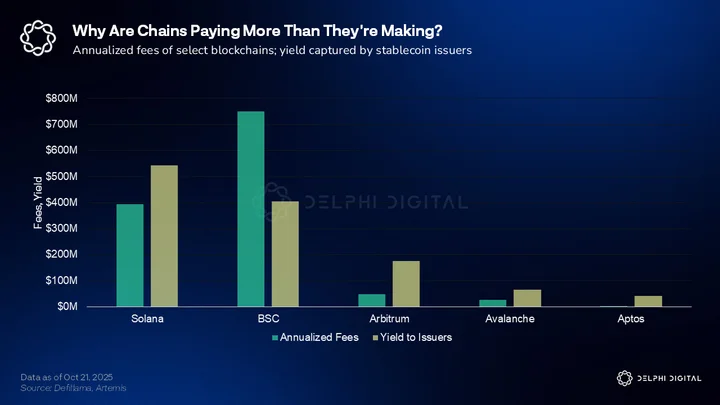
In short, the ecosystems that are actually driving stablecoin usage are leaking more to issuers than they earn themselves.
This is part of what’s pushed Hyperliquid to act.
With ~$5.5B of USDC parked on the exchange at the time of USDH proposal process (implying more than $200M in annualized yield flowing to Circle and Coinbase), the team initiated a fully competitive bidding process for the USDH ticker. Nearly every major issuer participated. Native’s structure, which allocates half of the reserve yield to Hyperliquid’s Assistance Fund and reinvests the remainder into liquidity, ultimately won.
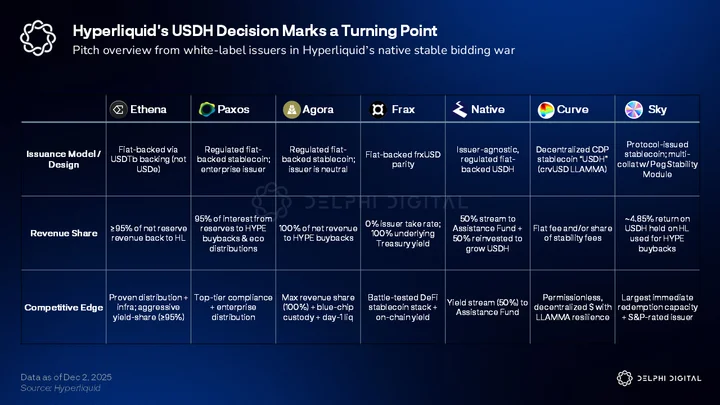
This was the first large-scale example of an application deciding that if its users generate the demand, it should capture the economics as well.
Since then, the model has spread across ecosystems. MegaETH has been explicit about the motivation: transaction-fee economics cap growth. A chain only earns more when users pay more, which is structurally misaligned with building low-cost, high-throughput systems.
This is why USDm exists.
To overcome the artificial ceiling imposed by transaction-fee economics, replacing it with yield-backed sustainability.
Keeping fees low and UX uncompromised for builders and users alike.
A low cost and predictable ecosystem primed for innovation. pic.twitter.com/SCgzruDiE5
— MegaETH (@megaeth) September 8, 2025
Their USDm launch reframes stablecoin yield as the economic backbone of the network, internalizing it allows the sequencer to run at cost while redirecting surplus toward ecosystem initiatives.
Ethena’s stablecoin-as-a-service model is now being adopted by Sui, MegaETH, and Jupiter. Yield-bearing designs like USDe and USDai are scaling as well, with BUIDL emerging as core collateral infrastructure for many issuers. It now underpins products such as Ethena’s USDtb and the other white-label stablecoins beginning to launch through Ethena.
The appeal is simple: stablecoins can become the single largest revenue driver for chains and apps. Relying solely on transaction fees caps what an ecosystem can earn. Redirecting stablecoin yield breaks that dependency and introduces a recurring, non-cyclical revenue surface.
This is the core shift: yield that once accrued passively to incumbents is now being actively reclaimed by the platforms that actually generate demand for these assets.
Historically, this was harder to execute. Issuing or integrating an ecosystem-aligned stablecoin required bespoke infrastructure, regulatory overhead, and coordination. There was little incentive to push through that friction because the market wasn’t demanding it. Chains received premium valuations simply for being L1s. Investors assumed that value would eventually accrue back to the base layer as activity scaled.
.@keoneHD be like “Steady lads …” pic.twitter.com/vG9PeUY5L4
— Arthur Hayes (@CryptoHayes) November 30, 2025
That assumption has unraveled. Appetite for undifferentiated infrastructure is low, and it’s increasingly clear that applications, not chains, are capturing the bulk of the economic value. You can see this in the lukewarm reception to new L1 token launches, most recently Monad’s, where investors questioned how another general-purpose chain could justify a multi-billion-dollar valuation in an environment where excitement, usage, and revenue now sit above the chain rather than on it.
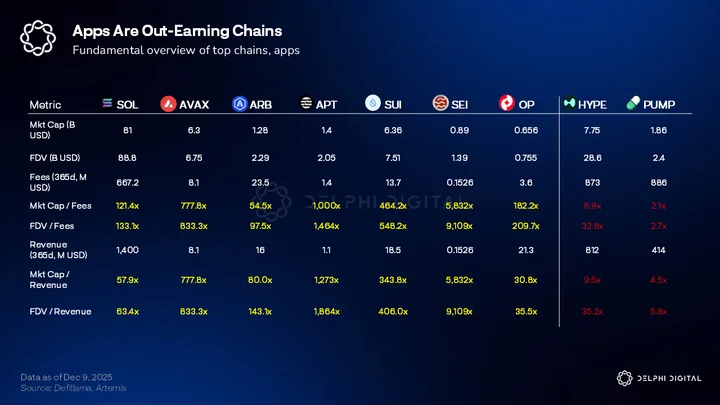
This shift is equally evident in the erosion of the L1 premium. Solana trades at ~166× market cap to revenue; many L2s sit at triple-digit or even four-digit multiples. Meanwhile, the leading consumer and trading applications have been forced by the market to give back an increasingly large share of revenue to tokenholders through buybacks while still trading at materially lower valuations.
Cross-chain messaging, unified liquidity routing, and better aggregator infrastructure are making stablecoins increasingly interchangeable. Users no longer care which stable they hold as long as it’s liquid, on-peg, and native to the venue they already trade on. The historical network effects that protected USDT and USDC are eroding, and with that erosion comes leverage. Chains and applications can negotiate alignment or launch their own stablecoins, and in most cases the user experience barely changes.
Regulatory clarity is accelerating the transition. GENIUS established a baseline U.S. framework for issuance, narrowed the design space for what compliant dollars look like, and removed much of the uncertainty around bank participation. As standards converge and the rules of the game harden, the moat around incumbent issuers shrinks. Stablecoins begin competing on economics and ecosystem integration, not regulatory ambiguity.
The question for 2026 is which ecosystems can act before path dependency hardens. Solana has over $10B of USDC, economic flow that ultimately strengthens Coinbase/Base, but the network is now so reliant on USDC liquidity that shifting to a Solana-aligned stablecoin would require massive coordination.
USDmanlet powered by @withAUSD. 80% of the revenue goes back to the manlet foundation. The other 20% used to build liquidity and utility.
— Nick van Eck (@Nick_van_Eck) September 10, 2025
Sui is avoiding this trap by moving early. Jupiter has the distribution to force adoption of JupUSD across perps, lending, and liquidity. Hyperliquid is internalizing its stablecoin flows, and MegaETH is already using stablecoin yield to subsidize its sequencer.
Tether and Circle benefitted from being early. The next phase will be shaped by distribution, coordination speed, and the willingness of ecosystems to keep value inside their own walls rather than leaking it to issuers. Stablecoins have a credible path to replace transaction fees as the dominant recurring revenue layer for chains and applications. And for the first time, liquid investors will be able to underwrite that dynamic directly through the tokens of the platforms that successfully align stablecoin economics with their own ecosystems.
X402 Rejuvenates Crypto x AI
x402 is a blockchain-based open payment protocol that enables an internet-native value transfer. Developed by Coinbase, x402 is a chain agnostic extension of the HTTP 402 status code that lets users and AI agents pay per request using stablecoins.
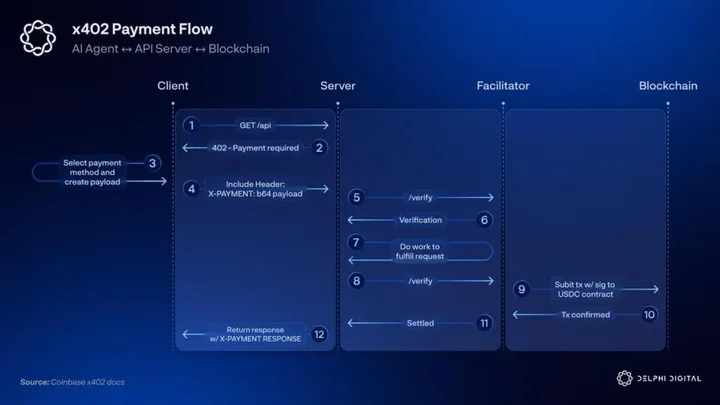
The most relatable, immediate use case for x402 is solving the clunky UX of paywalls. The typical flow for a user is as follows: click on a link > hit paywall > register for an account > add credit card info > pay for service. With x402, users could seamlessly pay by article or by action instead of reloading API credits or committing to a subscription.
The big picture use case is AI agent commerce, allowing agents to natively transfer value and act on behalf of users. x402 is beneficial for everyone, but it is uniquely beneficial for AI agents that lack an alternative. Model context protocol (MCP) allows agents to interact with tools. x402 is essentially a payments MCP. Here is an example of it working with Claude.
x402 Claude MCP
Instead of adding a new MCP for every service, Claude can access any API and pay for whatever it needs
Like @CoinbaseDev‘s Payment MCP, but customizable. You set your own wallet, define your own endpoints & choose which tools Claude can access pic.twitter.com/3MFL3yCu3v
— Ash (@Must_be_Ash) December 4, 2025
x402 has had strong mindshare within the builder community for much of 2025. In September, this excitement reached retail, causing a massive spike in mindshare and usage.
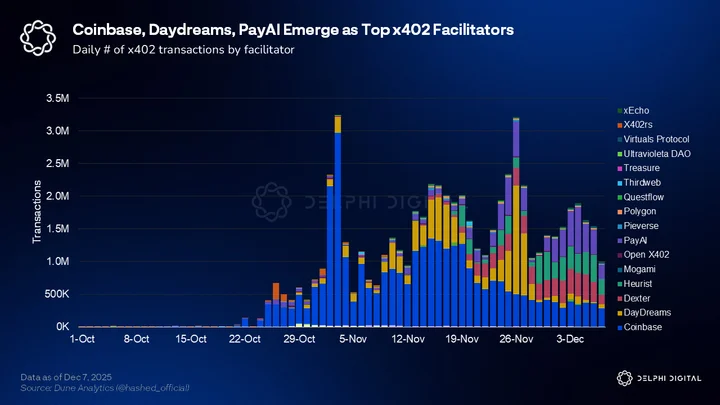
The impact of Oct. 10 and the broader market drawdown thereafter muted x402’s mindshare and marked the top of the x402 tokens. x402 has a ton of momentum and is only getting started.
Google announced an x402 extension for its Apent Payments Protocol (AP2). Lowe’s is piloting AI agent commerce with Google’s AP2. Here is a demo demonstrating how an agent can research, shop and purchase a refrigerator. Cloudfare is partnering with Coinbase to launch the x402 Foundation.
Solana x402 adoption is rapidly increasing, having just reached 50% of total x402 transactions. EIP-8004 brings trust and reputation layer for AI agents, aiding in discoverability and collaboration. x402 v2 was just released, offering better devx, fiat payment support, and extensions.
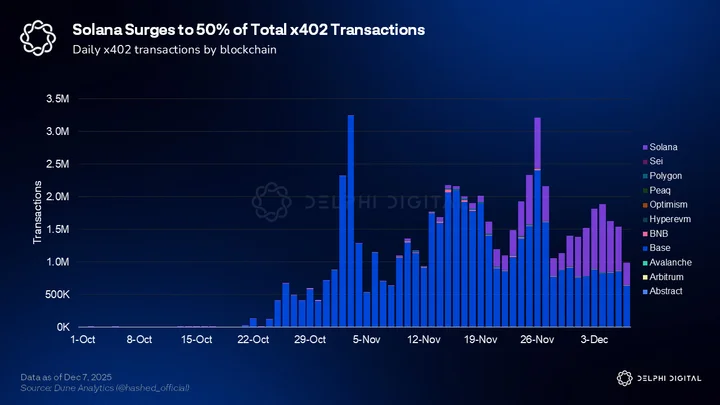
x402 is similar to intents and zkTLS, in that it is a powerful, disruptive primitive that lends itself to big ideas. It’s easy to see the importance, but hard to fully grasp the implications or forecast the path to true adoption.

Builders are excided, analysts have been nerdsniped, speculators want exposure. x402 will be a headline hog in 2026, and it touches all the narratives: AI, robotics, payments, stablecoins, consumer apps. Without a clean way to get directional exposure to x402, the market takeaway so far seems to be green light to speculate on crypto x AI. If the real usecases surface, there could be a fundamentals driven narrative push. Easy way to separate signal from noise here is to look at projects that have been discussing x402 well before the September surge.
Ambitious DeFi Apps
3Jane
3Jane is perhaps the most ambitious DeFi project of the cycle so far. Achieving undercollateralized lending at scale is arguable the pinnacle of DeFi. We must both incorporate and reinvent existing solutions for underwriting and recovering consumer loans at scale. We covered 3Jane in our report Engineering Real Credit Onchain: The 3Jane Bet.
3Jane uses zkTLS to verify user financial health and underwrite their loans. Lenders supply USDC and receive CDs in the form of USD3, which can be staked in a subordinate tranche as sUSD3 for improved yield. As a last resort, non-performing loans are auctioned to collection agencies to pursue legal recourse.
3Jane has reached $40M in supply with under $10M in outstanding debt. Borrowing USDC on 3Jane is startlingly smooth, and we expect the product to succeed so long as the risk framework holds up. The design space for integrations across DeFi is wide open. Idle liquidity is deposited into Aave, removing a yield tradeoff that often acts as a supply growth bottleneck.
If undercollateralized lending is ever going to work onchain, it can’t be TradFi in disguise. It must be engineered from first principles: trust must be earned and proven; incentives must be aligned across borrowers and lenders; enforcement must be cryptographically credible and legally actionable.
With verifiable data proofs, real-world enforcement rails, risk tranching, and programmatic loan logic, 3Jane is building a credit system that feels native to the crypto stack and not stapled on from the outside. It could start a new wave of financial apps built around identity-aware capital.
Project0
Project0, formerly MarginFi, is building an onchain prime broker. Composable portfolio margin would be a 0 to 1 deliverable for DeFi. It is extremely difficult to pull off and we’ve seen few attempts at this in the past. The protocol must monitor and liquidate arbitrary instruments and positions across numerous venues, things move fast, could end up with a lot of bad debt. We know little about the core architecture at this time. But if it works, there is a lot of cool new things you can do:
- Better hedging
- Improved arbitrage > more efficient derivative pricing
- More expressive positions by combining instruments e.g., collars, swaptions, calibrating portfolio Greeks
This exists in TradFi and is absolutely necessary in a mature DeFi ecosystem. If Project0 were to work flawlessly, all of DeFi would level-up. Project0 is currently live, with only the borrow/lend product currently supported. Derivatives support will be rolled out later alongside TGE.
USD.AI
USD.AI provides a robust system to bring liquidity and leverage to illiquid infrastructure assets. Through its synthetic dollar, USDai, USD.AI offers a better way to scale AI hardware and DePIN mining operations by transforming illiquid assets into liquid, productive capital. We covered USD.AI in our report USD.AI: Financing the Future of AI Infra.
USD.AI launched in June, consistently hitting deposit caps immediately after their increase. USDai has now reached $676M supply. In 2026, USD.AI will look to scale borrower demand. GPU loan principals currently make up only $1.06M of the total USDai backing.
Ethena had a big impact on DeFi because it was a source of impressive, composable, organic yield through a net-new instrument people were unfamiliar with. USDAI offers much of the same. It is less liquid, but also less cyclical. DeFi needs more avenues of organic, startlingly high yield to build around.
Alchemix
Alchemix v3 is several years in the making. Along with YFI, Alchemix v2 was one of the more impressive and viral defi apps of last cycle. It allowed users to take out nonliquidatable, self-repaying loans at 30% LTV. Users were encouraged to spend their loans on real world items and allow the protocol to amortize their debt. At the time, Alchemix was the most relatable, articulately crafted pitch for DeFi’s utility for normies.
The initial version had three major flaws:
- Conservative loan terms – A 30% LTV against DAI was required to ensure solvency on liquidation-free loans. ETH was the only exotic collateral type onboarded.
- Lack of yield instruments – Yearn.finance was the only yield avenue supported. Once yields compressed, outstanding loans suggested decades-long payback periods.
- The transmuter was a module to maintain the peg of Alchemix’ native stablecoin alUSD. Since alUSD was branded as a spending asset, peg stability was heavily subsidized by incentives. It became an unsustainable money incinerator requiring perpetual stake in CRV wars.
Introducing Alchemix v3.
✦ Up to 90 % LTV while your collateral keeps earning
✦ The new Meta-Yield Token simplifies yield strategies
✦ Fixed-duration redemptions keep alUSD & alETH on pegRead on 🧵 pic.twitter.com/ZwRB5XSuRg
— Alchemix (@AlchemixFi) August 5, 2025
Alchemix v3 appears to address all of these issues. Alchemix v3 will allow up to 90% LTV for borrowers, vastly improving capital efficiency. It appears Alchemix will embrace the bond-like aspect of alUSD by incorporating fixed-duration redemptions. It will also support a variety of integrations and yield strategies, allowing for more user control over payback period. Alchemix has been largely forgotten about, sitting at $28M FDV. But it remains one of the biggest ideas in DeFi history and could be a major comeback story if they get it right.
Gaming
2025 has been a slow and bleak year for blockchain gaming. Yearly funding is fast approaching where it was pre-2021, the most highly anticipated launches of the year didn’t achieve the results many were hoping for, and there is a general lack of enthusiasm for what to expect over the next 12 to 24 months.
That being said, it has never been clearer to us why, how, and when blockchain technology should be integrated into games.
Taking a step back, let’s briefly highlight the current state of Web3 game funding. Unfortunately, the funding environment has continued to worsen YoY since its peak at the beginning of 2022 – annual game funding and the total number of deals announced in 2025 have fallen YoY by over 55% and 57%, respectively. Without a clear success story to point to, it is likely this trend will continue, especially since the Web2 game funding environment is not much better.
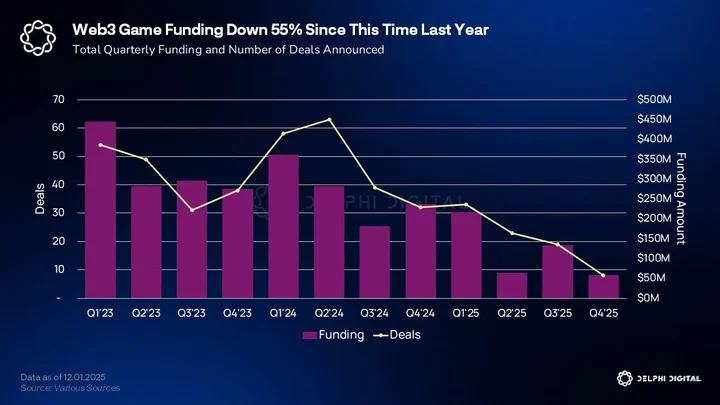
We wrote in last year’s report that chains were increasingly taking on the role of publishers. Unsurprisingly, it turns out that you need good apps before you can make use of a publisher, and so out of those that couldn’t make it work, many have pivoted into UA financing funds or rewarded engagement platforms.
UA financing is the more novel of the two and is the business of giving teams (typically mobile apps) loans to use for scaling user acquisition (UA) spend. Despite mobile gaming accounting for over 50% of this >$180B market, banks seldom fill these loan requests due to the high perceived risk. However, this sector is growing fast in Web2 world, and now it seems Web3 wants a slice with several chains offering low-to-no interest loans to promising consumer apps.
The main challenge here is that traditional UA financing partners only give out loans to teams that can prove their apps have achieved the baseline requirements (typically a mix of metrics such as ROAS, LTV, and CAC calculations, which are then compared to industry benchmarks). The unfortunate fact is that there are very few Web3 apps that can profitably scale UA via performance marketing. Therefore, I expect most of these Web3 UA funds to not be profitable and instead, finance the acquisition of low-value, high-activity wallets. To be clear, I still view this as a net positive provided that quality teams are able to secure ongoing funding.
So what type of games have and will continue to find success in leveraging blockchain technology?
The divide in what describes a Web3 game is growing deeper. On one side, you have “Web3-native” games that leverage financial returns and speculation at their core. On the other, you have “Web2.5” games that use blockchain purely as an enabling technology (oftentimes without a token). The former’s success is largely based on market sentiment and ROI; the latter is judged based on its competitiveness in Web2 markets and how much real revenue it generates.
Over the course of the past 11 months, there have been several Web3-native games that have generated 6-7 figures in revenues (not accounting for rewards). This is quite impressive given their typically simplistic nature, but it isn’t enough to distract from the fact that their scale is limited to a relatively small pool of Web3 players and a growing number of AI automation bots. Category leaders tend to share a founder-forward brand, a mix of player rewards (liquid tokens and airdrop points), and a continuous flow of new features and gameplay elements to keep speculators engaged.
The fatal flaw most of these games have is that the fun stops once the incentives dry up and the token is distributed. Pandemic Labs attempts to combat this with its studio token model, where trading fees fund the development of additional “throwaway” games, and a portion of all revenues goes toward buybacks. Open Game Protocol is another novel approach to games distribution that merges memecoin attention markets with rewarded play.
Despite not currently having the broadest appeal, this sub-sector of gaming is well-suited for rapid iteration, and it’s likely we will see more innovation from these projects, some of which will eventually bleed into other sectors of Web3.
A more middle-of-the-road approach is taken by Sport.Fun, which launched earlier this year to much fanfare and generated over $10M in revenue YTD, is to take what Web3 does best and package it in a way that appeals to the wider Web2 user base. In this case, Sport.Fun is taking on the fantasy sports and sports betting behemoths by leveraging blockchain technology to provide users with a low barrier to entry but high strategic depth, maximize agency over player-owned assets that don’t reset each season, and utilize an economic framework that better distributes value across the ecosystem, resulting in a much higher ceiling for player rewards.
In the world of Web2.5 consumer apps, the most profitable teams tend to be the ones you hear the least about. For gaming, studios like Fumb Games, Mythical Games, and Wemade/Wemix continue to generate significant revenues and leverage blockchain in their own unique ways. In most cases, blockchain acts as a technical solution that improves margins, increases user engagement, or introduces new revenue streams. We expect to see wider adoption in this sub-sector as the benefits become increasingly obvious, and expect many prospecting studios to be encouraged by the recent developments in the stablecoin space.
It is pretty much consensus that stablecoin adoption rates will continue to rise now that a significant number of leading regional markets have clear regulatory frameworks in place. Leading use cases for gaming include enabling nanotransactions, engagement-based rewards, and global payment rails or idle treasury yield for studios that struggle with traditional providers (e.g., igaming, UGC platforms, or games in unbanked regions).
Although we believe progress in this sector is a net benefit to Web3 and we look forward to seeing more innovative applications of stables in consumer apps, it must be said that it is not a perfect solution. Most large PSPs already offer payment gateways to all major markets, and the ones they don’t cover are typically due to risk factors such as regulations or fraud (the latter being something stablecoins currently do not solve for). Additionally, nanotransactions can only be unlocked to their fullest potential in environments where frequent sub-$0.1 transactions are economically feasible, which currently disqualifies most major blockchains.
Finally, yield on idle treasury is a somewhat flawed value proposition due to the fact that all small to medium-sized game studios should reinvest all capital into growth, not letting it sit idle for a low single-digit yield. Moreover, most large studios that have the luxury of keeping some cash on the balance sheet are already generating yield from tradfi products, which will continue to be perceived as the safer and more attractive solution (at least for now).
In summary, gaming might not have had the best year but certain sub-sectors will continue to perform relatively well, and, more importantly, the technology has finally caught up to the needs of Web2.5 studios that want to leverage blockchain’s advantages without feeling the need to shove speculation and financial gain in the face of users in order to justify the clunky UX. There might not be as many shots on goal as there were two years ago, but there are still a handful of really promising games to look forward to such as Eve Frontier, Project O, Fableborne, and Avalon.



0 Comments