The Year Ahead for Crypto 2025 – Full Series:
AI+DePIN
DeFi
Gaming
Infrastructure
Markets
Introduction
At the end of 2023, a series of successful launches meant that things were looking good for Web3 gaming. Despite this, in last year’s Year Ahead report, we voiced concerns about the sheer number of new games and tokens launching and how a challenging Web2 distribution landscape would have them all compete over the same limited pool of Web3 users. This fight for player liquidity, combined with the monopolization of attention by memecoins and, more recently, AI, has resulted in a relatively underperforming year for Web3 gaming.
However, 2024 has also been the year with objectively the highest-quality gaming content ever. Early access launches for highly anticipated titles such as Off The Grid and MapleStory Universe (MapleStoryU), along with some promising updates from ecosystems like Telegram and a plethora of exciting AI innovations make us more bullish than ever on this sector’s future.
This report will provide a brief summary of the year so far for gaming across all key areas and highlight how we believe things could progress in 2025. It will also outline three core themes for the year ahead: the current state of liquid gaming tokens, how prospects for broader adoption will impact the fight for player liquidity, and what role gaming will play in the future of crypto x AI.
This is a pivotal moment for the gaming sector, and the next 12 months will be instrumental in forecasting the next five years. Bull or bear, we believe tremendous opportunities will be available to the well-informed who can best position themselves as the market continues to evolve and mature.
The Year In Review
Web3 Game Funding
Funding for Web3 games has shown relative levels of resilience in 2024, with a total of $715.5M raised by the end of Q3. The number of Web3 gaming deals has remained consistent, with 135 deals recorded so far in 2024, on par with the entirety of 2021 but below the peak of 265 deals in 2022.
While funding metrics are notably smaller than the total $4.07B raised in 2022 (the accumulated funding in 2024 represents only roughly 43.8% of funding in the first quarter of 2022), it still reflects a relatively healthy flow of capital in a challenging macroeconomic environment that saw the highest interest rates in over 20 years.
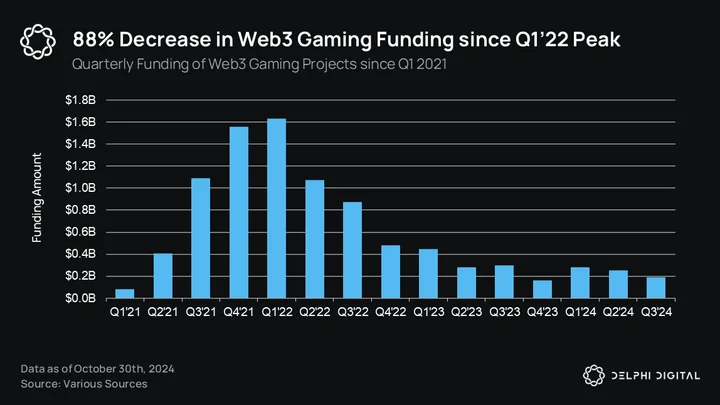
Despite the decline in overall funding, the focus has pivoted toward fewer, higher-quality projects. Only eight gaming projects raised more than $20M in 2024, compared to eighteen in 2023, suggesting that investors are becoming increasingly more selective.
In the absence of a unifying narrative like play-to-earn (P2E) or the metaverse, many investors who lack the necessary expertise to evaluate deals or have a fund mandate that does not prioritize gaming are pulling back after having been burnt too many times.
Additionally, funding has seen a noticeable shift toward early-stage deals, with fewer later-stage rounds being reported. This trend suggests that despite the significant levels of capital deployed during the 2021-2022 funding boom, many projects from that period are struggling to secure follow-up rounds. This could indicate a lack of product-market fit or difficulties in sustaining growth amid harsh market conditions.
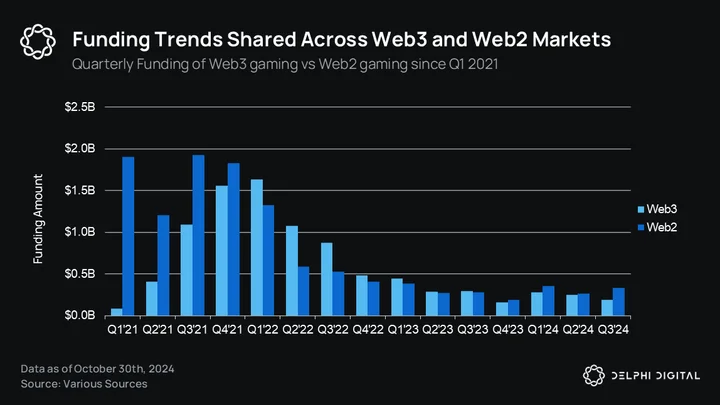
This current environment highlights how the rising price of BTC and bull market vibes do not immediately flow into gaming markets. However, it also signals a maturing sector that is less at the whims of market movements, and where capital can find teams with stronger fundamentals and more sustainable long-term visions.
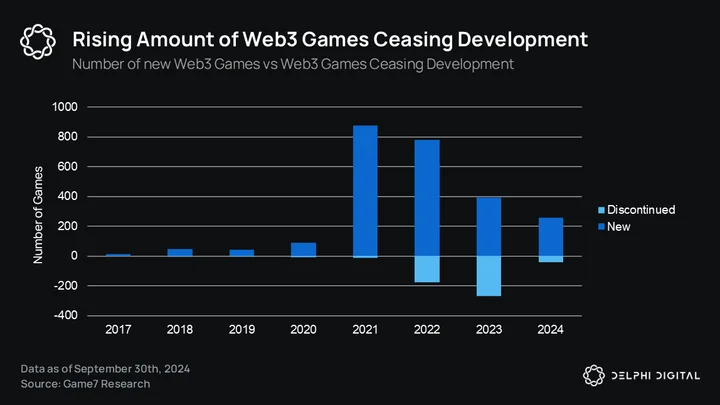
The bear market of 2022 and 2023 acted as a much-needed purge, with many subpar projects ceasing development. Of the 2,489 funded Web3 gaming projects tracked by Game7 DAO, 514 have stopped development, with over half (271) in 2023 alone.
Further regulatory clarity under the Trump administration, along with increasing MiCA compliance for EU markets, would provide some much-needed confidence for institutional and retail investors alike. The increased liquidity and novel value accrual mechanisms Web3 token rounds provide investors will remain an attractive value proposition in stark contrast to the relatively more harsh landscape of Web2 game funding.
Looking ahead to 2025, the trajectory of Web3 game funding will largely depend on market sector conditions. In a more bullish scenario, successful token launches on leading exchanges from the likes of Off The Grid and MapleStoryU will attract new liquidity and reiterate the importance of leading with a great product first. This both attracts more developer and VC interest for future sector growth but also catalyzes additional interest in more niche sub-sectors, such as high-stakes on-chain games and the intersection of AI and gaming.
If the most anticipated launches of late 2024/early 2025 don’t go as well as many hope, then a bear case scenario will lead to aggressive consolidation, a lack of liquidity flows (aside from maybe AI gaming), and a tough next 2-3 years for gaming teams. The silver lining here is that teams able to make it out alive will have demonstrated both their antifragility and, presumably, strong fundamentals. This will create several interesting bear market buying opportunities for those who can identify the strongest teams with the best products and sustainable token models (more on this in theme #1).
Market Trends
The total gaming market capitalization has shown significant growth since mid-October 2023, when it stood at $7.49B. As of now, the market cap has reached $34.8B, a >360% increase from its 2023 lows and a notable 115% rise from pre-election levels of $16.16B. However, the market remains 10% below its March 2024 peak of $38B, and approximately 43.5% below last cycle’s $49.96B peak.
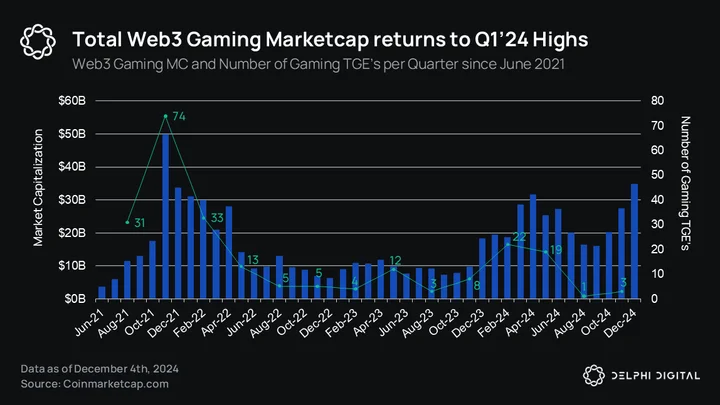
In 2024, 66 new gaming tokens were launched, according to Game7 data, bringing the total to 349 – a 23.3% increase. This marks a significant acceleration in launches compared to 2023, which saw only 34 new tokens, representing a 94.1% year-over-year increase in new tokens. The data suggests that as the gaming market cap rebounded strongly from its October 2023 lows, many projects that had built their products during the bear rushed out their TGEs to capitalize on this renewed momentum.
The sector’s subsequent underperformance, when compared to the meme and AI sectors, speaks to the importance of attention markets and sustaining “price goes up” marketing. As we will go on to outline later in the report, the current state of gaming tokens has led teams to re-evaluate their go-to-market strategies. Nonetheless, 2025 will undoubtedly be a crowded market for Web3 games. Whether or not a series of successful launches and new narratives can turn things around is yet to be seen.
Gaming NFT Market
As previously mentioned, Web3 gaming NFTs have shown small signs of recovery over the past 12 months, with trading volumes increasing significantly since November 2024. The volume for collections like Pirate Nation Genesis Pirates and Hytopia Worlds has seen over 100% month-over-month growth, while My Pet Hooligan and Infinigods have experienced a 50% increase since October 2024. Astonishingly, old gaming NFT collections like Sandbox, Decentraland, and Otherdeed/Otherdeed Expanded – three metaverse projects that have lost most of the hype surrounding them throughout 2022 – are still leading the charge with Neo Tokyo as the most valuable gaming NFT collections by marketcap.
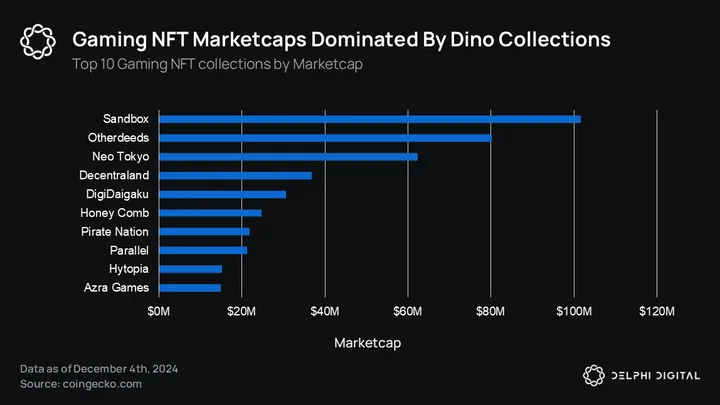
Collections promising token airdrops continue to perform well, driven by the perceived uncapped potential they offer. This dynamic reflects a strong preference among Web3 investors for assets with speculative upside, even in a maturing market. The main takeaway from the recent uptick in NFT markets is that projects aligning token utility with compelling game mechanics will likely see the most sustained interest.
Infrastructure
Blockchains as Publishers
The role of blockchains in Web3 gaming has evolved beyond simply providing underlying infrastructure, with chains increasingly expected to offer additional support and funding (similar to what publishers provide in Web2) to remain competitive and attract top-tier teams.
Major networks like Avalanche, Arbitrum, and Ronin act as hubs for game developers that go far beyond the tech. For example, Arbitrum has allocated 225 million ARB tokens ($234M) through its DAO to support gaming initiatives, while Xai, Sophon, and SUI have distributed significant grants to secure exclusive titles for their ecosystems.
However, comparing these grants to traditional Web2 gaming publishers is not entirely fair. Web2 publishers typically invest millions, or even hundreds of millions, into taking games to market in exchange for ownership stakes, royalties, or a share of early revenues. In contrast, blockchains focus on milestone-based funding, technical support, and network effects to support teams and achieve broader ecosystem goals.
These goals include increasing on-chain activity, indirectly earning from fees, and solidifying their position in an increasingly crowded domain of gaming networks. As competition among chains grows, offering such “additional services” has become essential for staying relevant and attracting the best teams.
The Explosion of New Ecosystems
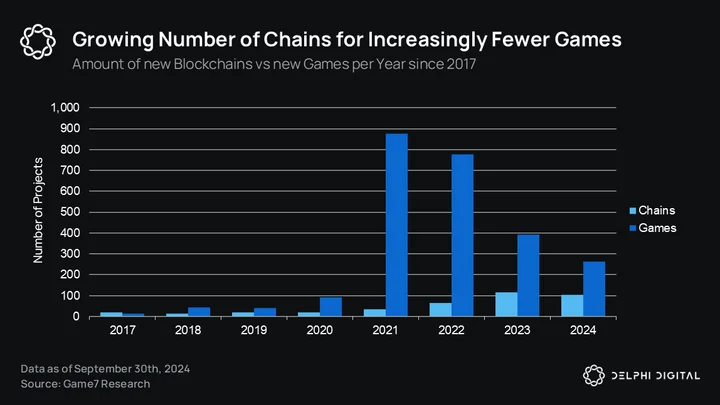
The number of new gaming-focused ecosystems, particularly Layer 2s and Layer 3s, has skyrocketed, creating a growing imbalance between the number of networks vs. games. With over 104 new L2/L3 networks announced in 2024 for just 263 new games, the ratio speaks to the perceived “premium” of ecosystems vs individual apps.
Ecosystems often seem more appealing because they promise multiple shots on goal through onboarding a variety of diverse applications, including games. While the number of new games decreased from 875 to 778 between 2021 and 2022, the amount of new networks almost doubled from 33 to 64. Since then, the number of games continued to decrease (391 in 2023 – 263 in 2024), while the number of new networks increased or remained stable (116 in 2023 – 104 in 2024).
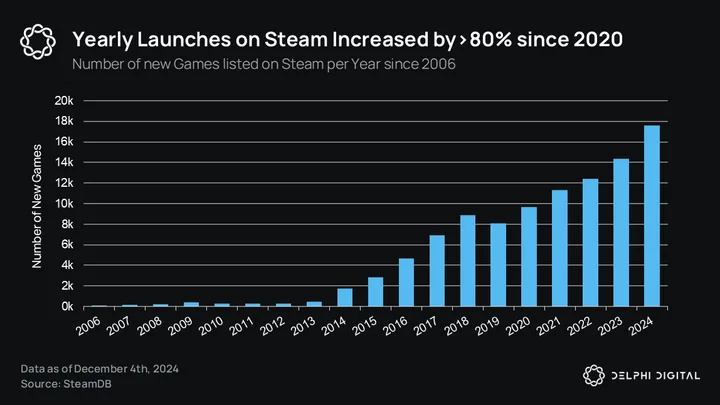
The success of Steam as a platform is a good example that underscores the importance of killer apps in driving ecosystem adoption. Steam started as a way to ship updates digitally to millions of players for Valve’s flagship games Half-Life 2, Team Fortress 2, and Counter-Strike. Over time, Valve opened up the platform to all developers and continued to add features like the Steam Store, the Steam Workshop, and the Steam Community for player profiles, gradually evolving into the go-to platform for digital game distribution.
As the technology underpinning L2s and L3s improves and continues to trend toward commoditization, fees are expected to converge toward zero while throughput increases. This gradual shift makes it increasingly tricky for high-performance networks to stand out on the tech alone, emphasizing the importance of exclusive killer content in capturing market share.
However, this raises critical concerns about the implications of exclusivity on the games themselves, especially since distribution remains the biggest challenge in Web3. For example, Epic Games Store’s reliance on exclusives has often led to underwhelming sales, as seen recently with Alan Wake 2, highlighting the potential risks of restricting a game’s reach in favor of ecosystem loyalty.
Established Top Networks
Ronin
Ronin continues to lead in player engagement, leveraging Axie Infinity’s legacy success and demonstrating its ability to rally ecosystem-wide support behind standout titles like Pixels – which remains the highest DAU game in Web3 (currently around 400k). After Pixel’s success in early 2024, Ronin has begun to slowly open up its ecosystem, signing over ten games in the last 3 months. However, none have come close to Pixel’s explosive launch, raising questions on how thin Ronin can spread its player liquidity.
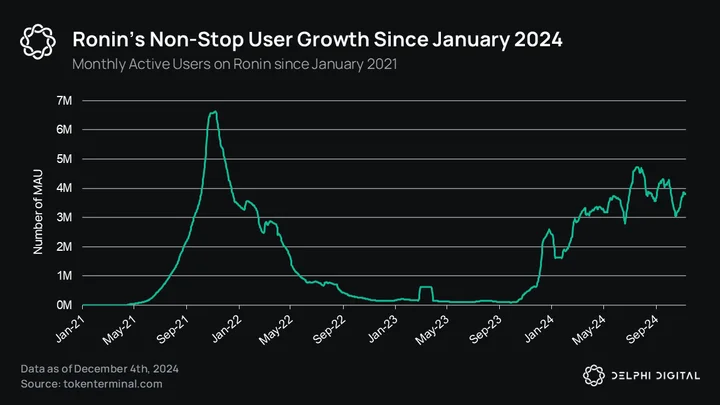
After signing Fableborne – one of the most anticipated games in Web3 – Ronin’s ability to rally a massive Web3 user
Read the full report
This report is part of Delphi Pro.
- 800+ Pro reports across every major sector
- Talk directly with our analysts
- Private community of funds and builders
Already a Pro member? Log in

0 Comments